
FatSecret MCP. Calculate macro splits and track food nutrition.
 Gemini
 Works with every AI agent you already use
…and any MCP-compatible client









Just plug in your AI agents and start using Vinkius.
FatSecret MCP Server gives your AI client access to a massive food database. Use it to search for specific food items and get detailed nutritional data.
It tracks calories, protein, fat, and carbs for branded and generic products, covering multiple serving sizes (like per cup or 100g).
Stop guessing nutrition facts; get precise, reliable data from 30M+ users' trusted source.
What your AI agents can do
Get fatsecret food details
Retrieves detailed nutritional information for a specific food item, providing the full macro breakdown and handling multiple serving sizes.
Search fatsecret foods
Searches the FatSecret database for food items, returning basic calorie and macro data per serving for popular foods.
The search_fatsecret_foods tool queries the database for foods based on a search term, returning preliminary data like calories and macro counts.
The get_fatsecret_food_details tool retrieves the full nutritional profile for a specific food item, accounting for multiple serving sizes.
Ask AI about this MCP
Supported MCP Clients
Gemini Waiting for input…
019d7597get fatsecret food details
Retrieves detailed nutritional information for a specific food item, providing the full macro breakdown and handling multiple serving sizes.
019d7597search fatsecret foods
Searches the FatSecret database for food items, returning basic calorie and macro data per serving for popular foods.
Choose How to Get Started
Build a custom MCP for your own tools, or connect a ready-made integration from our catalog.
Build Your Own
Turn any API into an MCP. Import a spec, define Agent Skills, or deploy with MCPFusion.
- Import from OpenAPI, Swagger, or YAML specs
- Create Agent Skills with progressive disclosure
- Deploy to edge with MCPFusion framework
- Built in DLP, auth, and compliance on every call
- Real time usage dashboard and cost metering
- Publish to catalog or keep private
Make Your AI Do More
Start with FatSecret, then connect any of our 4,700+ other servers whenever your AI needs more. One click, no limits.
- Use this MCP plus 4,700+ others, all in one place
- Add new capabilities to your AI anytime you want
- Every connection is secured and compliant automatically
- Track usage and costs across all your servers
- Works with Claude, ChatGPT, Cursor, and more
- New servers added to the catalog every week
What you can do with this MCP connector
Your AI client gets access to the FatSecret database. This lets you search for food items and pull detailed nutritional stats. You can find food using search_fatsecret_foods by entering a search term, and it'll give you basic calorie and macro counts for popular foods. If you need the full scoop, use get_fatsecret_food_details to pull the complete nutritional profile for a specific item, which handles multiple serving sizes.
This tool lets you track the full macro breakdown—calories, protein, fat, and carbs—for both generic and branded products. It'll account for various serving measures, like per cup or 100g. You're always getting precise, reliable data from a huge source. You can track anything from restaurant meals to packaged goods. The database includes extensive coverage of branded items and generic foods.
You'll never have to guess nutrition facts again.
How FatSecret MCP Works
- 1 First, your agent calls
search_fatsecret_foodswith the food name (e.g., 'apple') to find the item and get its unique ID. - 2 Next, the agent passes the retrieved item ID to
get_fatsecret_food_detailsto pull the full nutritional breakdown. - 3 You receive a structured data object containing calories, protein, fat, and carbs, adjusted for the specific serving size you requested.
The bottom line is, you search for the food first, then you pull the details using the result of that search.
Who Is FatSecret MCP For?
Nutritionists and Dietitians who need to validate recipes or patient intake; fitness coaches managing client diets; and Culinary Developers building food-tracking apps. If your job involves calculating macro splits or checking ingredient nutritional data, this server is for you.
Verifies complex meal plans and patient food logs, ensuring macro ratios meet specific medical requirements.
Calculates accurate nutrient profiles for recipes, adjusting for different ingredient weights and serving sizes.
Integrates reliable, structured food data into client-facing applications that require precise calorie and macro tracking.
What Changes When You Connect
- See the full nutritional breakdown for any food. Using
get_fatsecret_food_detailsgives you the complete macro picture (protein, fat, carbs, calories) for precise dietary logging. - Check multiple serving sizes in one go. The server handles different units—per cup, per 100g, per piece—so you don't have to calculate conversions manually.
- Search a huge variety of foods.
search_fatsecret_foodscovers branded items and generic groceries, making it reliable for real-world meal planning. - Get structured data for logging. The output from both tools provides reliable JSON data, perfect for feeding into databases or reporting dashboards.
- Use it for recipe validation. Instead of manually checking ingredient labels, your agent can query the server to validate the total nutrient count for a whole dish.
Real-World Use Cases
Calculating a meal's total macro count
A user is building a high-protein meal plan. They ask their agent, 'How many macros are in chicken breast, a side of rice, and an avocado?' The agent first runs search_fatsecret_foods for each item, gets the IDs, and then uses get_fatsecret_food_details to aggregate the final, accurate macro count for the entire meal.
Checking a restaurant dish's nutrition
A user wants to know the nutritional facts for a 'Big Mac' from a specific chain. They prompt their agent, and the agent calls search_fatsecret_foods to find the item, then get_fatsecret_food_details to pull the exact calorie and fat count for the standard serving size.
Comparing ingredient options
A recipe developer needs to compare two different brands of peanut butter. They ask the agent to find the nutrition for both using search_fatsecret_foods. This lets them compare the fat and carb ratios quickly, helping them select the best option for a low-sugar diet.
Scaling nutrient data for reports
A health tech company needs to generate a database of common foods for a client report. They use the server to run targeted queries via search_fatsecret_foods and get_fatsecret_food_details, building a reliable dataset without manual data entry.
Converting measurements for logging
A user has a recipe that calls for '1 cup' of ingredients but wants to log it by '100g'. They ask the agent, and the agent uses get_fatsecret_food_details to return the exact macro data for the 100g metric, solving the unit conversion problem.
The Tradeoffs
Assuming a single search endpoint
Trying to use one single API call to find a food AND get its detailed macros. This usually fails or returns incomplete data because the system needs two distinct steps.
→
You must use a two-step process: First, run search_fatsecret_foods to locate the food ID. Then, pass that specific ID to get_fatsecret_food_details to pull the complete, accurate macro breakdown.
Manually converting serving units
Finding the macro count for a food, then having to manually calculate what 1 cup is worth if the API only gives data per 100g. This introduces human error.
→
The get_fatsecret_food_details tool handles multiple serving sizes. Simply specify the unit you need (e.g., 'per cup') in your prompt, and the tool returns the correct, calculated macro data.
Ignoring branded coverage
Only searching for generic items and missing out on accurate data for restaurant meals or packaged goods. Generic data is often inaccurate.
→
Use the server's full database coverage. Both search_fatsecret_foods and get_fatsecret_food_details access a database that includes branded items and restaurant chains, ensuring accurate real-world data.
When It Fits, When It Doesn't
Use this server if your primary goal is retrieving precise, reliable nutritional facts for food items. You need to calculate macros, compare branded products, or manage diet logs. The two tools are designed for a sequential process: search_fatsecret_foods finds the item; get_fatsecret_food_details gets the details. Don't use this if you just need a simple list of food names. If you need to compare food data against a custom, internal database, use a general data warehousing tool instead. This server is strictly for FatSecret data.
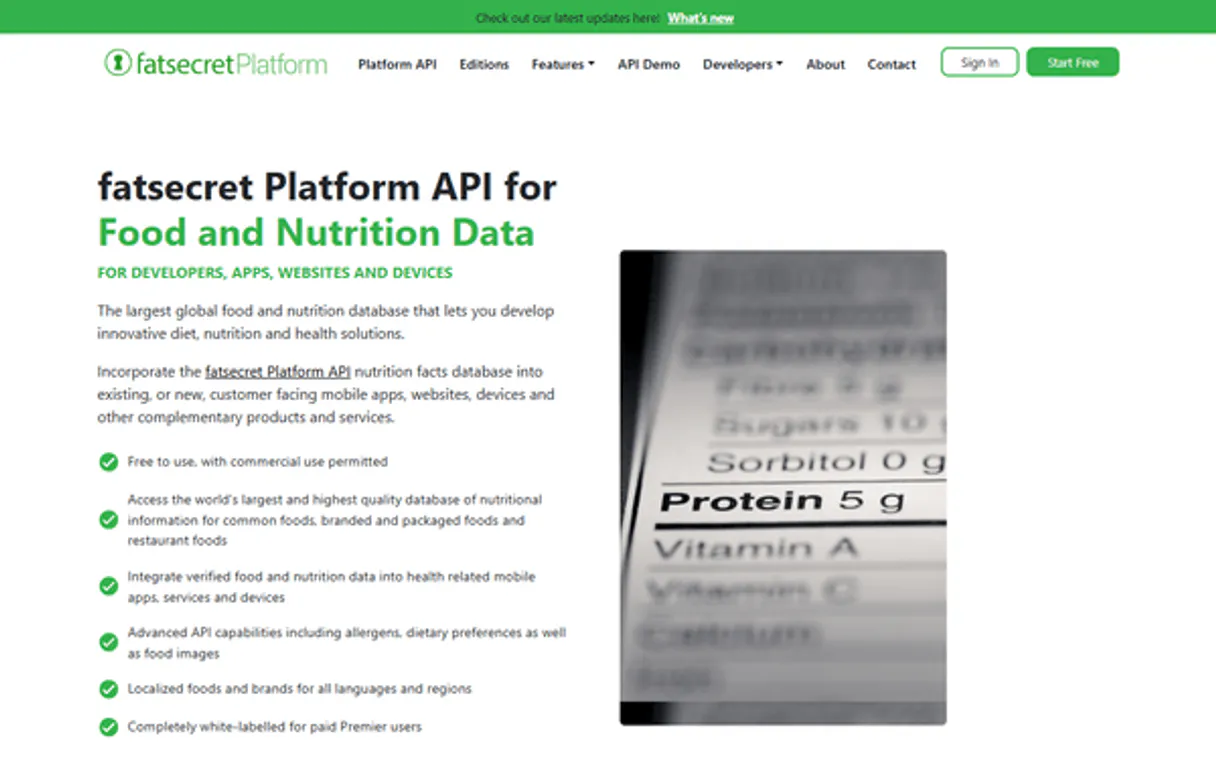
Independent Platform Disclaimer: Vinkius is an independent platform and is not affiliated with, endorsed by, sponsored by, verified by, or otherwise authorized by FatSecret. All third-party trademarks, logos, and brand names are the property of their respective owners. Their use on this website is strictly for informational purposes to identify service compatibility and interoperability.
VINKIUS INFRASTRUCTURE
Cloud Hosted
Managed infra
V8 Isolated
Sandboxed per request
Zero-Trust Proxy
No stored credentials
DLP Enforced
Policy on every call
GDPR Compliant
EU data residency
Token Compression
~60% cost reduction
Works with Claude, ChatGPT, Cursor, and more
The Model Context Protocol standardizes how applications expose capabilities to LLMs. Instead of operating in isolation, your AI gains direct access to external platforms, live data, and real-world actions through secure, standardized connections.
This server provides 2 capabilities that interface natively with Claude, ChatGPT, Cursor, and any MCP client. No middleware. No custom integration required.
Available Capabilities
Tracking nutrition shouldn't mean cross-referencing ten different labels.
Before this, logging a meal meant opening multiple websites, looking up ingredients, and manually comparing calorie counts and fat percentages. You’d copy-paste data from one site, then switch to another for the next ingredient, inevitably losing track of the total count or confusing the serving size.
Now, your agent handles it. You ask it for the full meal breakdown. The server uses `search_fatsecret_foods` to locate everything and `get_fatsecret_food_details` to get the exact macro numbers. You get one clean, structured report, period.
FatSecret MCP Server: Precise Macro Data Access
The most time-consuming part of diet planning is the constant unit conversion and data validation. Did the recipe use 'a handful' or '100g'? Is the label for the whole package or just one serving?
The server fixes that. It handles the math and the sourcing. You just ask for the macro data for '1 cup' or 'per 100g,' and you get the right number. It's that simple.
Common Questions About FatSecret MCP
How do I use the `search_fatsecret_foods` tool? +
The search_fatsecret_foods tool takes a food name as input. It returns preliminary data, including calories, protein, fat, and carbs, for the item you search for.
What is the difference between `search_fatsecret_foods` and `get_fatsecret_food_details`? +
Use search_fatsecret_foods to find the item and get a quick overview. Use get_fatsecret_food_details when you know the food ID and need the complete, granular nutritional profile, including serving size options.
Can I get macro data for a branded product? +
Yes. The FatSecret database covers extensive branded product coverage, including major restaurant chains and packaged goods. Both tools access this full database.
Does FatSecret MCP Server handle unit conversions? +
Yes. The get_fatsecret_food_details tool specifically handles multiple serving size options. You can request the data per cup, per 100g, or per piece, and it will adjust the macros accordingly.
What data is returned for a successful search using `search_fatsecret_foods`? +
+
The search tool returns calorie, protein, fat, and carb data per serving. This data is enough for a quick check, but for a full breakdown, you'll need the details tool.
How does the `get_fatsecret_food_details` tool handle different serving sizes? +
It returns nutritional data for multiple measurements. You can specify the food and the exact serving size (like per 100g, per cup, or per piece) to get the precise data you need.
What authentication method do I use when calling `search_fatsecret_foods`? +
This server uses OAuth 2.0 client credentials for authentication. You'll need to set up client credentials to connect your AI client and access the food data.
How do I get FatSecret API access? +
Register at platform.fatsecret.com for a free developer account. You'll receive a Client ID and Client Secret for OAuth 2.0 authentication.
Does FatSecret include data on restaurant chains and packaged foods? +
Yes, the database includes a vast array of branded products, restaurant chains, and generic foods from around the world.
Are multiple serving sizes supported for foods? +
Yes, most foods in the platform have multiple serving size options available, such as per 100g, per piece, or per cup, giving you highly accurate portion logging.
Use it with your favorite AI tools
Connect this server to Cursor, Claude, VS Code, and more.
More in this category

Corsizio
Equip your AI agent to manage event registrations, attendees, and payments through the Corsizio API.

LEAP Legal
Manage legal matters, cards (contacts), and documents via the LEAP API.

Sapling (Kallidus)
Manage employee onboarding, data, and tasks via Sapling API.
You might also like

Storybook
Connect your AI to Storybook. Explore your design system, inspect UI components, and retrieve implementation guidance programmatically.

Correios API (REST)
Track Brazilian postal objects and calculate shipping prices and deadlines directly through the official Correios REST API.

Withings
Access comprehensive health and fitness data — track weight, blood pressure, sleep cycles, steps, workouts, and heart rate directly from Withings devices.