
Internet Archive MCP Server for CrewAI 10 tools — connect in under 2 minutes
Connect your CrewAI agents to Internet Archive through Vinkius, pass the Edge URL in the `mcps` parameter and every Internet Archive tool is auto-discovered at runtime. No credentials to manage, no infrastructure to maintain.
ASK AI ABOUT THIS MCP SERVER
Vinkius supports streamable HTTP and SSE.
from crewai import Agent, Task, Crew

agent = Agent(
    role="Internet Archive Specialist",
    goal="Help users interact with Internet Archive effectively",
    backstory=(
        "You are an expert at leveraging Internet Archive tools "
        "for automation and data analysis."
    ),
    # Your Vinkius token. get it at cloud.vinkius.com
    mcps=["https://edge.vinkius.com/[YOUR_TOKEN_HERE]/mcp"],
)

task = Task(
    description=(
        "Explore all available tools in Internet Archive "
        "and summarize their capabilities."
    ),
    agent=agent,
    expected_output=(
        "A detailed summary of 10 available tools "
        "and what they can do."
    ),
)

crew = Crew(agents=[agent], tasks=[task])
result = crew.kickoff()
print(result)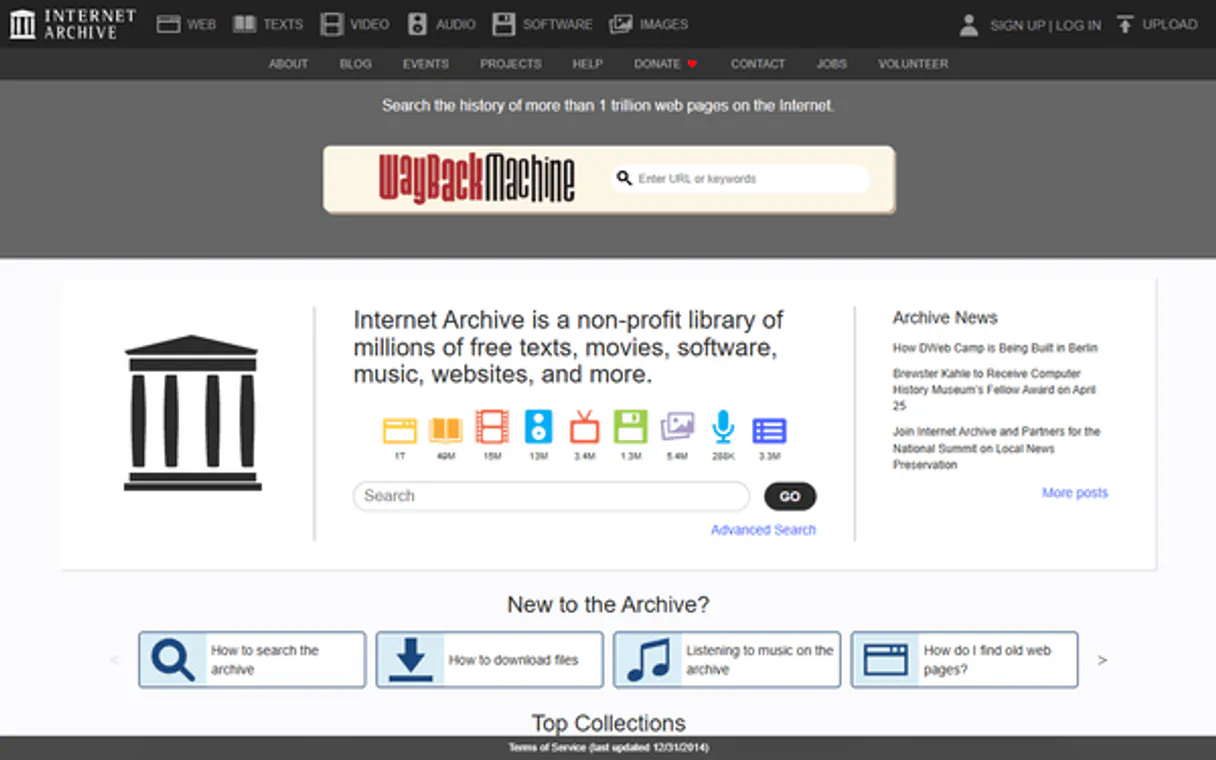
* Every MCP server runs on Vinkius-managed infrastructure inside AWS - a purpose-built runtime with per-request V8 isolates, Ed25519 signed audit chains, and sub-40ms cold starts optimized for native MCP execution. See our infrastructure
About Internet Archive MCP Server
Connect the Internet Archive to any AI agent and access the world's largest digital library — 40M+ books, videos, audio recordings, software, images, and archived web pages — plus the Wayback Machine for historical website snapshots, all through natural conversation.
When paired with CrewAI, Internet Archive becomes a first-class tool in your multi-agent workflows. Each agent in the crew can call Internet Archive tools autonomously, one agent queries data, another analyzes results, a third compiles reports, all orchestrated through Vinkius with zero configuration overhead.
What you can do
- Universal Search — Search across the entire Internet Archive collection for books, films, music, software, images, and web pages with complex query syntax
- Collection Browsing — Explore curated collections like Prelinger Archives, Project Gutenberg, NASA images, TV news, and more
- Media Type Filtering — Search specifically for texts, movies, audio, software, images, or datasets
- Creator Search — Find all works by a specific author, director, musician, or organization
- Historical Date Range — Discover content from specific decades or year ranges
- Item Metadata — Get complete details for any item including description, subjects, collections, file formats, and download links
- File Listings — See all downloadable files for an item with formats (PDF, EPUB, MP4, MP3) and sizes
- User Reviews — Read community reviews and ratings for archived items
- Wayback Machine — Check if any URL has been archived and find the closest snapshot date
- View Statistics — Track popularity and access counts for archived items
The Internet Archive MCP Server exposes 10 tools through the Vinkius. Connect it to CrewAI in under two minutes — no API keys to rotate, no infrastructure to provision, no vendor lock-in. Your configuration, your data, your control.
How to Connect Internet Archive to CrewAI via MCP
Follow these steps to integrate the Internet Archive MCP Server with CrewAI.
Install CrewAI
Run pip install crewai
Replace the token
Replace [YOUR_TOKEN_HERE] with your Vinkius token from cloud.vinkius.com
Customize the agent
Adjust the role, goal, and backstory to fit your use case
Run the crew
Run python crew.py. CrewAI auto-discovers 10 tools from Internet Archive
Why Use CrewAI with the Internet Archive MCP Server
CrewAI Multi-Agent Orchestration Framework provides unique advantages when paired with Internet Archive through the Model Context Protocol.
Multi-agent collaboration lets you decompose complex workflows into specialized roles, one agent researches, another analyzes, a third generates reports, each with access to MCP tools
CrewAI's native MCP integration requires zero adapter code: pass Vinkius Edge URL directly in the `mcps` parameter and agents auto-discover every available tool at runtime
Built-in task delegation and shared memory mean agents can pass context between steps without manual state management, enabling multi-hop reasoning across tool calls
Sequential and hierarchical crew patterns map naturally to real-world workflows: enumerate subdomains → analyze DNS history → check WHOIS records → compile findings into actionable reports
Internet Archive + CrewAI Use Cases
Practical scenarios where CrewAI combined with the Internet Archive MCP Server delivers measurable value.
Automated multi-step research: a reconnaissance agent queries Internet Archive for raw data, then a second analyst agent cross-references findings and flags anomalies. all without human handoff
Scheduled intelligence reports: set up a crew that periodically queries Internet Archive, analyzes trends over time, and generates executive briefings in markdown or PDF format
Multi-source enrichment pipelines: chain Internet Archive tools with other MCP servers in the same crew, letting agents correlate data across multiple providers in a single workflow
Compliance and audit automation: a compliance agent queries Internet Archive against predefined policy rules, generates deviation reports, and routes findings to the appropriate team
Internet Archive MCP Tools for CrewAI (10)
These 10 tools become available when you connect Internet Archive to CrewAI via MCP:
get_item_files
Items may contain multiple files in various formats (PDF, EPUB, MP4, MP3, JPEG, etc.). The identifier is the unique item ID from search results or the item URL. Use this to see what formats are available for download. Files can be downloaded from: https://archive.org/download/{identifier}/{filename} Get the file listing for a specific Internet Archive item
get_item_metadata
Returns: title, creator, date, description, subjects, collection(s), publisher, language, license, download stats, reviews, and complete file listing with formats and sizes. The identifier is obtained from search results or can be found in the item URL (e.g., from https://archive.org/details/big_buck_bunny, the identifier is "big_buck_bunny"). Use this to get comprehensive information about a specific item before downloading or citing it. Get complete metadata and details for a specific Internet Archive item
get_item_reviews
Each review includes reviewer name, star rating, review text, and submission date. Use this to understand community reception and quality assessment of items. Not all items have reviews — community items tend to have more user feedback. Get user reviews for a specific Internet Archive item
get_views_stats
Returns total views and, when available, daily view counts and geographic breakdown. Use this to measure the popularity and reach of archived content. The identifier is the unique item ID from search results or the item URL. Get view count statistics for an Internet Archive item
search
The query parameter supports complex search syntax: AND, OR, NOT, wildcards (*), phrase matching ("..."), and field-specific searches (title:"X", subject:"Y"). Returns item identifiers, titles, media types, creators, dates, and collection info. Use this for broad searches across all media types. Optional fields parameter specifies which fields to return (comma-separated: "identifier,title,mediatype,creator,date,collection"). Default returns 25 rows; use rows to get up to 100 per page. Use page for pagination. Sort options: "date desc", "date asc", "title asc", "title desc", "creator asc", "downloads desc". Example queries: "moon landing", "subject:world war 2", "collection:prelinger". Search the Internet Archive for books, videos, audio, software, images, and more
search_by_collection
Common collections: "prelinger" (Prelinger Archives), "fedflix" (Federal government films), "gutenberg" (Project Gutenberg ebooks), "opensource_movies" (community films), "netlabels" (netlabel music), "softwarelibrary" (classic software), "tv" (TV news archive), "pubmed" (medical journal articles), "nasa" (NASA images and videos), "americanlibraries" (library collections). Returns items within that collection with their identifiers, titles, and metadata. Use this to browse or search within curated collections. Search for items in a specific Internet Archive collection
search_by_creator
The creator name should match how it appears in the item metadata (may be full name or organization name). Use this to find the complete works of an author, all films by a director, or all content from an organization. Example creators: "George Orwell", "Charlie Chaplin", "NASA", "Project Gutenberg". Search for items created by a specific person or organization
search_by_date_range
Combines a search query with year filtering to find historical content from a specific era. Use this to find content from specific decades or periods. Example: query="science fiction", startYear="1950", endYear="1959" finds 1950s sci-fi. The query parameter can be any valid search term. Years should be 4-digit format. Search for items within a specific year range
search_by_mediatype
Media types include: "texts" (books, articles, documents), "movies" (films, videos, TV clips), "audio" (music, podcasts, radio, audiobooks), "software" (classic PC games, applications), "image" (photos, artwork, maps), "dataset" (data files), "web" (web pages). Use this when you want to find only items of a specific format. Example: mediatype="movies" returns only video content. Search for items of a specific media type in the Internet Archive
wayback_availability
Returns the closest (most recent) archived snapshot with its timestamp and availability status. Use this to find archived versions of websites, verify if a page is preserved, or get the date of the most recent snapshot. The archived URL can be accessed at: https://web.archive.org/web/{timestamp}/{original_url}. Example: For https://example.com, returns the closest archived snapshot date and URL. Check if a URL has been archived by the Wayback Machine and find available snapshots
Example Prompts for Internet Archive in CrewAI
Ready-to-use prompts you can give your CrewAI agent to start working with Internet Archive immediately.
"Search for public domain films from the 1940s."
"Check if https://example.com has been archived."
"Show me all NASA images available."
Troubleshooting Internet Archive MCP Server with CrewAI
Common issues when connecting Internet Archive to CrewAI through the Vinkius, and how to resolve them.
MCP tools not discovered
Agent not using tools
Timeout errors
Rate limiting or 429 errors
Internet Archive + CrewAI FAQ
Common questions about integrating Internet Archive MCP Server with CrewAI.
How does CrewAI discover and connect to MCP tools?
tools/list method. This means tools are always fresh and reflect the server's current capabilities. No tool schemas need to be hardcoded.Can different agents in the same crew use different MCP servers?
mcps list, so you can assign specific servers to specific roles. For example, a reconnaissance agent might use a domain intelligence server while an analysis agent uses a vulnerability database server.What happens when an MCP tool call fails during a crew run?
Can CrewAI agents call multiple MCP tools in parallel?
process=Process.parallel, each calling different MCP tools concurrently. This is ideal for workflows where separate data sources need to be queried simultaneously.Can I run CrewAI crews on a schedule (cron)?
crew.kickoff() method runs synchronously by default, making it straightforward to integrate into existing pipelines.Connect Internet Archive with your favorite client
Step-by-step setup guides for every MCP-compatible client and framework:
Anthropic's native desktop app for Claude with built-in MCP support.
AI-first code editor with integrated LLM-powered coding assistance.
GitHub Copilot in VS Code with Agent mode and MCP support.
Purpose-built IDE for agentic AI coding workflows.
Autonomous AI coding agent that runs inside VS Code.
Anthropic's agentic CLI for terminal-first development.
Python SDK for building production-grade OpenAI agent workflows.
Google's framework for building production AI agents.
Type-safe agent development for Python with first-class MCP support.
TypeScript toolkit for building AI-powered web applications.
TypeScript-native agent framework for modern web stacks.
Python framework for orchestrating collaborative AI agent crews.
Leading Python framework for composable LLM applications.
Data-aware AI agent framework for structured and unstructured sources.
Microsoft's framework for multi-agent collaborative conversations.
Connect Internet Archive to CrewAI
Get your token, paste the configuration, and start using 10 tools in under 2 minutes. No API key management needed.