
Mabl MCP. Manage E2E Test Runs and Failure Diagnostics.
 Gemini
 Works with every AI agent you already use
…and any MCP-compatible client









Just plug in your AI agents and start using Vinkius.
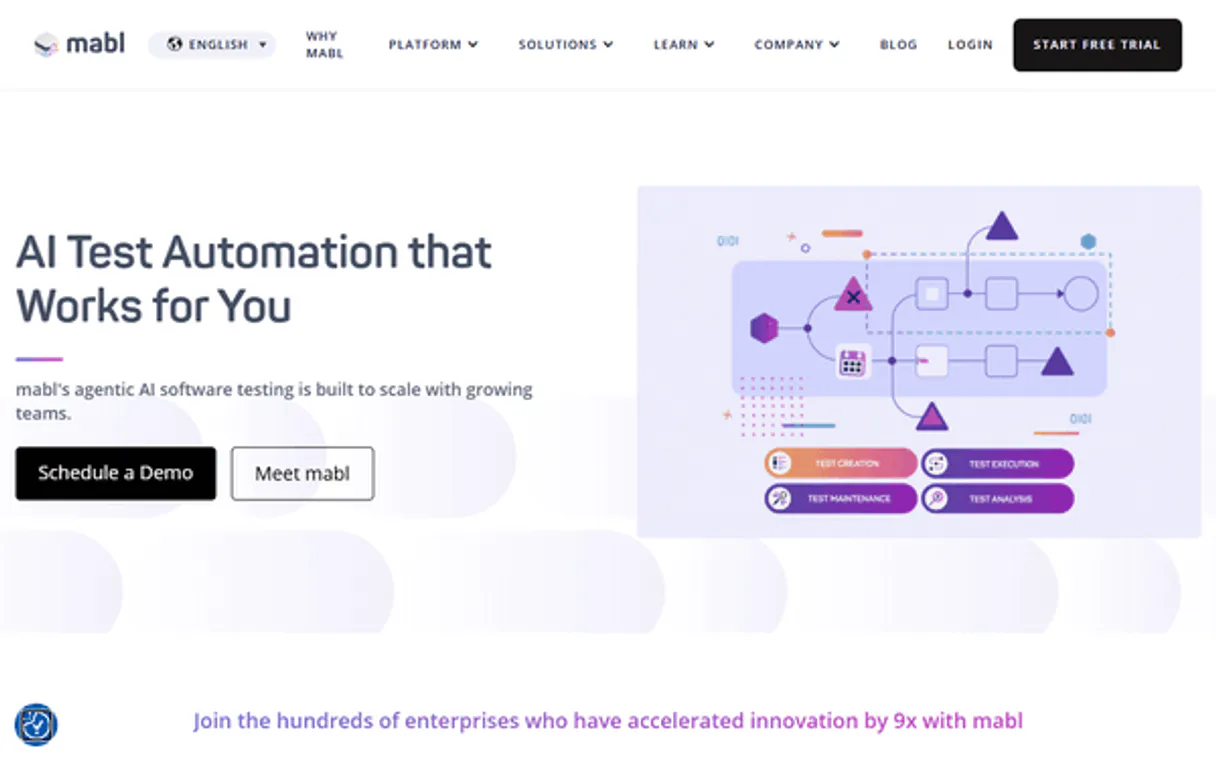
Mabl (AI-Powered Test Automation) provides full control over your E2E testing pipeline via natural language commands. You can trigger test runs across specific environments, monitor real-time progress, and deep-dive into failures using AI analysis.
It lets you list applications, check environment variables, and get detailed results—all without leaving your IDE or chat client.
What your AI agents can do
Mb.get app
Gets full details for a specific Mabl application, including its name, description, and all target URLs (web or API).
Mb.get execution
Retrieves complete data on a single test run, including status, duration, pass/fail counts, failure analysis details, and screenshots.
Mb.list apps
Lists all Mabl applications monitored by the account; useful for getting an overview of your testing scope.
Retrieves full data for a specific Mabl app, including its name, description, target web URLs, and API base URLs.
Fetches detailed results from an execution, giving you status, duration, pass/fail breakdown, failure analysis notes, and screenshots.
Retrieves a list of every available test plan (run policy) in your Mabl workspace, along with their current statuses.
Initiates an immediate run for a specified Mabl test plan via the deployment event system.
Lists all configured testing environments and pulls back their associated variable names, ensuring context accuracy.
Retrieves a summary of the latest test run results across your entire Mabl account.
Ask AI about this MCP
Supported MCP Clients
Gemini Waiting for input…
Mabl (AI-Powered Test Automation) MCP Server: 10 Tools
These tools let you manage the full lifecycle of E2E testing—from listing applications and environments to triggering plans and analyzing failure results.
019d75cbmb.get app
Gets full details for a specific Mabl application, including its name, description, and all target URLs (web or API).
019d75cbmb.get execution
Retrieves complete data on a single test run, including status, duration, pass/fail counts, failure analysis details, and screenshots.
019d75cbmb.list apps
Lists all Mabl applications monitored by the account; useful for getting an overview of your testing scope.
019d75cbmb.list envs
Returns a list of configured test environments and their associated variables (e.g., staging, production).
019d75cbmb.list executions
Provides a summary view of the latest executed test results across all plans.
019d75cbmb.list labels
Lists all organizational labels (tags) used to group and trigger specific Mabl testing suites.
019d75cbmb.list plans
Retrieves a list of all defined test plans, showing their names, current statuses, triggers, and linked apps/envs.
019d75cbmb.list tests
Lists all API tests defined within Mabl for direct checking of service endpoints.
019d75cbmb.trigger plan
Starts a specific test plan run immediately, simulating a deployment event to verify the build's quality.
019d75cbmb.workspace info
Retrieves metadata about the Mabl workspace itself, including its name and organizational details.
Choose How to Get Started
Build a custom MCP for your own tools, or connect a ready-made integration from our catalog.
Build Your Own
Turn any API into an MCP. Import a spec, define Agent Skills, or deploy with MCPFusion.
- Import from OpenAPI, Swagger, or YAML specs
- Create Agent Skills with progressive disclosure
- Deploy to edge with MCPFusion framework
- Built in DLP, auth, and compliance on every call
- Real time usage dashboard and cost metering
- Publish to catalog or keep private
Make Your AI Do More
Start with Mabl (AI-Powered Test Automation), then connect any of our 4,700+ other servers whenever your AI needs more. One click, no limits.
- Use this MCP plus 4,700+ others, all in one place
- Add new capabilities to your AI anytime you want
- Every connection is secured and compliant automatically
- Track usage and costs across all your servers
- Works with Claude, ChatGPT, Cursor, and more
- New servers added to the catalog every week
What you can do with this MCP connector
The Mabl MCP Server: Full Control Over E2E Testing from Your Chat Client
You're done clicking through dashboards just to check if a build passed. This server gives your AI client direct control over your entire end-to-end testing pipeline using nothing but natural language commands. You can manage, trigger, and analyze Mabl tests—all without leaving your chat or IDE.
Getting Your Lay of the Land
When you need an overview, your agent first checks what assets you've got running. It runs mb.list_apps to list every monitored application in the account. You can also use mb.list_plans to pull up a rundown of all defined test plans (the run policies) and see their current status. If you want to know which tags group your tests, mb.list_labels lists those organizational labels.
For quick checks on API endpoints, running mb.list_tests gives you a list of every defined service endpoint Mabl monitors.
Controlling the Environment and Scope
To make sure your tests run in the right place, you'll use mb.list_envs to pull back all configured testing environments; this also grabs the associated variables for context accuracy. You can get full details on any single application using mb.get_app, which delivers the app's name, description, target web URLs, and API base URLs.
Running and Triggering Tests
Need a test run right now? Your agent uses mb.trigger_plan to start an immediate execution for any specified test plan, simulating that deployment event you need to verify the build's quality. To scope out all active plans, it calls mb.list_plans again. Meanwhile, if you just want a quick status check on recent runs across your whole account, mb.list_executions gives you a summary of the latest test results.
Analyzing Results and Failures
When tests run, you need to know what went wrong. Your agent uses mb.get_execution to fetch complete data on any single test run; this delivers the status, duration, pass/fail count, detailed failure analysis notes, and even screenshots for debugging. You can also retrieve metadata about the entire Mabl workspace itself using mb.workspace_info, which gives you organizational details and the name.
This server lets your agent do it all: list out every asset (mb.list_apps), scope your environment variables (mb.list_envs), initiate a run (mb.trigger_plan), check the overall history of runs (mb.list_executions), or deep-dive into exactly why one specific test failed (mb.get_execution).
How Mabl MCP Works
- 1 First, check what assets exist. Use
mb.list_envsto confirm you have the right target environment andmb.list_appsto see all monitored applications. - 2 Next, validate your plan. Run
mb.list_plansto find the exact name or ID of the test suite you need to run, then usemb.get_appif you need specific web/API targets for that plan. - 3 Finally, trigger the action using
mb.trigger_plan, passing in the necessary parameters (like environment and app ID). You'll get back confirmation and a unique execution ID to monitor status later.
The bottom line is: you use listing tools to confirm state, then one targeted tool to change that state or pull specific data points.
Who Is Mabl MCP For?
This is for the QA Automation Engineer who gets tired of switching between the Mabl console and their IDE just to check a failure log. It's for the DevOps team member who needs to audit CI/CD results across multiple environments without logging into five different dashboards. If your job involves verifying build quality, this saves you time.
Triggers complex test plans and analyzes failure diagnostics using natural conversation right where they write code or run tests.
Verifies build quality and pulls session screenshots from failed runs to debug UI regressions directly in their workspace, without leaving VS Code.
Audits CI/CD test results and monitors environment health across multiple Mabl projects efficiently via the agent.
What Changes When You Connect
- Analyze Failures Instantly: Instead of digging through logs, use
mb.get_executionto pull detailed failure analysis notes, specific error reasons, and direct screenshots from the run ID. You know exactly why it failed. - Control the Pipeline from Chat: Trigger a test plan instantly using
mb.trigger_plan. Your agent sends the command, and you get immediate confirmation that the run has started in your target environment. - Full Scope Visibility: Need to know what assets Mabl is watching? Run
mb.list_appsormb.list_plansto enumerate every monitored application and test suite name at a glance. - Contextual Testing: Use
mb.list_envsbefore triggering anything. You can confirm the correct environment variables are available, preventing the classic 'It worked on my machine' issue. - Audit Everything: Check plan dependencies by running
mb.list_labels. This lets you group and verify that specific test suites only run when required for a particular release cycle.
Real-World Use Cases
The nightly smoke test failed, but I don't know why.
A developer sees the CI build fail. They ask their agent to check the last run: 'Show me details for the latest failure.' The agent uses mb.list_executions then mb.get_execution, pulling back screenshots and diagnostic insights that show a missing element on the checkout page, solving the problem without needing manual log diving.
I need to test the hotfix in Staging right now.
The team needs immediate verification. They tell their agent: 'Trigger the Checkout Regression plan for Staging.' The agent uses mb.trigger_plan (passing the required env/app context), and the run starts instantly, notifying the team when results are available.
We updated an API endpoint; does our web app test hit it?
The QA engineer wants to verify coverage. They use mb.list_apps first, then check the specific target URLs for both the web and API components using mb.get_app. This confirms their testing scope covers the new service endpoint.
Which test plan should I run next?
A junior developer is unsure where to start. They ask the agent, 'What plans are available?' The agent uses mb.list_plans and presents a structured list of all available suites, letting the developer quickly choose the right one.
The Tradeoffs
Assuming global state
Just telling your agent to 'run the smoke test' without specifying the environment or checking if it exists.
→
Never guess. Always start by running mb.list_envs first. Once you confirm the target, use that name when calling mb.trigger_plan. This keeps deployments scoped and accurate.
Ignoring dependency checks
Running a complex plan (mb.trigger_plan) against an environment variable (like API keys) that hasn't been updated since the last successful build.
→
Before triggering, run mb.list_envs to confirm the expected variables are present and correct for the target test scope.
Treating results as a single data dump
Asking the agent 'What did the tests do?' which returns one massive, unreadable block of text.
→
Be specific. Always ask to use mb.get_execution and specify which run ID you care about. This cuts out the noise and gives precise diagnostic data.
When It Fits, When It Doesn't
Use this server if your testing process needs deep, conversational control over test execution results—specifically, when analyzing failure diagnostics is half the job. You need to know why a UI element failed or what environment variables are active before you run anything.
Don't use it if all you need is a simple list of URLs or an API key. For those basic data retrievals, simpler JSON-only tools suffice. If your goal is purely tracking metrics over time (e.g., 'how many tests passed last month'), you might prefer dedicated analytics dashboards rather than relying solely on mb.list_executions. However, if that metric failure requires deep, actionable debugging—like pulling a screenshot and an error message—then this MCP server is the only way to get it directly into your workflow.
Independent Platform Disclaimer: Vinkius is an independent platform and is not affiliated with, endorsed by, sponsored by, verified by, or otherwise authorized by Mabl. All third-party trademarks, logos, and brand names are the property of their respective owners. Their use on this website is strictly for informational purposes to identify service compatibility and interoperability.
VINKIUS INFRASTRUCTURE
Cloud Hosted
Managed infra
V8 Isolated
Sandboxed per request
Zero-Trust Proxy
No stored credentials
DLP Enforced
Policy on every call
GDPR Compliant
EU data residency
Token Compression
~60% cost reduction
Works with Claude, ChatGPT, Cursor, and more
The Model Context Protocol standardizes how applications expose capabilities to LLMs. Instead of operating in isolation, your AI gains direct access to external platforms, live data, and real-world actions through secure, standardized connections.
This server provides 10 capabilities that interface natively with Claude, ChatGPT, Cursor, and any MCP client. No middleware. No custom integration required.
Available Capabilities
Sifting through test failures used to be a painful process of copy-pasting logs across five different tabs.
Today, when a build breaks, you're stuck. You jump into the Mabl console, find the run ID, click on the failure step, and then you copy the error message—a giant block of text that means nothing without context. Then you switch to your IDE just to compare it against existing code.
With this MCP server, you tell your agent: 'Show me details for the last failed execution.' The agent uses `mb.get_execution`. It pulls back the failure analysis, the diagnostic notes, *and* the visual screenshot in one go. You get actionable data, not just a wall of text.
Mabl MCP Server: Triggering test runs with `mb.trigger_plan`
Manual testing requires multiple steps to verify deployment readiness. You have to manually select the plan, pick the environment dropdown (staging/prod), and click 'Run Test.' If you forget one step or choose the wrong variable set, the test runs against bad data.
Now, your agent handles it. You simply tell it: 'Trigger the Regression plan for Staging.' The server uses `mb.trigger_plan`, passing all the required parameters in a single call. It's clean, immediate, and impossible to execute incorrectly.
Common Questions About Mabl MCP
How do I find out which environments are available using mb.list_envs? +
Run mb.list_envs. This returns a clear list of all your configured environments (like Staging, QA, Prod) and, crucially, lists the specific variables tied to each one so you know what context is being used.
What's the difference between mb.list_plans and mb.list_apps? +
mb.list_plans shows your test suites (the policies or run definitions). mb.list_apps shows the underlying applications that Mabl is monitoring, including their web and API targets.
Can I get a screenshot of a failed test using mb.get_execution? +
Yes. Using mb.get_execution, you pull back the detailed results for an execution ID. This includes diagnostic insights and visual screenshots, so you don't have to manually capture anything.
How do I check if a test plan exists before triggering it? +
First, run mb.list_plans. This gives you the definitive list of all available plans and their unique IDs. Use that confirmed name when you call mb.trigger_plan.
What information does `mb.workspace_info` provide about my connection setup? +
It returns core details about your connected Mabl workspace. This includes verifying the organization name, the specific workspace ID, and metadata confirming the API key is active. Use this to confirm you're hitting the right environment before running tests.
How can I narrow down results when listing past runs using `mb.list_executions`? +
You specify filters like date ranges or specific statuses (e.g., 'failed', 'passed'). This prevents loading massive amounts of data, which helps you quickly locate the exact run you need to debug.
When I use `mb.get_app`, what does it show about the application's targets? +
It gives a comprehensive view of the app's scope by listing all associated web URLs and API base URLs. This lets you know exactly which endpoints are included in testing for that specific application.
If I call `mb.list_plans`, how do I handle potentially large numbers of plans? +
The tool returns results in pages. You must check the API response metadata for a 'next page token.' Using this token lets your agent loop through all available data until every single test plan is listed.
Can I see exactly why a Mabl test failed using my agent? +
Yes. Use the mb.get_execution tool with a specific Execution ID. Your agent will retrieve deep diagnostic information, including the failure reason, test outcomes, and visual screenshots to help you identify UI regressions instantly.
How do I trigger a specific test plan through a conversation? +
The mb.trigger_plan tool allows your agent to start executions associated with a Plan ID or Label. You can also specify an optional Environment ID to target a specific stage (e.g., Staging vs Prod) for your automated tests.
Can my agent list all available testing environments in my account? +
Absolutely. Use the mb.list_envs tool to identify all configured environments. Your agent will report the environment names, IDs, and any associated environment variables defined in Mabl.
Use it with your favorite AI tools
Connect this server to Cursor, Claude, VS Code, and more.
More in this category

Heroku (PaaS)
Manage Heroku apps via AI — list apps, restart dynos, toggle maintenance mode, and audit config vars.

Beeceptor
Mock APIs, intercept requests, and manage proxy rules directly from your AI agent.
OpenAI
Use GPT-4o, DALL-E 3, embeddings, fine-tuning, and moderation as tools inside your AI agent workflows.
You might also like

Firecrawl
Turn any website into clean, LLM-ready Markdown with a single API call — scrape, crawl, search, and map the entire web for your AI agent.

Beamer
Manage product updates and user feedback via Beamer — create posts, track analytics, and monitor feedback directly from any AI agent.

Worldpay
Process payments, manage refunds, and audit settlements on Worldpay — the global leader in payment processing technology.