
Numbers API MCP. Instant Facts on Dates, Numbers, and Years.
 Gemini
 Works with every AI agent you already use
…and any MCP-compatible client









Just plug in your AI agents and start using Vinkius.
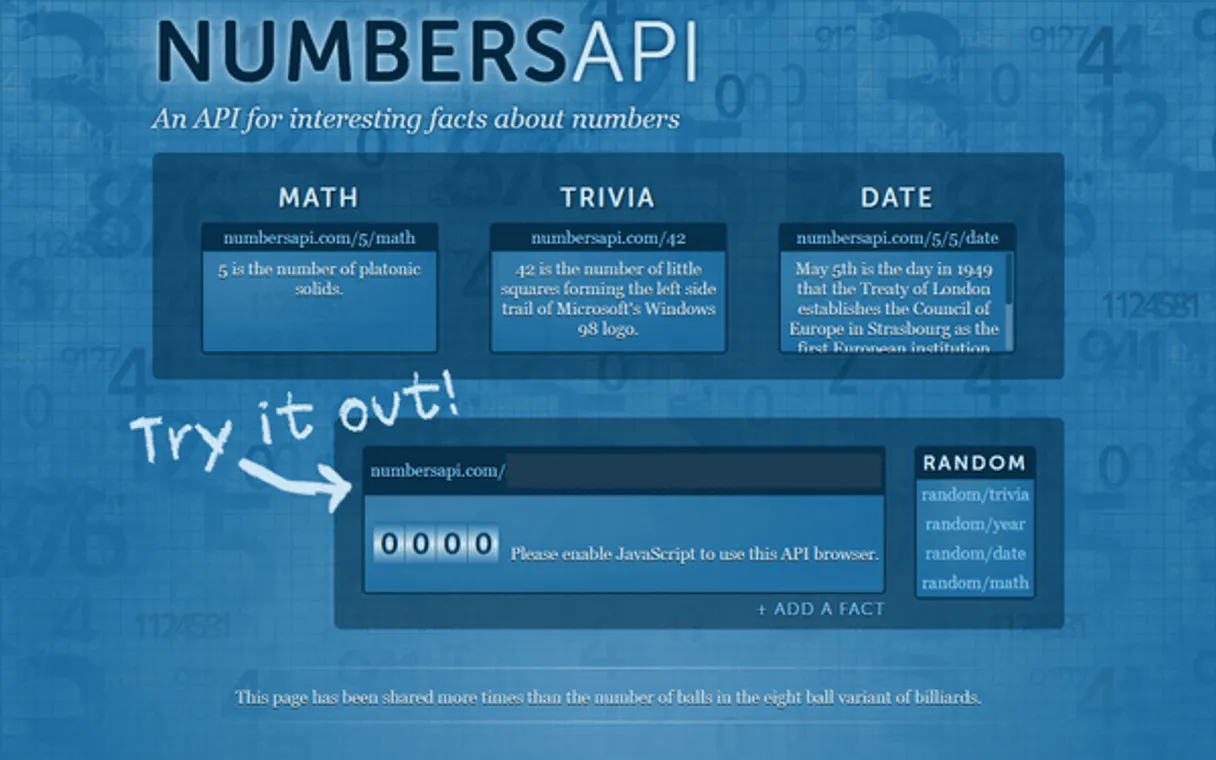
Numbers API provides instant factual data about dates, years, and integers. Your AI client can pull trivia, mathematical properties, and historical events for any number or day—all through natural conversation.
What your AI agents can do
Get date fact
Fetches a historical event fact for a given month and day (e.g., what happened on October 24th).
Get math fact
Returns specific mathematical properties or facts about any provided integer.
Get random fact
Delivers a fact drawn randomly from all categories (history, math, trivia) when no specific context is given.
You give the server a month and day, and it returns significant historical milestones that occurred on that exact date.
The tool calculates and reports technical facts about how a specific number works mathematically (e.g., prime status, sums).
It provides fun or obscure knowledge associated with an integer that isn't strictly mathematical.
When you need context but don't know what to ask for, this tool delivers a completely unpredictable and interesting fact.
The server aggregates major global or cultural events that happened during the specified year.
Ask AI about this MCP
Supported MCP Clients
Gemini Waiting for input…
Numbers API MCP Server: 5 Tools for Fact Retrieval
Use these five specialized functions to pull instant, factual information on dates, years, and integers directly into your conversation.
019d8461get date fact
Fetches a historical event fact for a given month and day (e.g., what happened on October 24th).
019d8461get math fact
Returns specific mathematical properties or facts about any provided integer.
019d8461get random fact
Delivers a fact drawn randomly from all categories (history, math, trivia) when no specific context is given.
019d8461get trivia fact
Retrieves fun or obscure general knowledge facts for any specified number.
019d8461get year fact
Looks up significant historical milestones and context associated with an entire year.
Choose How to Get Started
Build a custom MCP for your own tools, or connect a ready-made integration from our catalog.
Build Your Own
Turn any API into an MCP. Import a spec, define Agent Skills, or deploy with MCPFusion.
- Import from OpenAPI, Swagger, or YAML specs
- Create Agent Skills with progressive disclosure
- Deploy to edge with MCPFusion framework
- Built in DLP, auth, and compliance on every call
- Real time usage dashboard and cost metering
- Publish to catalog or keep private
Make Your AI Do More
Start with Numbers API, then connect any of our 4,700+ other servers whenever your AI needs more. One click, no limits.
- Use this MCP plus 4,700+ others, all in one place
- Add new capabilities to your AI anytime you want
- Every connection is secured and compliant automatically
- Track usage and costs across all your servers
- Works with Claude, ChatGPT, Cursor, and more
- New servers added to the catalog every week
What you can do with this MCP connector
Yo, check this out: This Numbers API hooks up your agent to a massive database of facts. It lets you pull trivia, math properties, and history for any date, year, or integer—all just by talking to it naturally.
You ain't gotta search the web; your AI client hits this dedicated numerical encyclopedia instead. You wanna know what went down on October 24th? Ask for a specific month and day, and the server spits out all the significant historical milestones that happened then. Need some context about a whole year? Just give it the date, and get_year_fact aggregates major global or cultural events from that time.
If you're dealing with numbers—and you always are—you got three ways to dig deep. You can use get_math_fact to get technical facts about how a number works mathematically; it calculates and reports stuff like prime status or sums. Then, if you just want fun knowledge for an integer, get_trivia_fact pulls obscure general trivia associated with that specific number.
When you're feeling lost on what context you need but wanna keep the conversation going, get_random_fact delivers a totally unpredictable and interesting fact drawn from every category—history, math, or just plain old trivia.
When talking about dates specifically, if you give it a month and day, get_date_fact returns historical events that occurred on that exact date. For instance, if you ask for the 7th of March, it’ll tell ya what happened historically on March 7th. If you've got some integer and need to know how its structure works mathematically, use get_math_fact to get technical mathematical properties.
If that math ain't your thing, but you wanna hear a fun fact about the number itself—like why the number seven is weird or something—you call get_trivia_fact, and it gives ya fun or obscure general knowledge. Need to check out what big deals went down in 1929? You use get_year_fact to get a rundown of major global events for that entire year.
If you're just vibing and need something quick, unpredictable, and totally random, just send the prompt to get_random_fact, and it hits ya with a completely unpredictable fact across all types of knowledge.
It’s straightforward: Give it a number or a date, and your agent gets you the facts. You're set. No manual searching required for none of this.
How Numbers API MCP Works
- 1 Subscribe to the Numbers API server on Vinkius.
- 2 Your AI client recognizes your query requires factual data (date, number, or year).
- 3 The agent calls one of the specialized tools—for example,
get_math_fact(number=42)—and returns the result directly into the conversation.
The bottom line is: you talk to your AI client like a human talking to an encyclopedia, and it handles the database lookups automatically.
Who Is Numbers API MCP For?
Anyone who needs factual context—historians, content writers, or data analysts. This is for the educator stuck in research mode who can't find a single interesting fact about a date, or the tech writer who needs obscure trivia to make an article pop.
Uses get_trivia_fact and get_random_fact to quickly generate unique talking points for social media posts, blog articles, or video scripts.
Runs get_math_fact and get_date_fact in class examples to provide immediate, context-rich historical or mathematical background for lessons.
Takes a dry data point (like '1945') and runs it through get_year_fact to instantly add human-readable narrative context.
What Changes When You Connect
- Need to back up a claim? Use
get_date_factto prove what happened on specific dates, instantly grounding your writing in verifiable history. It's better than skimming Wikipedia. - Stop searching for fun facts manually. Just ask your agent for a random fact and use
get_random_factto inject unexpected, high-quality trivia into any piece of content. - Struggling with dry data? Run the year through
get_year_fact. Instead of just seeing '1945,' you get context about the UN Charter coming into effect. It's instant narrative building. - Forget simple definitions. Use
get_math_factto pull deep, technical mathematical insights for a number, giving your audience depth they won’t expect. - It cuts down on effort. Instead of juggling five different search queries (history, math, random, year, trivia), you route it all through one server using specialized tools.
Real-World Use Cases
Writing a time capsule article
The writer needs to populate an article about the early 20th century. They ask their agent for facts on '1918.' The server uses get_year_fact and provides three major global events, letting the writer structure the content without leaving their chat window.
Creating an educational quiz
A teacher needs five random questions for a class on math history. They prompt the agent to generate facts using get_trivia_fact and get_random_fact, ensuring they get diverse, interesting numbers like 1729 without having to look them up themselves.
Developing data visualizations
A data analyst is working with a timeline that includes the date 'May 30th.' They use get_date_fact to pull the historical context for that specific day, allowing them to add a powerful narrative caption next to their purely numerical chart.
Need filler content fast
A marketer needs an obscure fact for a viral social media post. They prompt the agent with 'Give me something random.' The server uses get_random_fact, immediately providing high-quality, unexpected knowledge that makes their post shareable.
The Tradeoffs
Asking for a general search
Prompting: 'Tell me everything interesting about the number 42 and history.' The agent gets confused because it can't determine if you mean math, trivia, or date context.
→
Be specific. If you want fun facts, use get_trivia_fact. If you need historical events, specify the day and use get_date_fact.
Over-relying on one tool
Only running get_random_fact for every piece of content. The results are unpredictable, and you can't guarantee the context matches your current topic.
→
Always map the fact to a specific domain. If it’s about math, call get_math_fact. If it's about history, use get_year_fact.
Trying to synthesize facts manually
Asking: 'What was the relationship between 1945 and the number 7?' The server cannot connect those two separate topics because it only retrieves isolated facts, not relationships.
→
Run them separately. Get the year fact first (get_year_fact) to understand 1945, then get a random fact or math fact independently.
When It Fits, When It Doesn't
Use this API if your task is purely knowledge retrieval: 'What happened?' or 'What is it?' You need isolated facts—like the UN Charter coming into effect in 1945 (use get_year_fact), or a fun fact about prime numbers (use get_trivia_fact).
Don't use this if you need reasoning. If your task requires connecting multiple concepts ('How did the invention of printing technology influence global math theory?'), this server won't help. It delivers raw, structured data points; it doesn't connect them into a cohesive argument or story. For synthesis, you still need to write the narrative yourself after calling the necessary tools.
Independent Platform Disclaimer: Vinkius is an independent platform and is not affiliated with, endorsed by, sponsored by, verified by, or otherwise authorized by Numbers API. All third-party trademarks, logos, and brand names are the property of their respective owners. Their use on this website is strictly for informational purposes to identify service compatibility and interoperability.
VINKIUS INFRASTRUCTURE
Cloud Hosted
Managed infra
V8 Isolated
Sandboxed per request
Zero-Trust Proxy
No stored credentials
DLP Enforced
Policy on every call
GDPR Compliant
EU data residency
Token Compression
~60% cost reduction
Works with Claude, ChatGPT, Cursor, and more
The Model Context Protocol standardizes how applications expose capabilities to LLMs. Instead of operating in isolation, your AI gains direct access to external platforms, live data, and real-world actions through secure, standardized connections.
This server provides 5 capabilities that interface natively with Claude, ChatGPT, Cursor, and any MCP client. No middleware. No custom integration required.
Available Capabilities
Gathering historical facts shouldn't feel like pulling teeth.
Before this, adding context meant switching tabs: looking up a date on Wikipedia for history, then checking WolframAlpha for math properties, and finally searching random trivia sites. It was fragmented, time-consuming copy-pasting across multiple windows.
Now, you ask your agent to pull the facts. The system runs `get_date_fact` or `get_year_fact`, and it deposits clean, context-rich data straight into your chat stream. You get the fact, not a link.
Use the Numbers API MCP Server to access specialized knowledge.
You don't have to manually check if a number is prime or if it has historical significance. You simply ask for 'math facts about 1729,' and the agent uses `get_math_fact` to deliver that specific data point immediately.
The difference is control. Instead of wading through generic searches, you call a targeted tool—like `get_trivia_fact`—and get exactly the obscure piece of knowledge you need.
Common Questions About Numbers API MCP
How do I use get_date_fact to find history? +
You just provide the month and day. For example, 'What happened on October 24th?' The agent runs get_date_fact and returns historical events for that specific date.
Is get_trivia_fact different from get_random_fact? +
Yes. Use get_trivia_fact when you know the number (e.g., '42') and need a fun fact about it. Use get_random_fact when you have no idea what kind of fact you want.
Which tool should I use for historical events? +
Use get_year_fact if you want context for an entire year (e.g., 1945). Use get_date_fact if the specific day matters more than the whole year.
Can I use get_math_fact to check prime numbers? +
Yes, that's its purpose. Simply ask for math facts about a number and get_math_fact will deliver properties like primality or factorization details.
Do I need an API key when calling `get_year_fact`? +
No. This server uses a free public API, meaning you don't have to manage or input any keys or credentials. Your AI agent connects directly through Vinkius and executes the function call immediately.
What happens if I pass an invalid date range to `get_date_fact`? +
It returns a structured error message detailing the specific issue with your input. The API validates dates before processing, so you'll get clear feedback instead of a crash or incorrect data.
Should I use `get_date_fact` or `get_year_fact` for historical context? +
You should generally use get_date_fact. While get_year_fact gives general milestones, the date tool allows you to pinpoint the exact day and month of an event for much more precise records.
Is there a rate limit if I call `get_math_fact` many times in one session? +
No explicit limits are documented. Since this is running on Vinkius's managed infrastructure, you can rely on standard usage patterns for repeated calls within your workflow.
Do I need an API key to use this server? +
No, the Numbers API is completely free and does not require any authentication or API keys.
Can I search for facts about specific dates like my birthday? +
Yes! Use the get_date_fact tool and provide the month and day. Your agent will return a historical event associated with that specific calendar day.
What kind of mathematical facts are available? +
The get_math_fact tool provides properties like whether a number is a prime, Fibonacci number, perfect number, or has other unique mathematical characteristics.
Use it with your favorite AI tools
Connect this server to Cursor, Claude, VS Code, and more.
More in this category

FreshBooks
Manage small business accounting via FreshBooks — track clients and invoices, handle payments and billing via AI agents.

Alegra
Handle your Latin American business accounting with electronic invoicing, expense tracking, and tax-ready financial reports.

Design Prover
Every AI frontend looks identical: hero, 3 cards, 3 cards, CTA, rounded-xl, shadow-lg, blue/gray/white. Design Prover forces the agent to prove its design has dramatic hierarchy, unpredictable layout, intentional whitespace, commanding typography, and color with actual personality.
You might also like

Hotjar (Behavior Analytics)
Analyze user behavior via Hotjar — list sites, retrieve survey responses, and manage feedback widgets.

360Learning
Collaborative learning platform — manage users, courses, paths, and training statistics via AI.

SmartHR
Empower your AI to manage employee records, organizational structures, and payrolls directly from your SmartHR workspace.