
Sentinel Hub MCP Server for CursorGive Cursor instant access to 14 tools to Catalog Search, Check Sentinel Hub Status, Generate False Color Evalscript, and more
Cursor is an AI-first code editor built on VS Code that integrates LLM-powered coding assistance directly into the development workflow. Its Agent mode enables autonomous multi-step coding tasks, and MCP support lets agents access external data sources and APIs during code generation.
Ask AI about this App Connector for Cursor
The Sentinel Hub app connector for Cursor is a standout in the Cloud Infrastructure category — giving your AI agent 14 tools to work with, ready to go from day one.
Vinkius delivers Streamable HTTP and SSE to any MCP client
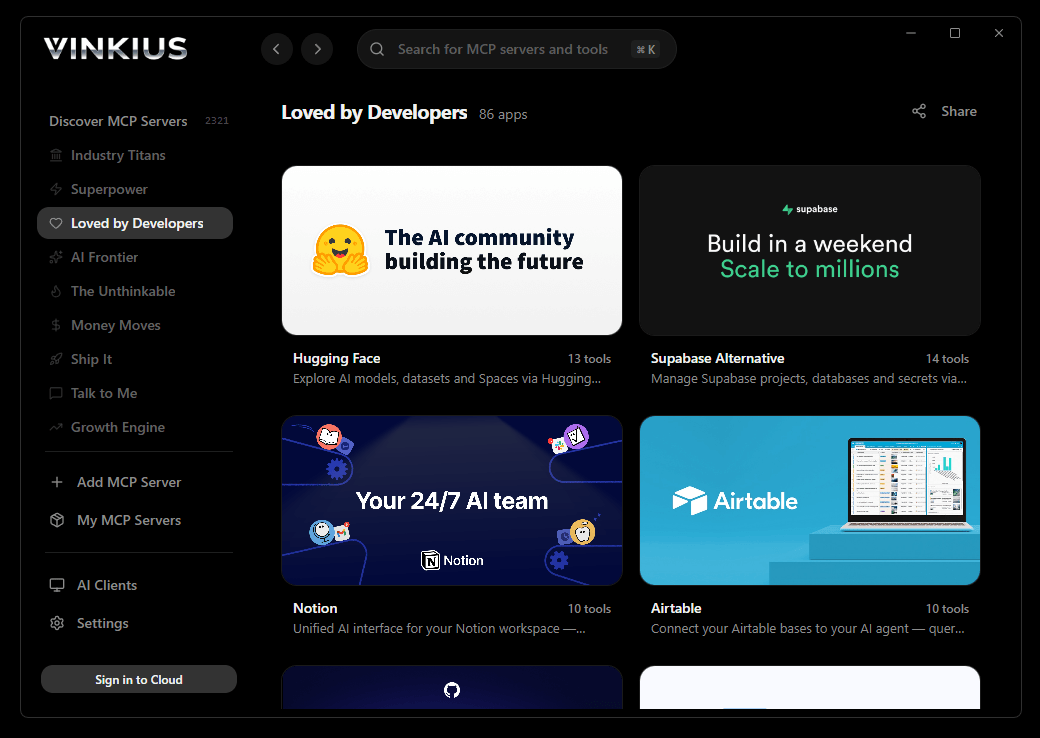
Vinkius Desktop App
The modern way to manage MCP Servers — no config files, no terminal commands. Install Sentinel Hub and 3,400+ MCP Servers from a single visual interface.
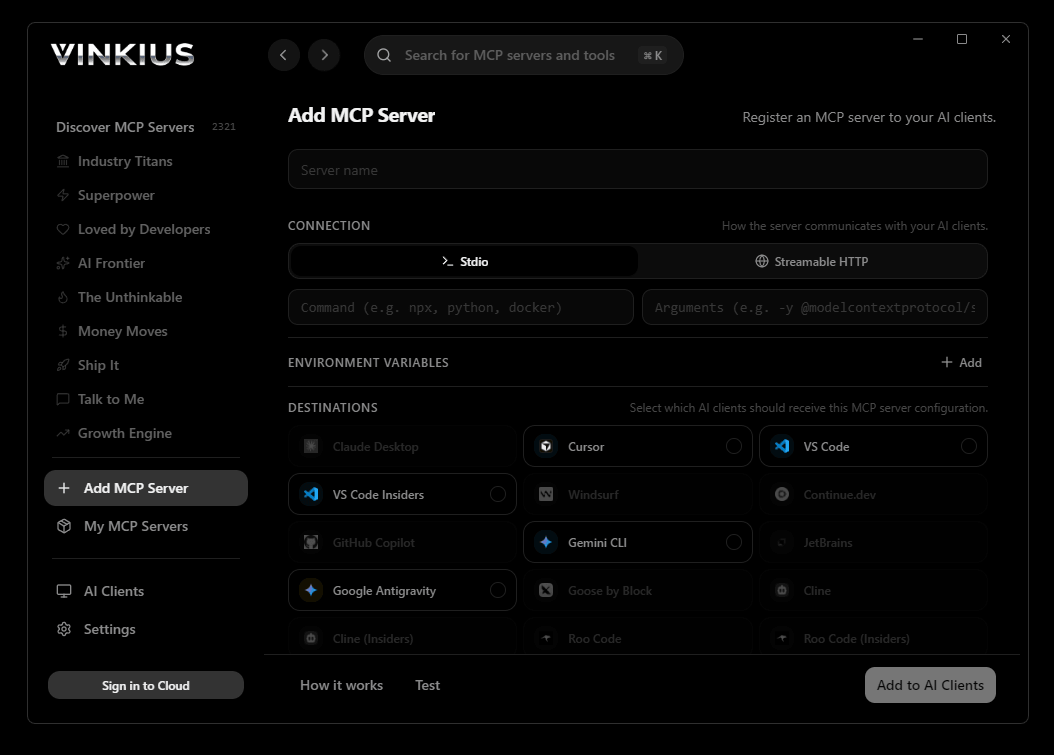

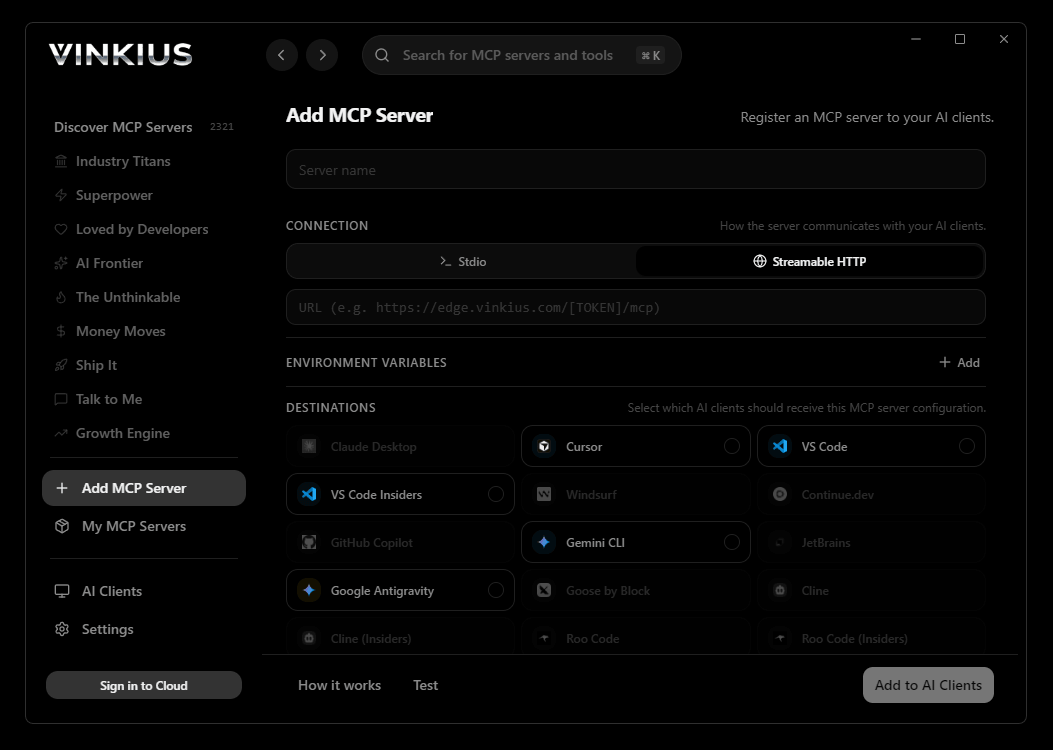
{
  "mcpServers": {
    "sentinel-hub": {
      "url": "https://edge.vinkius.com/[YOUR_TOKEN_HERE]/mcp"
    }
  }
}
* Every MCP server runs on Vinkius-managed infrastructure inside AWS - a purpose-built runtime with per-request V8 isolates, Ed25519 signed audit chains, and sub-40ms cold starts optimized for native MCP execution. See our infrastructure
About Sentinel Hub MCP Server
Connect to Sentinel Hub — the most powerful satellite imagery processing API in Europe — and transform raw Earth observation data into actionable intelligence.
Cursor's Agent mode turns Sentinel Hub into an in-editor superpower. Ask Cursor to generate code using live data from Sentinel Hub and it fetches, processes, and writes. all in a single agentic loop. 14 tools appear alongside file editing and terminal access, creating a unified development environment grounded in real-time information.
What you can do
- STAC Catalog Search — Discover available satellite scenes by location, date, collection, cloud cover, and MGRS tile ID across all Sentinel missions and Landsat
- Image Processing — Render custom satellite imagery using evalscripts (JavaScript-based processing scripts) that define how bands are combined, indices are calculated, and pixels are colored
- Vegetation Analysis (NDVI) — Generate ready-to-use NDVI evalscripts that color-code vegetation density from bare soil to dense forest
- Statistical Analysis — Calculate mean, min, max, standard deviation, and histograms over areas of interest with temporal aggregation (daily, weekly, monthly)
- Cloud-Free Search — Find satellite scenes below a specified cloud cover threshold for clean optical analysis
- Band Combinations — Access a curated library of 10 predefined band combinations including True Color, False Color, NDWI, Moisture Index, SWIR, and Burn Severity
The Sentinel Hub MCP Server exposes 14 tools through the Vinkius. Connect it to Cursor in under two minutes — no API keys to rotate, no infrastructure to provision, no vendor lock-in. Your configuration, your data, your control.
All 14 Sentinel Hub tools available for Cursor
When Cursor connects to Sentinel Hub through Vinkius, your AI agent gets direct access to every tool listed below — spanning satellite-imagery, earth-observation, geospatial-data, and more. Every call is secured with network, filesystem, subprocess, and code evaluation entitlements inside a sandboxed runtime. Beyond a simple connection, you get a full AI Gateway with real-time visibility into agent activity, enterprise governance, and optimized token usage.
Specify a collection ID (e.g., "sentinel-2-l2a", "sentinel-1-grd"), a bounding box as [west, south, east, north] coordinates, and a date range. Returns item metadata including geometry, cloud cover, and band information. Search the Sentinel Hub STAC catalog for satellite imagery
Returns the connection status and service URL. Use this to verify your client_id:client_secret credentials are working correctly. Verify Sentinel Hub API connectivity and authentication
In the output, healthy vegetation appears bright red, urban areas appear cyan/grey, and water appears dark blue. This is the standard false-color composite used in remote sensing for vegetation mapping and land cover classification. Generate a false-color evalscript for vegetation emphasis
The output is color-coded: dark for water/shadow, grey for bare soil, yellow-green for sparse vegetation, and deep green for dense vegetation. Use the returned evalscript with the process_image tool. Generate a ready-to-use NDVI evalscript for vegetation analysis
Use the returned evalscript with the process_image tool to get visually appealing satellite photos of any location on Earth. Generate a true-color RGB evalscript for natural imagery
Get detailed information about a specific data collection
Use the item ID returned from a catalog_search query. Get detailed metadata for a specific STAC catalog item
Requires an evalscript that defines which bands to analyze. Supports temporal aggregation (daily, weekly, monthly) for time-series analysis of vegetation indices, water levels, or urban expansion. Calculate statistics over an area from satellite imagery
Useful for verifying credentials and understanding available quotas. Get authenticated Sentinel Hub user profile information
Includes True Color, False Color (vegetation), NDVI, NDWI, Moisture Index, SWIR, SAR polarizations, Scene Classification, and Burn Severity (NBR). Each entry specifies the required bands and target collection. List predefined satellite band combinations and indices
Includes Sentinel-1 GRD (radar), Sentinel-2 L1C/L2A (optical), Sentinel-3 OLCI/SLSTR, Sentinel-5P (atmosphere), Landsat 8-9, DEM, and Copernicus Land Monitoring Service data. List all available Sentinel Hub satellite data collections
Specify the data collection, area of interest as a bounding box, date range, and the evalscript. The evalscript defines band inputs, processing logic, and output format. Use generate_ndvi_evalscript or generate_true_color_evalscript tools to get ready-made evalscripts. Process satellite imagery with a custom evalscript
MGRS tiles are the standard spatial reference for Sentinel-2 data (e.g., "33UUP" for central Europe, "29SQB" for Lisbon area). Returns all scenes for the specified tile within the date range. Search Sentinel-2 imagery by MGRS tile identifier
Essential for optical analysis where cloud contamination would corrupt results. Typical thresholds: <10% for clean analysis, <30% for general use, <50% for temporal coverage. Search for cloud-free satellite imagery below a threshold
Connect Sentinel Hub to Cursor via MCP
Follow these steps to wire Sentinel Hub into Cursor. The entire setup takes under two minutes — your credentials stay safe behind the Vinkius.
Open MCP Settings
Cmd+Shift+P (macOS) or Ctrl+Shift+P (Windows/Linux) → search "MCP Settings"Add the server config
mcp.json file that opensSave the file
Start using Sentinel Hub
Why Use Cursor with the Sentinel Hub MCP Server
Cursor AI Code Editor provides unique advantages when paired with Sentinel Hub through the Model Context Protocol.
Agent mode turns Cursor into an autonomous coding assistant that can read files, run commands, and call MCP tools without switching context
Cursor's Composer feature can generate entire files using real-time data fetched through MCP. no copy-pasting from external dashboards
MCP tools appear alongside built-in tools like file reading and terminal access, creating a unified agentic environment
VS Code extension compatibility means your existing workflow, keybindings, and extensions all work alongside MCP tools
Sentinel Hub + Cursor Use Cases
Practical scenarios where Cursor combined with the Sentinel Hub MCP Server delivers measurable value.
Code generation with live data: ask Cursor to generate a security report module using live DNS and subdomain data fetched through MCP
Automated documentation: have Cursor query your API's tool schemas and generate TypeScript interfaces or OpenAPI specs automatically
Infrastructure-as-code: Cursor can fetch domain configurations and generate corresponding Terraform or CloudFormation templates
Test scaffolding: ask Cursor to pull real API responses via MCP and generate unit test fixtures from actual data
Example Prompts for Sentinel Hub in Cursor
Ready-to-use prompts you can give your Cursor agent to start working with Sentinel Hub immediately.
"Show me an NDVI vegetation analysis for the Amazon rainforest region."
"Find cloud-free Sentinel-2 imagery over Paris with less than 10% clouds."
"What band combinations can I use for wildfire assessment?"
Troubleshooting Sentinel Hub MCP Server with Cursor
Common issues when connecting Sentinel Hub to Cursor through the Vinkius, and how to resolve them.
Tools not appearing in Cursor
Server shows as disconnected
Sentinel Hub + Cursor FAQ
Common questions about integrating Sentinel Hub MCP Server with Cursor.
What is Agent mode and why does it matter for MCP?
Where does Cursor store MCP configuration?
mcp.json file. You can configure servers at the project level (.cursor/mcp.json in your project root) or globally (~/.cursor/mcp.json). Project-level configs take precedence.