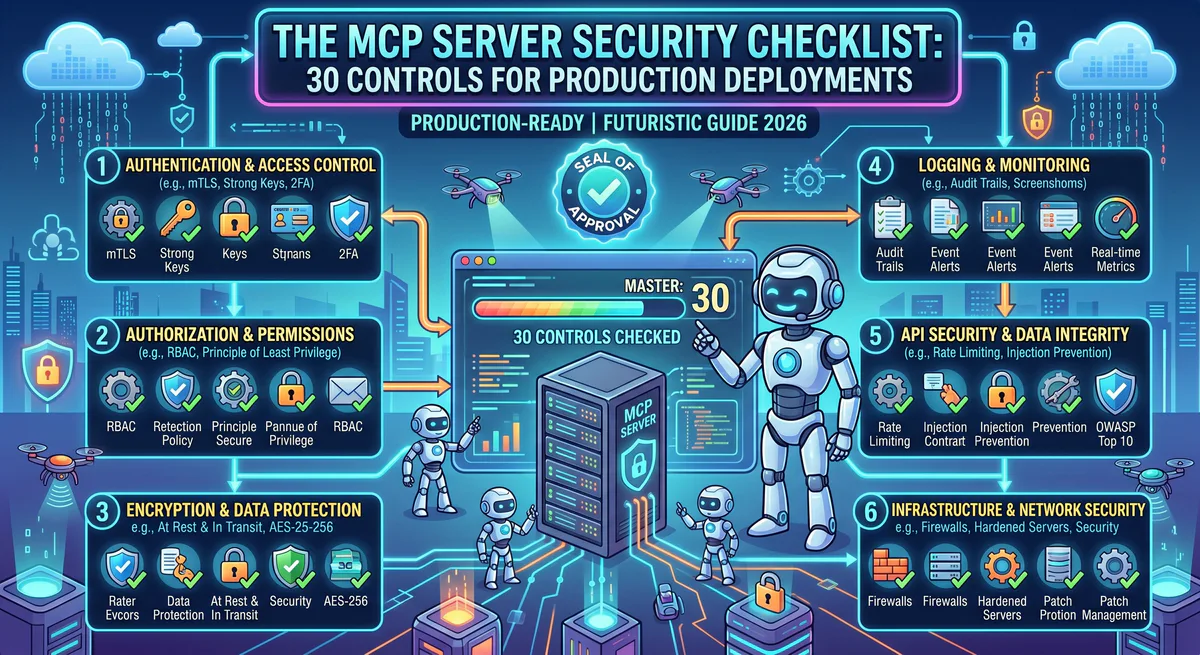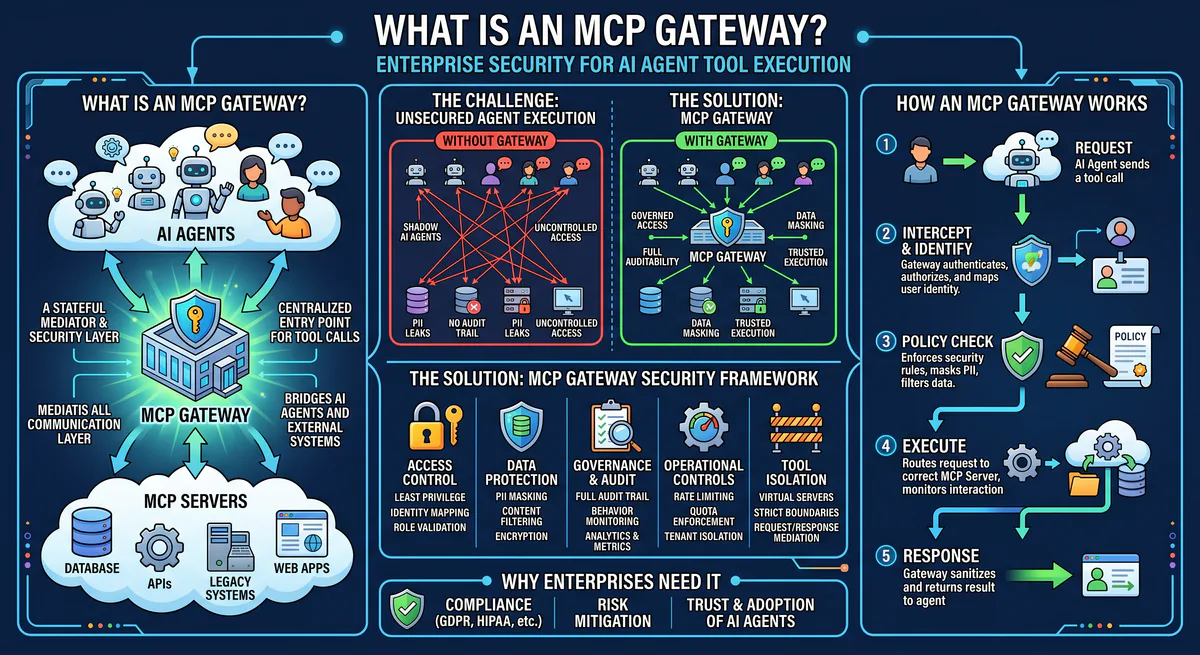
An MCP gateway is a security and governance proxy that routes traffic between AI agents (MCP clients) and the tools they call (MCP servers). It intercepts JSON-RPC messages, checks authorization tokens, executes outbound data loss prevention filters, and records every request in an immutable audit log.
Standardizing integrations via the Model Context Protocol (MCP) provides models with direct access to backend systems. However, this access introduces risks like credential theft, prompt injection exploits, and unauthorized database writes.
If MCP acts as a connection interface for AI models, the gateway functions as a firewall, credential vault, and traffic monitor. Connecting an autonomous model directly to database networks without proxy protection exposes production systems to high-risk exploits.
Here is a breakdown of how an MCP gateway protects enterprise networks.
Why Do Enterprise AI Agent Deployments Require an MCP Gateway?
Enterprise AI agent deployments require an MCP gateway to establish a secure boundary between models and production networks. Without this proxy layer, agents execute API calls with unmediated credential access, exposing databases, customer records, and code repositories to critical vulnerabilities like prompt injections and unauthorized data exfiltration.
Deploying MCP tools without a proxy layer exposes three major system vulnerabilities:
- Plain-Text Credential Leaks: Local configurations like
claude_desktop_config.jsonstore API tokens in plain text. A successful prompt injection can command the model to read its own configuration files and output those keys to external servers. - Unchecked Write Operations: Models connected to database servers can run
DELETEqueries or request large financial transfers without human approval. - Undocumented Tool Calls: Standard MCP installations do not maintain hash-chained audit trails. If a model modifies database values, developers cannot trace the execution context or determine which prompt triggered the change.
How Does an MCP Gateway Pipeline Enforce Security Policies on Tool Calls?
An MCP gateway pipeline intercepts JSON-RPC messages to verify authentication tokens, run semantic classification, and apply data loss prevention (DLP) filters. By auditing inputs and outputs before they execute, the gateway blocks destructive actions, redacts sensitive payload variables, and registers every call in an immutable cryptographic audit log.
Every tool request passes through an execution pipeline before reaching the destination tool:
[AI Host / Agent Client]
         —
         ? (JSON-RPC tool call request)
[MCP Security Gateway]
   +-- 1. Scoped Token Verification
   +-- 2. Semantic Intent Classification
   +-- 3. Data Loss Prevention (DLP) Scan
   +-- 4. Access Control List Validation
         —
         ? (Forwarded secure payload)
[Target MCP Server Tool]
The Seven Core Pipeline Operations
- Token Verification: The gateway evaluates incoming tokens to verify execution scopes, expiration timelines, and rate limits. API keys remain vaulted inside the gateway, so the model never consumes raw credentials.
- Intent Classification: The gateway analyzes the semantic structure of the tool call to categorize actions:
| Action Class | Call Example | Default Security Policy |
|---|---|---|
| Read Only | database.query.select | Allow execution |
| Write / Edit | github.issue.create | Allow with log registration |
| Destructive | stripe.refund.create | Block and request human approval |
| Exfiltrative | hubspot.contacts.export | Block and trigger admin review |
- Data Loss Prevention (DLP): An outbound filter inspects the data payloads returned by the tools. Credit card numbers, password hashes, and database secrets are redacted before they reach the model’s context window.
- Access Control Lists (ACL): Administrators assign permission roles to specific agents. For example, a developer agent has access to GitHub and Sentry tools, but is blocked from accessing Stripe or billing databases.
- Cryptographic Logs: Every transaction generates a hash-chained log entry, linking the caller’s identity, the target tool parameters, and the response payload size. Tampering with any log entry breaks the hash chain, exposing the alteration.
- Rate Limiting: The gateway tracks request volumes per client to prevent execution loops from consuming API budgets.
- Emergency revoking: Administrators can terminate all connection paths instantly using a centralized kill switch.
What Are the Key Vulnerabilities of Operating MCP Servers Without a Gateway?
Operating MCP servers without a gateway exposes systems to plain-text credential leaks, unchecked write or delete operations, and unmonitored execution paths. Without proxy isolation, compromised models automatically follow prompt injection instructions, allowing attackers to access databases, extract API tokens, and execute destructive database queries without generating audit records.
Three common exploits occur in unmanaged MCP environments:
- Prompt Injection Hijacking: A model parses an external email containing hidden commands. The commands instruct the agent to run database queries and export the results to an external webhook.
- Unverified Third-Party Code: Developers install unvetted MCP servers from public repositories, allowing malicious code to run directly inside their local workspace.
- Accidental Deletions: An agent tasked with cleanup deletes directory structures or databases because there is no policy filter blocking broad write commands.
How Does an MCP Gateway Compare to a Traditional API Gateway?
Traditional API gateways route developer-to-API traffic using URL paths and request headers. In contrast, MCP gateways interpret non-deterministic, agentic tool requests by executing deep semantic payload checks, detecting sensitive variables inside unstructured data fields, and vaulting API credentials so the model never consumes raw keys directly.
Traditional gateways are not designed to analyze agentic interactions:
| Feature | Traditional API Gateway | MCP Security Gateway |
|---|---|---|
| Core Protocol | REST HTTP, GraphQL | JSON-RPC 2.0 (stdio, SSE) |
| Traffic Type | Static client-to-API | Non-deterministic agent-to-tool |
| Inspection Scope | Header values, URL paths | Semantic payloads, unstructured text |
| Data Protection | Basic string matching | Context-aware PII and secret redaction |
| Credential Management | Token forwarding | Token vaulting and edge proxying |
| Audit Focus | HTTP access status codes | Hash-chained execution tracking |
Traditional tools act as traffic routing gates. MCP gateways act as semantic firewalls that evaluate what the AI model is trying to do before allowing the payload to execute.
What Features Should You Evaluate When Selecting an MCP Gateway?
When selecting an MCP gateway, verify that the platform isolates credentials, runs semantic intent analysis, applies real-time data loss prevention, and writes immutable cryptographic audit trails. The system must support role-based access control, enforce request rate limits, and provide immediate revocation kill switches for compromised agent tokens.
An enterprise-ready gateway must satisfy these requirements:
- Isolated Runtime Execution: Host third-party server code inside sandboxed V8 isolates, blocking path-traversal attacks and unauthorized local file system read operations.
- Dynamic Policy Enforcement: Configure rules that trigger human-in-the-loop approvals based on the cost, scale, or destination of the tool call.
- Transport Flexibility: Support local stdio connections along with remote HTTP/SSE transports to secure hybrid local and cloud agent fleets.
- Platform Agnosticism: Integrate with any LLM client (Claude Desktop, Cursor, Custom SDKs) and any model provider.
FAQs: Choosing the Best MCP Server Platform for Your Team
Integrating travel systems via MCP requires structured API clients, sandboxed V8 runtimes, and immutable audit logs. Implementing these tools prevents data exfiltration, redacts passenger details, and allows administrators to immediately disconnect compromised servers using centralized connection kill switches.
Why do tool integrators need cryptographic audits?
Without cryptographic signatures and hash-chaining, standard database logs can be mutated, leaving security teams unable to prove that a specific agent was responsible for an unauthorized API call.
How does Vinkius isolate third-party MCP code?
Vinkius routes execution through ephemeral V8 isolates. The code is isolated from local system processes and the host filesystem, preventing path-traversal attacks and malicious resource hijacking.
What is the difference between an inference gateway and an execution gateway?
An inference gateway handles prompts, token limits, and LLM availability on the inbound path. An execution gateway handles stateful JSON-RPC commands, data loss prevention, sandboxing, and access controls on the outbound path.
How does Vinkius handle agentic budget overruns?
Vinkius utilizes a sliding-window financial circuit breaker linked to client accounts. If an agent swarm runs into an execution loop and exceeds a set budget, the circuit trips and requires manual administrative reset.
Can Vinkius convert OpenAPI specs into MCP servers?
Yes. Vinkius provides an automated OpenAPI import utility that translates standard Swagger and OpenAPI JSON manifests into functional, sandboxed MCP servers instantly.
What Is an MCP Gateway? AI Security Layer Explained Setup Steps
- Select your tools in our App Catalog.
- Connect to the endpoints:
- Copy the secure URLs into Claude, Cursor, or ChatGPT to start querying.
Related Guides
- MCP API Key Management ? — Vaulting secrets in agent systems
- Fleet Intelligence Recipe ? — Connecting maps, fleet APIs, and messaging tools securely
- E-Commerce MCP Servers ? — Shopify and WooCommerce integrations
- The Complete MCP Server Directory ? — Database of 2,500+ tools
Build Secure Pipelines for What Is an MCP Gateway? AI Security Layer Explained
Host your tool connections behind a secure, monitored execution gateway. The integrations above establish the foundational connection layer.
Need custom security configurations or self-hosted enterprise options? Contact support@vinkius.com.
Analyze with AI
Send this article directly to your preferred AI to analyze concepts, extract actionable insights, or seamlessly integrate into your own projects.
Connect AI agents to your entire stack.
Browse ready-to-use MCP servers. Paste one URL to connect live databases, APIs, and business tools instantly.