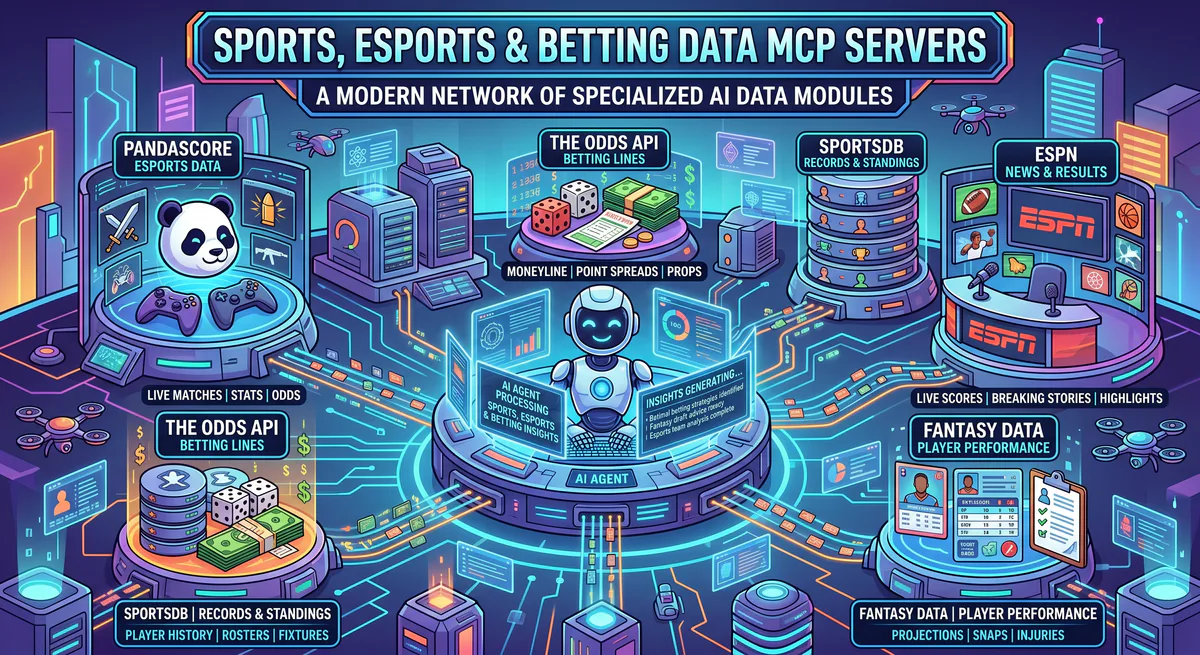
The global sports betting market has grown rapidly, driven by an technological arms race: sportsbooks use algorithmic models to set odds, and sophisticated bettors use AI to identify market discrepancies. The advantage goes to whoever has faster data, faster analysis, and deeper cross-platform intelligence.
Let’s be real: sports media, fantasy sports, and eSports are all being refactored by AI agents that can consume, correlate, and analyze data from multiple sources simultaneously — a task that is impossible for human analysts to replicate across hundreds of live games and data feeds.
Connecting your AI to the world’s sports and betting data infrastructure allows you to build sophisticated research models:
“Compare the odds for today’s Champions League matches across 5 bookmakers. Flag any where the implied probability differs by more than 3%. Show me the head-to-head stats. What’s the best value bet?”
One prompt. Multiple data sources. The kind of cross-platform analysis that professional sports analysts spend hours compiling — delivered in seconds. We host these servers in our App Catalog.
Why Do Sports Tech Teams Require Unified Sports Data MCP Connections?
Sports tech teams require unified sports data MCP connections to eliminate latency in data collection and aggregate disparate statistics across multiple bookmakers. Connecting AI agents directly to sports databases enables real-time odds comparison, instant roster updates, and cross-league performance correlations within a single automated pipeline.
The sports and eSports MCP directory lists the active integrations available for connecting your AI client directly to betting and performance APIs:
| Platform | MCP Server | Coverage | Primary Use Case |
|---|---|---|---|
| PandaScore | PandaScore MCP | LoL, CS2, Dota 2, Valorant, 20+ titles | eSports live data, match history, player stats |
| The Odds API | The Odds API MCP | 35+ sports, 80+ bookmakers | Real-time odds from every major sportsbook |
| TheSportsDB | TheSportsDB MCP | 400+ leagues worldwide | Team info, schedules, results, media |
| API-Football | API-Football MCP | 900+ leagues, live scores | Football and soccer analytics data |
| FantasyData | FantasyData MCP | NFL, NBA, MLB, NHL, MLS, CFB | Player projections, fantasy scoring, DFS |
| Broadage Sports | Broadage Sports MCP | Multi-sport coverage | Pre-match and live statistics |
| API Futebol | API Futebol MCP | Brazilian football (Série A/B/C/D) | Brazilian league analytics |
| SportsDB | SportsDB MCP | Multi-sport reference | Sports reference data |
| VSPN eSports | VSPN eSports DB MCP | APAC eSports | Asian eSports data |
| Cartola FC | Cartola FC MCP | Brazilian fantasy football | Fantasy league data |
How Do You Perform Cross-Bookmaker Betting Odds Analysis?
Performing cross-bookmaker betting odds analysis requires querying live APIs like The Odds API to compare implied probabilities against historical match statistics. An AI agent using MCP can automate this calculations, identifying value bets where a bookmaker’s pricing underestimates a team’s statistical home form.
The Odds API provides real-time odds from 80+ bookmakers. When combined with sports statistics from TheSportsDB or API-Football, the AI can identify value bets — matches where the bookmaker’s implied probability differs significantly from the statistical probability.
Real-World Workflow: Today’s Best Value
Here is the thing: a sports analyst can prompt the agent to audit matches on demand.
“Show me all Champions League matches today. Compare odds across the top 5 bookmakers. Calculate implied probability for each outcome. Flag the best value bet based on home/away form from the last 10 matches.”
The AI queries the database and generates:
“Champions League matches:
Match 1: Real Madrid vs. Bayern Munich (21:00 CET)
| Outcome | bet365 | Betfair | DraftKings | FanDuel | BetMGM | Avg Implied Prob |
|---|---|---|---|---|---|---|
| Real Madrid Win | 2.20 | 2.25 | 2.15 | 2.18 | 2.30 | 45.2% |
| Draw | 3.40 | 3.50 | 3.30 | 3.45 | 3.40 | 29.6% |
| Bayern Munich Win | 3.10 | 2.95 | 3.25 | 3.10 | 2.90 | 32.8% |
Statistical analysis (last 10 matches — API-Football):
- Real Madrid home form: W7 D2 L1 (70% win rate, 1.9 goals/game)
- Bayern Munich away form: W5 D3 L2 (50% win rate, 1.6 goals/game)
- H2H (last 6 meetings): Real Madrid 3W, Bayern 2W, 1D
Value assessment:
- Real Madrid win at BetMGM (2.30, implied 43.5%) vs. statistical probability (~55% based on form + H2H) ? VALUE Edge. The odds underrate Real Madrid’s home advantage by ~11.5 percentage points.
- Bayern win at Betfair (2.95, implied 33.9%) vs. statistical probability (~25%).
Recommendation: Real Madrid win at BetMGM (2.30) offers the best value with a 11.5% edge over implied probability.”
This combines The Odds API (real-time odds), API-Football (match statistics), and the AI’s ability to calculate implied probabilities. No single betting site provides this cross-platform view.
How Does PandaScore MCP Automate Live eSports Analytics?
The PandaScore MCP automates live eSports analytics by feeding granular match telemetry, team histories, and player performance metrics directly into your AI client. This allows analysts to run map pool win-rate calculations, track in-game kill-death ratios, and generate match predictions for tournaments.
eSports is a rapidly expanding segment. PandaScore covers 20+ titles with granular match data. The PandaScore MCP gives your AI access to live matches, player statistics, team histories, and tournament brackets.
Real-World Workflow: CS2 Pre-Match Intelligence
The analyst prompts:
“NAVI vs. FaZe in the IEM Katowice semi-final tomorrow. Give me a complete pre-match analysis: recent form, head-to-head, map pool analysis, and each player’s rating.”
The AI queries the PandaScore server:
“CS2 Pre-Match Intel — NAVI vs. FaZe Clan (IEM Katowice Semi-Final):
Recent form (last 10 matches):
- NAVI: 8W 2L (80%) — on a 5-match winning streak
- FaZe: 6W 4L (60%) — lost 3 of last 5 vs. top-10 teams
Head-to-head: 4 matches played — NAVI 3W, FaZe 1W
Map pool analysis:
| Map | NAVI Win% | FaZe Win% | Advantage | Likely ban |
|---|---|---|---|---|
| Mirage | 78% | 62% | NAVI +16% | FaZe bans |
| Inferno | 71% | 74% | FaZe +3% | NAVI bans |
| Anubis | 82% | 55% | NAVI +27% | NAVI picks |
| Nuke | 45% | 68% | FaZe +23% | FaZe picks |
| Dust2 | 65% | 60% | Neutral | Decider |
Key players:
| Player | Team | Rating | K/D | Impact | Clutch% |
|---|---|---|---|---|---|
| s1mple | NAVI | 1.31 | 1.42 | 1.45 | 12.8% |
| ropz | FaZe | 1.18 | 1.24 | 1.22 | 9.4% |
| b1t | NAVI | 1.15 | 1.19 | 1.18 | 8.2% |
| broky | FaZe | 1.14 | 1.18 | 1.15 | 7.8% |
Prediction: NAVI favored 65-35%. Their Anubis dominance (+27% win rate over FaZe) gives them a strong pick advantage. s1mple’s form (1.31 rating) is decisive.”
How Do You Optimize Fantasy Lineups Using Player Projections?
Optimizing fantasy lineups using player projections requires calculating weekly projection models against salary caps using platforms like FantasyData. By connecting this data to an AI agent, developers can build contrarian tournament lineups with low projected ownership percentages to maximize leverage in daily contests.
The short version: FantasyData provides player projections, injury reports, and fantasy scoring data. The FantasyData MCP turns your AI into a fantasy sports research assistant.
Real-World Workflow: NFL Week Lineup Optimization
The user prompts:
“Build me the optimal DraftKings lineup for NFL Week 6. Budget: $50,000. Include projected points, ownership percentages, and ceiling scores. I want a contrarian build with low ownership.”
The AI outputs:
“DraftKings NFL Week 6 — Contrarian Lineup:
| Position | Player | Salary | Proj. Pts | Ceiling | Ownership | Rationale |
|---|---|---|---|---|---|---|
| QB | Jalen Hurts | $7,800 | 22.4 | 34.2 | 8% | Rushing upside vs. weak front |
| RB1 | De’Von Achane | $7,200 | 18.1 | 29.5 | 12% | Matchup-proof, dual-threat |
| RB2 | Zack Moss | $5,400 | 14.8 | 22.3 | 4% | Workhorse role, goal-line back |
| WR1 | Drake London | $6,800 | 17.2 | 28.4 | 6% | Target monster, low ownership |
| WR2 | Jaxon Smith-Njigba | $5,600 | 14.5 | 24.1 | 3% | Emerging WR1, contrarian play |
| WR3 | Adonai Mitchell | $4,200 | 11.8 | 20.6 | 2% | Deep threat, tournament upside |
| TE | Sam LaPorta | $5,200 | 13.2 | 21.8 | 7% | Top-5 target share TE |
| FLEX | Bucky Irving | $4,800 | 12.4 | 19.7 | 5% | Increasing snap count |
| DST | Texans | $3,000 | 8.5 | 18.0 | 4% | Facing turnover-prone QB |
Total salary: $50,000 / $50,000 | Projected: 132.9 pts | Ceiling: 218.6 pts Average ownership: 5.7% (highly contrarian — tournament-ready)
Key leverage play: JSN (3% owned) vs. chalk WRs like CeeDee Lamb (28% owned). If JSN hits his ceiling, this lineup differentiates massively.”
How Do You Orchestrate Workflows Across Sports Databases?
You orchestrate workflows across sports databases by utilizing an AI agent to route queries across multiple integrations like API-Football and Broadage. This setup enables developers to automate live score updates, sync player injury reports to shared communication channels, and manage historical tournament databases.
— and this matters — because it changes sports analysis from a manual compilation task into a structured conversation.
Here are the typical workflows that can be run:
| Workflow | Tools Combined | What You Ask |
|---|---|---|
| Cross-bookmaker odds comparison | The Odds API + API-Football | ”Best value bets for today’s Premier League matches” |
| eSports tournament preview | PandaScore + TheSportsDB | ”Full pre-match analysis for this weekend’s LoL Worlds” |
| Fantasy lineup optimization | FantasyData + API-Football | ”Build the optimal DraftKings lineup for Week 6” |
| Live match intelligence | API-Football + Slack | ”Post live score updates and key stats to #sports” |
| Brazilian football analytics | API Futebol + API-Football | ”Compare Série A team performance with South American qualifiers” |
| Betting bankroll management | The Odds API + Google Sheets | ”Track my betting record, ROI, and bankroll in Sheets” |
How Do You Implement Compliance and Safety in Sports Betting Data?
Implementing compliance and safety in sports betting data requires routing queries through a gateway that enforces read-only access and logs telemetry requests. This setup prevents automated betting execution, restricts insights to regulated regions, and protects API keys behind server-side credential vaults.
Sports betting and gambling are regulated activities. Our platform does not execute bets. The MCP servers provide data and analysis only — the human decides whether and where to place a bet.
- No automated betting execution — analysis and intelligence only.
- Age-gated content — betting-related insights should be consumed by adults in jurisdictions where sports betting is legal.
- Responsible gambling — if you or someone you know has a gambling problem, contact the National Council on Problem Gambling (1-800-522-4700).
- All API credentials are stored in an encrypted vault.
- Audit trail on all queries.
Compare how a local configuration exposes raw API keys compared to a secure gateway URL.
Local configuration (unsafe plaintext file):
{
  "mcpServers": {
    "the-odds-api": {
      "command": "node",
      "args": ["dist/index.js"],
      "env": {
        "THE_ODDS_API_KEY": "1a2b3c4d5e6f7g8h9i0j"
      }
    }
  }
}
Remote configuration (secure gateway url):
{
  "mcpServers": {
    "the-odds-api": {
      "url": "https://mcp.vinkius.com/token-xyz890/the-odds-api"
    }
  }
}
How Do You Connect Sports Data MCP Servers to Your AI Client?
You connect sports data MCP servers to your AI client by subscribing to preferred platform feeds in our catalog, copying the connection endpoint URLs, and updating your local client configuration. This routes all tool calls through a secure gateway proxy, removing the need for manual API coding.
Here is the setup flow:
- Go to our App Catalog.
- Subscribe to your data sources:
- Copy URLs and paste them into Claude, Cursor, or ChatGPT.
- Start analyzing.
Related Guides
- Crypto & DeFi MCP Servers — Binance, Coinbase, Kraken
- Database MCP Servers — Supabase, PostgreSQL, MongoDB
- Communication MCP Servers — Post updates to Slack
- The Complete MCP Server Directory — 2,500+ apps
FAQs: Choosing and Running Betting Data MCP Servers
Addressing concerns about data accuracy, feed latency, API access keys, and multi-user configurations helps teams integrate betting tools safely. Consolidating sports databases at a secure gateway allows developers to query real-time match stats without violating platform terms of service or exposing plaintext tokens.
Can I place actual bets automatically using these MCP servers?
No. To comply with licensing laws and promote responsible gaming, sports betting MCP servers are strictly read-only. They supply odds and historical data, but do not support financial transactions or automatic bet execution.
How is feed latency managed for live in-game betting analysis?
The Odds API and Broadage Sports servers support real-time streaming updates. When routed through a remote proxy, typical protocol transit adds 20-100ms, which fits well within standard in-game betting update windows.
Do these integrations cover player statistics for fantasy leagues?
Yes. Servers like FantasyData and API-Football feed player projection metrics, historical game scoring, and active injury statuses directly into your AI client, enabling automated lineup updates.
How does the gateway secure premium API tokens from unauthorized users?
The gateway stores API keys in an encrypted vault. Instead of copying keys to local developer configuration files, the AI client accesses the integration using a proxy token with custom query limits.
Can I build custom odds-compiling scripts using these feeds?
Yes. By connecting these servers to your AI assistant, you can write natural language prompts to calculate implied probabilities, identify arbitrage opportunities, and test prediction models.
Analyze with AI
Send this article directly to your preferred AI to analyze concepts, extract actionable insights, or seamlessly integrate into your own projects.
Connect AI agents to your entire stack.
Browse ready-to-use MCP servers. Paste one URL to connect live databases, APIs, and business tools instantly.