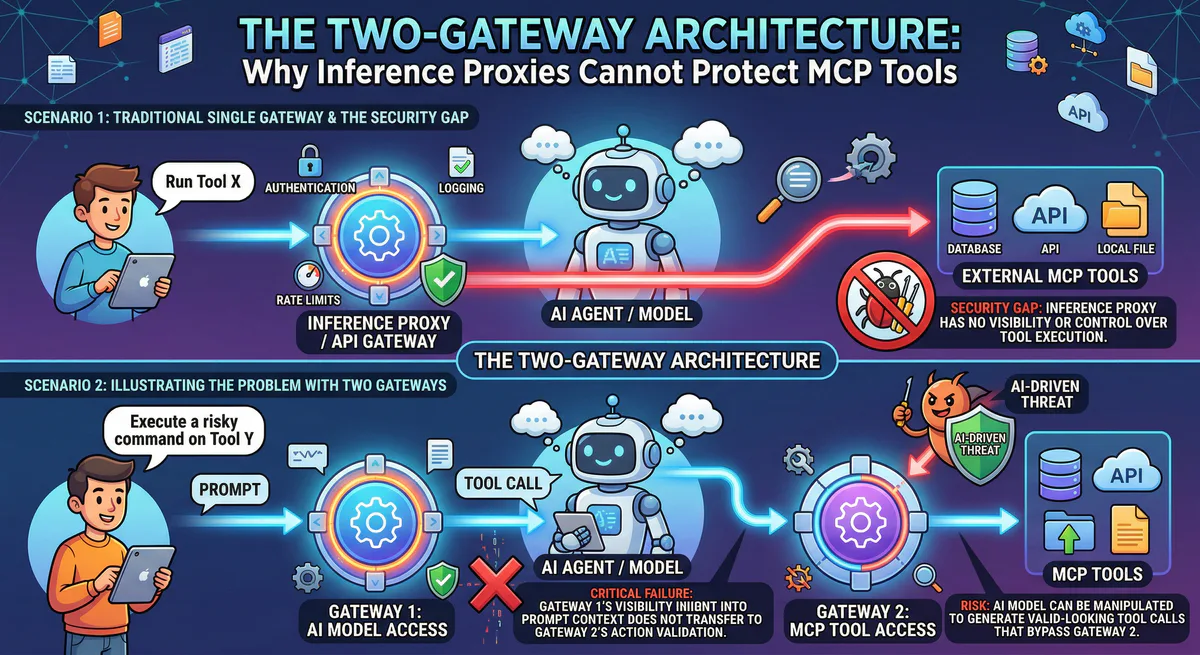
The standardization of the Model Context Protocol (MCP) in 2025 triggered a hidden infrastructure crisis. By 2026, enterprise architecture teams realized that an AI Agent is split into two distinct operational vectors: the “Brain” and the “Hands”.
Attempting to govern both vectors with a single piece of infrastructure has been a failure. Senior architectural circles have crystallized a new paradigm to solve this: The Two-Gateway Architecture.
To secure an autonomous agent, you must decouple the infrastructure securing its intelligence from the infrastructure securing its actions. If you attempt to force stateful, bidirectional JSON-RPC tool traffic through an Inference Gateway, or force LLM prompt caching through an Execution Gateway, your architecture is structurally compromised.
This deep dive exposes why the legacy approach of routing everything through standard AWS API Gateways fails, defines the modern split between Inference Gateways (like Cloudflare AI Gateway) and Execution Gateways (like Vinkius Edge), and dissects the technological advantages of Vinkius for MCP capability governance.
What is the Difference Between the Inference Path and the Execution Path?
The Inference Path (the Brain) routes stateless HTTP prompts to cognitive models to determine agent behavior, requiring token caching and model routing. The Execution Path (the Hands) routes stateful JSON-RPC commands to physical tools and databases, requiring sandbox isolation, role-based access controls, and data loss prevention filters.
An enterprise AI Agent requires two network paths:
- The Inference Path (The Brain): The Agent sends a prompt to an LLM (e.g., Anthropic, OpenAI) to ask, “What should I do next?” This traffic is largely stateless HTTP REST (
/v1/chat/completions). It handles massive token payloads and requires caching, load balancing, and model routing. - The Execution Path (The Hands): The Agent has decided on an action. It uses MCP (via Streamable HTTP or SSE) to tell your backend, “Drop the users table”. This traffic is stateful JSON-RPC 2.0. It requires strict RBAC, data redaction (DLP), and sandboxed compute environments.
A gateway built for the Brain is entirely blind to the Hands.
Why Do Inference Gateways and API Proxies Fail to Secure MCP Tools?
Inference gateways and API proxies fail to secure MCP tools because they cannot inspect JSON-RPC payloads, enforce execution sandboxing, or manage long-running data streams. Generic API gateways enforce low timeouts and lack the capacity to intercept or redact sensitive data before it reaches external language models.
Look, let’s be real: when evaluating infrastructure for Agents, engineering teams must deploy the right proxy for the right vector.
Cloudflare AI Gateway: The King of Inference
Cloudflare AI Gateway is the industry standard for Inference Observability. It sits exclusively on the Inference Path. If your Agent needs to route a prompt to OpenAI, fallback to Anthropic if OpenAI is down, or cache a semantic query to save money, Cloudflare is the tool you use.
The Misunderstanding: The industry consistently makes the mistake of assuming Cloudflare AI Gateway evaluates MCP traffic. It does not. Cloudflare AI Gateway sits in front of the LLM, not in front of your internal infrastructure. If your Agent sends a tools/call JSON-RPC payload to your database via MCP, Cloudflare views it as generic transparent bytes. It cannot parse the custom JSON-RPC schema to enforce tool execution validation.
How Do AWS, Cloudflare, and Vinkius Compare for Agent Security?
AWS API Gateway enforces strict execution timeouts and payload limits that break agentic streams, while Cloudflare AI Gateway focuses solely on caching inference tokens. Vinkius functions as a dedicated execution gateway, sandboxing tool execution within secure V8 isolates and intercepting payloads to sanitize sensitive customer data.
AWS attempts to handle both the Brain and the Hands using its legacy API Gateway and the newer Bedrock AgentCore Runtime.
- The Stream Collapse: AWS API Gateway enforces a 29-second integration timeout. It completely lacks native support for persistent Streamable HTTP or multiplexed SSE. Autonomous agents frequently spawn multi-step asynchronous processes that stream progress notifications back to their orchestrator. AWS severs these streams arbitrarily, forcing the Agent’s reasoning engine to hallucinate the result of a process it assumes survived.
- The 64 KB Command Chokehold: AWS Bedrock introduces a constraint: a 64 KB limit on command payloads for the Agent-to-Agent (A2A) protocol. Deploying a complete, detailed MCP server on AgentCore routinely triggers
ValidationExceptionerrors because modern schema manifests exceed the physical transport capabilities of the AWS router. - Data Blindness: Because the API Gateway maps HTTP calls to Lambda blindly, it cannot inspect the egress JSON stream. If your database leaks a password hash, the Lambda function serializes it, the AWS API Gateway streams it, and the Agent ingests it as context.
How Does Vinkius Sandboxing and Egress Firewalls Protect Databases?
Vinkius sandboxing runs every MCP server in isolated V8 environments to block system filesystem access, while custom CPU guillotines terminate infinite loops. Egress firewalls inspect returning database payloads, redacting sensitive user information and PII in memory before the data crosses the network to the cognitive model.
If Cloudflare AI Gateway protects the LLM, our Vinkius AI Gateway protects your Enterprise.
We built Vinkius exclusively from the ground up to serve as the runtime engine for the Model Context Protocol standard. We do not proxy Inference tokens. We intercept the Streamable HTTP execution stream, hydrate a defense-grade environment, and enforce absolute control over the MCP tools your agents attempt to call.
1. V8 Isolate Sandboxing (Zero Attack Surface)
Every MCP server tool deployed to our gateway does not run in a standard Docker container or a raw Node.js script. It runs inside a mathematically sealed V8 JavaScript isolate. There is zero raw access to the global process object, no open fs filesystem handles, and no raw network bindings.
- The CPU Guillotine: Execution is hard-capped. Our custom Isolate monitors the CPU cycle count at the C++ level. If an executed MCP Tool enters an infinite sequence (e.g., a runaway regex or malicious payload), the execution is severed by a hardware guillotine at exactly 5 seconds.
- Dual-Stack SSRF Protection: If an agent calls a tool that fetches a URL, DNS is pre-resolved and IP-pinned across both the Node.js and internal PHP layers, making internal network port-scanning impossible.
2. Forensic Auditing (Mathematically Tamper-Proof)
If an AI Agent executes a tool that drops a database table, your CISO will ask: “Can you mathematically prove the Agent ordered this action?” AWS and Cloudflare can only offer basic text logs.
Every stream, connection, and tool call routed through our infrastructure is serialized, hash-chained via SHA-256, and cryptographically signed with Ed25519 session keys. We maintain a 3-tier PKI hierarchy rotated every 24 hours. The audit trail is streamed in real-time to Splunk HEC or Datadog via Redis Streams. You can prove in a court of law exactly what the AI Agent did.
3. Stateful Hibernation in 3-5ms
Agents idle for long periods while the LLM generates tokens. In AWS Lambda, waiting for an LLM means paying for idle compute, or suffering 500ms+ cold starts when the Lambda drops.
Our Edge infrastructure implements V8 heap snapshot restoration. The exact millisecond the MCP tool’s internal execution pauses, the isolate is hibernated. Upon the next JSON-RPC tools/call traversing the Streamable HTTP pipe, the specific sandbox state-complete with memory variables, open SDK references, and finite state machine progress-is pulled from storage and restored to RAM in 3 to 5 milliseconds. You achieve serverless billing while maintaining the persistent session required by MCP.
4. In-Flight DLP (Egress Firewalls)
As established in our framework Vurb.ts, we operate the industry’s only real-time Egress Firewall.
When your backend database streams sensitive PII back to the agent, a standard gateway routes it directly to Anthropic or OpenAI as context. Our AI Gateway intercepts the payload, applies the schema-driven Presenter, and physically destroys the PII fields in RAM before they cross the outbound wire. The Agent’s context window receives [REDACTED]. Your own poorly configured tools cannot legally leak data to a third-party model.
How Do You Configure a Secure Two-Gateway Architecture?
You configure a secure two-gateway architecture by decoupling the token routing proxy from the action execution gateway. Inference paths query models via caching endpoints, while tool execution paths route JSON-RPC traffic through sandboxed gateways that log queries, redact data, and provide cryptographic kill switch tokens.
Here is the thing: separating these domains keeps credentials out of the model’s reach. Here is a configuration comparison:
Direct-to-LLM client tool calling setup (credentials in orchestrator context):
{
  "inference": {
    "model": "claude-3-5-sonnet",
    "apiKey": "sk-ant-sid123..."
  },
  "tools": {
    "database": {
      "host": "production-db.internal",
      "password": "plaintext_db_password"
    }
  }
}
Secure Two-Gateway Setup (Inference proxied via CF, tools isolated via Vinkius Gateway):
{
  "inference": {
    "provider": "cloudflare-ai-gateway",
    "endpoint": "https://gateway.ai.cloudflare.com/v1/vinkius/production",
    "token": "cf_token_abc123"
  },
  "execution": {
    "provider": "vinkius-gateway",
    "endpoint": "https://gateway.vinkius.com/session-xyz789",
    "token": "vnk_sec_789xyz"
  }
}
FAQs: Implementing the Two-Gateway Architecture for AI Agents
Implementing the two-gateway architecture protects enterprise systems by routing cognitive tokens and physical actions through distinct, specialized proxies. Using separate pathways guarantees that databases remain isolated, data loss prevention rules block outgoing leaks, and security teams can immediately terminate rogue agent sessions.
Why are local .env files unsafe for production AI agents?
Local .env files expose plaintext credentials directly to the executing code. If an agent is targeted by a prompt injection attack, the model can be manipulated into leaking these sensitive keys, whereas a secure gateway decouples credentials from the cognitive context.
What is the Confused Deputy problem in agentic architecture?
The Confused Deputy problem occurs when an MCP server executes actions blindly based on instructions from an LLM without checking limits or scopes. This allows a compromised or hallucinating agent to perform unauthorized mutations or database wipes.
How do ephemeral V8 Isolates protect agent integrations?
Vinkius runs each MCP server inside its own ephemeral V8 Isolate. This ensures that even if one server is compromised or contains a supply chain vulnerability, it cannot access other servers, system memory, or the wider network.
How does Agents-as-a-Service (AaaS) differ from standard SaaS?
Standard SaaS relies on human users interacting with graphical dashboards. Agents-as-a-Service (AaaS) uses headless, ultra-low latency semantic interfaces that allow autonomous AI systems to negotiate, exchange data, and execute tasks directly with other agents.
Can Vinkius integrate with enterprise security tools like CrowdStrike?
Yes. Vinkius provides hardened integrations for enterprise security suites, allowing teams to audit agent actions, monitor privilege levels, and stream telemetry data directly to Splunk or Datadog.
Analyze with AI
Send this article directly to your preferred AI to analyze concepts, extract actionable insights, or seamlessly integrate into your own projects.
Connect AI agents to your entire stack.
Browse ready-to-use MCP servers. Paste one URL to connect live databases, APIs, and business tools instantly.