
Strava Training MCP, Ready to Go
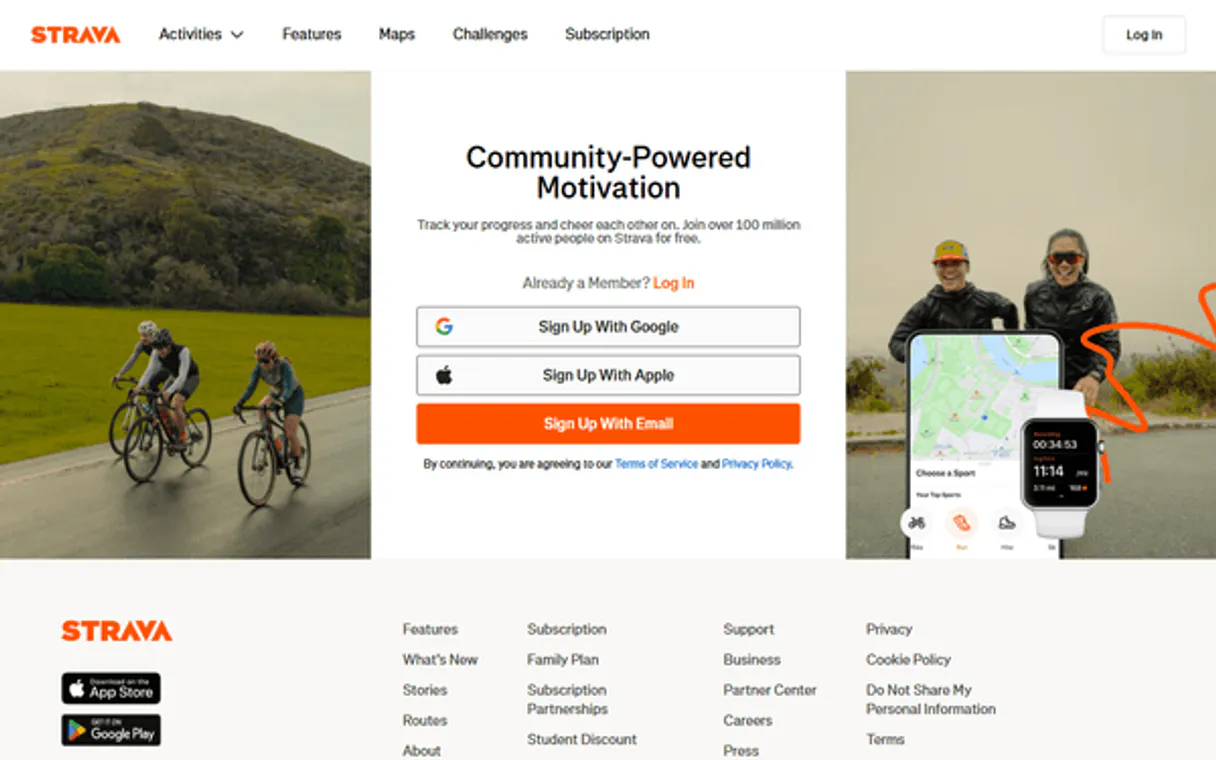
Use Strava Training MCP with Claude or Cursor to analyze your heart rate, power zones, and GPS data for better fitness results.
No credit card required. Experience the power of this integration risk-free.
Analyze your fitness data and training zones with deep Strava performance metrics.
Works with every AI agent you already use
…and any MCP-compatible client









How fast is the Strava Training Connector?
Average time for the server to become ready for requests over the last 14 days, measured until the initialize / tools/list handshake completes. Metrics are updated daily between 00:00 and 04:00 UTC. Create a free account, use this Connector on Vinkius Cloud, and connect it to your AI agent in seconds.
Waiting for input…
What AI agents can do with Strava Training MCP 12 Fitness Tools
Use these tools to analyze your heart rate, power zones, and GPS data for better fitness results.
Get activity laps
This pulls the distance, time, and pace for every lap in an activity. It helps you see if your effort stays consistent or where you start to fade.
Get activity streams
This fetches raw time-series data like heart rate, watts, and GPS coordinates. You can use it to see exactly how your power and speed interact during a workout.
Get activity zones
This shows your heart rate and power zone distribution for a specific activity. It helps you understand if you're hitting the correct intensity for your training goals.
Get athlete stats
This summarizes your recent and all-time totals for runs and rides. Use it to get a quick high-level overview of your fitness progress over time.
Get athlete zones
This retrieves your personal heart rate and power zone settings. It provides the necessary context for your agent to analyze your training intensity accurately.
Get gear
This provides details on your equipment mileage and models. You can use it to track wear and tear on your shoes or bikes to plan maintenance.
List segment efforts
This lists all your attempts on a specific Strava segment. It makes it easy to track your progress toward a personal record over several months.
Get segment
This pulls the distance, elevation, and grade for a specific segment. Use it to preview a route's difficulty before you head out.
Get segment effort
This shows the heart rate and power for a single segment attempt. It lets you compare your best efforts on a specific climb or road.
Get segment effort streams
This gets time-series data for a single segment effort. Use it to see exactly where your power peaked during a specific PR attempt.
Get segment streams
This pulls the elevation and grade profiles for a Strava segment. It helps you see the terrain layout and steepness patterns along a route.
Get activity
This retrieves the full set of metrics for a specific Strava activity. Use it as a starting point for a deep dive into a single workout.
A Connector is a URL. Vinkius runs it: hosting, security, governance, observability.
You're looking at one of 5,800+ managed Connectors. The real value isn't the catalog. It's the control plane that secures, governs, audits, and manages every interaction between your agents and the tools they use.
No Shadow AI
Every agent action is visible, approved, and auditable. Nothing runs outside your governance.
Absolute agent control
Fine-grained permissions for every agent, MCP, and tool. Instantly revoke access and audit every execution.
Cost control per token
Spend broken down to the token, tool, and agent. Budgets and hard limits. No surprise invoices.
Managed & monitored infra
We operate the runtime, authentication, scaling, retries, and monitoring. Your team manages AI, not infrastructure.
Data protection, DLP by design
Sensitive data is filtered before reaching the model. Access is governed so agents receive only the information they're allowed to use.
Token optimization, real savings
Lower AI costs by delivering the right context instead of unnecessary tools. Better accuracy, faster responses, and fewer wasted tokens.
Strava Training MCP for Solving Manual Fitness Data Entry
This is for endurance athletes who are tired of staring at messy spreadsheets and for coaches who need to see the why behind an athlete's plateau.
Endurance Coach
Analyzes athlete streams and zone data on Tuesday afternoons to build more accurate weekly training plans.
Cyclist
Tracks power data and gear mileage to plan out maintenance schedules and performance upgrades.
Marathon Runner
Checks lap splits and elevation profiles to identify exactly where their pace drops during long runs.
Frequently Asked Questions
Can Strava Training MCP help me see my power zones? +
Yes, it lets your agent pull your heart rate and power zone distribution for any specific workout. This helps you see if you're hitting the right intensity for your training goals.
How does Strava Training MCP handle my GPS data? +
It pulls raw time-series data including GPS coordinates, altitude, and speed. Your agent can use this to analyze your pace and movement patterns over time.
Can I use Strava Training MCP to track my bike maintenance? +
Yes, you can use it to see the mileage and models of your gear. This makes it easy to ask your agent when it might be time for new shoes or service your bike.
Does Strava Training MCP work for runners too? +
It works for any Strava activity. You can use it to analyze run laps, heart rate trends, and elevation profiles just as easily as cycling data.
How can Strava Training MCP help me with coaching? +
Coaches can use it to review athlete streams and segment efforts. It makes it much faster to provide data-driven feedback on an athlete's progress.
Can Strava Training MCP show me my personal records? +
Yes, your agent can list all your efforts on a specific segment. You can then ask it to compare your recent times to find your personal bests.
What data streams are available for activities? +
Available streams include: time, distance, latlng (GPS coordinates), altitude, velocity_smooth (speed), heartrate, cadence, watts (power), temp (temperature), moving (moving flag), and grade_smooth (incline %). Request specific streams with comma-separated types, e.g., "heartrate,watts,velocity_smooth". Not all streams are available for every activity — it depends on the recording device.
What are activity zones and how are they calculated? +
Activity zones show the time spent in each heart rate zone (Z1-Z5) or power zone during an activity. Zones are based on the athlete's personal zone configuration (set in Strava settings). Zone analysis reveals training intensity — whether a workout was aerobic (Z1-Z2), threshold (Z3), or anaerobic (Z4-Z5). This data requires a heart rate monitor or power meter.
How do I find my athlete ID on Strava? +
Your athlete ID is the numeric portion of your Strava profile URL. For example, from https://www.strava.com/athletes/12345678, your athlete ID is 12345678. You can also get it from the get_athlete tool in the Strava Planning or Strava Social Connectors.
Your AI, connected to everything.











No credit card required · Free tier available











Other Connectors in this category
DOD Contracts (FPDS) Connector
Search and analyze Department of Defense (DOD) and federal contracts via the FPDS Atom Feed directly from your AI agent.
Serper Connector
Perform fast Google searches. Audit web results, images, news, and places via AI.
PatentsView Connector
Universal US patent intelligence. Search patents, inventors, and assignees via AI.
Related Connectors
Geotab Connector
Automate fleet management via Geotab. Manage devices, track trips, and monitor vehicle diagnostics directly from any AI agent.
Baota Panel / 宝塔面板 API Connector
Leading server management panel in China. Manage websites, databases, and system resources via AI.

Marketing ROI Calculator Connector
Calculate marketing Return on Investment (ROI), payback period, and efficiency across all campaigns using detailed cost and revenue attribution.