
BattleMetrics MCP Server for Cursor 12 tools — connect in under 2 minutes
Cursor is an AI-first code editor built on VS Code that integrates LLM-powered coding assistance directly into the development workflow. Its Agent mode enables autonomous multi-step coding tasks, and MCP support lets agents access external data sources and APIs during code generation.
ASK AI ABOUT THIS MCP SERVER
Vinkius supports streamable HTTP and SSE.
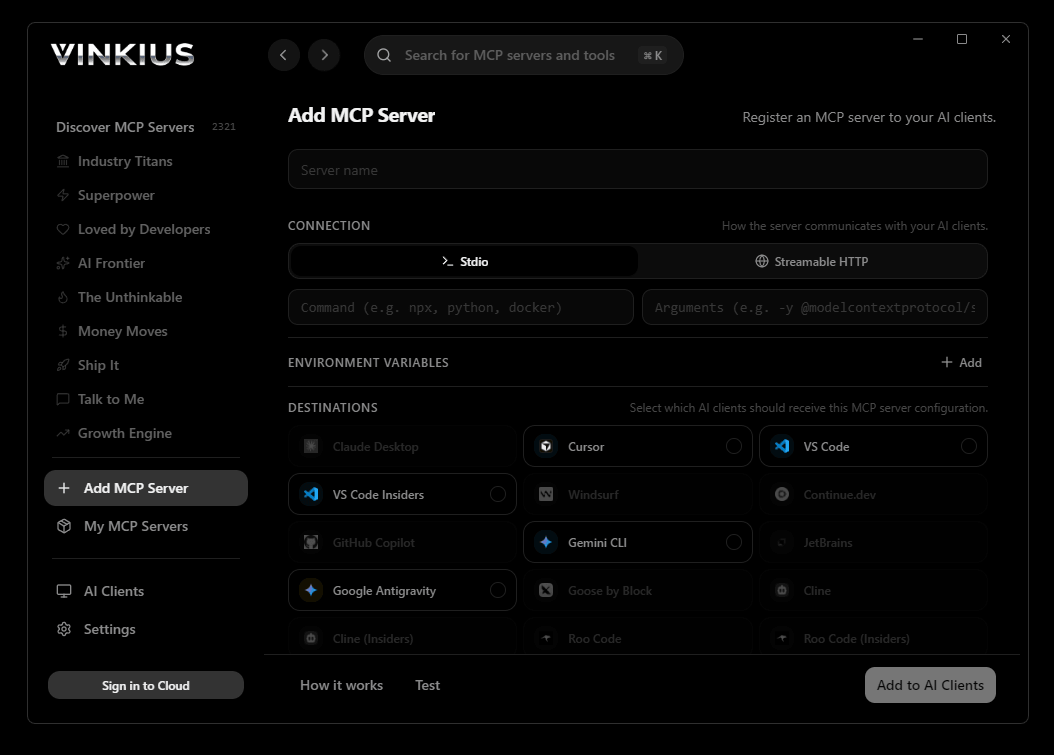
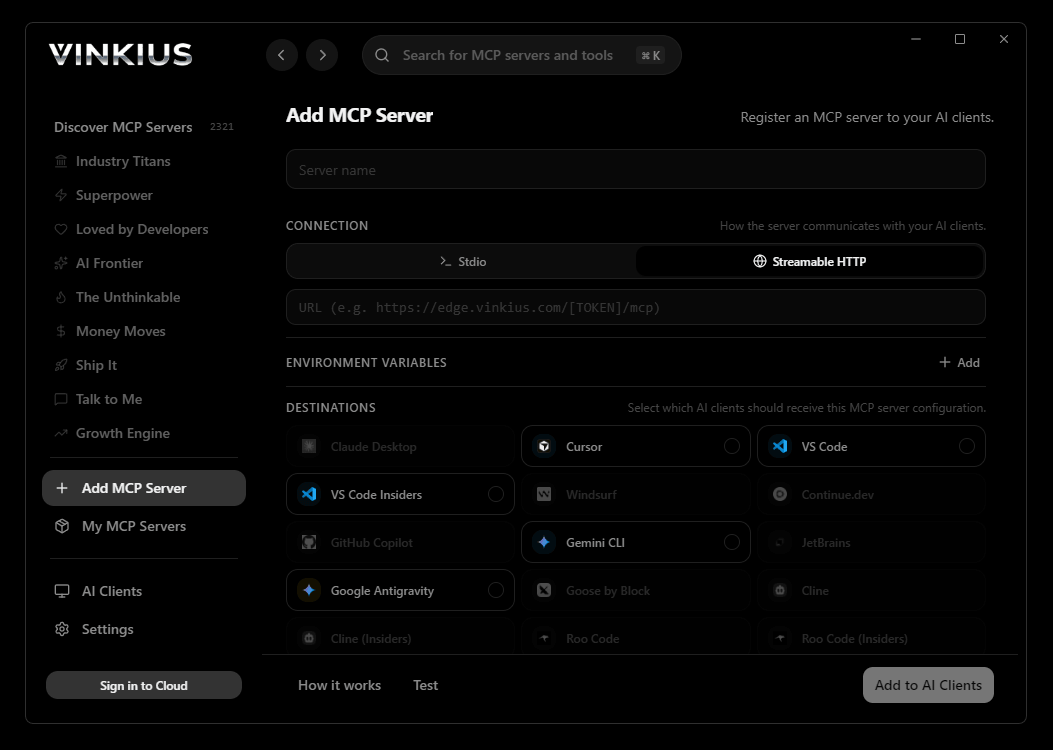
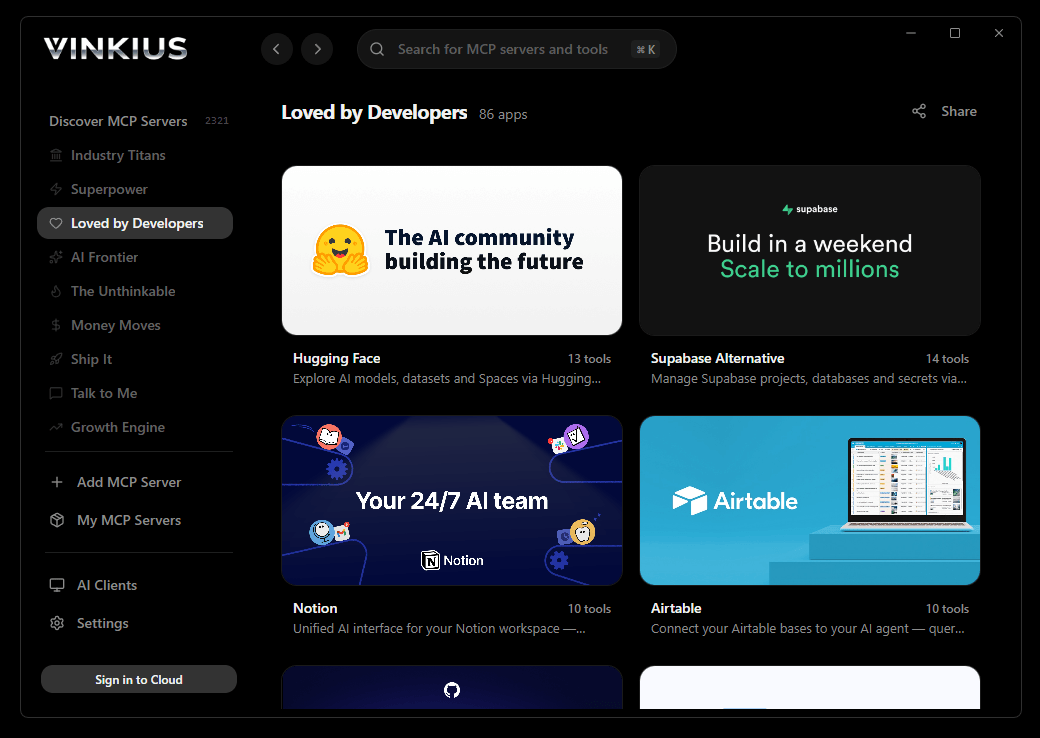
Vinkius Desktop App
The modern way to manage MCP Servers — no config files, no terminal commands. Install BattleMetrics and 2,500+ MCP Servers from a single visual interface.

{
  "mcpServers": {
    "battlemetrics": {
      "url": "https://edge.vinkius.com/[YOUR_TOKEN_HERE]/mcp"
    }
  }
}
* Every MCP server runs on Vinkius-managed infrastructure inside AWS - a purpose-built runtime with per-request V8 isolates, Ed25519 signed audit chains, and sub-40ms cold starts optimized for native MCP execution. See our infrastructure
About BattleMetrics MCP Server
Empower your AI agent to operate as a real-time intelligence layer over the global gaming server ecosystem with BattleMetrics, the industry-standard platform for game server monitoring. By connecting BattleMetrics to your agent, you transform complex server population analytics, player lookups, and ban auditing into natural conversation. Your agent can instantly search across thousands of tracked game servers, identify specific players, analyze population trends, and review ban records without navigating dashboards.
Cursor's Agent mode turns BattleMetrics into an in-editor superpower. Ask Cursor to generate code using live data from BattleMetrics and it fetches, processes, and writes. all in a single agentic loop. 12 tools appear alongside file editing and terminal access, creating a unified development environment grounded in real-time information.
What you can do
- Server Discovery — Search and filter game servers by name, game, or country. View live player counts, rank, IP address, and detailed metadata.
- Player Lookups — Search the global player database by name and retrieve full profiles including identifiers, playtime stats, and linked servers.
- Session Tracking — View a player's complete session history showing which servers they played on, join/leave times, and duration.
- Population Analytics — Retrieve historical player count data for any server to analyze peak hours, activity trends, and growth patterns.
- Ban Auditing — List and review bans from your organization, filter by server, and inspect ban reasons, scope, and expiry.
- Leaderboards — Access time-based leaderboards for any server to identify the most active players.
- Game Catalog — Browse all games tracked by BattleMetrics and get detailed ecosystem statistics.
The BattleMetrics MCP Server exposes 12 tools through the Vinkius. Connect it to Cursor in under two minutes — no API keys to rotate, no infrastructure to provision, no vendor lock-in. Your configuration, your data, your control.
How to Connect BattleMetrics to Cursor via MCP
Follow these steps to integrate the BattleMetrics MCP Server with Cursor.
Open MCP Settings
Press Cmd+Shift+P (macOS) or Ctrl+Shift+P (Windows/Linux) → search "MCP Settings"
Add the server config
Paste the JSON configuration above into the mcp.json file that opens
Save the file
Cursor will automatically detect the new MCP server
Start using BattleMetrics
Open Agent mode in chat and ask: "Using BattleMetrics, help me...". 12 tools available
Why Use Cursor with the BattleMetrics MCP Server
Cursor AI Code Editor provides unique advantages when paired with BattleMetrics through the Model Context Protocol.
Agent mode turns Cursor into an autonomous coding assistant that can read files, run commands, and call MCP tools without switching context
Cursor's Composer feature can generate entire files using real-time data fetched through MCP. no copy-pasting from external dashboards
MCP tools appear alongside built-in tools like file reading and terminal access, creating a unified agentic environment
VS Code extension compatibility means your existing workflow, keybindings, and extensions all work alongside MCP tools
BattleMetrics + Cursor Use Cases
Practical scenarios where Cursor combined with the BattleMetrics MCP Server delivers measurable value.
Code generation with live data: ask Cursor to generate a security report module using live DNS and subdomain data fetched through MCP
Automated documentation: have Cursor query your API's tool schemas and generate TypeScript interfaces or OpenAPI specs automatically
Infrastructure-as-code: Cursor can fetch domain configurations and generate corresponding Terraform or CloudFormation templates
Test scaffolding: ask Cursor to pull real API responses via MCP and generate unit test fixtures from actual data
BattleMetrics MCP Tools for Cursor (12)
These 12 tools become available when you connect BattleMetrics to Cursor via MCP:
get_ban
Returns the ban reason, banned player identifier, timestamps, expiry date, scope (server-level or organization-wide), and the administrator who issued the ban. Requires appropriate ban:read scope on the API token. Use this after identifying a ban ID from list_bans. Get details for a specific ban
get_game
Returns details such as the game name, the number of tracked servers and players, and game-specific metadata. Use this to get an overview of a game's ecosystem on BattleMetrics. Get details about a specific tracked game
get_player
Returns the player name, associated identifiers (Steam, EOS, etc.), time played statistics, linked servers, and recent activity. Use this after identifying a player ID from list_players or session history. Get detailed profile for a specific player
get_player_sessions
Each session shows which server the player was on, when they joined, when they left, and the session duration. Useful for auditing player activity, tracking playtime, or verifying presence on a specific server. Get session history for a specific player
get_server
Returns the server name, IP address, port, current player count, max players, rank, game details, map, status, and detailed metadata. Use this when the user already has a server ID and wants deep information. Get detailed information about a specific game server
get_server_leaderboard
Returns player names, IDs, and playtime duration. This is useful for identifying the most active or dedicated players on any tracked game server. Use page_number for pagination. Get the time-based leaderboard for a game server
get_server_player_count_history
Useful for analyzing population trends, peak hours, and server activity patterns over a given time range. If start and stop are omitted, the API returns recent history. Use ISO 8601 timestamps for the date range. Get player count history for a game server over time
list_bans
Each ban includes the ban reason, the banned player identifier, timestamps, expiry, and scope (server-level or organization-wide). Requires appropriate ban:read scope on the API token. Use page_number for pagination and optional server_id to filter bans from a specific server. List bans in your BattleMetrics organization
list_games
Returns each game's ID, display name, and metadata. Useful for discovering which games are available for server and player queries, and for getting the correct game identifier to use in server filters. List all games tracked by BattleMetrics
list_players
Use the search parameter to find players by name. Returns player names, IDs, and metadata. Results are paginated — use page_number to navigate. This is a powerful tool for looking up any player across all supported games. Search and list players across all tracked game servers
list_servers
Use the optional search parameter to find servers by name, or filter by game and country. Returns server name, IP, port, player count, rank, and game type. Results are paginated — use page_number to navigate through results. List game servers tracked by BattleMetrics
search_servers
Unlike the basic list_servers tool, this supports granular filtering by server name, game, country, minimum/maximum player count, rank range, and more. Returns matching servers with full metadata including name, IP, port, player count, rank, game type, map, and status. Use this when you need precise filtering to find specific servers. Results are paginated — use page_number to navigate. Search game servers with advanced filters
Example Prompts for BattleMetrics in Cursor
Ready-to-use prompts you can give your Cursor agent to start working with BattleMetrics immediately.
"Show me the most popular Rust servers in the US right now."
"Look up the player 'shroud' and show me their recent session history."
"Show me the player count trend for server ID 12345 over the last 7 days."
Troubleshooting BattleMetrics MCP Server with Cursor
Common issues when connecting BattleMetrics to Cursor through the Vinkius, and how to resolve them.
Tools not appearing in Cursor
Server shows as disconnected
BattleMetrics + Cursor FAQ
Common questions about integrating BattleMetrics MCP Server with Cursor.
What is Agent mode and why does it matter for MCP?
Where does Cursor store MCP configuration?
mcp.json file. You can configure servers at the project level (.cursor/mcp.json in your project root) or globally (~/.cursor/mcp.json). Project-level configs take precedence.Can Cursor use MCP tools in inline edits?
How do I verify MCP tools are loaded?
Connect BattleMetrics with your favorite client
Step-by-step setup guides for every MCP-compatible client and framework:
Anthropic's native desktop app for Claude with built-in MCP support.
AI-first code editor with integrated LLM-powered coding assistance.
GitHub Copilot in VS Code with Agent mode and MCP support.
Purpose-built IDE for agentic AI coding workflows.
Autonomous AI coding agent that runs inside VS Code.
Anthropic's agentic CLI for terminal-first development.
Python SDK for building production-grade OpenAI agent workflows.
Google's framework for building production AI agents.
Type-safe agent development for Python with first-class MCP support.
TypeScript toolkit for building AI-powered web applications.
TypeScript-native agent framework for modern web stacks.
Python framework for orchestrating collaborative AI agent crews.
Leading Python framework for composable LLM applications.
Data-aware AI agent framework for structured and unstructured sources.
Microsoft's framework for multi-agent collaborative conversations.
Connect BattleMetrics to Cursor
Get your token, paste the configuration, and start using 12 tools in under 2 minutes. No API key management needed.