
BOSSDesk MCP. Manage IT assets, users, and tickets via chat.
 Gemini
 Works with every AI agent you already use
…and any MCP-compatible client









Just plug in your AI agents and start using Vinkius.
BOSSDesk MCP Server handles all IT Service Management (ITSM) tasks. Use it to list tickets, create new support requests, check user profiles, and inspect hardware/software assets.
It lets your AI agent manage your entire IT inventory and support queue directly from your chat window, without opening the BOSSDesk portal.
What your AI agents can do
Add ticket note
Adds a public or private comment to a specific support ticket.
Create ticket
Generates a new support ticket record in the system.
Get asset
Retrieves the full details for a single, specific hardware or software asset.
The agent retrieves a list of tickets, allowing you to see open cases, status, and unique IDs.
The agent generates new tickets or updates existing ones with specific details and notes.
The agent pulls up a hardware or software asset's full profile, including serial numbers and specifications.
The agent accesses the employee directory to get user profiles and associated metadata.
The agent lists and retrieves details for any physical site or office location recorded in the system.
The agent appends a comment or note to a specific ticket ID, maintaining the audit trail.
Ask AI about this MCP
Supported MCP Clients
Gemini Waiting for input…
BOSSDesk MCP Server: 10 Tools for IT Service Management
Run all your core IT operations—from asset tracking to incident reporting—using natural language with these 10 tools.
019d7561add ticket note
Adds a public or private comment to a specific support ticket.
019d7561create ticket
Generates a new support ticket record in the system.
019d7561get asset
Retrieves the full details for a single, specific hardware or software asset.
019d7561get ticket
Pulls the complete record and history for a given ticket ID.
019d7561get user
Retrieves the profile and directory details for a specific employee.
019d7561list assets
Lists all IT assets currently managed by the system.
019d7561list locations
Lists all physical office or site locations recorded in the platform.
019d7561list tickets
Lists all support tickets, allowing you to see the IDs and current status of multiple cases.
019d7561list users
Lists all system users and their basic profile information.
019d7561update ticket
Changes the status or details of an existing support ticket.
Choose How to Get Started
Build a custom MCP for your own tools, or connect a ready-made integration from our catalog.
Build Your Own
Turn any API into an MCP. Import a spec, define Agent Skills, or deploy with MCPFusion.
- Import from OpenAPI, Swagger, or YAML specs
- Create Agent Skills with progressive disclosure
- Deploy to edge with MCPFusion framework
- Built in DLP, auth, and compliance on every call
- Real time usage dashboard and cost metering
- Publish to catalog or keep private
Make Your AI Do More
Start with BOSSDesk, then connect any of our 4,700+ other servers whenever your AI needs more. One click, no limits.
- Use this MCP plus 4,700+ others, all in one place
- Add new capabilities to your AI anytime you want
- Every connection is secured and compliant automatically
- Track usage and costs across all your servers
- Works with Claude, ChatGPT, Cursor, and more
- New servers added to the catalog every week
What you can do with this MCP connector
BOSSDesk handles your entire IT service management stack. You'll use your AI client to manage support tickets and assets without ever opening the BOSSDesk portal. You'll use the agent to list all open support tickets and see their IDs and current status. You can pull the complete history and record for any specific ticket ID using get_ticket.
If you need to add a comment, you can write notes to a ticket using add_ticket_note, keeping the whole team in the loop. You'll use create_ticket to log a brand new incident, and you can change the status or details of an existing ticket with update_ticket. To figure out what hardware or software you're dealing with, you can get the full profile for a single asset using get_asset, or you can see every single asset managed by the system with list_assets.
Need to check on an employee? You'll use list_users to get a list of everyone in the system, and you can pull a specific user's profile details using get_user. If you're dealing with physical locations, you can see every site recorded in the platform using list_locations. You can also get a list of every system user and their basic profile info by running list_users.
How BOSSDesk MCP Works
- 1 1. Subscribe to this server and provide your BOSSDesk API Token and Subdomain.
- 2 2. Give your AI client a natural language goal (e.g., 'Check John Doe's laptop status and update ticket 102').
- 3 3. The agent runs the necessary tools (like
get_userandget_asset) and outputs the final action or summary.
The bottom line is, your AI agent handles the API calls and data orchestration so you just talk to it.
Who Is BOSSDesk MCP For?
IT Managers, Help Desk Technicians, and System Administrators. If your job involves tracking down a laptop serial number, checking who owns a user account, or logging an incident before you even open the official BOSSDesk portal, this is for you. It cuts the clicks.
Monitors active cases and pulls user details straight from their primary workflow tool. They use it to get ticket history and add notes without switching applications.
Checks ticket queues and asset availability quickly. They use it to audit the department's capacity and spot resource bottlenecks instantly.
Verifies asset metadata, checks office locations, and manages user accounts using natural language queries, eliminating manual portal logins.
What Changes When You Connect
- Stop opening the BOSSDesk portal just to check status. You can use
list_ticketsorget_ticketto pull up full ticket histories and status updates right in your agent's chat window. - The
get_usertool gives you instant access to the employee directory, pulling up user profiles and metadata without having to navigate through the user management section of the web app. - Need to audit inventory? Use
list_assetsto see every managed hardware and software asset. Then, useget_assetto drill down and inspect specific details like serial numbers and warranty expiration dates. - You can maintain a perfect audit trail. After diagnosing an issue, use
add_ticket_noteto append a private or public note to the ticket, keeping the team loop closed without logging into the service desk.
Real-World Use Cases
A user reports a broken printer and needs the ticket created.
The agent handles this: The user simply says, 'Create a ticket for a broken printer in the Marketing department.' The agent runs create_ticket and gets a new ID. The user then runs add_ticket_note to add 'Called IT, awaiting parts.' The entire incident is logged in two steps.
The IT manager needs to know which user has a specific asset.
The manager asks, 'Who has the Dell Latitude laptop with serial XYZ123?' The agent runs get_asset and returns the user's name and current status. They can then run get_user to confirm the user's department details.
A technician needs to update a ticket and check the user's details.
The technician asks, 'Update ticket 105 to 'Awaiting Parts' and check John Doe's location.' The agent first runs update_ticket using the status change, then runs get_user to pull the location details, giving a complete status report.
Auditing a site's physical assets and users.
An admin needs to verify if all regional offices are accounted for. They run list_locations to get a list of all sites. Then they run list_users to verify if all employees are linked to an active location.
The Tradeoffs
Manually tracking status changes
Opening the BOSSDesk portal, navigating to the ticket, finding the status field, and clicking the dropdown to change it. This is slow and requires multiple context switches.
→
Tell your agent to run update_ticket directly. You just specify the ticket ID and the new status, and the agent handles the API call for you.
Searching for asset specs
Having to remember the asset ID or serial number, then searching through a giant spreadsheet or the BOSSDesk asset inventory tab.
→
Use get_asset and give the agent the serial number or asset ID. It returns the full spec sheet and assignment details immediately.
Checking user contact info
Jumping to the HR directory, searching for the user's name, and manually copying the phone number or manager's email.
→
Run get_user with the user's name or ID. The agent pulls the profile details and gives you the contact info in plain text.
When It Fits, When It Doesn't
Use this server if your primary bottleneck is context switching between different IT systems (e.g., Jira, CMDB, HR Directory). It's built to orchestrate multiple data points—user info, asset status, and ticket history—into a single chat response. Don't use this if you only need to read a simple list of users; just use the list_users tool. If you need to write complex reports or analyze data trends across months, you'll need a separate BI tool, not just the tools in BOSSDesk. This server is for immediate operational execution.
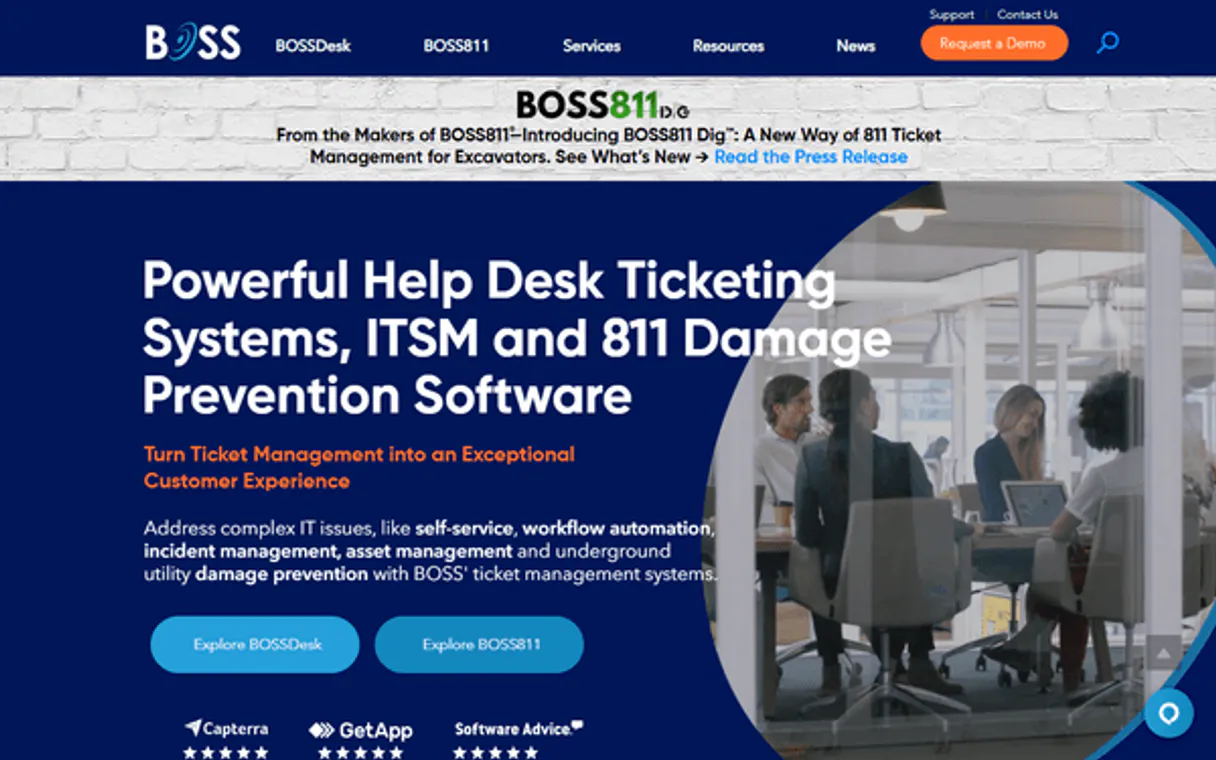
Independent Platform Disclaimer: Vinkius is an independent platform and is not affiliated with, endorsed by, sponsored by, verified by, or otherwise authorized by BOSSDesk. All third-party trademarks, logos, and brand names are the property of their respective owners. Their use on this website is strictly for informational purposes to identify service compatibility and interoperability.
VINKIUS INFRASTRUCTURE
Cloud Hosted
Managed infra
V8 Isolated
Sandboxed per request
Zero-Trust Proxy
No stored credentials
DLP Enforced
Policy on every call
GDPR Compliant
EU data residency
Token Compression
~60% cost reduction
Works with Claude, ChatGPT, Cursor, and more
The Model Context Protocol standardizes how applications expose capabilities to LLMs. Instead of operating in isolation, your AI gains direct access to external platforms, live data, and real-world actions through secure, standardized connections.
This server provides 10 capabilities that interface natively with Claude, ChatGPT, Cursor, and any MCP client. No middleware. No custom integration required.
Available Capabilities
Logging an incident shouldn't require opening a browser and clicking through three different tabs.
Today, reporting an incident means logging into the BOSSDesk portal. You find the 'New Ticket' button, fill out the requester details, select the asset type, and then submit. If you forget a key detail, you have to hit 'Save Draft' and come back later to finish it.
With this MCP server, you just tell your agent: 'I need to report a broken monitor for Jane Doe in accounting.' The agent runs `create_ticket`, handles all the required fields, and gives you the ticket ID. You're done in a single conversation.
BOSSDesk MCP Server: Get asset data and update records instantly.
Manual workflows force you to check the asset inventory, find the serial number, then look up the user's assignment, and finally update the ticket status—all in separate tabs and systems.
Now, you can prompt your agent: 'Get the details for asset XYZ123, check who it belongs to, and update ticket 105.' The agent runs `get_asset`, checks the user, and runs `update_ticket` sequentially, giving you one cohesive answer.
Common Questions About BOSSDesk MCP
How do I use the `create_ticket` tool with BOSSDesk MCP Server? +
You simply tell your agent the issue and who it affects. The agent prompts you for necessary details (like department or asset ID) and executes create_ticket when you confirm the details.
What does `get_asset` do with BOSSDesk MCP Server? +
get_asset pulls the full profile of a single asset. You must provide an identifier (like serial number or asset ID) to get the details.
How do I list all tickets using `list_tickets`? +
You ask the agent to list tickets. The agent runs list_tickets and returns a list of IDs and current statuses. You can then ask for more details on a specific ID.
Can I use `add_ticket_note` to communicate with the user? +
Yes. You tell the agent to add a note, providing the ticket ID and the text you want to write. This note stays on the ticket for the team to see.
How do I get a user profile using `get_user`? +
Provide the user's name or ID. The agent runs get_user and returns all the metadata stored for that employee, like department and manager.
How do I use `list_assets` to find all managed hardware and software? +
The list_assets tool returns a comprehensive list of every IT asset you manage. You can then filter this data by asset type, assigned user, or status (e.g., 'In Use' or 'Storage').
What information does `update_ticket` require to change a ticket's status or details? +
You must provide the ticket's ID and the specific fields you want to change. For example, to change the status, you'll need the ticket ID and the new status value.
How do I check physical office locations using `list_locations`? +
The list_locations tool provides a record of all physical sites linked to your BOSSDesk account. Each entry includes the location name, address, and associated details.
Can I check the status of a specific support ticket? +
Yes! Use the get_ticket tool with the Ticket ID. Your agent will fetch the latest status, priority, and requester info directly from BOSSDesk.
How do I find information about a specific asset like a laptop? +
Simply ask the agent to get_asset and provide the Asset ID or serial number. It will retrieve the technical specifications and assignment details from the BOSSDesk inventory.
Does the integration allow creating a ticket for an employee? +
Yes. Use the create_ticket tool and provide the employee's email. BOSSDesk will link the new ticket to their existing user profile automatically.
Use it with your favorite AI tools
Connect this server to Cursor, Claude, VS Code, and more.
More in this category

Humanloop (LLM Prompt Management API)
Manage, version, and deploy LLM prompts directly from your AI agent using the Humanloop API.

Color Contrast Checker Alternative
Instantly verify if your text is readable on any background. WCAG 2.1 AA/AAA compliance in one call — the AI guesses ratios, this engine calculates them.
Lanhu
Product design collaboration platform — manage design files, handoffs, and team feedback via AI.
You might also like

Liveblocks
Manage real-time collaboration infrastructure—create rooms, authorize users, and inspect collaborative storage or threads directly from your AI agent.

CMS.gov Data
Access public healthcare data from the Centers for Medicare & Medicaid Services, including provider information.

Kisi
Control building access with cloud-managed smart locks, mobile credentials, and audit trails that replace traditional key cards.