
Genderize MCP. Determine name gender using statistical data.
 Gemini
 Works with every AI agent you already use
…and any MCP-compatible client









Just plug in your AI agents and start using Vinkius.
Genderize MCP Server. Predict a person's likely gender from their first name using global statistical data. This tool accesses a database of over 114 million records to assign probability scores (0.0 to 1.0) for male or female identities.
You can localize these predictions by country code (e.g., US, BR, GB) or process lists of names in a single request.
It's designed for data enrichment, letting your AI agent quickly assess naming patterns for marketing or data quality checks.
What your AI agents can do
Estimate gender
Predicts the gender for a single name using global data.
Estimate gender brazil
Predicts the gender for a single name using Brazilian naming data.
Estimate gender france
Predicts the gender for a single name using French naming data.
Your AI agent determines if a single first name is associated with a male or female identity using global data.
Your AI agent processes a list of up to 10 names and returns the estimated gender and probability for every entry.
Your AI agent restricts the gender estimate to specific national naming conventions using ISO country codes (e.g., 'US', 'GB').
Your AI agent runs a simple check to confirm the connection to the Genderize API is active and working.
Ask AI about this MCP
Supported MCP Clients
Gemini Waiting for input…
Genderize MCP Server: 8 Tools for Name Analysis
Run gender predictions for single names, process large lists, or localize results by country using these specialized tools.
019d75a3estimate gender
Predicts the gender for a single name using global data.
019d75a3estimate gender brazil
Predicts the gender for a single name using Brazilian naming data.
019d75a3estimate gender france
Predicts the gender for a single name using French naming data.
019d75a3estimate gender spain
Predicts the gender for a single name using Spanish naming data.
019d75a3estimate gender uk
Predicts the gender for a single name using UK naming data.
019d75a3estimate gender us
Predicts the gender for a single name using US naming data.
019d75a3estimate genders bulk
Predicts the gender for a list of names in a single request.
019d75a3verify api connection
Checks the connection status and basic connectivity to the Genderize API.
Choose How to Get Started
Build a custom MCP for your own tools, or connect a ready-made integration from our catalog.
Build Your Own
Turn any API into an MCP. Import a spec, define Agent Skills, or deploy with MCPFusion.
- Import from OpenAPI, Swagger, or YAML specs
- Create Agent Skills with progressive disclosure
- Deploy to edge with MCPFusion framework
- Built in DLP, auth, and compliance on every call
- Real time usage dashboard and cost metering
- Publish to catalog or keep private
Make Your AI Do More
Start with Genderize, then connect any of our 4,700+ other servers whenever your AI needs more. One click, no limits.
- Use this MCP plus 4,700+ others, all in one place
- Add new capabilities to your AI anytime you want
- Every connection is secured and compliant automatically
- Track usage and costs across all your servers
- Works with Claude, ChatGPT, Cursor, and more
- New servers added to the catalog every week
What you can do with this MCP connector
Connect your AI agent to the Genderize MCP Server to predict a person's likely gender from their first name. This server uses global statistical data—backed by over 114 million records—to assign probability scores (0.0 to 1.0) for male or female identities. You can check names for single entries, process lists of up to 10 names, or localize predictions using specific national naming conventions.
estimate_gender predicts the gender for a single name using global data. estimate_genders_bulk processes a list of names in one request. You can localize predictions for specific countries with these tools: estimate_gender_us predicts gender using US data; estimate_gender_uk uses UK data; estimate_gender_brazil uses Brazilian data; estimate_gender_france uses French data; and estimate_gender_spain uses Spanish data.
To check the connection first, run verify_api_connection. This tells you if your agent can access the Genderize API. Your agent determines if a single first name is male or female using the global database via estimate_gender. For checking multiple names at once, your agent processes up to 10 names and gets the estimated gender and probability for every entry using estimate_genders_bulk.
You can restrict the gender estimate to specific national naming habits—like making the prediction US-only or UK-only—using the localized tools like estimate_gender_us or estimate_gender_uk.
How Genderize MCP Works
- 1 Your AI agent identifies the name(s) and the required country (if applicable).
- 2 The agent calls the appropriate tool (e.g.,
estimate_gender_usorestimate_genders_bulk) via the MCP. - 3 The server returns a structured result showing the estimated gender, a certainty score (0.0 to 1.0), and the data count used.
The bottom line is, your agent gets statistically backed gender estimations for names, localized to specific countries or groups.
Who Is Genderize MCP For?
Data Analysts and Marketers need this to quickly enrich lead lists or CRM data. Growth Engineers use it to automate user profile localization based on name probability. Developers use it to verify naming patterns and test statistical distributions without manually hitting an external API.
Enriching a spreadsheet of leads with predicted gender data before running targeted marketing campaigns.
Segmenting a new user list by predicted gender for personalized ad creative testing.
Automating the pipeline that validates and localizes user profile data streams based on name patterns.
What Changes When You Connect
- See gender probability scores immediately. You get a certainty score (0.0 to 1.0) and the total number of records supporting the estimate, so you know how reliable the data is.
- Process entire lead lists fast. Use
estimate_genders_bulkto check up to 10 names in one go, saving you from writing repetitive loops or running multiple API calls. - Improve accuracy with localization. Need to know the gender for a name in France? Use
estimate_gender_franceto restrict the data to French naming patterns, which is much better than a general search. - Audit your data sources. Run
verify_api_connectionanytime to confirm your AI client can still reach the Genderize API without hiccups. - Use region-specific tools. Instead of relying on general data, use
estimate_gender_usorestimate_gender_ukwhen your user base is confined to those regions. The results are much more accurate. - Start immediately. The server has a free tier with up to 100 daily requests, so you can test it without setting up API keys first.
Real-World Use Cases
Segmenting a new user base by geography
A marketing analyst needs to segment 5,000 leads from a multi-national campaign. They ask their agent to run estimate_genders_bulk on the list, specifying the country context. The agent quickly processes the names, returning gender estimates and the supporting country data, allowing the analyst to build targeted ad groups for the US, UK, and Brazil.
Cleaning up CRM data before an outreach campaign
A sales team manager receives a list of old contacts with missing demographic data. They prompt their agent to use estimate_gender on the list. The agent returns the predicted gender and the statistical probability for each name, letting the manager filter out low-confidence entries and focus outreach on the most reliable leads.
Validating user profiles in a specific market
A data scientist is building a profile verification tool for a Latin American market. They use estimate_gender_brazil to ensure the name patterns match local expectations. This prevents incorrect segmentation that would happen if they used the general estimate_gender tool.
Testing API integration reliability
A developer building a data pipeline needs to test the connection. They run verify_api_connection first. This confirms the MCP Server is operational before the main code deployment, preventing runtime failures when the pipeline goes live.
The Tradeoffs
Using general tools for local data
Running the general estimate_gender tool for a name known to be specific to France. The results might be inaccurate because the tool pulls from a global dataset, ignoring local French naming patterns.
→
Always use the specific tool for the region. For France, run estimate_gender_france. This limits the prediction to the appropriate local dataset, giving you a much more accurate result.
Handling names one by one
Copying 20 names and asking the agent to run estimate_gender 20 times. This is slow, inefficient, and wastes tokens/API calls.
→
Use the estimate_genders_bulk tool instead. It accepts a list of names and processes them all in a single request, making the process fast and efficient.
Ignoring API status checks
Writing a pipeline that assumes the external API is up, and only finding out when the data enrichment job fails in production. This causes immediate service downtime.
→
Check the connection first. Run verify_api_connection as part of your deployment checklist. This confirms the server is working before you write any code that relies on the prediction data.
When It Fits, When It Doesn't
Use this server if your primary goal is enriching structured data with predicted gender information based on names. It's ideal when you need high accuracy for specific regions (e.g., estimate_gender_us for US leads, estimate_gender_uk for UK leads) or when you need to process large lists of names quickly using estimate_genders_bulk.
Don't use this if you need to predict other demographics (like age or occupation). Also, if your data source isn't a first name, this tool won't help. For pure statistical analysis of name frequencies, check dedicated name-frequency databases instead. The key is: name + gender + probability.
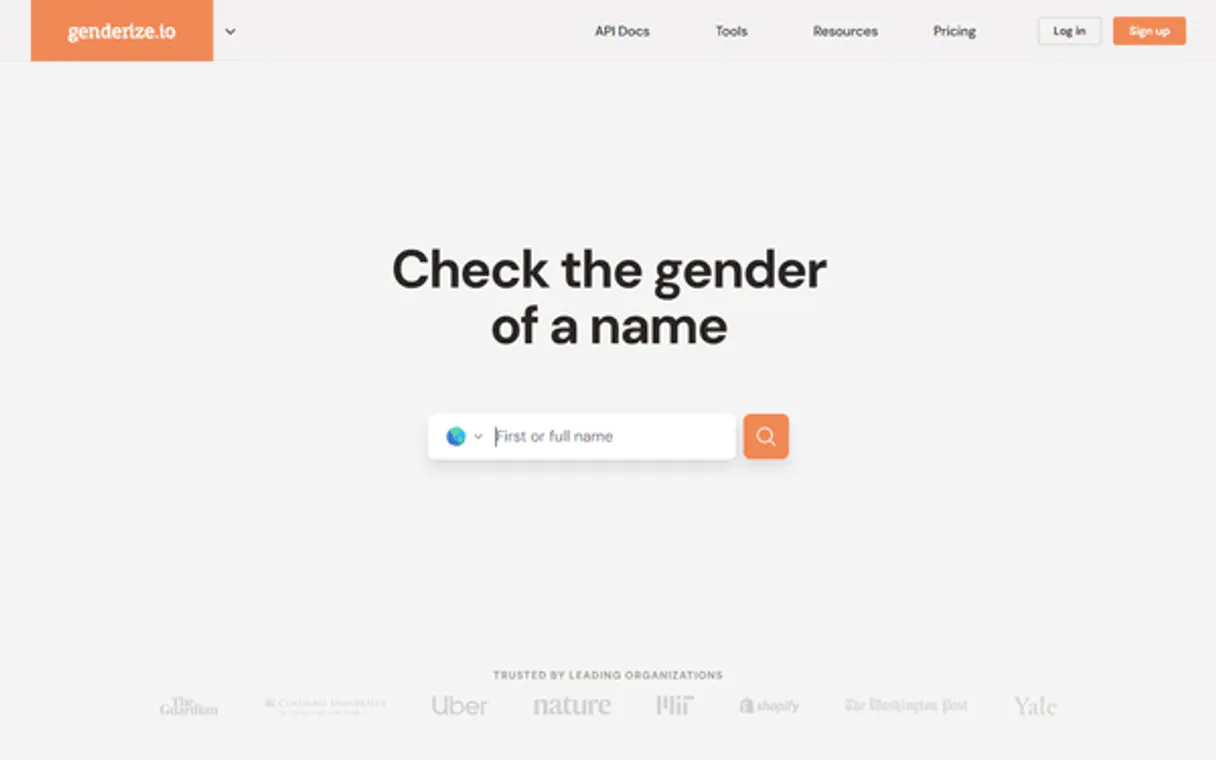
Independent Platform Disclaimer: Vinkius is an independent platform and is not affiliated with, endorsed by, sponsored by, verified by, or otherwise authorized by Genderize. All third-party trademarks, logos, and brand names are the property of their respective owners. Their use on this website is strictly for informational purposes to identify service compatibility and interoperability.
VINKIUS INFRASTRUCTURE
Cloud Hosted
Managed infra
V8 Isolated
Sandboxed per request
Zero-Trust Proxy
No stored credentials
DLP Enforced
Policy on every call
GDPR Compliant
EU data residency
Token Compression
~60% cost reduction
Works with Claude, ChatGPT, Cursor, and more
The Model Context Protocol standardizes how applications expose capabilities to LLMs. Instead of operating in isolation, your AI gains direct access to external platforms, live data, and real-world actions through secure, standardized connections.
This server provides 8 capabilities that interface natively with Claude, ChatGPT, Cursor, and any MCP client. No middleware. No custom integration required.
Available Capabilities
Getting gender data used to be a pain in the butt.
Before this MCP server, getting gender estimates was a manual, multi-step process. You'd grab a list of names, then have to open a separate database or use an unreliable web API. For every single name, you'd copy the name, paste it into the tool, wait for the result, and copy the data back into your spreadsheet. It was slow, error-prone, and impossible to scale.
Now, you tell your agent the list of names and the country. The agent uses the tools—like `estimate_genders_bulk`—and handles the entire sequence. You get a clean, structured JSON output with the predicted gender, the confidence score, and the data count, all without leaving your chat interface.
Genderize MCP Server: Predict gender in seconds.
You don't have to worry about which regional tool to use. You just ask your agent, "What's the gender for [Name] in [Country]?" The agent knows to call the right tool—maybe `estimate_gender_us` or `estimate_gender_brazil`—and gives you the right answer instantly.
The difference is control. You get reliable, statistically backed data from specialized sources, executed through a single, predictable API call. It just works.
Common Questions About Genderize MCP
How do I use the `estimate_genders_bulk` tool with specific country localization? +
You need to specify the country in your prompt. The agent handles the routing. You tell it to predict genders for a list of names, mentioning the country code (e.g., 'US').
Does `estimate_gender_us` use the same data as `estimate_gender`? +
No, they use different datasets. estimate_gender_us is specialized for US naming patterns, giving you better accuracy for American names than the general estimate_gender tool.
Is the prediction gender reliable? +
The result includes a statistical probability (0.0 to 1.0) and the total data count. This lets you judge the reliability. Low data counts mean lower confidence in the result.
What if I need to check the API connection before using the tool? +
Always run verify_api_connection first. This confirms the entire MCP Server is connected to the external Genderize API and ready to process requests.
Can I predict gender for names not in the database? +
The tool will still provide the best estimate based on its available data, but you must pay attention to the statistical probability. A low probability suggests the name is rare or unknown to the database.
How do I check the connection using the `verify_api_connection` tool? +
The verify_api_connection tool checks your API credentials immediately. It confirms if your AI client can successfully reach the Genderize.io endpoint, letting you know right away if your key is valid.
Can I use `estimate_gender_brazil` for names outside of Brazil? +
No, the specialized tools like estimate_gender_brazil are designed specifically for Brazilian naming conventions. Using them for other countries will give inaccurate or irrelevant results.
What is the best way to handle rate limits when using `estimate_genders_bulk`? +
For large lists, you'll want to use an API key for higher rate limits. If you hit the free tier cap, switch to an API key to keep your data enrichment process running without interruption.
Is an API Key required for Genderize.io? +
No, you can use the service for free without an API key for up to 100 requests per day. For higher volume, you can obtain a key from genderize.io.
How accurate is the gender prediction? +
The API returns a 'probability' score between 0.0 and 1.0. A score of 0.99 means the API is 99% certain of the associated gender based on its database.
Can I localise the results for a specific country? +
Yes! Use the 'countryId' parameter with an ISO 3166-1 alpha-2 code (e.g., 'BR' for Brazil) to get results optimized for that specific region.
How many names can I check at once? +
The 'estimate_genders_bulk' tool allows you to check up to 10 names in a single API request, which is efficient for processing small lists.
Use it with your favorite AI tools
Connect this server to Cursor, Claude, VS Code, and more.
More in this category

Bitquery (Web3 Blockchain GraphQL APIs)
Query real-time and historical blockchain data across 40+ chains including Ethereum, Solana, and Bitcoin using GraphQL.

Phabricator (Development Platform Conduit API)
Manage tasks, code reviews, and repositories via Phabricator's Conduit API — search Maniphest tasks, edit revisions, and query users directly.

Drone CI
Automate your CI/CD workflows with Drone CI—manage repositories, monitor builds, and handle secrets directly from your AI agent.
You might also like

CNMC (Comisión Mercados y Competencia)
Access Spanish market and competition data — search datasets and retrieve records from the CNMC open data portal.

Cosmic (Headless CMS & Content API)
Manage your content, media, and object types via Cosmic — list objects, create content, and handle media assets directly through any AI agent.

Punk
Explore the BrewDog beer catalog — search by ingredients, food pairings, and technical specs like ABV or IBU.