
Bring Meteorology
to Claude Desktop
Create your Vinkius account to connect NOAA Full — Ultimate Weather & Climate Intelligence to Claude Desktop and start using all 36 AI tools in minutes. Fully managed, enterprise secure, and ready to use without writing a single line of code. No hosting, no server setup — just connect and start using.
 GDPR Free for Subscribers
Compatible with every major AI agent and IDE
 Gemini
What is the NOAA Full — Ultimate Weather & Climate Intelligence MCP Server?
The ultimate NOAA Mega-Server — 36 tools across 7 domains from 5 official APIs.
36 Tools
- 🌤️ Forecast (5) — Daily, hourly, grid, AFD, metadata
- ⚠️ Alerts (4) — By state, zone, point, types
- 📡 Observations (5) — Stations, current, history, radar
- ✈️ Aviation (5) — METAR, TAF, PIREP, SIGMET, station
- 🌊 Marine (6) — Tides, predictions, currents, water temp, met, sea level
- ☀️ Space (6) — Kp, forecast, solar wind, aurora, flux, Dst
- 📊 Climate (5) — Daily, monthly, yearly, normals, station search
No API Key Required
Built-in capabilities (36)
Filter by state (2-letter code: TX, FL, CA), severity (Extreme, Severe, Moderate, Minor), urgency (Immediate, Expected, Future), or event type (Tornado Warning, Hurricane Warning, etc.). Get active weather alerts by US state or severity
). Use this to discover valid event type values for filtering alerts. List all NWS weather alert types available
Internally resolves the location to find active alerts in that area. Get active weather alerts for a specific US latitude/longitude
g., TXZ211, FLZ050). Zone IDs can be found via the get_point_metadata tool. Useful for focused monitoring of a specific area. Get active weather alerts for a specific NWS zone
Powered by real-time solar wind data. The gold standard for aurora forecasting worldwide. Get the aurora probability forecast map data (Ovation model)
Use ICAO codes (KJFK, EGLL, LFPG, SBGR). Get aviation weather station information by ICAO code
This is the statistical baseline that defines "normal" weather for any location. Get 30-year climate normals — the baseline for what is "normal" weather
Available at select CO-OPS stations with current meters. Get observed ocean current speed and direction at a US coastal station
This is the planet's largest archive of daily weather records. Filter by station, data types (TMAX, TMIN, PRCP, SNOW, SNWD), and date range. Stations are worldwide but densest coverage is in the US. Get daily weather data (GHCN-Daily): temperatures, precipitation, snow
Measures the intensity of the ring current around Earth. Values below -50 nT indicate a moderate storm, below -100 nT a strong storm, below -250 nT a severe storm. Critical for satellite operators and power grid monitoring. Get the Dst index — real-time geomagnetic storm intensity
Provide latitude and longitude for any US location. Returns high/low temps, wind speed/direction, precipitation probability, and detailed narrative. Get 7-day weather forecast for a US location by latitude and longitude
Use the 3-letter WFO code (e.g., OKX=New York, LAX=Los Angeles, MFL=Miami). Lists recent product IDs — retrieve the latest for full text. Get the Area Forecast Discussion (AFD) from a NWS Weather Forecast Office
Useful for programmatic analysis. US only. Get raw NWS grid weather data: temperature, precipitation, wind, humidity arrays
5 days. Includes temperature, wind, humidity, precipitation, and sky condition for each hour. US locations only. Get hour-by-hour weather forecast (156 hours) for a US location
Use this to plan for aurora viewing, satellite vulnerabilities, or HF radio propagation impacts. Get the 3-day Kp index forecast — predicted geomagnetic activity
Provide a 4-character station ID such as KJFK, KLAX, KORD, KDFW. Get current weather conditions from a specific NWS station
Provide ICAO codes comma-separated (KJFK, EGLL, LFPG). Returns temperature, wind, visibility, clouds, pressure, weather phenomena. Optionally retrieve past hours of data. Get METAR (current airport weather) for any airport worldwide by ICAO code
Complements water-level data for a complete coastal picture. Get coastal meteorological data: air temp, wind, pressure at a station
Monthly aggregates of temperature averages, precipitation totals, and degree days. Less granular than daily but ideal for climate trend analysis. Get monthly climate summary (GSOM): average temp, total precipitation, heating degree days
Useful for seeing temperature trends, wind changes, and weather evolution over recent hours. Get recent observation history for a NWS station
Filter by age (hours). Get PIREPs (Pilot Reports) for turbulence, icing, and weather conditions
Kp ranges 0-9. Values ≥5 indicate geomagnetic storms with visible aurora at lower latitudes. Updated every 3 hours. Essential for aurora hunters, satellite operators, and power grid managers. Get the NOAA Planetary K-index — geomagnetic activity and aurora probability
US locations only. Get NWS metadata for a US location: responsible WFO, grid coordinates, zones
List all NWS radar stations and their status
Shows long-term relative sea level trends calculated from decades of tide gauge data. Critical for climate research. Get long-term sea level rise trends for a US coastal station
These define areas of significant weather hazards for aviation: convection, turbulence, icing, IFR conditions, mountain obscuration. Get SIGMETs and AIRMETs — significant aviation weather hazards
7 solar flux index. Higher values (>100 SFU) indicate increased solar activity, more sunspots, and higher probability of solar flares and CMEs. Normal quiet-sun values are 70-80 SFU. Get the 10.7cm solar radio flux — a proxy for solar activity level
The solar wind drives geomagnetic storms — when speed exceeds 500 km/s with southward Bz, aurora probability increases dramatically. Get real-time solar wind speed and magnetic field conditions
Useful for understanding where a station is and what data it provides. Get metadata about a specific NWS weather station
Each station has a 4-character ID (e.g., KJFK, KLAX). US only. Use station IDs with get_latest_observation. Find nearby NWS weather observation stations by latitude/longitude
Includes forecast groups with wind, visibility, clouds, and weather changes. ICAO codes only. Get TAF (airport weather forecast) for any airport worldwide by ICAO code
Provides predicted high and low tide times and heights. Useful for fishing, boating, coastal activities. Default is next 48 hours. Get tide predictions (hi/lo) for a US coastal station
Data in meters relative to station datum. Provide a CO-OPS station ID (e.g., 8518750 for The Battery, NYC; 9414290 for San Francisco). Get observed water levels (tides) at a US coastal station
Useful for marine biology, fishing, surfing, and coastal research. Get water temperature at a US coastal station
Yearly temperature averages, precipitation totals, and extreme values. Perfect for long-term climate analysis spanning decades. Get annual climate summary (GSOY): yearly averages and extremes
Returns station IDs, names, and locations for use with other climate tools. Search NCEI weather stations by location bounding box or keyword
Why Claude Desktop?
Claude Desktop is the definitive way to connect NOAA Full — Ultimate Weather & Climate Intelligence to your AI workflow. Add Vinkius Edge URL to your config, restart the app, and Claude immediately exposes all 36 tools in the chat interface. ask a question, Claude calls the right tool, and you see the answer. Zero code, zero context switching.
- —
Claude Desktop is the reference MCP client. it was designed alongside the protocol itself, ensuring the most complete and stable MCP implementation available
- —
Zero-code configuration: add a server URL to a JSON file and Claude instantly discovers and exposes all available tools in the chat interface
- —
Claude's extended thinking capability lets it reason through multi-step tool usage, chaining multiple API calls to answer complex questions
- —
Enterprise-grade security with local config storage. your tokens never leave your machine, and connections go directly to Vinkius Edge network
NOAA Full — Ultimate Weather & Climate Intelligence in Claude Desktop
Why run NOAA Full — Ultimate Weather & Climate Intelligence with Vinkius?
The NOAA Full — Ultimate Weather & Climate Intelligence connection runs on our fully managed, secure cloud infrastructure. We handle the hosting, maintenance, and security so you don't have to deal with servers or code. All 36 tools are ready to work instantly without any complex setup.
You stay in complete control of your data. Your AI only accesses the information you approve, keeping your sensitive passwords and private details completely safe. Plus, with automatic optimizations, your AI works faster and more efficiently.
* Every connection is hosted and maintained by Vinkius. We handle the security, updates, and infrastructure so you don't have to write code or manage servers. See our infrastructure
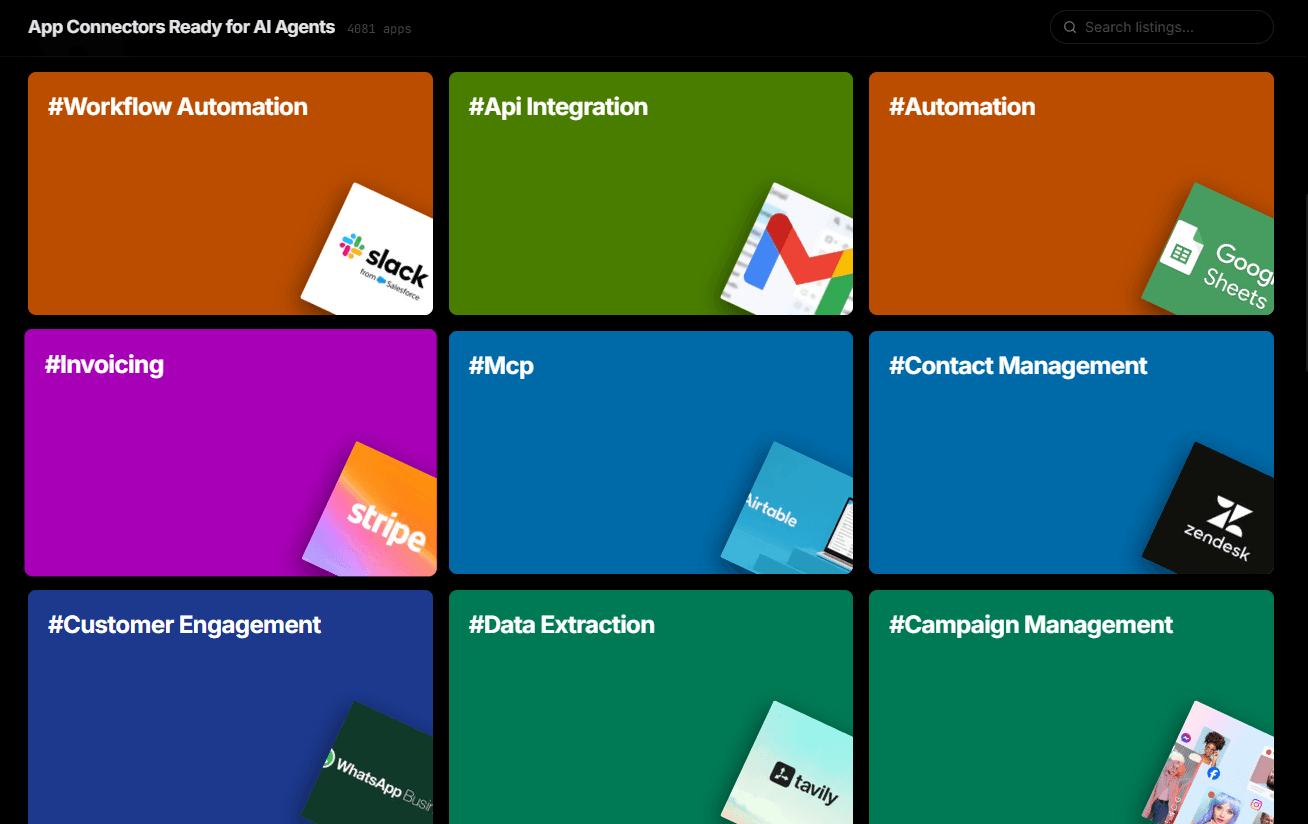
Over 4,000 integrations ready for AI agents
Explore a vast library of pre-built integrations, optimized and ready to deploy.
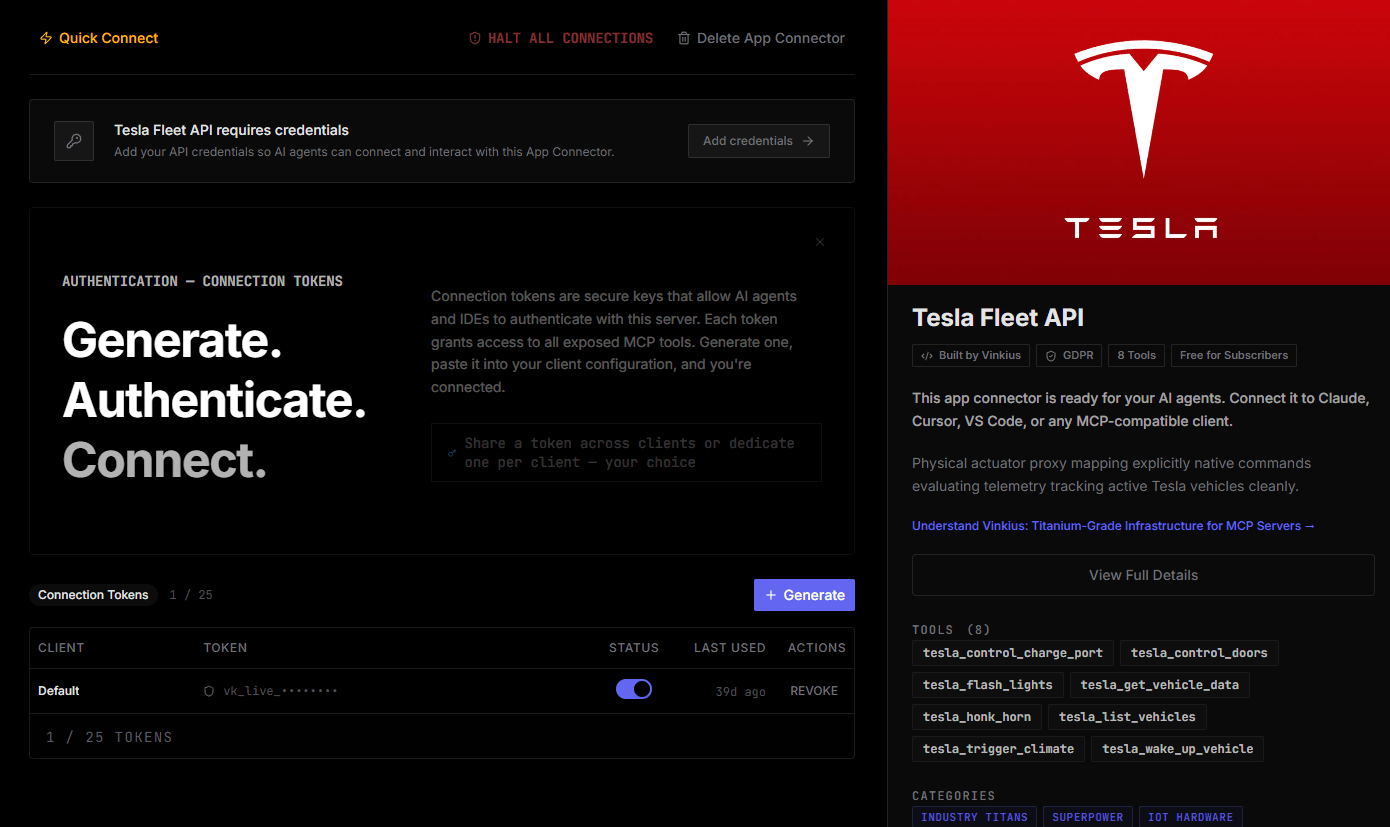
Connect securely in under 30 seconds
Generate tokens to authenticate and link external services in a single step.
Complete visibility into every agent action
Audit live requests, latency, success rates, and active security compliance policies.
Optimize spending and track token ROI
Analyze real-time token consumption and cost metrics detailed by connection.
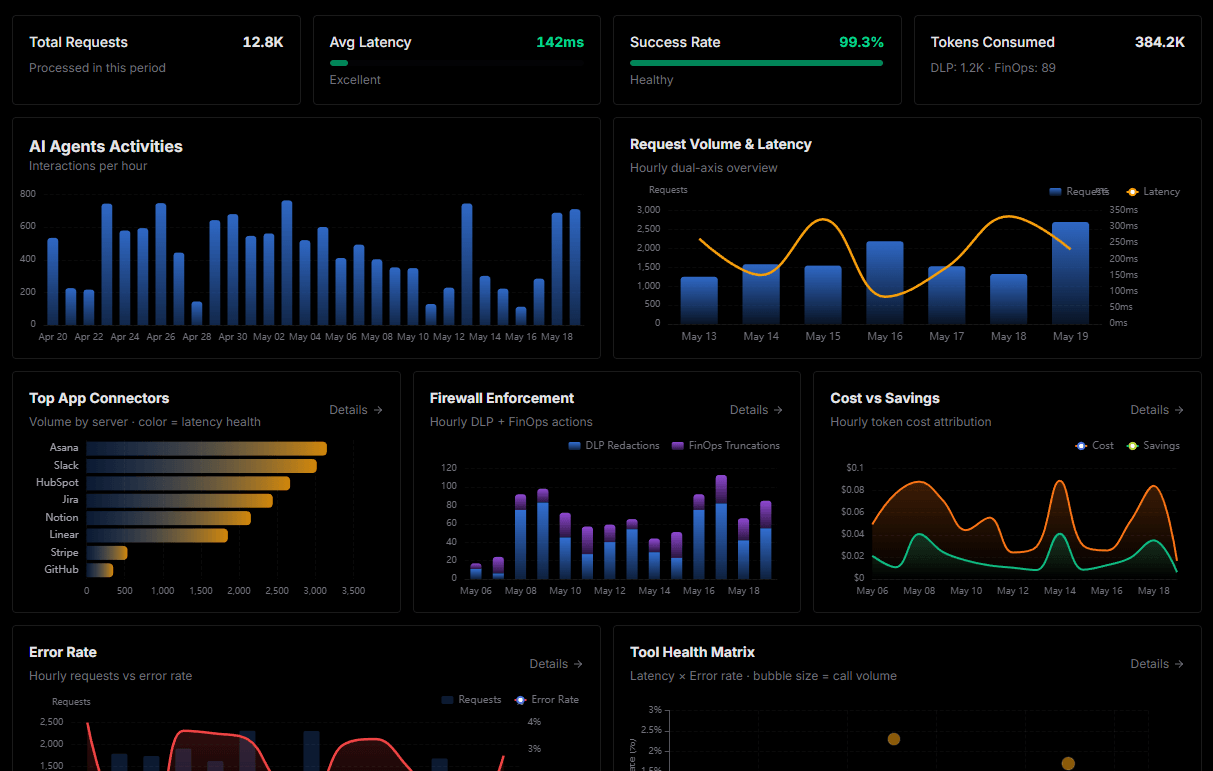
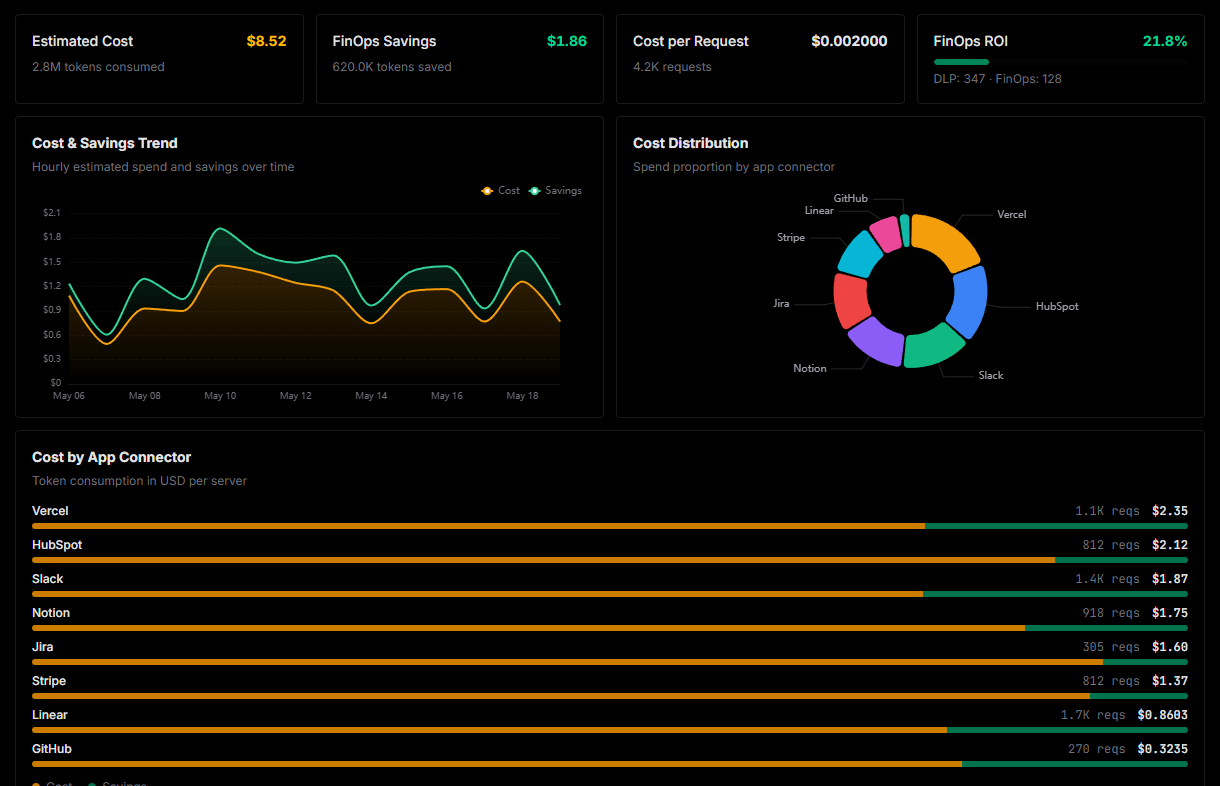
Explore our live AI Agents Analytics dashboard to see it all working
This dashboard is included when you connect NOAA Full — Ultimate Weather & Climate Intelligence using Vinkius. You will never be left in the dark about what your AI agents are doing with your tools.
NOAA Full — Ultimate Weather & Climate Intelligence and 4,000+ other AI tools. No hosting, no code, ready to use.
Professionals who connect NOAA Full — Ultimate Weather & Climate Intelligence to Claude Desktop through Vinkius don't need to write code, manage servers, or worry about security. Everything is pre-configured, secure, and runs automatically in the background.
Raw MCP | Vinkius | |
|---|---|---|
| Ready-to-use MCPs | Find and configure each manually | 4,000+ MCPs ready to use |
| Connection Setup | Manual coding & server setup | 1-click instant connection |
| Server Hosting | You host it yourself (needs 24/7 uptime) | 100% hosted & managed by Vinkius |
| Security & Privacy | Stored in plaintext config files | Bank-grade encrypted vault |
| Activity Visibility | Blind execution (no logs or tracking) | Live dashboard with real-time logs |
| Cost Control | Runaway AI token spend risk | Automatic budget limits |
| Revoking Access | Must delete files or code to stop | 1-click disconnect button |
How Vinkius secures
NOAA Full — Ultimate Weather & Climate Intelligence for Claude Desktop
Every request between Claude Desktop and NOAA Full — Ultimate Weather & Climate Intelligence is protected by our secure gateway. We automatically keep your sensitive data private, prevent unauthorized access, and let you disconnect instantly at any time.
Frequently asked questions
Why Full instead of individual servers?
The Full server has all 36 tools from 5 NOAA APIs. Get forecast AND alerts AND METAR AND tides AND aurora AND historical climate data in a single session.
How does Claude Desktop discover MCP tools?
When Claude Desktop starts, it reads the claude_desktop_config.json file and connects to each configured MCP server. It calls the tools/list endpoint to fetch the schema for every available tool, then surfaces them as clickable options in the chat interface via the 🔌 icon.
What happens if the MCP server is temporarily unavailable?
Claude Desktop handles disconnections gracefully. if the server is unreachable at startup, the tools simply won't appear. Once the server becomes available again, restarting Claude Desktop will re-establish the connection. There is no timeout penalty or error loop.
Can I connect multiple MCP servers simultaneously?
Yes. You can add as many servers as you need in the mcpServers section of the config file. Each server appears as a separate tool provider, and Claude can use tools from multiple servers in a single conversation turn.
Is there a limit on the number of tools per server?
Claude Desktop can handle hundreds of tools per server. However, for optimal LLM performance, Vinkius servers are designed to expose focused, well-documented tool sets rather than overwhelming the model with too many options.
Does Claude Desktop support Streamable HTTP transport?
Yes. Claude Desktop supports both SSE (Server-Sent Events) and the newer Streamable HTTP transport that Vinkius uses. Simply provide the server URL. Claude auto-negotiates the transport protocol.
Server not appearing after restart
Ensure the JSON is valid (no trailing commas). Check the file path: ~/Library/Application Support/Claude/claude_desktop_config.json (macOS) or %APPDATA%\\Claude\\ (Windows).
Authentication error
Verify your Vinkius token is correct. Go to cloud.vinkius.com to regenerate it if needed.
Tools not showing in chat
Click the 🔌 icon at the bottom of the chat input. If it shows 0 tools, the server may still be connecting. wait a few seconds.
Explore More MCP Servers
View all →
SAMHSA Treatment Locator
3 toolsFind substance use and mental health treatment facilities across the US using official SAMHSA locator data.
Equixly
10 toolsAutomate API security testing via Equixly — manage target services, trigger autonomous AI pentests, and audit vulnerability findings directly from any AI agent.

Public Suffix Extractor
1 toolsExtract the true root domain, TLD, and subdomain from any URL using the official Mozilla Public Suffix List.

Road511 Trucking
10 toolsAccess trucking data via Road511 — track truck routes, bridge clearances, weigh stations, truck stops, parking, and weight restrictions across US and Canada from any AI agent.