
Bring Generative Art
to Cursor
Create your Vinkius account to connect Playground AI to Cursor and start using all 10 AI tools in minutes. Fully managed, enterprise secure, and ready to use without writing a single line of code. No hosting, no server setup — just connect and start using.
 GDPR Free for Subscribers
Compatible with every major AI agent and IDE
 Gemini
What is the Playground AI MCP Server?
Connect your AI agent directly to the Playground AI compute clusters. Eliminate manual interface dragging by instructing your LLM (Claude, Cursor) to natively generate, radically outpaint, or surgically inpaint high-resolution visual components using the Playground v3 pipeline.
What you can do
- Direct Image Generation — Generate pristine assets instantly. Use the
generate_imagetool explicitly defining prompt nuances and tensor geometries (like 1024x1024). - ControlNet & Transformations — Substantially alter base images. Tell the agent to use
controlnet(depth/canny) or apply rawtransform_imageoverrides mutating your sketches into polished renders. - Precision Editing — Execute flawless structural edits. Instruct the AI to seamlessly
remove_backgroundand isolate elements, or useinpaint_imageoverlaying explicit masks. - Upscaling & Outpainting — Scale blurry inputs intelligently up to 4x, or instruct the diffusion model to geometrically expand boundary borders utilizing
outpaint_image.
How it works
- Append the Playground integration strictly to your MCP setup
- Provide your Playground API Key
- Start rendering graphics and UI components directly from code comments
Who is this for?
- Web Developers — generate perfectly sized graphical placeholders without opening a visual editor.
- Concept Artists — automate repetitive masking and background removal using the agent's
remove_backgroundnode. - Creative Directors — apply instantaneous upscaling or outpainting adjustments natively while discussing the copy.
Built-in capabilities (10)
Triggers immediate billing execution per inference step. Generate images from a text prompt using Playground AI. Playground offers multiple AI models including Playground v3 and SDXL variants for creative image generation. Instructions: Pass prompt, model name, width, height (multiples of 64)
Generate images with ControlNet guidance using Playground AI. Control types: canny, depth, pose, scribble. Instructions: Pass prompt, reference image URL, control type
Get details of a Playground AI generation by ID. Returns images, prompt, model, and metadata
Inpaint specific areas of an image using Playground AI. Uses a mask to define regions. Instructions: Pass prompt, image URL, and mask image URL (white = edit area)
List recent generations on Playground AI. Returns generation IDs, prompts, and timestamps
List available models on Playground AI. Returns model names, descriptions, and capabilities
Extend an image beyond its borders using Playground AI. AI generates new content in the specified direction. Instructions: Pass prompt, image URL, direction (up/down/left/right)
Remove the background from an image using Playground AI. Returns transparent PNG. Instructions: Pass public image URL
Transform an existing image with a text prompt using Playground AI. Strength controls how much the image changes (0-1). Instructions: Pass prompt, public image URL, and strength
Upscale an image using Playground AI. Enhances resolution and detail. Instructions: Pass image URL and scale factor (2 or 4)
Why Cursor?
Cursor's Agent mode turns Playground AI into an in-editor superpower. Ask Cursor to generate code using live data from Playground AI and it fetches, processes, and writes. all in a single agentic loop. 10 tools appear alongside file editing and terminal access, creating a unified development environment grounded in real-time information.
- —
Agent mode turns Cursor into an autonomous coding assistant that can read files, run commands, and call MCP tools without switching context
- —
Cursor's Composer feature can generate entire files using real-time data fetched through MCP. no copy-pasting from external dashboards
- —
MCP tools appear alongside built-in tools like file reading and terminal access, creating a unified agentic environment
- —
VS Code extension compatibility means your existing workflow, keybindings, and extensions all work alongside MCP tools
Playground AI in Cursor
Why run Playground AI with Vinkius?
The Playground AI connection runs on our fully managed, secure cloud infrastructure. We handle the hosting, maintenance, and security so you don't have to deal with servers or code. All 10 tools are ready to work instantly without any complex setup.
You stay in complete control of your data. Your AI only accesses the information you approve, keeping your sensitive passwords and private details completely safe. Plus, with automatic optimizations, your AI works faster and more efficiently.
* Every connection is hosted and maintained by Vinkius. We handle the security, updates, and infrastructure so you don't have to write code or manage servers. See our infrastructure
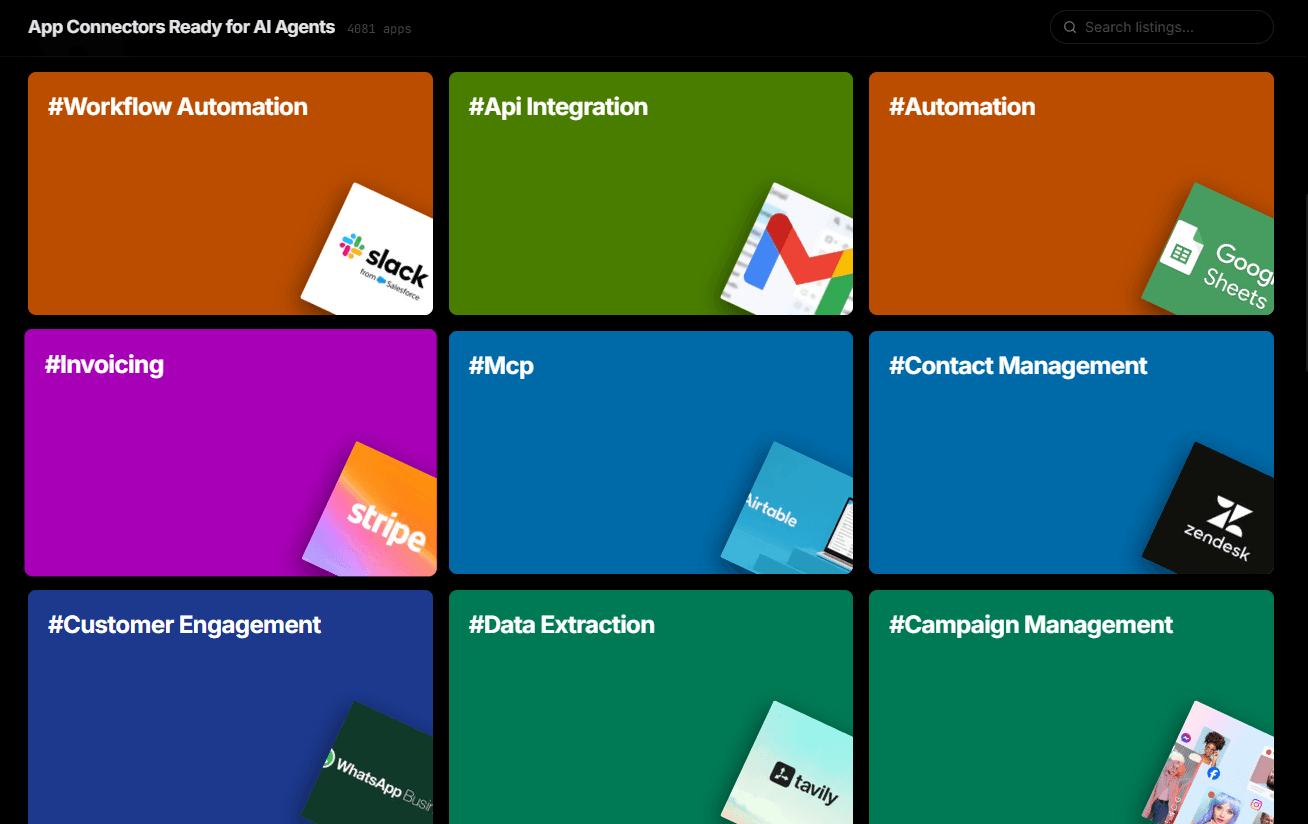
Over 4,000 integrations ready for AI agents
Explore a vast library of pre-built integrations, optimized and ready to deploy.
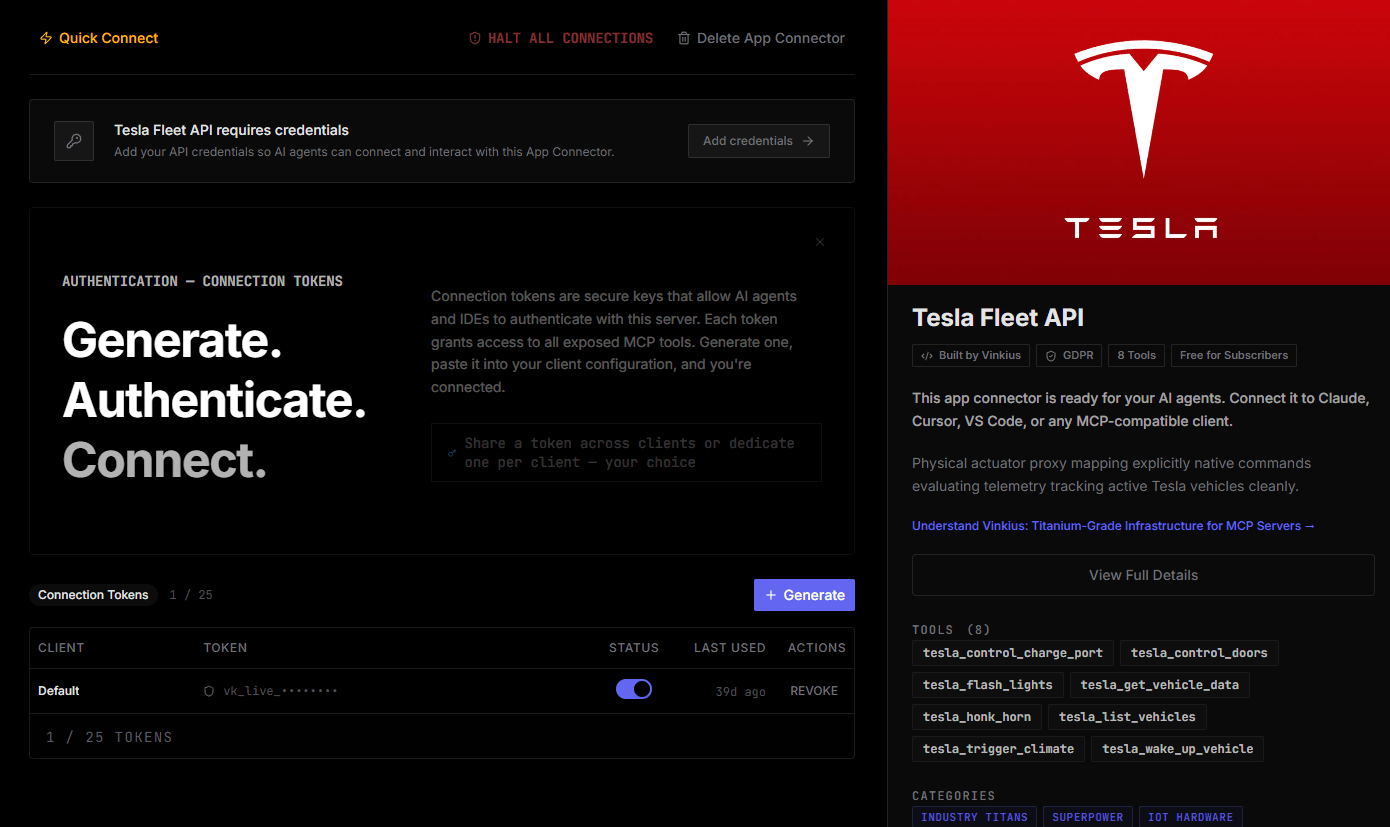
Connect securely in under 30 seconds
Generate tokens to authenticate and link external services in a single step.
Complete visibility into every agent action
Audit live requests, latency, success rates, and active security compliance policies.
Optimize spending and track token ROI
Analyze real-time token consumption and cost metrics detailed by connection.
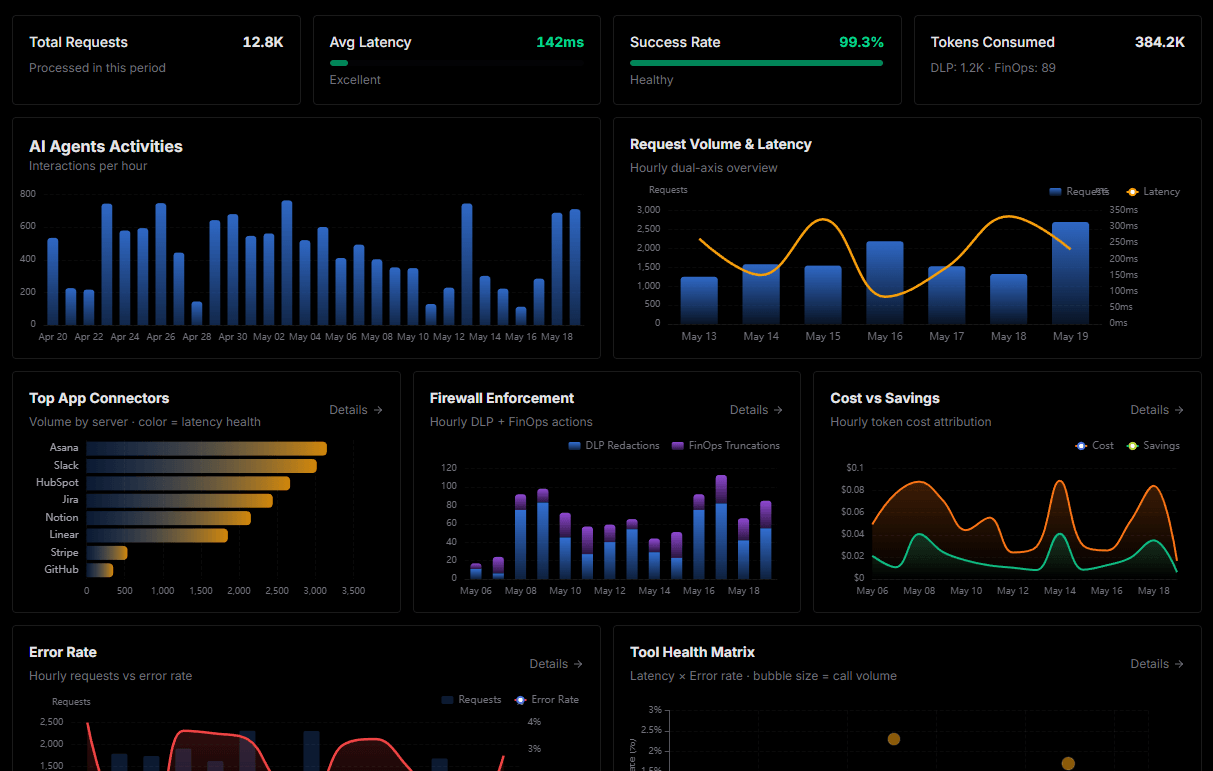
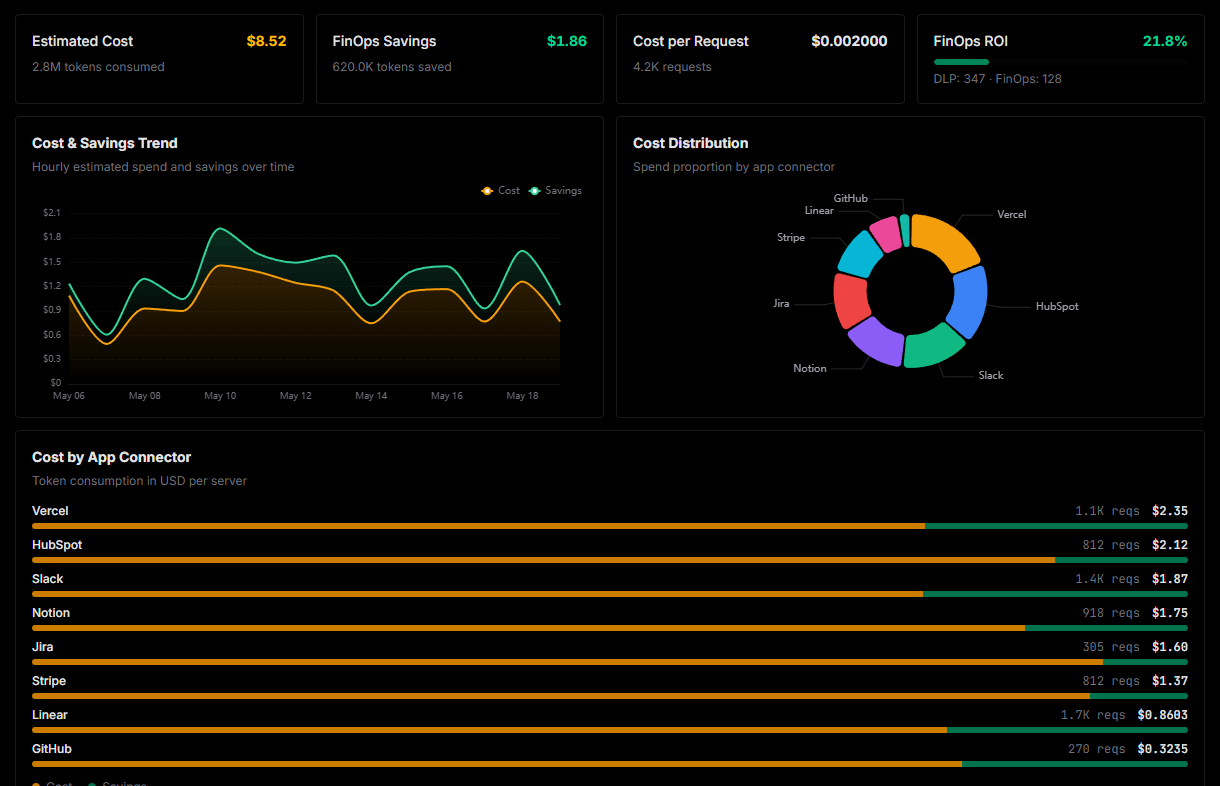
Explore our live AI Agents Analytics dashboard to see it all working
This dashboard is included when you connect Playground AI using Vinkius. You will never be left in the dark about what your AI agents are doing with your tools.
Playground AI and 4,000+ other AI tools. No hosting, no code, ready to use.
Professionals who connect Playground AI to Cursor through Vinkius don't need to write code, manage servers, or worry about security. Everything is pre-configured, secure, and runs automatically in the background.
Raw MCP | Vinkius | |
|---|---|---|
| Ready-to-use MCPs | Find and configure each manually | 4,000+ MCPs ready to use |
| Connection Setup | Manual coding & server setup | 1-click instant connection |
| Server Hosting | You host it yourself (needs 24/7 uptime) | 100% hosted & managed by Vinkius |
| Security & Privacy | Stored in plaintext config files | Bank-grade encrypted vault |
| Activity Visibility | Blind execution (no logs or tracking) | Live dashboard with real-time logs |
| Cost Control | Runaway AI token spend risk | Automatic budget limits |
| Revoking Access | Must delete files or code to stop | 1-click disconnect button |
How Vinkius secures
Playground AI for Cursor
Every request between Cursor and Playground AI is protected by our secure gateway. We automatically keep your sensitive data private, prevent unauthorized access, and let you disconnect instantly at any time.
Frequently asked questions
Can my AI automatically remove a background and embed the image into my project?
Yes! The agent triggers the remove_background method on any public image URL. Playground internally isolates the core subject, dropping the background layers, and replies with a secure pointer URL. Your agent can instantly fetch the response string and code an <img> tag placing the clean asset directly into the UI mapping you're developing.
How exactly does `outpaint_image` expand the canvas?
The tool passes the target image alongside the literal specific expansion vectors ('up', 'down', 'left', 'right') and a guiding context text. The diffusion nodes generate purely new mathematical tensor states radiating outward, predicting the lighting, shadows, and environment strictly following your prompt rules without stretching existing pixels.
Can I enforce specific structural references using ControlNet constraints?
Yes. Instead of standard generation, invoke generate_with_controlnet. You upload a scribble or an edges-only mapping layout as your source. By defining the explicit type ('canny', 'depth', 'pose', 'scribble'), the AI strictly anchors its conceptual render to those physical guiding constraints rather than randomizing spatial architecture.
What is Agent mode and why does it matter for MCP?
Agent mode is Cursor's autonomous execution mode where the AI can perform multi-step tasks: reading files, editing code, running terminal commands, and calling MCP tools. Without Agent mode, Cursor operates in a simpler ask-and-answer mode that doesn't support tool calling. Always ensure you're in Agent mode when working with MCP servers.
Where does Cursor store MCP configuration?
Cursor looks for MCP server configurations in a mcp.json file. You can configure servers at the project level (.cursor/mcp.json in your project root) or globally (~/.cursor/mcp.json). Project-level configs take precedence.
Can Cursor use MCP tools in inline edits?
No. MCP tools are only available in Agent mode through the chat panel. Inline completions and Tab suggestions do not trigger MCP tool calls. This is by design. tool calls require user visibility and approval.
How do I verify MCP tools are loaded?
Open Settings → Features → MCP and look for your server name. A green indicator means the server is connected. You can also check Agent mode's available tools by clicking the tools dropdown in the chat panel.
Tools not appearing in Cursor
Ensure you are in Agent mode (not Ask mode). MCP tools only work in Agent mode.
Server shows as disconnected
Check Settings → Features → MCP and verify the server status. Try clicking the refresh button.
Explore More MCP Servers
View all →
Statistics Engine
5 toolsA zero-latency statistical engine to process datasets. Instantly compute the exact mean, median, mode, standard deviation, and percentiles completely local.

Contentdrips
10 toolsTurn text into scroll-stopping social media carousels and visual content pieces that boost engagement on every platform.

Flowcode
12 toolsManage dynamic QR codes, track scan analytics, and oversee Flowpages via AI agents with Flowcode.

Cyberimpact
10 toolsEquip your AI agent to manage email subscribers, monitor campaigns, and track marketing metrics via the Cyberimpact API.