
Bring Code Review
to Google ADK
Create your Vinkius account to connect DeepSource to Google ADK and start using all 14 AI tools in minutes. Fully managed, enterprise secure, and ready to use without writing a single line of code. No hosting, no server setup — just connect and start using.
 GDPR Free for Subscribers
Compatible with every major AI agent and IDE
 Gemini
What is the DeepSource MCP Server?
Connect your DeepSource account to any AI agent and take full control of code quality analysis, vulnerability detection, and metrics monitoring through natural conversation.
What you can do
- Code Issues — List and inspect code quality issues (code smells, anti-patterns, bugs) across repositories with severity and file locations
- Analysis History — View recent analysis runs with status, branch, and analyzer information (Python, JavaScript, Go, etc.)
- Security Vulnerabilities — Identify dependency vulnerabilities (SCA) with CVE IDs, CVSS scores, reachability, and fixability status
- Code Metrics — Query maintainability index, cyclomatic complexity, lines of code, and test coverage percentages
- Report Cards — Get overall repository health grades (A-F) with score breakdowns and trend analysis
- SCA Targets — List all dependency manifest files being scanned for supply chain security
- Repository Management — Activate/deactivate repos, update default branches, and regenerate DSN tokens
How it works
- Subscribe to this server
- Enter your DeepSource Personal Access Token
- Start monitoring code quality, reviewing issues, and tracking vulnerabilities from Claude, Cursor, or any MCP-compatible client
No more manual navigation through the DeepSource dashboard. Your AI acts as a dedicated code quality analyst or security reviewer.
Who is this for?
- Engineering Managers — instantly review code quality grades, issue counts, and analysis status across multiple repositories without opening the dashboard
- Security Teams — monitor dependency vulnerabilities with CVE details, CVSS scores, and prioritize remediation based on reachability
- Developers — check code issues, metrics, and report cards directly from the IDE to fix quality problems before merging
- DevOps Leads — manage repository activation status, default branches, and DSN rotation across the organization
Built-in capabilities (14)
Once activated, DeepSource will start analyzing the code on each push/PR. You must provide the repository ID (obtained from get_repository). Use this to enable code quality monitoring for a repository that was previously inactive. Activate a repository for code analysis in DeepSource
No new analyses will run until the repository is reactivated. You must provide the repository ID (obtained from get_repository). Use this to pause analysis for archived repositories or when you want to stop billing for a specific repository. Deactivate a repository to stop code analysis in DeepSource
This provides a quick health check of the repository's overall code quality status. You must provide the repository name, login, and VCS provider. Use this to get a high-level view of code quality trends and identify areas needing improvement. Get the overall report card (grade) for a repository
You must provide the repository name, login (user or org name), and VCS provider (e.g., GITHUB, GITLAB, BITBUCKET). Use this to inspect repository configuration before querying issues, analyses, or metrics. Get details of a specific repository in DeepSource
You must provide the repository name, login, and VCS provider. Optionally filter by specific metric shortcodes (e.g., "LCV" for line coverage, "MI" for maintainability index, "CC" for cyclomatic complexity). If no shortcodes specified, returns all available metrics with their values and thresholds. Get code quality metrics for a repository
Shows the coverage percentage value and any configured thresholds. You must provide the repository name, login, and VCS provider. Use this to monitor code quality and ensure adequate test coverage across your codebase. Get test coverage metrics for a repository
Use this to verify your API token is working and to get your user details from DeepSource. Get the authenticated user profile from DeepSource
You must provide the repository name, login, VCS provider, and the vulnerability occurrence ID (obtained from list_vulnerabilities). Use this to deep-dive into a specific vulnerability before deciding on remediation steps. Get details of a specific dependency vulnerability by its ID
You must provide the repository name, login, and VCS provider. Optionally filter by branch name and limit the number of results (default: 20). Each run shows which analyzer was used (e.g., PYTHON, JAVASCRIPT, GO) and whether the analysis succeeded or failed. List recent code analysis runs for a repository
You must provide the repository name, login, and VCS provider. Optionally filter by analyzer short code (e.g., "PYTHON", "JS-A1") and limit results (default: 50). Each issue includes up to 3 sample occurrences with file path and line number. Use this to identify code smells, anti-patterns, and potential bugs across your codebase. List code quality issues in a repository
Each target includes ecosystem (e.g., npm, pip, gem), package manager, manifest file path, and activation status. You must provide the repository name, login, and VCS provider. Use this to understand which dependency files are being scanned for vulnerabilities. List all SCA (Supply Chain Analysis) targets in a repository
Each vulnerability includes severity, CVE ID, CVSS score, description, affected package name and version, reachability status, and fixability. You must provide the repository name, login, and VCS provider. Optionally limit the number of results (default: 20). Use this to identify security risks in your dependencies and prioritize remediation. List dependency vulnerabilities in a repository (SCA)
The DSN is used to authenticate DeepSource analysis runs. You must provide the repository ID (obtained from get_repository). This action invalidates the old DSN and returns the new one. Use this if you suspect the DSN has been compromised or needs rotation. Regenerate the DSN (Data Source Name) for a repository
This affects which branch is analyzed by default. You must provide the repository ID (from get_repository) and the new branch name (e.g., "main", "develop", "master"). Use this when your team changes the default branch name (e.g., migrating from "master" to "main"). Update the default branch for a repository in DeepSource
Why Google ADK?
Google ADK natively supports DeepSource as an MCP tool provider. declare Vinkius Edge URL and the framework handles discovery, validation, and execution automatically. Combine 14 tools with Gemini's long-context reasoning for complex multi-tool workflows, with production-ready session management and evaluation built in.
- —
Google ADK natively supports MCP tool servers. declare a tool provider and the framework handles discovery, validation, and execution
- —
Built on Gemini models, ADK provides long-context reasoning ideal for complex multi-tool workflows with DeepSource
- —
Production-ready features like session management, evaluation, and deployment come built-in. not bolted on
- —
Seamless integration with Google Cloud services means you can combine DeepSource tools with BigQuery, Vertex AI, and Cloud Functions
DeepSource in Google ADK
Why run DeepSource with Vinkius?
The DeepSource connection runs on our fully managed, secure cloud infrastructure. We handle the hosting, maintenance, and security so you don't have to deal with servers or code. All 14 tools are ready to work instantly without any complex setup.
You stay in complete control of your data. Your AI only accesses the information you approve, keeping your sensitive passwords and private details completely safe. Plus, with automatic optimizations, your AI works faster and more efficiently.
* Every connection is hosted and maintained by Vinkius. We handle the security, updates, and infrastructure so you don't have to write code or manage servers. See our infrastructure
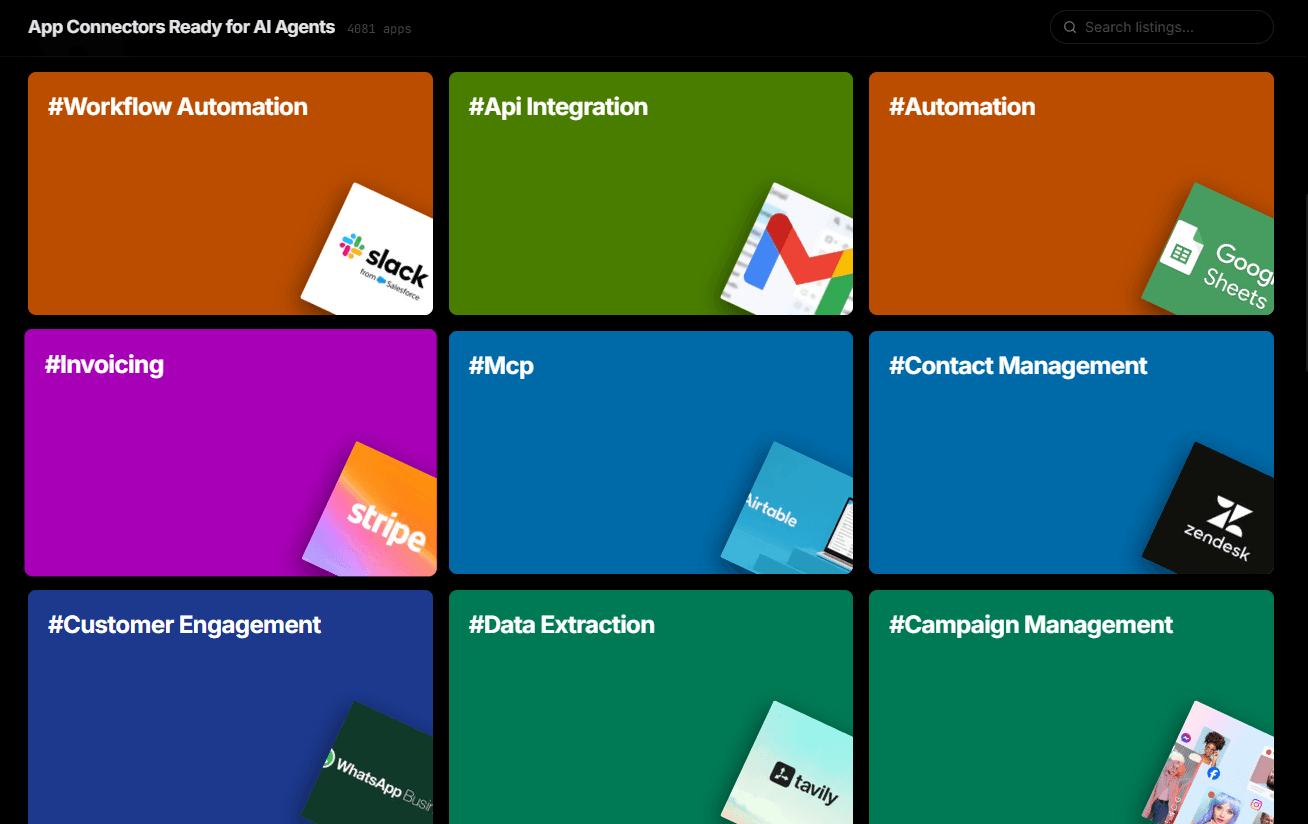
Over 4,000 integrations ready for AI agents
Explore a vast library of pre-built integrations, optimized and ready to deploy.
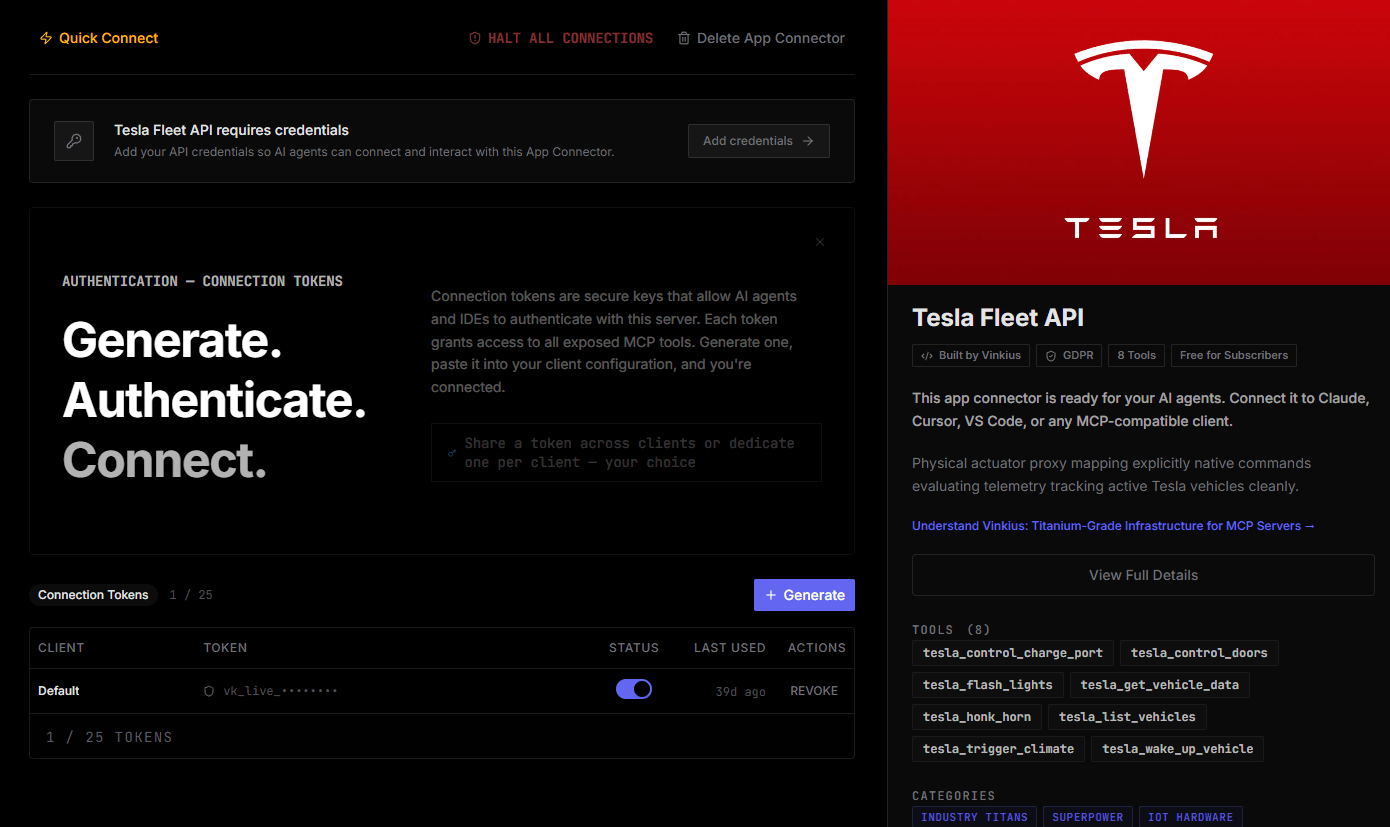
Connect securely in under 30 seconds
Generate tokens to authenticate and link external services in a single step.
Complete visibility into every agent action
Audit live requests, latency, success rates, and active security compliance policies.
Optimize spending and track token ROI
Analyze real-time token consumption and cost metrics detailed by connection.
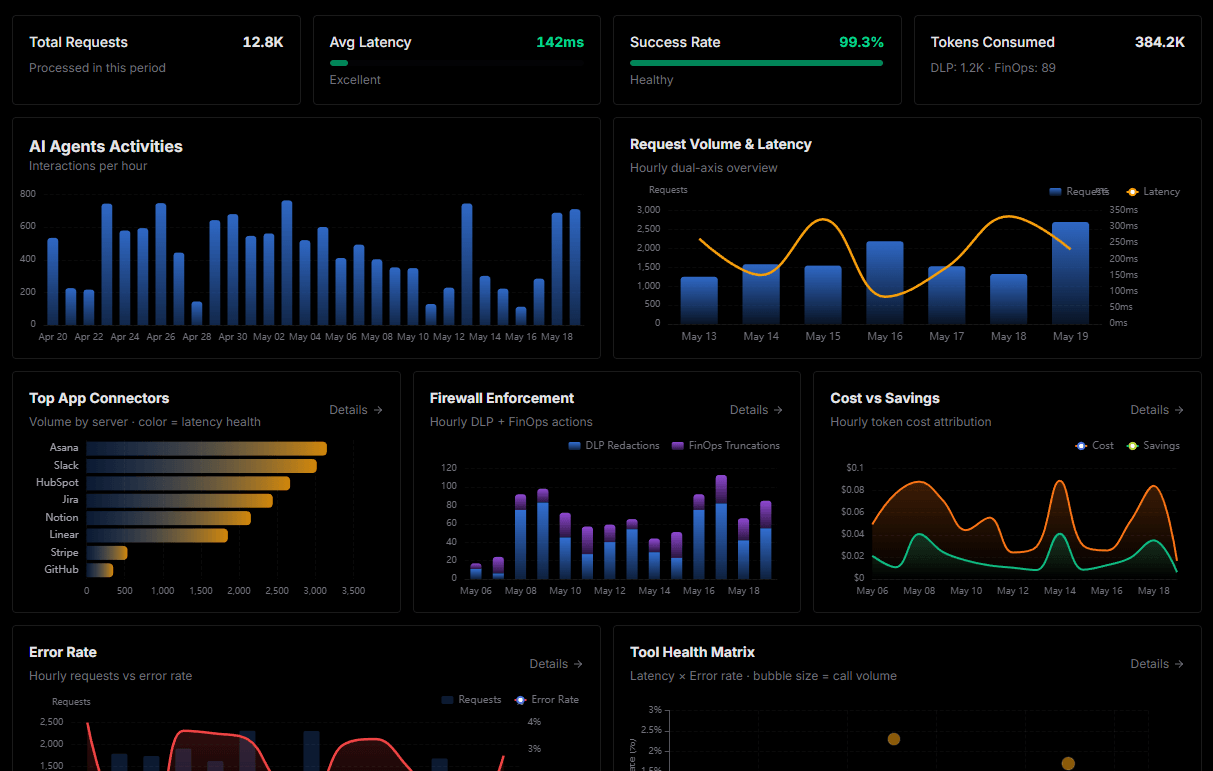
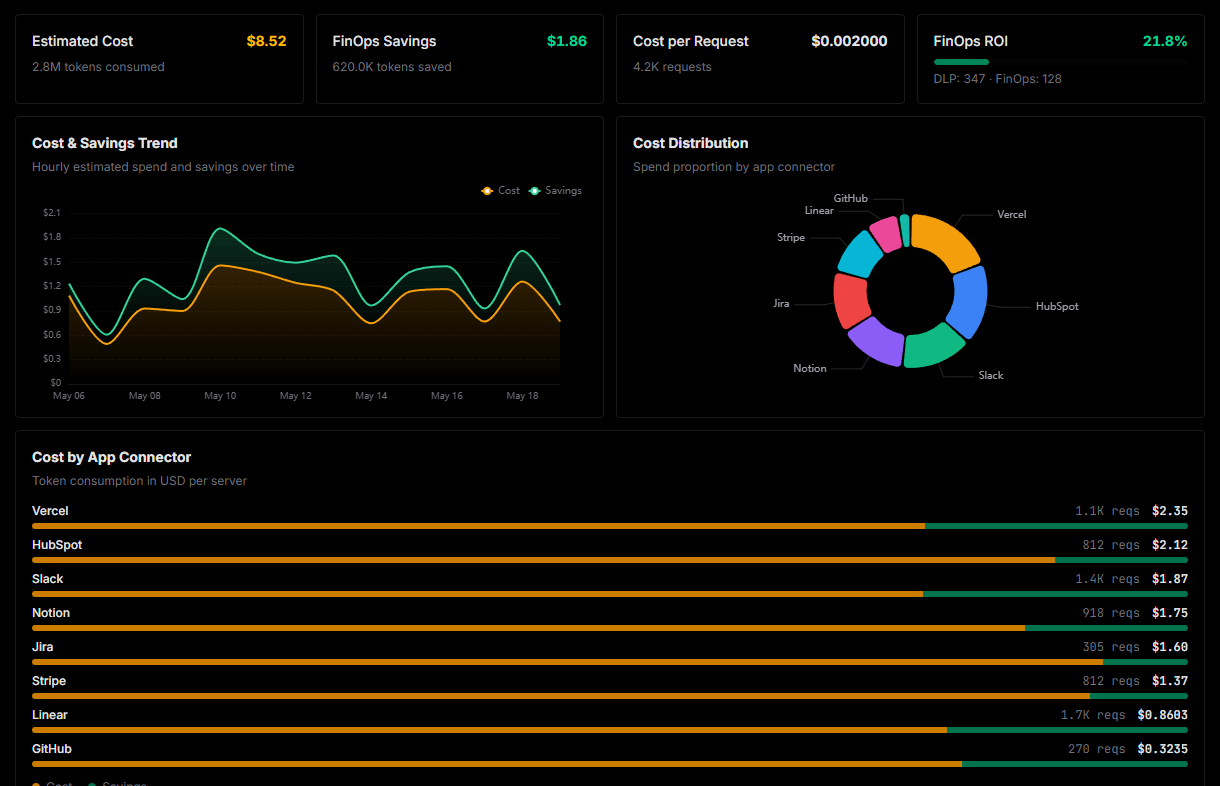
Explore our live AI Agents Analytics dashboard to see it all working
This dashboard is included when you connect DeepSource using Vinkius. You will never be left in the dark about what your AI agents are doing with your tools.
DeepSource and 4,000+ other AI tools. No hosting, no code, ready to use.
Professionals who connect DeepSource to Google ADK through Vinkius don't need to write code, manage servers, or worry about security. Everything is pre-configured, secure, and runs automatically in the background.
Raw MCP | Vinkius | |
|---|---|---|
| Ready-to-use MCPs | Find and configure each manually | 4,000+ MCPs ready to use |
| Connection Setup | Manual coding & server setup | 1-click instant connection |
| Server Hosting | You host it yourself (needs 24/7 uptime) | 100% hosted & managed by Vinkius |
| Security & Privacy | Stored in plaintext config files | Bank-grade encrypted vault |
| Activity Visibility | Blind execution (no logs or tracking) | Live dashboard with real-time logs |
| Cost Control | Runaway AI token spend risk | Automatic budget limits |
| Revoking Access | Must delete files or code to stop | 1-click disconnect button |
How Vinkius secures
DeepSource for Google ADK
Every request between Google ADK and DeepSource is protected by our secure gateway. We automatically keep your sensitive data private, prevent unauthorized access, and let you disconnect instantly at any time.
Frequently asked questions
How do I get a DeepSource Personal Access Token and where do I find it?
Log in to your DeepSource account, go to Account Settings → Personal Access Tokens, and click Create New Token. Give it a descriptive name (e.g., 'Vinkius MCP') and copy the token immediately — it won't be shown again. Paste this token into the API key field below. The token is used as a Bearer token in the Authorization header for all GraphQL requests to https://api.deepsource.com/graphql/.
What types of code issues can DeepSource detect and how are they categorized?
DeepSource detects various code quality issues including code smells, anti-patterns, performance issues, security vulnerabilities, and bugs. Issues are categorized by severity (CRITICAL, HIGH, MEDIUM, LOW) and by analyzer type (e.g., PYTHON for Python issues, JS-A1 for JavaScript anti-patterns, GO for Go issues). Each issue includes a shortcode, title, category, and file locations with line numbers. You can filter issues by analyzer short code when querying repositories.
How does DeepSource detect dependency vulnerabilities and what information is provided?
DeepSource uses Supply Chain Analysis (SCA) to scan dependency manifest files (package.json, requirements.txt, Gemfile, etc.) for known vulnerabilities. Each vulnerability includes: CVE ID, CVSS score (0-10), severity level, description, affected package name and version, ecosystem (npm, pip, etc.), reachability status (whether the vulnerable code is actually called), and fixability (whether a fix version is available). This helps prioritize which vulnerabilities to address first based on real risk rather than just theoretical severity.
What is the API rate limit and how many requests can I make per hour?
DeepSource enforces a rate limit of 5,000 requests per hour per user account. This limit covers both read (queries) and write (mutations) operations. If you exceed this limit, the API will return HTTP 429 (Too Many Requests). For most code review and monitoring workflows, this limit is more than sufficient. If you need higher limits for large-scale analysis, contact DeepSource support.
How does Google ADK connect to MCP servers?
Import the MCP toolset class and pass the server URL. ADK discovers and registers all tools automatically, making them available to your agent's tool-use loop.
Can ADK agents use multiple MCP servers?
Yes. Declare multiple MCP tool providers in your agent configuration. ADK merges all tool schemas and the agent can call tools from any server in a single turn.
Which Gemini models work best with MCP tools?
Gemini 2.0 Flash and Pro models both support function calling required for MCP tools. Flash is recommended for latency-sensitive use cases, Pro for complex reasoning.
McpToolset not found
Update: pip install --upgrade google-adk
Explore More MCP Servers
View all →
Open WebUI
12 toolsManage your Open WebUI instance — list models, handle chat completions, and manage RAG collections directly from any AI agent.

Google Books Alternative
12 toolsSearch the world's most comprehensive index of full-text books, manage personal bookshelves, and retrieve detailed literary metadata.

Orderful
8 toolsEDI integration made simple — manage transactions, relationships, and guidelines via Orderful.

EPA ECHO (Enforcement & Compliance)
7 toolsAccess US EPA environmental compliance data — search facilities, inspect air/water permits, and analyze enforcement history directly.