
Bring Kubernetes
to Google ADK
Create your Vinkius account to connect Rancher to Google ADK and start using all 10 AI tools in minutes. Fully managed, enterprise secure, and ready to use without writing a single line of code. No hosting, no server setup — just connect and start using.
 GDPR Free for Subscribers
Compatible with every major AI agent and IDE
 Gemini
What is the Rancher MCP Server?
Connect your Rancher Kubernetes management platform to your AI agent, allowing seamless orchestration of your container infrastructure directly from a chat interface. By integrating this server, your AI can introspect and interact with multiple remote Kubernetes clusters managed governed by your Rancher deployment.
What you can do
- Cluster Oversight — List and examine the status of all managed clusters connected to your Rancher control plane.
- Namespace Discovery — Explore specific logical partitions (namespaces) within those clusters without digging into complex kubectl configuration.
- Workload Management — Access deployments, daemonsets, and statefulsets to observe operational health across environments.
- Pod Introspection — Query individual pod states, find crashing containers, and pull context faster than running manual CLI queries.
How it works
- Enable the MCP server integration.
- Configure it with your Rancher Server URL and the generated Bearer Token for API authentication.
- Instruct your AI to inspect a cluster, query specific namespaces, or detail the status of a specific pod.
Who is this for?
- DevOps Engineers — Debug and query live cluster statuses interactively, bypassing the need to constantly switch context between terminals and UI dashboards.
- Kubernetes Administrators — Run automated queries to verify policies, scaling sets, and general deployment topologies rapidly.
- Backend Developers — Ensure microservices are running smoothly on target clusters and verify namespace health without complex local setups.
Built-in capabilities (10)
Retrieves details for a specific Kubernetes cluster
Retrieves details for a specific Rancher project
Lists Helm applications installed in a project
Lists available Helm chart repositories (Catalogs)
Lists all Kubernetes clusters managed by Rancher
Lists Kubernetes namespaces associated with a project
Lists all nodes within a specific cluster
Use this to find project IDs. Lists logical projects within a cluster
Lists all user accounts in the Rancher platform
Lists all Kubernetes workloads (Deployments, StatefulSets) in a project
Why Google ADK?
Google ADK natively supports Rancher as an MCP tool provider. declare Vinkius Edge URL and the framework handles discovery, validation, and execution automatically. Combine 10 tools with Gemini's long-context reasoning for complex multi-tool workflows, with production-ready session management and evaluation built in.
- —
Google ADK natively supports MCP tool servers. declare a tool provider and the framework handles discovery, validation, and execution
- —
Built on Gemini models, ADK provides long-context reasoning ideal for complex multi-tool workflows with Rancher
- —
Production-ready features like session management, evaluation, and deployment come built-in. not bolted on
- —
Seamless integration with Google Cloud services means you can combine Rancher tools with BigQuery, Vertex AI, and Cloud Functions
Rancher in Google ADK
Why run Rancher with Vinkius?
The Rancher connection runs on our fully managed, secure cloud infrastructure. We handle the hosting, maintenance, and security so you don't have to deal with servers or code. All 10 tools are ready to work instantly without any complex setup.
You stay in complete control of your data. Your AI only accesses the information you approve, keeping your sensitive passwords and private details completely safe. Plus, with automatic optimizations, your AI works faster and more efficiently.
* Every connection is hosted and maintained by Vinkius. We handle the security, updates, and infrastructure so you don't have to write code or manage servers. See our infrastructure
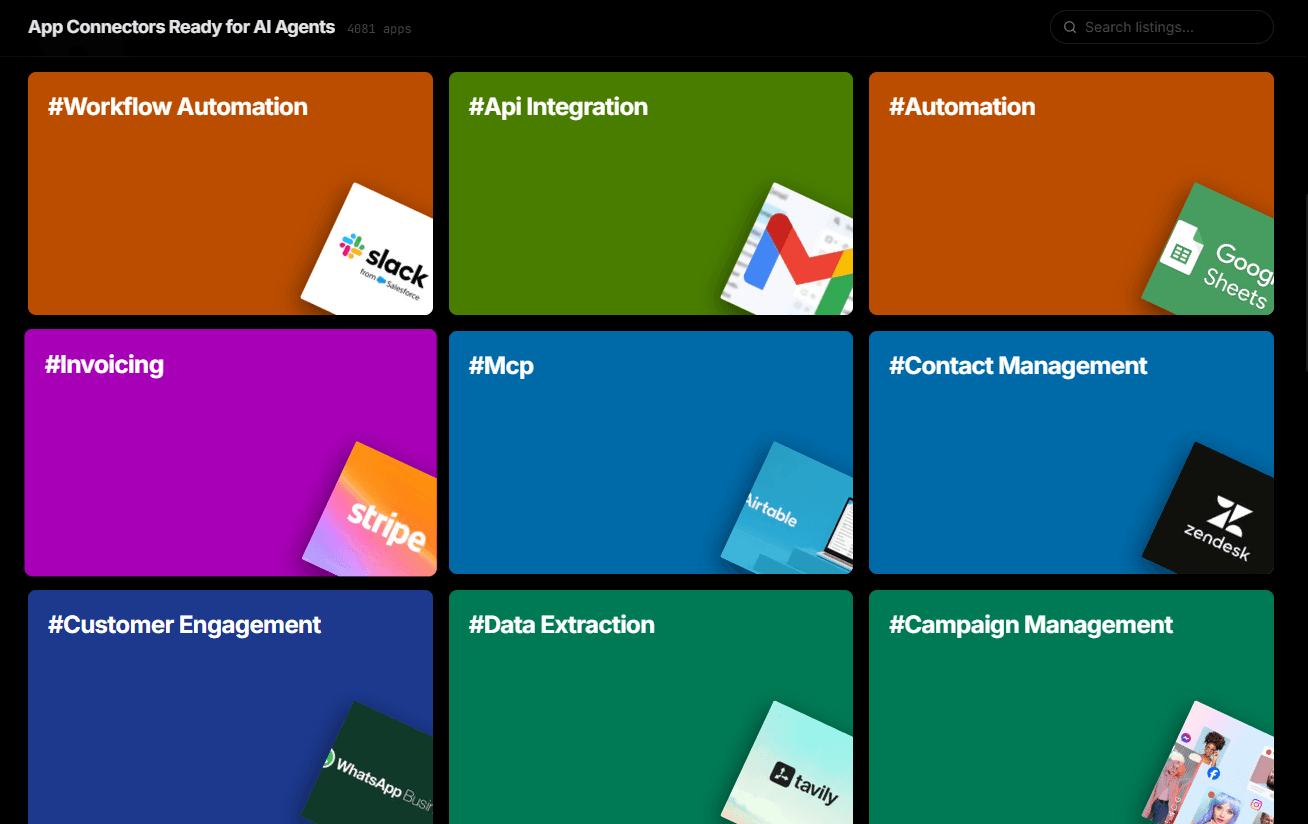
Over 4,000 integrations ready for AI agents
Explore a vast library of pre-built integrations, optimized and ready to deploy.
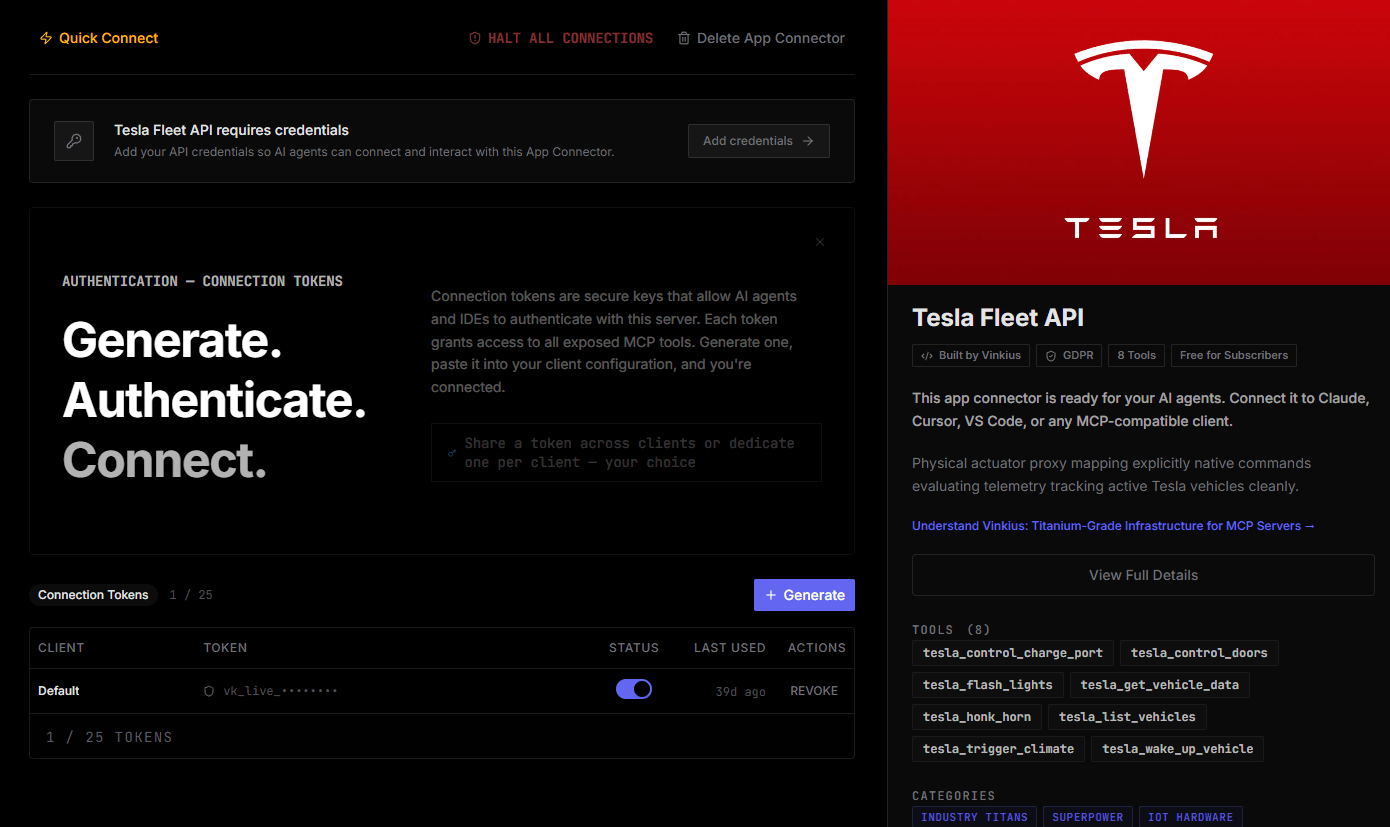
Connect securely in under 30 seconds
Generate tokens to authenticate and link external services in a single step.
Complete visibility into every agent action
Audit live requests, latency, success rates, and active security compliance policies.
Optimize spending and track token ROI
Analyze real-time token consumption and cost metrics detailed by connection.
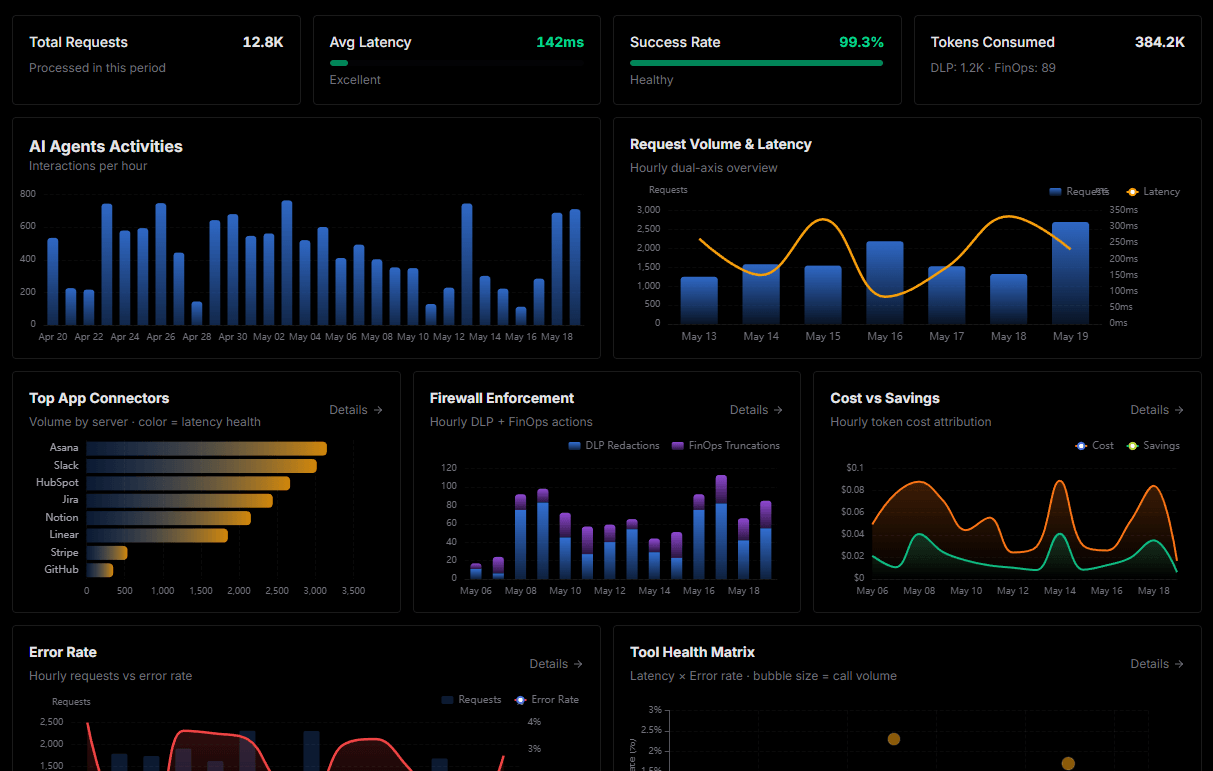
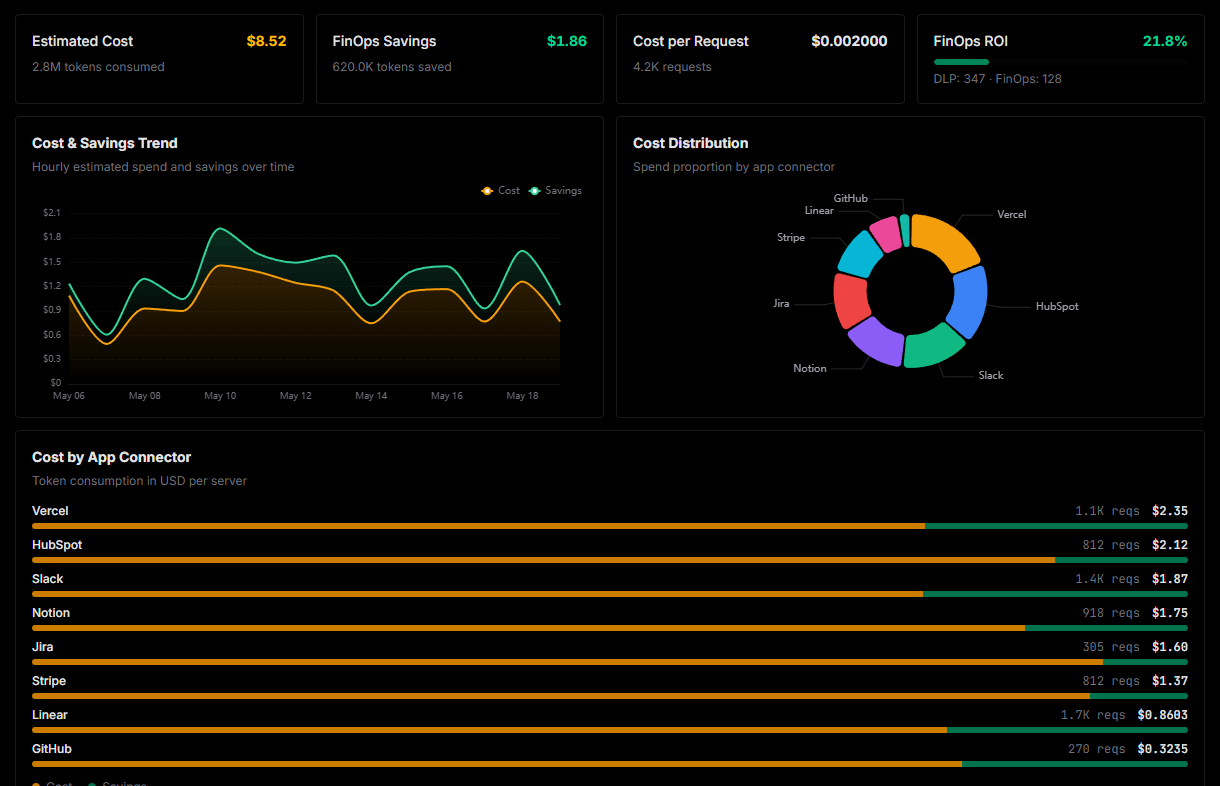
Explore our live AI Agents Analytics dashboard to see it all working
This dashboard is included when you connect Rancher using Vinkius. You will never be left in the dark about what your AI agents are doing with your tools.
Rancher and 4,000+ other AI tools. No hosting, no code, ready to use.
Professionals who connect Rancher to Google ADK through Vinkius don't need to write code, manage servers, or worry about security. Everything is pre-configured, secure, and runs automatically in the background.
Raw MCP | Vinkius | |
|---|---|---|
| Ready-to-use MCPs | Find and configure each manually | 4,000+ MCPs ready to use |
| Connection Setup | Manual coding & server setup | 1-click instant connection |
| Server Hosting | You host it yourself (needs 24/7 uptime) | 100% hosted & managed by Vinkius |
| Security & Privacy | Stored in plaintext config files | Bank-grade encrypted vault |
| Activity Visibility | Blind execution (no logs or tracking) | Live dashboard with real-time logs |
| Cost Control | Runaway AI token spend risk | Automatic budget limits |
| Revoking Access | Must delete files or code to stop | 1-click disconnect button |
How Vinkius secures
Rancher for Google ADK
Every request between Google ADK and Rancher is protected by our secure gateway. We automatically keep your sensitive data private, prevent unauthorized access, and let you disconnect instantly at any time.
Frequently asked questions
How do I generate a Bearer Token in Rancher?
Log into your Rancher UI. Go to your User Profile menu and select 'API & Keys'. Create a new API Key with appropriate scopes. Combine the generated Access Key and Secret Key using a colon (AccessKey:SecretKey), or use the final Bearer Token provided to authenticate the MCP server.
Does the integration require direct cluster network access?
No, the MCP server acts exclusively by pinging the overarching main Rancher Server API URL rather than connecting locally to standard cluster API endpoints separately. Your network configuration remains secure as it relies completely on the Rancher gateway role.
Can I deploy new workloads to my cluster via the chat interface?
Currently, the server allows listing and fetching comprehensive statuses for namespaces, workloads, endpoints, clusters, and pods natively to observe the infrastructure state interactively without allowing unmanaged destructive configurations to roll out purely based on prompt.
How does Google ADK connect to MCP servers?
Import the MCP toolset class and pass the server URL. ADK discovers and registers all tools automatically, making them available to your agent's tool-use loop.
Can ADK agents use multiple MCP servers?
Yes. Declare multiple MCP tool providers in your agent configuration. ADK merges all tool schemas and the agent can call tools from any server in a single turn.
Which Gemini models work best with MCP tools?
Gemini 2.0 Flash and Pro models both support function calling required for MCP tools. Flash is recommended for latency-sensitive use cases, Pro for complex reasoning.
McpToolset not found
Update: pip install --upgrade google-adk
Explore More MCP Servers
View all →
HotDocs
14 toolsAutomate document assembly via HotDocs Advance — list templates, create work items, conduct interviews, and generate documents directly from any AI agent.

Monzo Banking
3 toolsUniversal Monzo intelligence — check balances, accounts, and transactions via AI.
Amazon Redshift
7 toolsEquip your AI to directly query, analyze, and manage your petabyte-scale data warehouse via the serverless AWS Redshift Data API.
DataScope
6 toolsCreate mobile forms for field inspections, audits, and data collection that work offline and sync when connectivity returns.