
Bring Sso
to Pydantic AI
Create your Vinkius account to connect Ping Identity to Pydantic AI and start using all 10 AI tools in minutes. Fully managed, enterprise secure, and ready to use without writing a single line of code. No hosting, no server setup — just connect and start using.
 GDPR Free for Subscribers
Compatible with every major AI agent and IDE
 Gemini
What is the Ping Identity MCP Server?
Connect your Ping Identity environment to any AI agent to streamline identity and access management (IAM). You can audit users, check security policies, and review applications directly through conversation.
What you can do
- User Management — List identities, view detailed user profiles, and safely delete users across the enterprise directory.
- Applications & Groups — Audit all Web, Native, or SPA apps federated under your environment, and list active IAM groups.
- Populations — Review isolated populations dividing contractors, partners, or B2B clients.
- Risk & Policies — Inspect active Risk Management rules and Zero-Trust sign-on workflows dictating real-time MFA.
How it works
- Subscribe to this server
- Enter your PingOne Environment ID and API Token
- Start managing your enterprise identity posture from Claude, Cursor, or any MCP-compatible client
Who is this for?
- IAM Administrators — audit active user populations, access groups, and verify application settings faster.
- Security Engineers — review real-time risk policies, sign-on flows, and MFA requirements instantly without navigating consoles.
- IT Support — quickly fetch specific user metadata and check active session/credential health.
Built-in capabilities (10)
Revokes all current session tokens, nullifies application scopes, isolates SCIM directory references, and executes the formal deletion API. Hard delete a user identity and purge related credentials
Determines configured Implicit/Authorization Code grants, token lifespan definitions, embedded sign-on policies, and allowed callback URIs required for stringent redirection security mapping. Get configuration for a single federated Ping Identity application
View explicit details encompassing a standard Ping Group
Get complete contextual metadata for a specific Ping Identity user
Crucial to verify application exposure footprint. List Web, Native or SPA apps federated under standard PingOne
Allows mapping high-level RBAC scopes dynamically injected into ID tokens returned via SSO channels upon successful client authorization flows. List identity Groups utilized for aggregate permissions
g., 'Contractors', 'Partners', 'B2B Clients') possessing inherently different default password complexities, independent password expiration parameters, and isolated self-service recovery scopes. List isolated Populations logically partitioning the Environment
Evaluates contextual IP anomalies, impossible travel, blocklisted VPN routes, or behavioral irregularities explicitly stepping up authentication flows or directly blocking malicious login execution. List active Risk Management rules dictating real-time MFA
Sign-on policies chain distinct rules together enforcing explicit MFA prompts, enforcing complex password structures based on population assignment, or mandating implicit biometric validation prior to releasing environment tokens. List logical Sign-on flows and strict authentication conditions
Paginates across all bounded external and internal localized users containing primary credentials, deeply nested JSON identifiers, and physical verification states assigned under the Enterprise Directory schema. List all user identities within the standard PingOne Environment
Why Pydantic AI?
Pydantic AI validates every Ping Identity tool response against typed schemas, catching data inconsistencies at build time. Connect 10 tools through Vinkius and switch between OpenAI, Anthropic, or Gemini without changing your integration code. full type safety, structured output guarantees, and dependency injection for testable agents.
- —
Full type safety: every MCP tool response is validated against Pydantic models, catching data inconsistencies before they reach your application
- —
Model-agnostic architecture. switch between OpenAI, Anthropic, or Gemini without changing your Ping Identity integration code
- —
Structured output guarantee: Pydantic AI ensures tool results conform to defined schemas, eliminating runtime type errors
- —
Dependency injection system cleanly separates your Ping Identity connection logic from agent behavior for testable, maintainable code
Ping Identity in Pydantic AI
Why run Ping Identity with Vinkius?
The Ping Identity connection runs on our fully managed, secure cloud infrastructure. We handle the hosting, maintenance, and security so you don't have to deal with servers or code. All 10 tools are ready to work instantly without any complex setup.
You stay in complete control of your data. Your AI only accesses the information you approve, keeping your sensitive passwords and private details completely safe. Plus, with automatic optimizations, your AI works faster and more efficiently.
* Every connection is hosted and maintained by Vinkius. We handle the security, updates, and infrastructure so you don't have to write code or manage servers. See our infrastructure
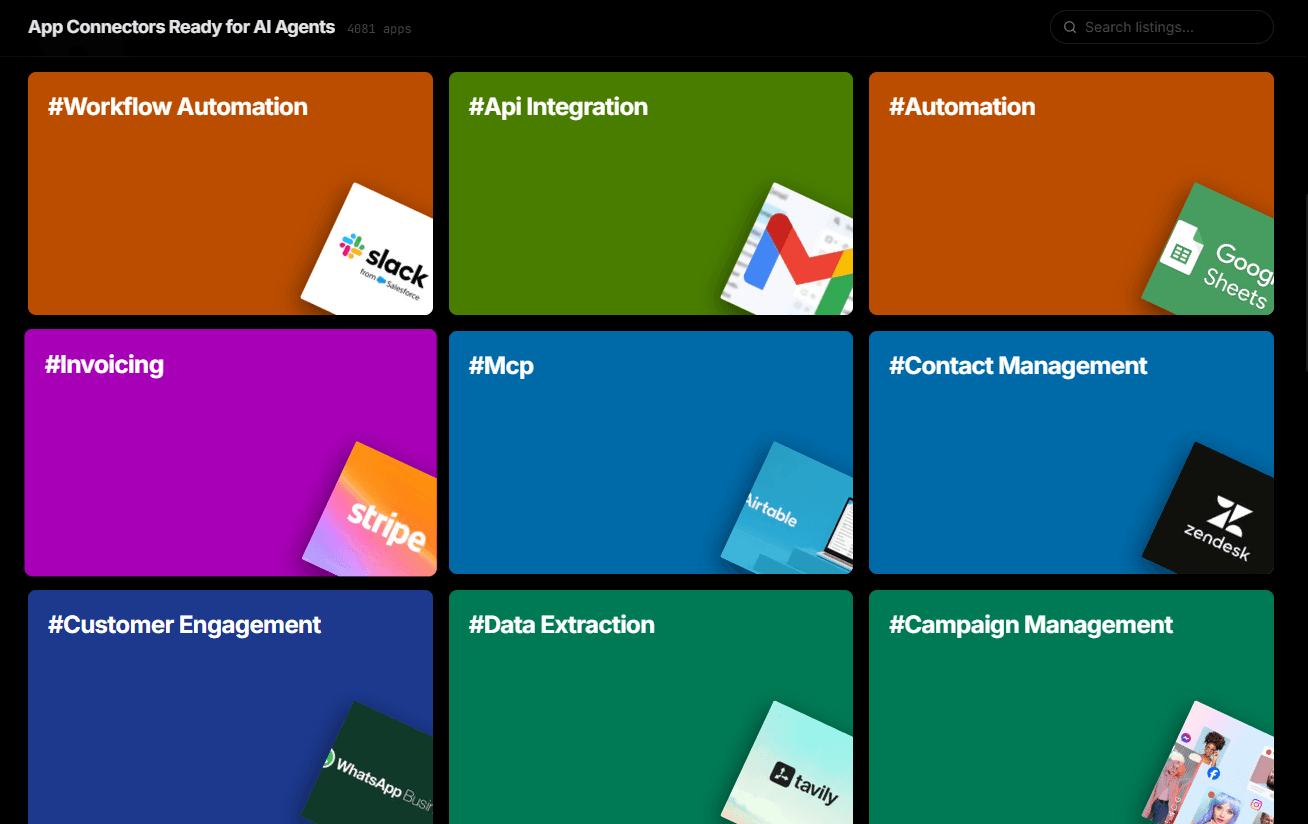
Over 4,000 integrations ready for AI agents
Explore a vast library of pre-built integrations, optimized and ready to deploy.
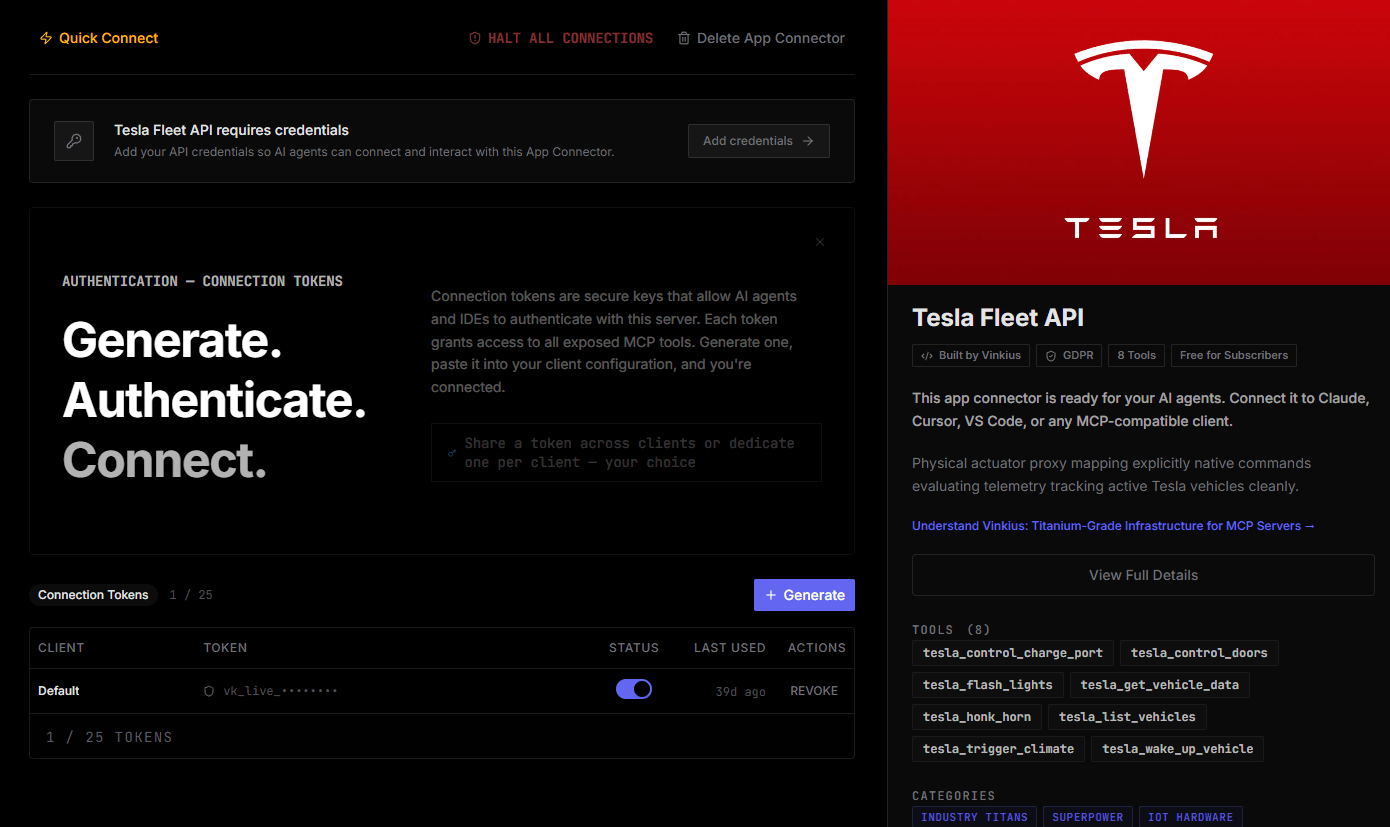
Connect securely in under 30 seconds
Generate tokens to authenticate and link external services in a single step.
Complete visibility into every agent action
Audit live requests, latency, success rates, and active security compliance policies.
Optimize spending and track token ROI
Analyze real-time token consumption and cost metrics detailed by connection.
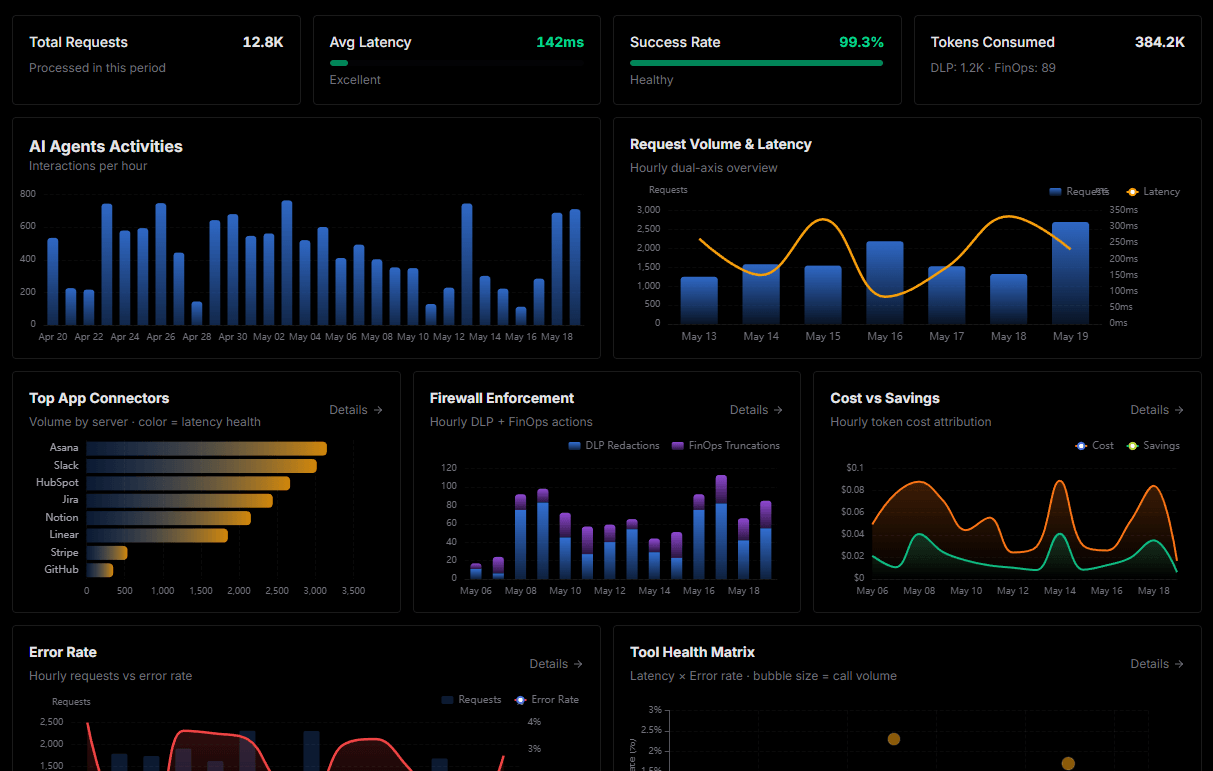
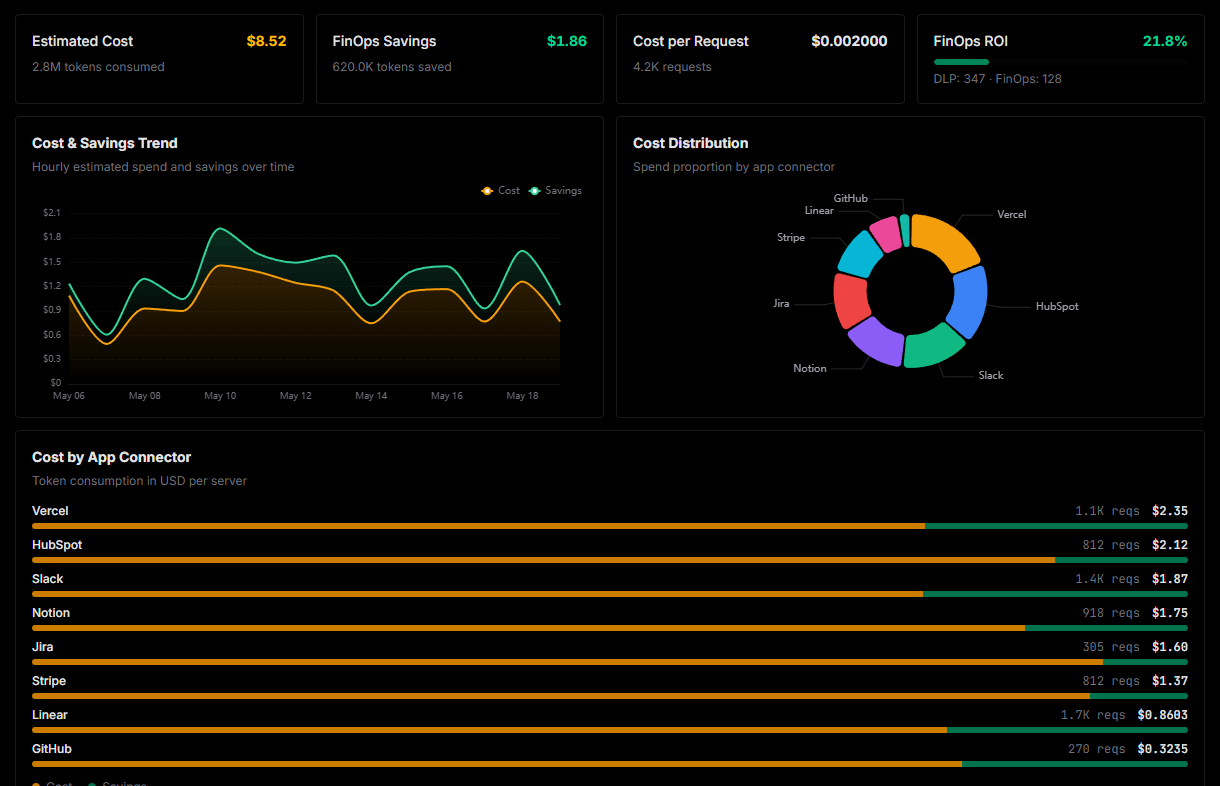
Explore our live AI Agents Analytics dashboard to see it all working
This dashboard is included when you connect Ping Identity using Vinkius. You will never be left in the dark about what your AI agents are doing with your tools.
Ping Identity and 4,000+ other AI tools. No hosting, no code, ready to use.
Professionals who connect Ping Identity to Pydantic AI through Vinkius don't need to write code, manage servers, or worry about security. Everything is pre-configured, secure, and runs automatically in the background.
Raw MCP | Vinkius | |
|---|---|---|
| Ready-to-use MCPs | Find and configure each manually | 4,000+ MCPs ready to use |
| Connection Setup | Manual coding & server setup | 1-click instant connection |
| Server Hosting | You host it yourself (needs 24/7 uptime) | 100% hosted & managed by Vinkius |
| Security & Privacy | Stored in plaintext config files | Bank-grade encrypted vault |
| Activity Visibility | Blind execution (no logs or tracking) | Live dashboard with real-time logs |
| Cost Control | Runaway AI token spend risk | Automatic budget limits |
| Revoking Access | Must delete files or code to stop | 1-click disconnect button |
How Vinkius secures
Ping Identity for Pydantic AI
Every request between Pydantic AI and Ping Identity is protected by our secure gateway. We automatically keep your sensitive data private, prevent unauthorized access, and let you disconnect instantly at any time.
Frequently asked questions
Can my AI automatically detect insecure applications federated under my PingOne Environment?
Yes. Ask the agent to list all applications and their OIDC/SAML parameters. It will return grant types and callback URIs. You can instruct your AI to identify any applications exposing excessive grants, lacking mandatory PKCE, or missing secure redirection URLs.
Can I use the agent to investigate complex zero-trust policies?
Absolutely. Query the agent for your current Risk Policies and Sign-On Policies. The AI translates raw rulesets (like IP anomalies, VPN blocklists, or ML-based behavioral steps) into human-readable summaries, letting you track how authentication flows operate without reverse-engineering JSON files.
How does the agent organize directories inside PingOne?
The agent can separate users utilizing Ping Identity's native Population boundaries and abstract mapping Groups. You can list all Populations to see distinct buckets entirely independent of each other, enforcing different self-service and strict password compliance boundaries globally across your organization.
How does Pydantic AI discover MCP tools?
Create an MCPServerHTTP instance with the server URL. Pydantic AI connects, discovers all tools, and generates typed Python interfaces automatically.
Does Pydantic AI validate MCP tool responses?
Yes. When you define result types as Pydantic models, every tool response is validated against the schema. Invalid data raises a clear error instead of silently corrupting your pipeline.
Can I switch LLM providers without changing MCP code?
Absolutely. Pydantic AI abstracts the model layer. your Ping Identity MCP integration works identically with OpenAI, Anthropic, Google, or any supported provider.
MCPServerHTTP not found
Update: pip install --upgrade pydantic-ai
Explore More MCP Servers
View all →
Beisen (iTalentX)
10 toolsComprehensive HR cloud platform — manage employees, attendance, and recruitment via AI.

DebtPayPro
10 toolsEquip your AI agent to manage contacts, track payments, and monitor sales opportunities via the DebtPayPro API.
KeyPay
10 toolsManage payroll, employees, and pay runs via the Employment Hero Payroll (KeyPay) API.
8x8 Work
3 toolsBusiness communication analytics — audit call records, extension performance, and ring groups via AI.