
Bring Stock Levels
to AutoGen
Create your Vinkius account to connect Odoo Inventory to AutoGen and start using all 9 AI tools in minutes. Fully managed, enterprise secure, and ready to use without writing a single line of code. No hosting, no server setup — just connect and start using.
 GDPR Free for Subscribers
Compatible with every major AI agent and IDE
 Gemini
What is the Odoo Inventory MCP Server?
Connect Odoo ERP to any AI agent — manage your entire business without switching tabs.
What you can do
- CRM — Search and create leads, track opportunities through your pipeline
- Contacts — Find individual contacts and companies, create new partners
- Sales — List and manage sales orders with full order details
- Notes — Add comments and notes to any record in your Odoo instance
Who is this for?
- Sales Teams — CRM pipeline at your fingertips through AI
- Account Managers — Quick access to contact and company information
- Operations — Monitor sales orders without switching screens
- Odoo Administrators — Query any module through natural conversation
Built-in capabilities (9)
picking record with all fields including move line IDs. Use after listing transfers to drill into a specific receipt, delivery, or internal transfer for full details. Get complete details of a specific stock transfer including its individual stock move lines
quant records where inventory_quantity_set is true — these are quants with a proposed adjustment that has not yet been applied. Use when the user asks about pending stock corrections, cycle count discrepancies, or inventory adjustments awaiting approval. List pending inventory adjustments that need to be validated or reviewed by a warehouse manager
location records with usage="internal" — the physical locations where stock is stored. Returns location name, full hierarchical path (e.g., WH/Stock/Zone A), and parent warehouse. Use when the user needs to find specific storage locations, plan inventory placement, or understand the warehouse structure. List internal stock locations (bins, zones, shelves) within Odoo warehouses
move records ordered by date descending. Each move represents a single product movement from one location to another. Returns product name, quantity, state, origin/destination locations, and source document. Use when the user needs a granular audit trail of what moved where and when. List recent individual stock movements showing product, quantity, source, destination, and processing state
picking records — each represents a batch of stock moves like incoming shipments, outgoing deliveries, or internal transfers. Returns transfer reference, partner, operation type, state (draft/waiting/confirmed/assigned/done), source document (e.g., SO or PO number), scheduled date, and source/destination locations. Filter by state to see only pending, ready, or completed transfers. List stock transfers (receipts, deliveries, internal moves) in Odoo with their current processing status
warehouse records. Each warehouse has a name, short code (e.g., WH, WH2), and linked partner/address. Warehouses are the top-level organizational unit in Odoo Inventory. Use when the user asks about warehouse locations, needs warehouse codes for transfers, or wants an overview of the logistics network. List all configured warehouses in Odoo with their short codes and addresses
quant records for the given product ID, showing quantity and reserved quantity at each internal location. Use when the user needs to know WHERE stock is located, not just the total — e.g., "how much of Product X is in Warehouse A vs Warehouse B?" Get detailed stock levels for a specific product broken down by warehouse location
product records (variants) by name. Returns product name, internal reference (SKU), quantity on hand (qty_available), forecasted quantity (virtual_available), incoming qty, outgoing qty, category, and product type. Use when the user wants to check stock levels, find products with low inventory, or verify availability before fulfillment. Search products in Odoo Inventory with real-time stock quantities, including available, incoming, and outgoing
lot records by name/number. Returns lot name, associated product, and total quantity in that lot. Use for traceability — when the user needs to find which products belong to a specific batch, or trace a serial number back to its origin. Search for lot numbers or serial numbers in Odoo to trace product batches
Why AutoGen?
AutoGen enables multi-agent conversations where agents negotiate, delegate, and collaboratively use Odoo Inventory tools. Connect 9 tools through Vinkius and assign role-based access. a data analyst queries while a reviewer validates, with optional human-in-the-loop approval for sensitive operations.
- —
Multi-agent conversations: multiple AutoGen agents discuss, delegate, and collaboratively use Odoo Inventory tools to solve complex tasks
- —
Role-based architecture lets you assign Odoo Inventory tool access to specific agents. a data analyst queries while a reviewer validates
- —
Human-in-the-loop support: agents can pause for human approval before executing sensitive Odoo Inventory tool calls
- —
Code execution sandbox: AutoGen agents can write and run code that processes Odoo Inventory tool responses in an isolated environment
Odoo Inventory in AutoGen
Why run Odoo Inventory with Vinkius?
The Odoo Inventory connection runs on our fully managed, secure cloud infrastructure. We handle the hosting, maintenance, and security so you don't have to deal with servers or code. All 9 tools are ready to work instantly without any complex setup.
You stay in complete control of your data. Your AI only accesses the information you approve, keeping your sensitive passwords and private details completely safe. Plus, with automatic optimizations, your AI works faster and more efficiently.
* Every connection is hosted and maintained by Vinkius. We handle the security, updates, and infrastructure so you don't have to write code or manage servers. See our infrastructure
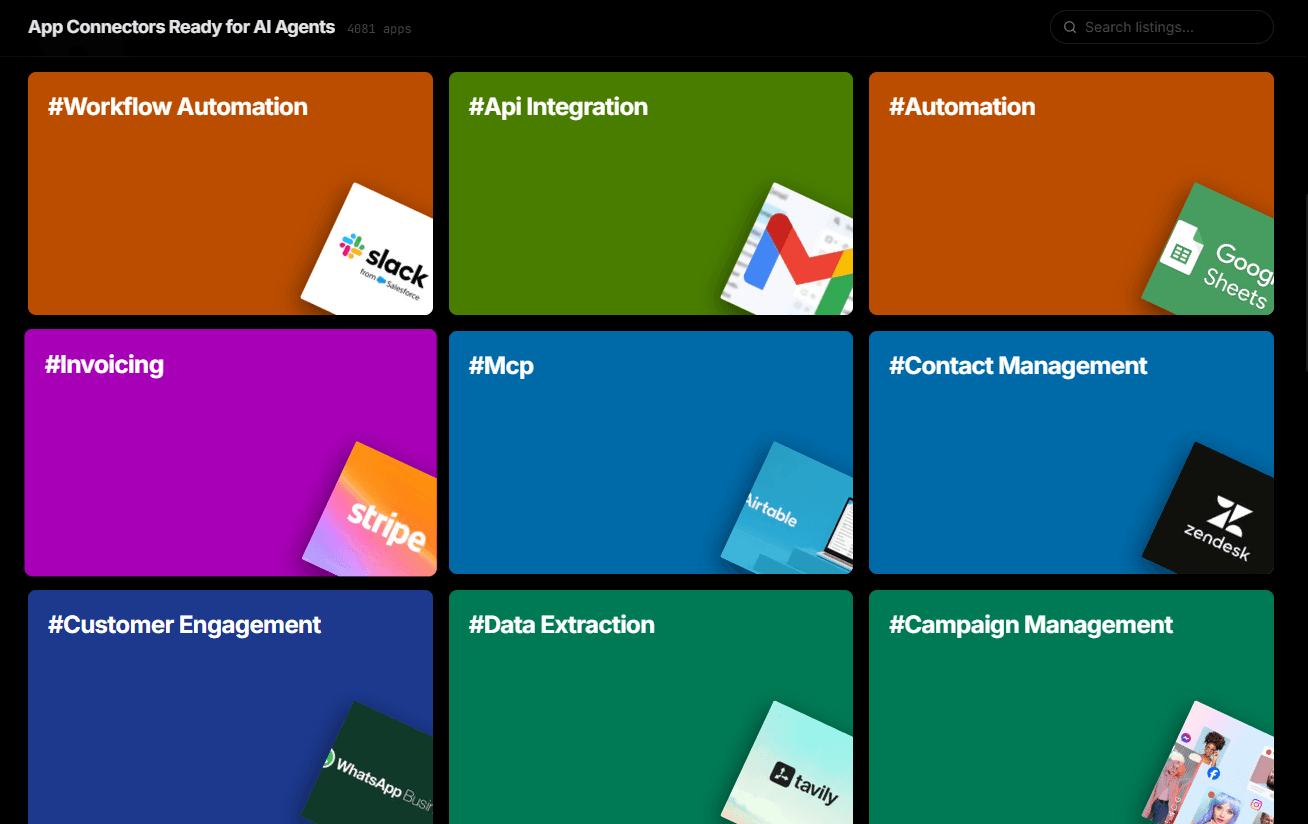
Over 4,000 integrations ready for AI agents
Explore a vast library of pre-built integrations, optimized and ready to deploy.
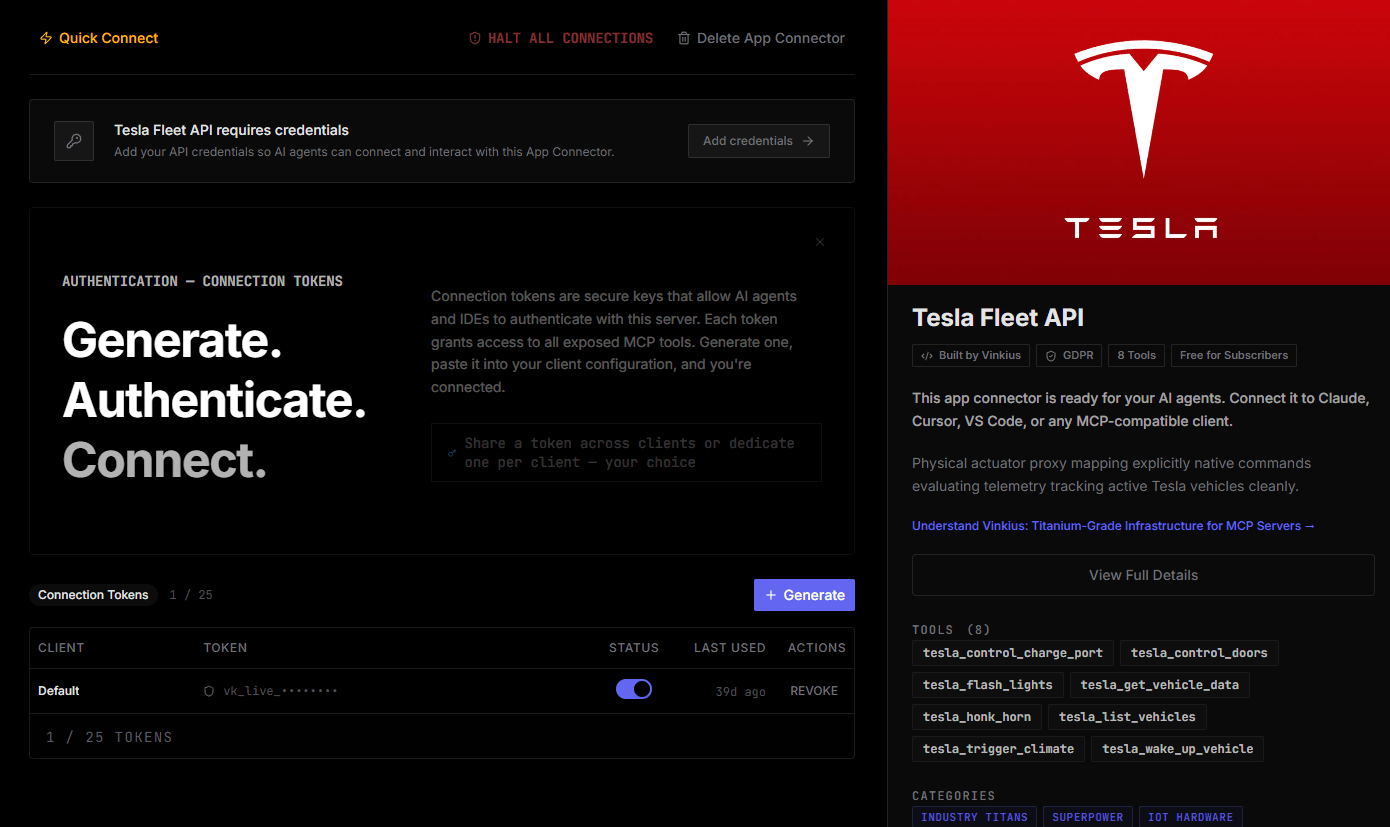
Connect securely in under 30 seconds
Generate tokens to authenticate and link external services in a single step.
Complete visibility into every agent action
Audit live requests, latency, success rates, and active security compliance policies.
Optimize spending and track token ROI
Analyze real-time token consumption and cost metrics detailed by connection.
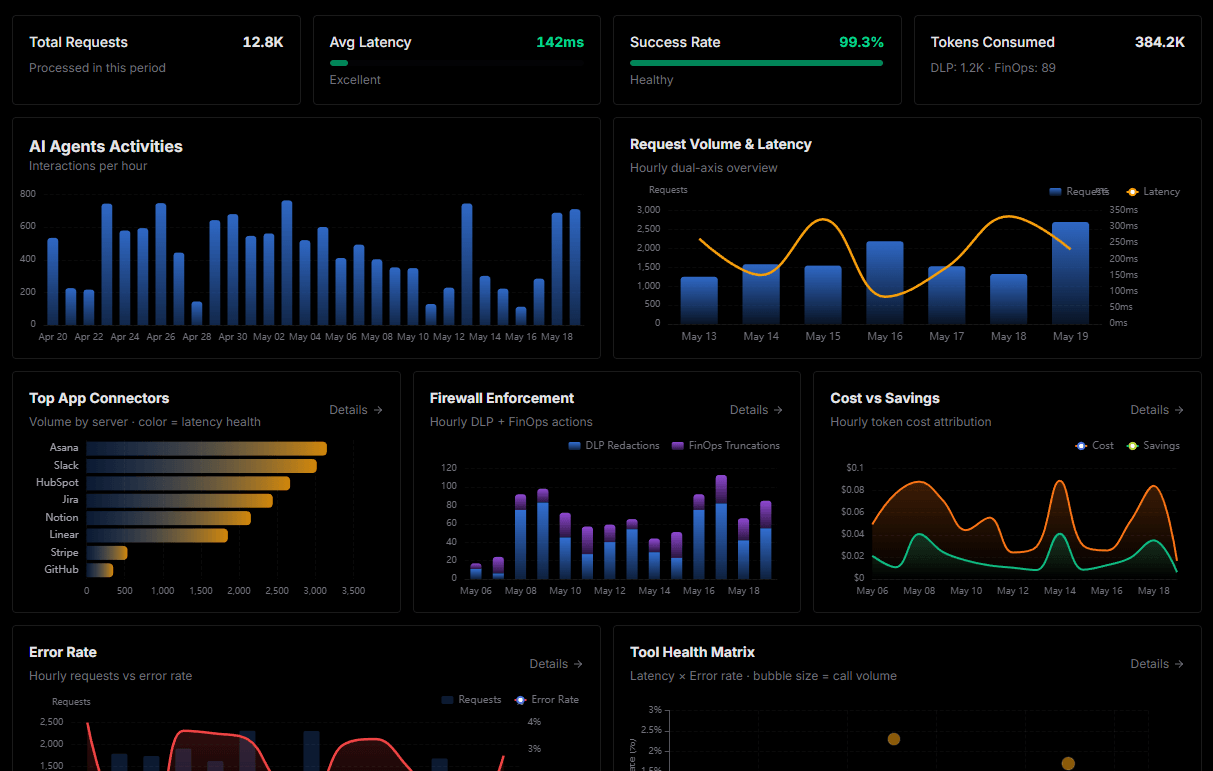
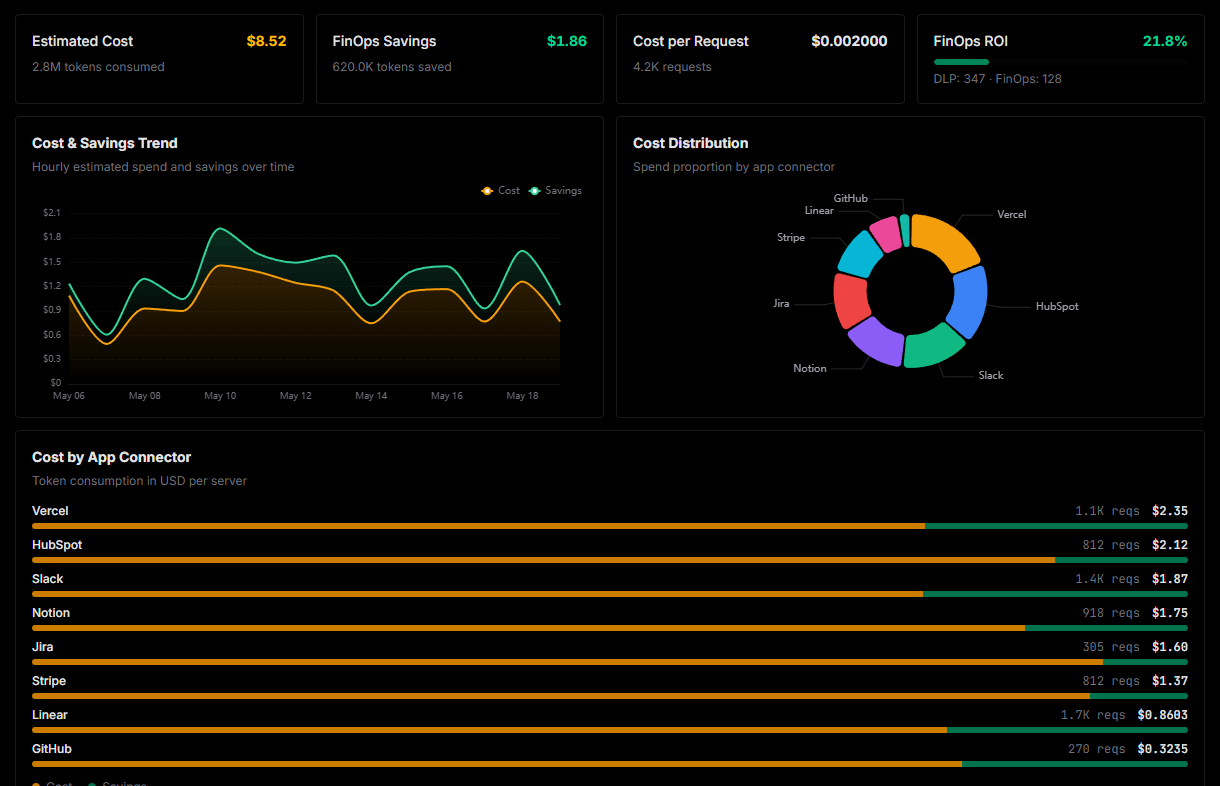
Explore our live AI Agents Analytics dashboard to see it all working
This dashboard is included when you connect Odoo Inventory using Vinkius. You will never be left in the dark about what your AI agents are doing with your tools.
Odoo Inventory and 4,000+ other AI tools. No hosting, no code, ready to use.
Professionals who connect Odoo Inventory to AutoGen through Vinkius don't need to write code, manage servers, or worry about security. Everything is pre-configured, secure, and runs automatically in the background.
Raw MCP | Vinkius | |
|---|---|---|
| Ready-to-use MCPs | Find and configure each manually | 4,000+ MCPs ready to use |
| Connection Setup | Manual coding & server setup | 1-click instant connection |
| Server Hosting | You host it yourself (needs 24/7 uptime) | 100% hosted & managed by Vinkius |
| Security & Privacy | Stored in plaintext config files | Bank-grade encrypted vault |
| Activity Visibility | Blind execution (no logs or tracking) | Live dashboard with real-time logs |
| Cost Control | Runaway AI token spend risk | Automatic budget limits |
| Revoking Access | Must delete files or code to stop | 1-click disconnect button |
How Vinkius secures
Odoo Inventory for AutoGen
Every request between AutoGen and Odoo Inventory is protected by our secure gateway. We automatically keep your sensitive data private, prevent unauthorized access, and let you disconnect instantly at any time.
Frequently asked questions
Which Odoo versions are supported?
This server uses the JSON-RPC protocol, which is compatible with Odoo 14, 15, 16, 17, and 18. Both Odoo Community and Enterprise editions are supported.
Does it work with Odoo.com (SaaS)?
Yes! Works with both Odoo.com hosted instances and self-hosted Odoo servers. Just provide your instance URL and API key.
How do I generate an API Key?
Go to Settings → Users → select your user → API Keys tab → New API Key. Give it a descriptive name and copy the generated key.
How does AutoGen connect to MCP servers?
Create an MCP tool adapter and assign it to one or more agents in the group chat. AutoGen agents can then call Odoo Inventory tools during their conversation turns.
Can different agents have different MCP tool access?
Yes. AutoGen's role-based architecture lets you assign specific MCP tools to specific agents, so a querying agent has different capabilities than a reviewing agent.
Does AutoGen support human approval for tool calls?
Yes. Configure human-in-the-loop mode so agents pause and request approval before executing sensitive MCP tool calls.
McpWorkbench not found
Install: pip install "autogen-ext[mcp]"
Explore More MCP Servers
View all →
Baota Panel / 宝塔面板 API
10 toolsLeading server management panel in China — manage websites, databases, and system resources via AI.

Genius
7 toolsSearch songs, get lyrics, annotations and artist info — the world's largest lyrics database.
ScrapingAnt
5 toolsExtract web data reliably with rotating proxies, headless Chrome rendering, and CAPTCHA solving built into every request.

Health XML Export Parser
1 toolsParse massive Apple Health or Google Fit XML exports safely without blowing up your AI's context window. Extracts actionable health metrics instantly.