
Bring Video Surveillance
to Claude Desktop
Create your Vinkius account to connect Arlo Smart to Claude Desktop and start using all 11 AI tools in minutes. Fully managed, enterprise secure, and ready to use without writing a single line of code. No hosting, no server setup — just connect and start using.
 GDPR Free for Subscribers
Compatible with every major AI agent and IDE
 Gemini
What is the Arlo Smart MCP Server?
Connect to Arlo Smart API and control your Arlo security cameras, review recordings, and manage security modes from any AI agent. Arm and disarm cameras, browse recorded videos, and monitor your home security through natural language commands.
What you can do
- Device Discovery — List all Arlo devices including basestations, cameras, doorbells, and floodlights
- Recording Access — Browse and download recorded videos from any camera with presigned URLs
- Recent Activity — Quickly check today's recordings across all cameras
- Security Modes — View and change automation modes (armed, disarmed, custom modes)
- Arm/Disarm — Enable or disable security monitoring on individual devices or basestations
- Recording Management — Delete old recordings to free up cloud storage space
- Metadata Access — Get detailed recording metadata including duration, timestamps, and download links
How it works
- Subscribe to this server
- Enter your Arlo authentication token
- Start controlling your Arlo security system from Claude, Cursor, or any MCP-compatible client
Your AI becomes a security assistant, helping you monitor recordings, manage security modes, and protect your home.
Who is this for?
- Homeowners — monitor security cameras and review recordings through natural language
- Property Managers — manage Arlo security systems across multiple properties
- Security-Conscious Users — arm/disarm cameras and check recent activity remotely
- Smart Home Enthusiasts — integrate Arlo cameras into broader home automation workflows
- Travelers — check home security recordings and adjust security modes while away
Built-in capabilities (11)
This enables motion detection and recording for the device. USE WHEN: - User wants to enable security monitoring - User asks to "arm the cameras" or "turn on security" - User wants to enable motion detection and recording - User is leaving home and wants security enabled PARAMETERS: - deviceId (REQUIRED): Arlo device ID to arm EXAMPLES: - "Arm the front door camera" → call with deviceId="FRONT_DOOR_ID" - "Enable security on the backyard camera" → call with deviceId="BACKYARD_ID" - "Arm the basestation" → call with deviceId="BASESTATION_ID" Arm an Arlo device (enable security monitoring)
This action is permanent and cannot be undone. USE WHEN: - User wants to free up cloud storage space - User wants to remove old or unwanted recordings - User asks to "delete recordings from [date]" - User is managing their Arlo cloud storage PARAMETERS: - recordings (REQUIRED): JSON array of recording objects to delete (from get_arlo_recordings response) EXAMPLES: - "Delete these recordings" → call with recordings=[{...}] Delete Arlo recordings from the library
This disables motion detection and recording for the device. USE WHEN: - User wants to disable security monitoring - User asks to "disarm the cameras" or "turn off security" - User wants to disable motion detection temporarily - User is home and wants to disable security PARAMETERS: - deviceId (REQUIRED): Arlo device ID to disarm EXAMPLES: - "Disarm the front door camera" → call with deviceId="FRONT_DOOR_ID" - "Disable security on the backyard camera" → call with deviceId="BACKYARD_ID" - "Disarm the basestation" → call with deviceId="BASESTATION_ID" Disarm an Arlo device (disable security monitoring)
Shows whether the device is armed, disarmed, or in a custom mode. Get the current automation modes for an Arlo device
Get detailed metadata for an Arlo recording
Returns presigned URLs for downloading video files along with metadata like duration, device ID, and creation date. USE WHEN: - User wants to download or view Arlo recordings - User needs to check what was recorded on specific dates - User is reviewing security footage - User asks "show me recordings from [date range]" PARAMETERS: - dateFrom (REQUIRED): Start date in YYYYMMDD format (e.g. 20260407) - dateTo (REQUIRED): End date in YYYYMMDD format - deviceId (OPTIONAL): Filter by specific device ID EXAMPLES: - "Get recordings from April 7 2026" → call with dateFrom="20260407", dateTo="20260407" - "Show recordings from last week" → call with dateFrom="20260331", dateTo="20260406" - "Get recordings for camera XYZ on April 5" → call with dateFrom="20260405", dateTo="20260405", deviceId="XYZ" Get Arlo camera recordings for a date range
Useful for quickly checking recent security activity. Get recent Arlo recordings from the last 24 hours
Basestations are the central hubs that connect wireless Arlo cameras to your network. List Arlo basestation/hub devices only
List Arlo camera devices only
Each device includes deviceId, deviceName, deviceType, state, and connection status. USE WHEN: - User wants to see all their Arlo security devices - User needs to find device IDs for other commands - User is exploring their Arlo security setup - User asks "what Arlo devices do I have" EXAMPLES: - "List all my Arlo devices" → call with no params - "Show my Arlo security devices" → call with no params - "What Arlo cameras and basestations do I have?" → call with no params List all Arlo devices (basestations and cameras)
Common modes: mode0 (disarmed), mode1 (armed), mode2 (armed with all motion). You can also use custom mode IDs created in the Arlo app. USE WHEN: - User wants to arm or disarm their Arlo security system - User wants to switch between different security modes - User asks to "arm the cameras" or "disarm the system" - User wants to enable/disable motion detection PARAMETERS: - deviceId (REQUIRED): Arlo device ID - mode (REQUIRED): Mode identifier (mode0=disarmed, mode1=armed, mode2=armed all motion, or custom mode ID) EXAMPLES: - "Arm the front door camera" → call with deviceId="FRONT_DOOR_ID", mode="mode1" - "Disarm all cameras" → call with deviceId="BASESTATION_ID", mode="mode0" - "Set to home mode" → call with deviceId, mode="mode_custom_home" Set the automation mode for an Arlo device
Why Claude Desktop?
Claude Desktop is the definitive way to connect Arlo Smart to your AI workflow. Add Vinkius Edge URL to your config, restart the app, and Claude immediately exposes all 11 tools in the chat interface. ask a question, Claude calls the right tool, and you see the answer. Zero code, zero context switching.
- —
Claude Desktop is the reference MCP client. it was designed alongside the protocol itself, ensuring the most complete and stable MCP implementation available
- —
Zero-code configuration: add a server URL to a JSON file and Claude instantly discovers and exposes all available tools in the chat interface
- —
Claude's extended thinking capability lets it reason through multi-step tool usage, chaining multiple API calls to answer complex questions
- —
Enterprise-grade security with local config storage. your tokens never leave your machine, and connections go directly to Vinkius Edge network
Arlo Smart in Claude Desktop
Why run Arlo Smart with Vinkius?
The Arlo Smart connection runs on our fully managed, secure cloud infrastructure. We handle the hosting, maintenance, and security so you don't have to deal with servers or code. All 11 tools are ready to work instantly without any complex setup.
You stay in complete control of your data. Your AI only accesses the information you approve, keeping your sensitive passwords and private details completely safe. Plus, with automatic optimizations, your AI works faster and more efficiently.
* Every connection is hosted and maintained by Vinkius. We handle the security, updates, and infrastructure so you don't have to write code or manage servers. See our infrastructure
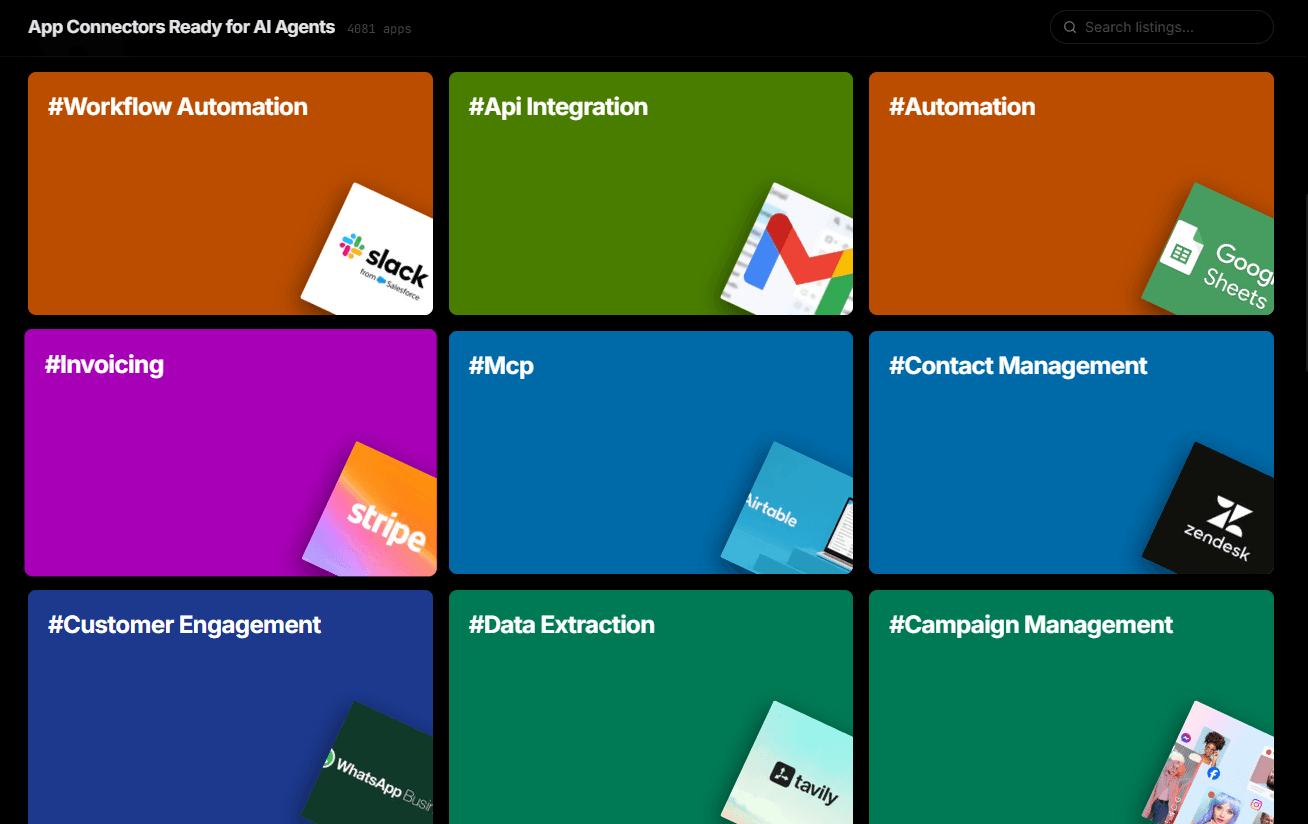
Over 4,000 integrations ready for AI agents
Explore a vast library of pre-built integrations, optimized and ready to deploy.
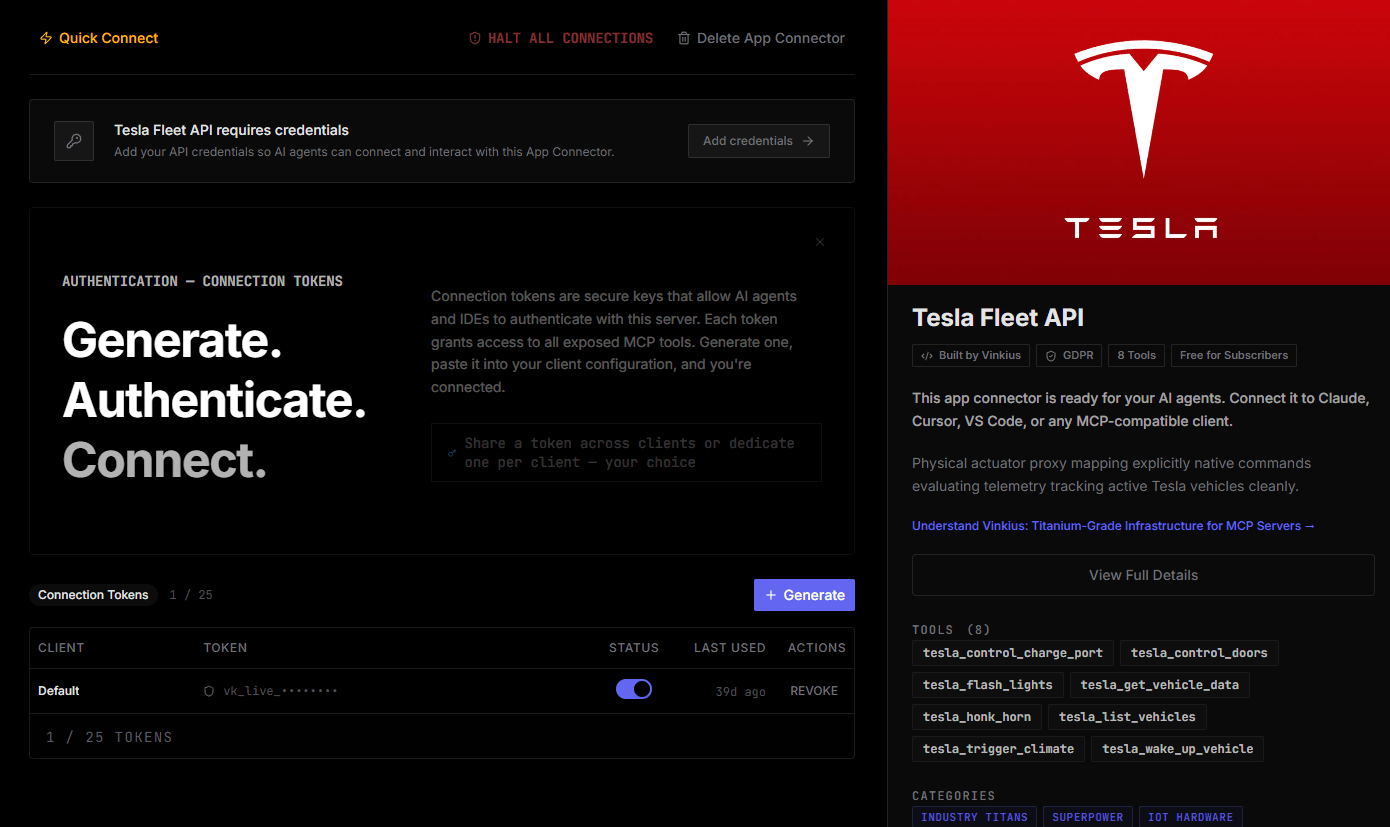
Connect securely in under 30 seconds
Generate tokens to authenticate and link external services in a single step.
Complete visibility into every agent action
Audit live requests, latency, success rates, and active security compliance policies.
Optimize spending and track token ROI
Analyze real-time token consumption and cost metrics detailed by connection.
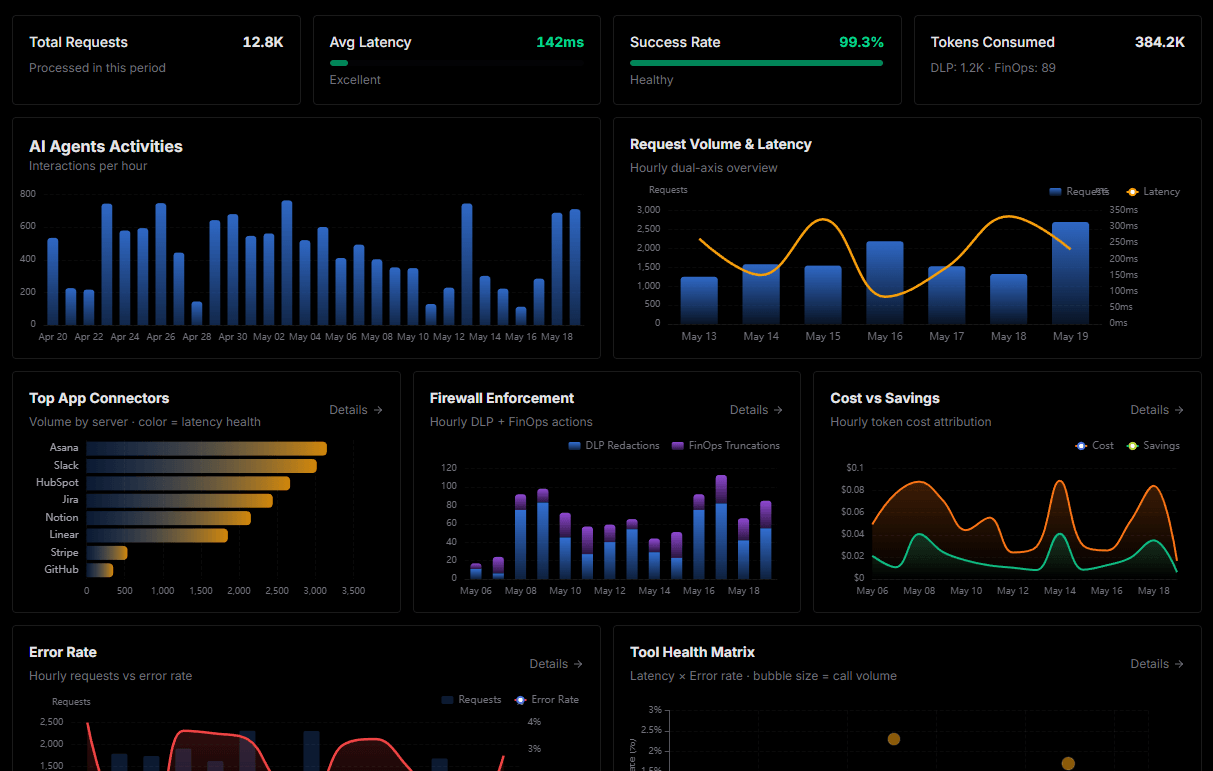
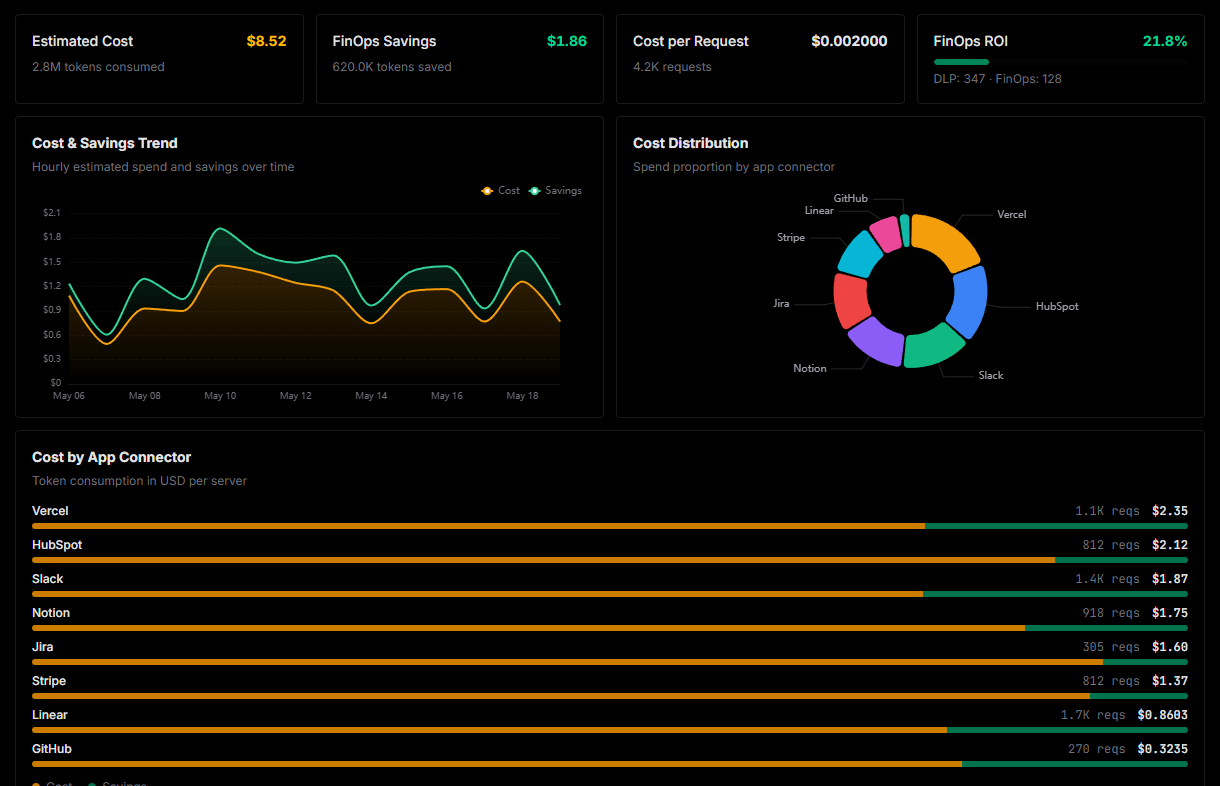
Explore our live AI Agents Analytics dashboard to see it all working
This dashboard is included when you connect Arlo Smart using Vinkius. You will never be left in the dark about what your AI agents are doing with your tools.
Arlo Smart and 4,000+ other AI tools. No hosting, no code, ready to use.
Professionals who connect Arlo Smart to Claude Desktop through Vinkius don't need to write code, manage servers, or worry about security. Everything is pre-configured, secure, and runs automatically in the background.
Raw MCP | Vinkius | |
|---|---|---|
| Ready-to-use MCPs | Find and configure each manually | 4,000+ MCPs ready to use |
| Connection Setup | Manual coding & server setup | 1-click instant connection |
| Server Hosting | You host it yourself (needs 24/7 uptime) | 100% hosted & managed by Vinkius |
| Security & Privacy | Stored in plaintext config files | Bank-grade encrypted vault |
| Activity Visibility | Blind execution (no logs or tracking) | Live dashboard with real-time logs |
| Cost Control | Runaway AI token spend risk | Automatic budget limits |
| Revoking Access | Must delete files or code to stop | 1-click disconnect button |
How Vinkius secures
Arlo Smart for Claude Desktop
Every request between Claude Desktop and Arlo Smart is protected by our secure gateway. We automatically keep your sensitive data private, prevent unauthorized access, and let you disconnect instantly at any time.
Frequently asked questions
What Arlo devices are supported by this API?
The Arlo Smart API supports all Arlo devices including: Arlo Basestations (VMB4500, VMB5000), Arlo Cameras (Pro, Ultra, Essential, Go), Video Doorbells, Floodlight Cameras, and Arlo Lights. Use list_arlo_devices to see all devices in your account with their types and connection status.
How do I get an Arlo authentication token?
Authenticate with the Arlo API by sending your email and password to the Arlo auth endpoint (ocapi-app.arlo.com/api/auth). The API returns an authentication token that you can use for all subsequent requests. The token should be refreshed periodically as it expires after a set duration.
What's the difference between arming and disarming an Arlo device?
Arming (mode1) enables motion detection and automatic recording on the device. When armed, the camera will detect motion, record video clips, and send alerts to your phone. Disarming (mode0) disables motion detection and recording. The camera remains powered on but won't trigger recordings. Use arming when you're away and want security monitoring, and disarming when you're home to avoid false alerts.
How do I download recordings from Arlo?
Use get_arlo_recordings with a date range to retrieve recordings. The response includes presignedContentUrl for each recording — these are temporary download links that expire after a set time. You can directly download the MP4 video files using these URLs. For thumbnail images, use presignedThumbnailUrl. Use get_recent_arlo_recordings for a quick way to get today's recordings.
How does Claude Desktop discover MCP tools?
When Claude Desktop starts, it reads the claude_desktop_config.json file and connects to each configured MCP server. It calls the tools/list endpoint to fetch the schema for every available tool, then surfaces them as clickable options in the chat interface via the 🔌 icon.
What happens if the MCP server is temporarily unavailable?
Claude Desktop handles disconnections gracefully. if the server is unreachable at startup, the tools simply won't appear. Once the server becomes available again, restarting Claude Desktop will re-establish the connection. There is no timeout penalty or error loop.
Can I connect multiple MCP servers simultaneously?
Yes. You can add as many servers as you need in the mcpServers section of the config file. Each server appears as a separate tool provider, and Claude can use tools from multiple servers in a single conversation turn.
Is there a limit on the number of tools per server?
Claude Desktop can handle hundreds of tools per server. However, for optimal LLM performance, Vinkius servers are designed to expose focused, well-documented tool sets rather than overwhelming the model with too many options.
Does Claude Desktop support Streamable HTTP transport?
Yes. Claude Desktop supports both SSE (Server-Sent Events) and the newer Streamable HTTP transport that Vinkius uses. Simply provide the server URL. Claude auto-negotiates the transport protocol.
Server not appearing after restart
Ensure the JSON is valid (no trailing commas). Check the file path: ~/Library/Application Support/Claude/claude_desktop_config.json (macOS) or %APPDATA%\\Claude\\ (Windows).
Authentication error
Verify your Vinkius token is correct. Go to cloud.vinkius.com to regenerate it if needed.
Tools not showing in chat
Click the 🔌 icon at the bottom of the chat input. If it shows 0 tools, the server may still be connecting. wait a few seconds.
Explore More MCP Servers
View all →
LaunchDarkly
9 toolsManage LaunchDarkly feature flags, environments, assignments and deployments smoothly through conversational AI.
NREL Energy Data
10 toolsAccess renewable energy and fuel data via NREL — track fuel stations, solar resources, and utility rates directly from your AI agent.
Apidog
5 toolsSync your Apidog workspace with your AI agent — list projects, fetch endpoint schemas, and export full OpenAPI specifications instantly.
ParseHub
10 toolsControl advanced cloud scraping projects via ParseHub — list targets, dispatch headless runs, trace crawler status, and fetch extracted datasets directly via AI.