
Bring Model Discovery
to Claude Desktop
Create your Vinkius account to connect Hugging Face to Claude Desktop and start using all 13 AI tools in minutes. Fully managed, enterprise secure, and ready to use without writing a single line of code. No hosting, no server setup — just connect and start using.
 GDPR Free for Subscribers
Compatible with every major AI agent and IDE
 Gemini
What is the Hugging Face MCP Server?
Connect your Hugging Face account to any AI agent and explore the world's largest AI model hub through natural conversation.
What you can do
- Model Discovery — Search and browse thousands of models by name, task type, framework and author
- Model Inspection — View model metadata including pipeline task, tags, download counts, likes and file structure
- Dataset Exploration — Find and inspect datasets with their descriptions, sizes and file trees
- Spaces Gallery — Browse ML demo apps (Gradio, Streamlit, Docker) and check their runtime status
- Collections — View curated collections of models, datasets and spaces organized by topic
- Community Discussions — Read model discussion threads for bug reports, feature requests and usage tips
- File Tree Browsing — List repository files (model weights, configs, tokenizers) without downloading
How it works
- Subscribe to this server
- Enter your Hugging Face Access Token
- Start exploring the ML hub from Claude, Cursor, or any MCP-compatible client
No more switching to the browser to check model tags or browse discussion threads. Your AI acts as a dedicated ML researcher.
Who is this for?
- ML Engineers — quickly find models by task type, inspect their tags and file structure, and review community discussions before integration
- Researchers — browse datasets, explore collections and discover related models without leaving your notebook
- Developers — check Space runtime status, review model files and find suitable models for your application via conversation
Built-in capabilities (13)
Requires the repo type (model, dataset or space), the repo ID in "author/name" format and the discussion title. Returns the created discussion with its ID, title and URL. Create a new discussion on a Hugging Face repo
Provide the collection slug. Get details for a specific Hugging Face collection
Provide the model ID in "author/name" format (e.g. "google-bert/bert-base-uncased"). Get details for a specific Hugging Face model
Tags include framework (pytorch, tensorflow), license, dataset, language and task-specific labels. The pipeline_tag indicates the model's primary task (e.g. "text-generation", "image-classification", "translation"). Get tags and pipeline info for a Hugging Face model
Provide the space ID in "author/name" format. Get details for a specific Hugging Face Space
Returns user name, avatar, organizations, auth type, plan and access tokens metadata. Use this to verify your token is working correctly. Get the authenticated Hugging Face user
Optionally filter by author and limit. Returns collection slug, title, description, author, item count and likes count. List collections on Hugging Face Hub
Returns filenames (e.g. "train.parquet", "test.parquet", "data/", "README.md"). Optionally set a subdirectory path. Useful for understanding dataset structure before downloading. List files in a Hugging Face dataset repository
Optionally filter by search term, author and limit. Returns dataset ID, author, description, download count, likes count and creation date. List datasets on Hugging Face Hub
Returns discussion title, author, creation date, number of comments and whether it is resolved. Use this to review community feedback, bug reports and feature requests for a model. List discussions for a Hugging Face model
Returns filenames, file sizes and paths (e.g. "model.safetensors", "tokenizer.json", "config.json", "README.md"). Optionally set a subdirectory path to list files within a specific folder. Useful for inspecting model artifacts and understanding the repository structure. List files in a Hugging Face model repository
Optionally filter by search term (free-text across model cards), author (organization or username) and limit the number of results. Returns model ID, author, pipeline task tag, download count, likes count and creation date. List models on Hugging Face Hub
Optionally filter by search term, author and limit. Returns space ID, title, author, SDK (Gradio, Streamlit, Docker), likes count and creation date. List Spaces on Hugging Face Hub
Why Claude Desktop?
Claude Desktop is the definitive way to connect Hugging Face to your AI workflow. Add Vinkius Edge URL to your config, restart the app, and Claude immediately exposes all 13 tools in the chat interface. ask a question, Claude calls the right tool, and you see the answer. Zero code, zero context switching.
- —
Claude Desktop is the reference MCP client. it was designed alongside the protocol itself, ensuring the most complete and stable MCP implementation available
- —
Zero-code configuration: add a server URL to a JSON file and Claude instantly discovers and exposes all available tools in the chat interface
- —
Claude's extended thinking capability lets it reason through multi-step tool usage, chaining multiple API calls to answer complex questions
- —
Enterprise-grade security with local config storage. your tokens never leave your machine, and connections go directly to Vinkius Edge network
Hugging Face in Claude Desktop
Why run Hugging Face with Vinkius?
The Hugging Face connection runs on our fully managed, secure cloud infrastructure. We handle the hosting, maintenance, and security so you don't have to deal with servers or code. All 13 tools are ready to work instantly without any complex setup.
You stay in complete control of your data. Your AI only accesses the information you approve, keeping your sensitive passwords and private details completely safe. Plus, with automatic optimizations, your AI works faster and more efficiently.
* Every connection is hosted and maintained by Vinkius. We handle the security, updates, and infrastructure so you don't have to write code or manage servers. See our infrastructure
Over 4,000 integrations ready for AI agents
Explore a vast library of pre-built integrations, optimized and ready to deploy.
Connect securely in under 30 seconds
Generate tokens to authenticate and link external services in a single step.
Complete visibility into every agent action
Audit live requests, latency, success rates, and active security compliance policies.
Optimize spending and track token ROI
Analyze real-time token consumption and cost metrics detailed by connection.
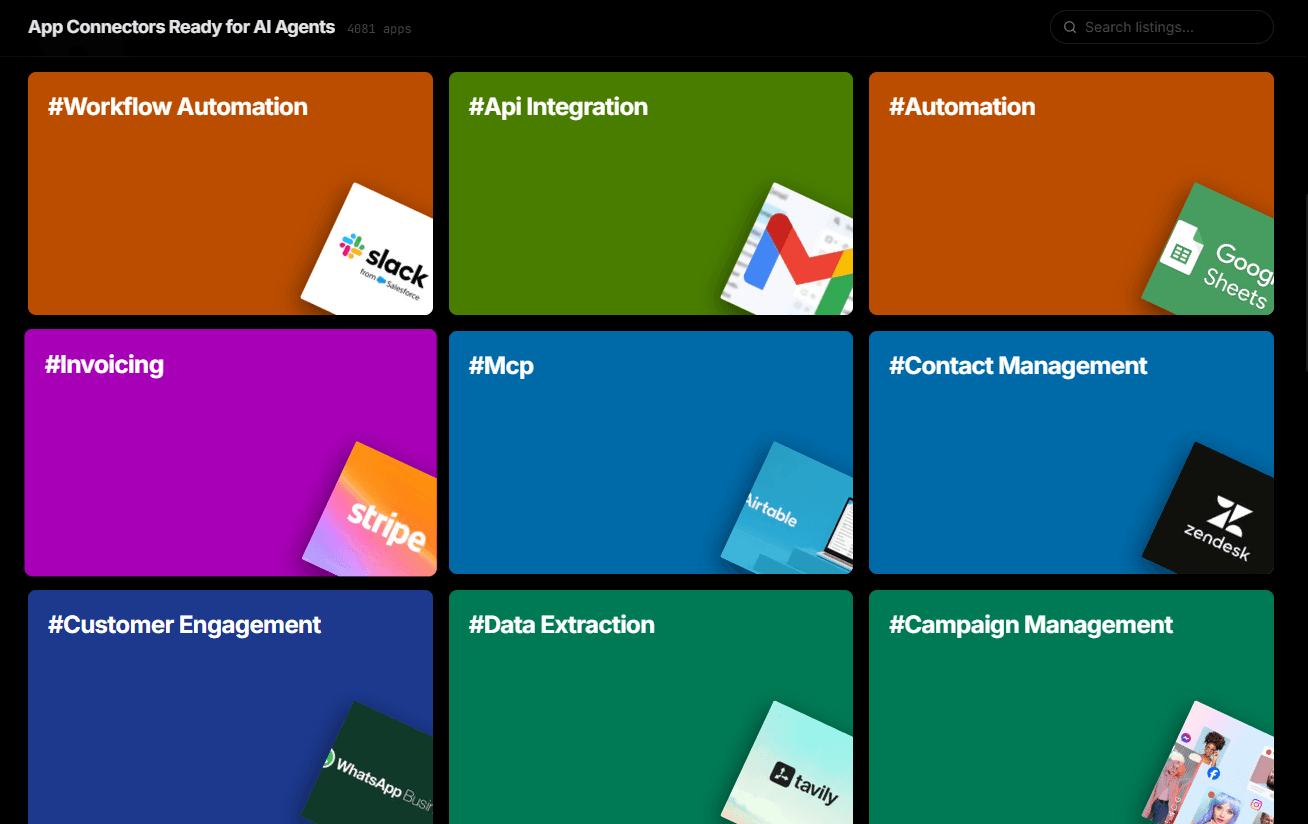
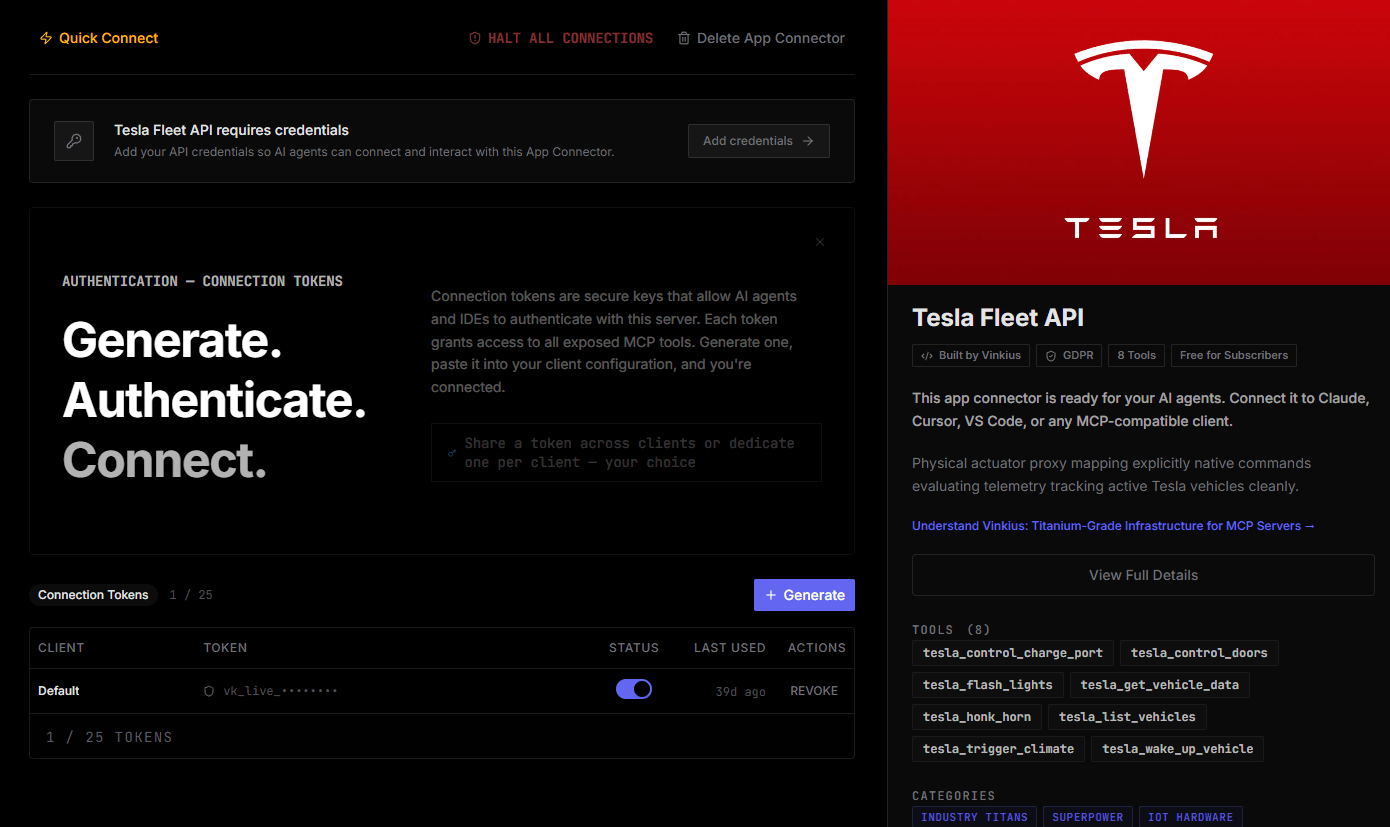
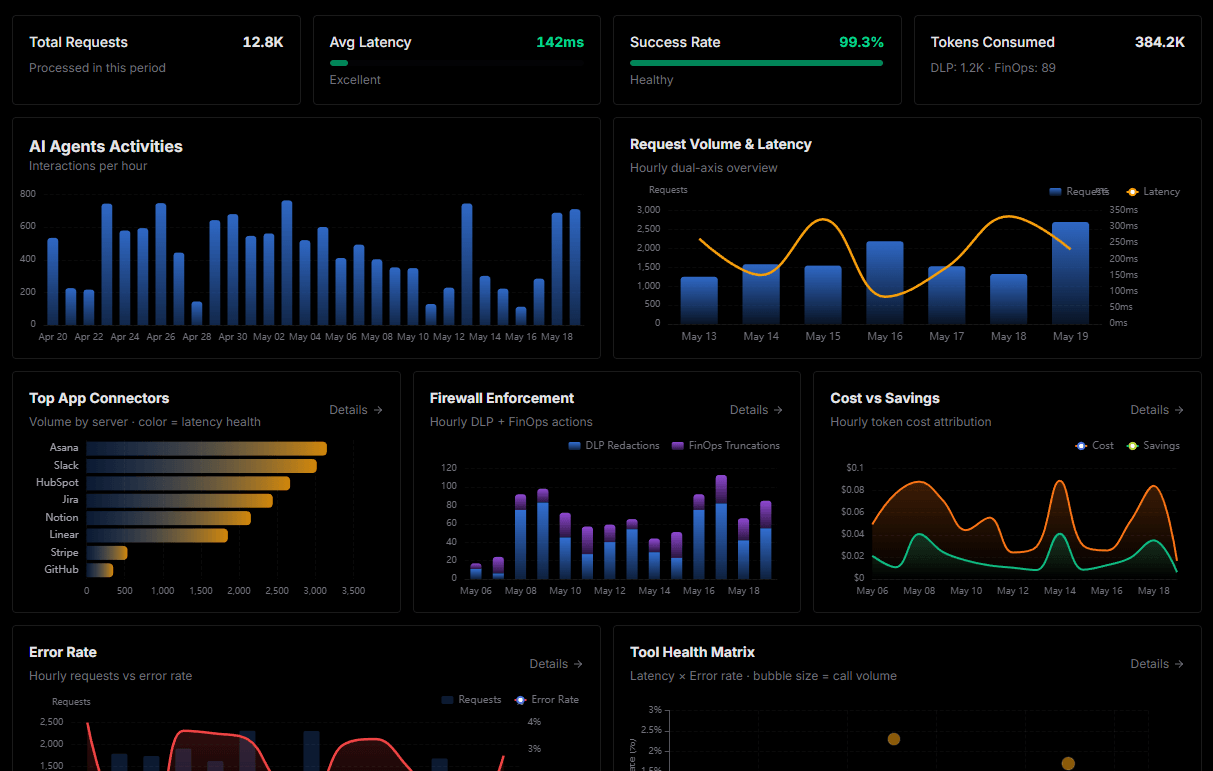
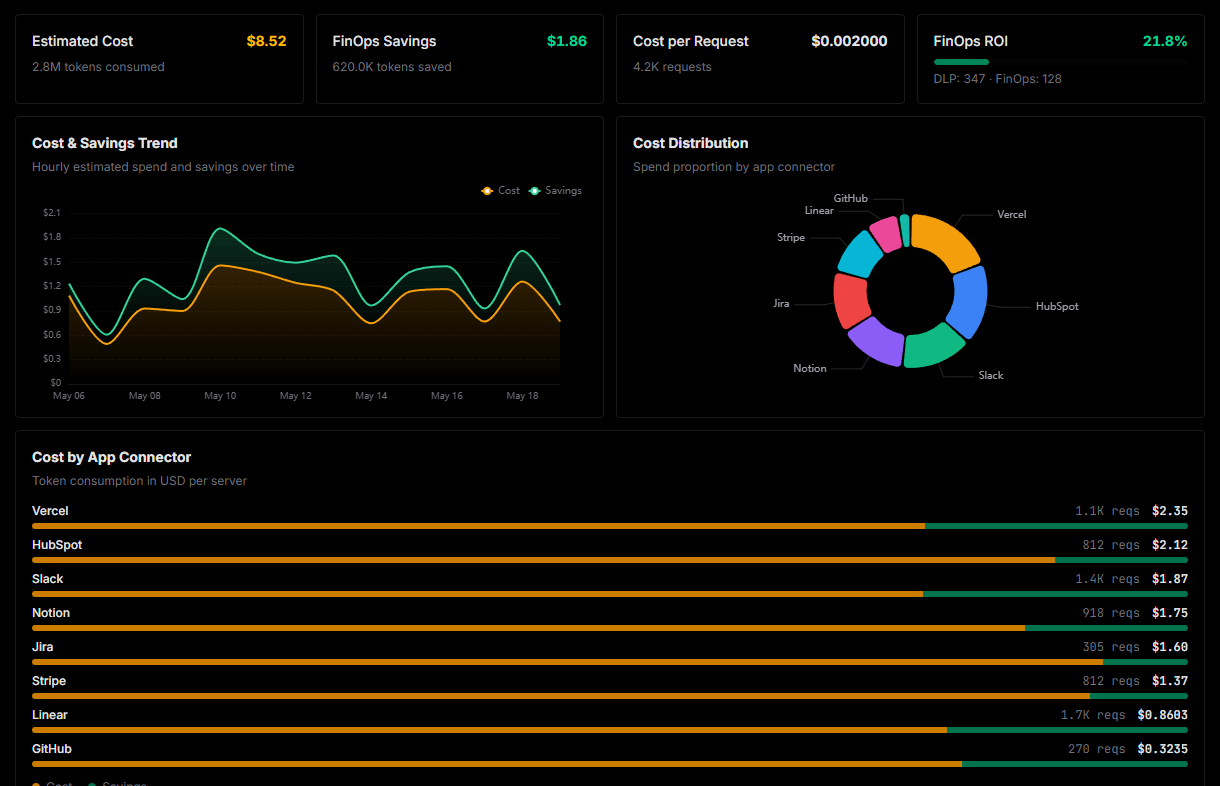
Explore our live AI Agents Analytics dashboard to see it all working
This dashboard is included when you connect Hugging Face using Vinkius. You will never be left in the dark about what your AI agents are doing with your tools.
Hugging Face and 4,000+ other AI tools. No hosting, no code, ready to use.
Professionals who connect Hugging Face to Claude Desktop through Vinkius don't need to write code, manage servers, or worry about security. Everything is pre-configured, secure, and runs automatically in the background.
Raw MCP | Vinkius | |
|---|---|---|
| Ready-to-use MCPs | Find and configure each manually | 4,000+ MCPs ready to use |
| Connection Setup | Manual coding & server setup | 1-click instant connection |
| Server Hosting | You host it yourself (needs 24/7 uptime) | 100% hosted & managed by Vinkius |
| Security & Privacy | Stored in plaintext config files | Bank-grade encrypted vault |
| Activity Visibility | Blind execution (no logs or tracking) | Live dashboard with real-time logs |
| Cost Control | Runaway AI token spend risk | Automatic budget limits |
| Revoking Access | Must delete files or code to stop | 1-click disconnect button |
How Vinkius secures
Hugging Face for Claude Desktop
Every request between Claude Desktop and Hugging Face is protected by our secure gateway. We automatically keep your sensitive data private, prevent unauthorized access, and let you disconnect instantly at any time.
Frequently asked questions
How do I get a Hugging Face Access Token?
Log in to Hugging Face, go to Settings > Access Tokens, click New token, give it a name and select scopes (read is sufficient for browsing, write if you need to create repos). Copy the token immediately — it starts with hf_.
Can I search models by task type (e.g. text-generation)?
Yes! Use list_models with a search query. While the search endpoint doesn't directly filter by pipeline_tag, you can search by task name (e.g. search='text-generation') and then use get_model or get_model_tags to verify the pipeline_tag of specific models.
Can I see what files are in a model repository?
Yes! Use list_model_files with the model ID (e.g. 'google-bert/bert-base-uncased') to see the complete file tree including model weights (.safetensors, .bin), config files, tokenizer files and README. Optionally set a path to browse a specific subdirectory like 'onnx' or 'pytorch'.
Can I create discussions on model pages?
Yes! Use create_discussion with the repo type ('model', 'dataset' or 'space'), the repo ID and a title. This creates a new discussion thread on the repository. You can use list_model_discussions first to check existing threads before creating a new one.
How does Claude Desktop discover MCP tools?
When Claude Desktop starts, it reads the claude_desktop_config.json file and connects to each configured MCP server. It calls the tools/list endpoint to fetch the schema for every available tool, then surfaces them as clickable options in the chat interface via the 🔌 icon.
What happens if the MCP server is temporarily unavailable?
Claude Desktop handles disconnections gracefully. if the server is unreachable at startup, the tools simply won't appear. Once the server becomes available again, restarting Claude Desktop will re-establish the connection. There is no timeout penalty or error loop.
Can I connect multiple MCP servers simultaneously?
Yes. You can add as many servers as you need in the mcpServers section of the config file. Each server appears as a separate tool provider, and Claude can use tools from multiple servers in a single conversation turn.
Is there a limit on the number of tools per server?
Claude Desktop can handle hundreds of tools per server. However, for optimal LLM performance, Vinkius servers are designed to expose focused, well-documented tool sets rather than overwhelming the model with too many options.
Does Claude Desktop support Streamable HTTP transport?
Yes. Claude Desktop supports both SSE (Server-Sent Events) and the newer Streamable HTTP transport that Vinkius uses. Simply provide the server URL. Claude auto-negotiates the transport protocol.
Server not appearing after restart
Ensure the JSON is valid (no trailing commas). Check the file path: ~/Library/Application Support/Claude/claude_desktop_config.json (macOS) or %APPDATA%\\Claude\\ (Windows).
Authentication error
Verify your Vinkius token is correct. Go to cloud.vinkius.com to regenerate it if needed.
Tools not showing in chat
Click the 🔌 icon at the bottom of the chat input. If it shows 0 tools, the server may still be connecting. wait a few seconds.
Explore More MCP Servers
View all →
Bureau of Labor Statistics Full — The Mega Server
1 toolsThe ultimate BLS Mega-Server: Access all 6 major datasets including CPI (Inflation), CES (Jobs), CPS (Unemployment), JOLTS (Turnover), LAUS (Local metrics), and OEWS (Wages by Profession).

Hipsy
16 toolsSell event tickets, manage registrations, and promote parties and festivals with a ticketing platform made for nightlife and entertainment.

AssemblyAI
9 toolsTranscribe audio and video files with industry-leading accuracy, detect speakers, and extract insights from spoken content.
Acuity Scheduling Alternative
10 toolsManage your Acuity appointments and calendars — audit availability and bookings via AI.