
Bring Precision Agriculture
to Claude Desktop
Create your Vinkius account to connect Taranis to Claude Desktop and start using all 12 AI tools in minutes. Fully managed, enterprise secure, and ready to use without writing a single line of code. No hosting, no server setup — just connect and start using.
 GDPR Free for Subscribers
Compatible with every major AI agent and IDE
 Gemini
What is the Taranis MCP Server?
Connect your Taranis AI Scouting API to any AI agent and take full control of AI-powered crop threat detection, ultra-high-resolution imagery analysis, field scouting recommendations, and precision agriculture decision-making through natural conversation.
What you can do
- Organizations — List all agricultural organizations and farms in your Taranis account
- Field Management — View all monitored fields with crop types, boundaries, and growth stages
- Flight History — Review all drone and aircraft flight missions with imagery acquisition dates
- Flight Imagery — Access ultra-high-resolution orthomosaics, DSMs, and NDVI maps from each flight
- All Detections — Get comprehensive AI-detected threats (weeds, diseases, pests, nutrients) in any field
- Threat Summary — View consolidated threat severity assessments and trend analysis per field
- Scouting Recommendations — Receive AI-powered action plans for targeted field scouting missions
- Multispectral Analysis — Access NDVI, NDRE, and GNDVI vegetation indices for vigor assessment
- Weed Detection — Identify specific weed species with coverage estimates and herbicide recommendations
- Disease Detection — Detect crop diseases with severity levels and fungicide treatment suggestions
- Nutrient Analysis — Identify nutrient deficiencies with variable rate fertilization recommendations
How it works
- Subscribe to this server
- Enter your Taranis API token (from the dashboard API settings)
- Start analyzing crop threats from Claude, Cursor, or any MCP-compatible client
No more manual field scouting or delayed threat identification. Your AI acts as a dedicated precision agriculture analyst and crop health monitoring assistant.
Who is this for?
- Farm Managers — detect crop threats early, prioritize scouting, and optimize treatment timing
- Agronomists — analyze ultra-high-resolution imagery, identify weed species, and track disease progression
- Crop Consultants — generate scouting recommendations, create treatment plans, and advise clients with data-driven insights
- Ag Retailers — identify treatment opportunities, plan product applications, and demonstrate ROI with before/after imagery
Built-in capabilities (12)
Returns detection locations (GPS coordinates), threat types (weeds, diseases, pests, nutrient deficiencies), severity levels, confidence scores, affected area estimates, and recommended actions. Detections are classified by AI models trained on millions of field images for sub-millimeter accuracy. Essential for early threat identification, targeted scouting, and precision treatment planning. AI agents should use this when users ask "show me all detections in my field", "what threats were detected in field X", or need comprehensive threat analysis before planning field operations. Optional threatType filters detections by specific threat category. Get all AI-detected crop threats (weeds, diseases, pests, nutrient deficiencies) in a field
Returns disease locations, pathogen identification where possible, severity levels (early, moderate, advanced), affected plant parts, and recommended fungicide treatments. Essential for early disease intervention, fungicide planning, and yield loss prevention. AI agents should reference this when users ask "what diseases are in my soybean field", "show disease progression over time", or need disease-specific analysis for crop protection decisions. Get crop disease detections and severity assessments for a field
Essential for understanding field context before analyzing detections, planning scouting missions, or generating management recommendations. AI agents should reference this when users ask "tell me about this field", "what crop is planted in field X", or need detailed field metadata for context-aware analysis. Get detailed information about a specific agricultural field
Returns field names, IDs, boundaries (GeoJSON polygons), area in hectares/acres, crop type, planting dates, and monitoring status. Essential for farm management overview, field inventory, and selecting target fields for threat detection and scouting analysis. AI agents should use this when users ask "show me all fields in my organization", "list monitored fields", or need to identify available fields for detection or flight queries. Optional orgId filters fields by specific organization. List all agricultural fields monitored by Taranis for an organization
Returns orthomosaic mosaics, digital surface models (DSM), digital terrain models (DTM), normalized difference vegetation index (NDVI) maps, and true-color RGB composites. Essential for visual crop assessment, change detection between flights, and downloading high-resolution imagery for GIS analysis. AI agents should reference this when users ask "show me the latest imagery from this flight", "get the NDVI map for flight X", or need specific imagery products for field analysis. Get ultra-high-resolution imagery products from a specific flight mission
Returns flight dates, times, aircraft type, imagery resolution, weather conditions during flight, coverage percentage, and processing status. Essential for understanding imagery acquisition history, assessing data quality, and selecting specific flights for detailed analysis. AI agents should use this when users ask "show me all flights over my corn field", "what imagery was captured last week", or need flight metadata before accessing specific imagery products. List all drone or aircraft flights that captured imagery for a specific field
Supports indices including NDVI (Normalized Difference Vegetation Index), NDRE (Normalized Difference Red Edge), GNDVI (Green NDVI), and custom band combinations. Returns imagery layers, statistical summaries (mean, min, max, std), and zone classifications. Essential for crop vigor assessment, variable rate application planning, and growth stage monitoring. AI agents should reference this when users ask "show me NDVI map for my field", "get multispectral analysis", or need vegetation index data for precision agriculture planning. Get multispectral imagery and vegetation indices (NDVI, NDRE, GNDVI) for a field
Returns deficiency locations, severity estimates, affected growth stages, and variable rate fertilization recommendations. Essential for precision nutrient management, yield optimization, and cost-efficient fertilization planning. AI agents should use this when users ask "does my field have nutrient deficiencies", "where do I need to apply nitrogen", or need nutrient-specific analysis for variable rate application planning. Get nutrient deficiency detections and fertilization recommendations for a field
Returns organization names, IDs, contact information, and field counts. Essential for multi-account management, selecting target organizations for field analysis, and understanding the scope of monitored agricultural operations. AI agents should use this when users ask "show me all my organizations", "list farms I have access to", or need to identify available organizations before querying fields or detections. List all organizations available to the user in Taranis platform
Returns specific action items including ground truth verification locations, recommended scouting patterns, treatment suggestions, timing recommendations, and priority levels. Essential for field team coordination, targeted scouting missions, and data-driven treatment decisions. AI agents should use this when users ask "what should I scout for in my field this week", "give me scouting recommendations", or need AI-generated action plans based on latest imagery analysis. Get AI-powered scouting recommendations and action plans for a field
Returns threat categories, overall severity ratings (low, medium, high, critical), affected area percentages, trend analysis (increasing, stable, decreasing), and priority rankings. Essential for quick field health assessment, prioritizing scouting missions, and making informed treatment decisions. AI agents should reference this when users ask "what is the overall threat level in my field", "summarize field health status", or need a high-level threat overview before diving into individual detections. Get consolidated threat summary and severity assessment for a field
Returns weed locations, estimated coverage area, species classification, growth stage, and herbicide resistance indicators. Essential for targeted spot spraying, herbicide selection, and resistance management. AI agents should use this when users ask "where are the weeds in my field", "what weed species were detected", or need weed-specific analysis for precision herbicide application. Get specific weed species detections and infestation maps for a field
Why Claude Desktop?
Claude Desktop is the definitive way to connect Taranis to your AI workflow. Add Vinkius Edge URL to your config, restart the app, and Claude immediately exposes all 12 tools in the chat interface. ask a question, Claude calls the right tool, and you see the answer. Zero code, zero context switching.
- —
Claude Desktop is the reference MCP client. it was designed alongside the protocol itself, ensuring the most complete and stable MCP implementation available
- —
Zero-code configuration: add a server URL to a JSON file and Claude instantly discovers and exposes all available tools in the chat interface
- —
Claude's extended thinking capability lets it reason through multi-step tool usage, chaining multiple API calls to answer complex questions
- —
Enterprise-grade security with local config storage. your tokens never leave your machine, and connections go directly to Vinkius Edge network
Taranis in Claude Desktop
Why run Taranis with Vinkius?
The Taranis connection runs on our fully managed, secure cloud infrastructure. We handle the hosting, maintenance, and security so you don't have to deal with servers or code. All 12 tools are ready to work instantly without any complex setup.
You stay in complete control of your data. Your AI only accesses the information you approve, keeping your sensitive passwords and private details completely safe. Plus, with automatic optimizations, your AI works faster and more efficiently.
* Every connection is hosted and maintained by Vinkius. We handle the security, updates, and infrastructure so you don't have to write code or manage servers. See our infrastructure
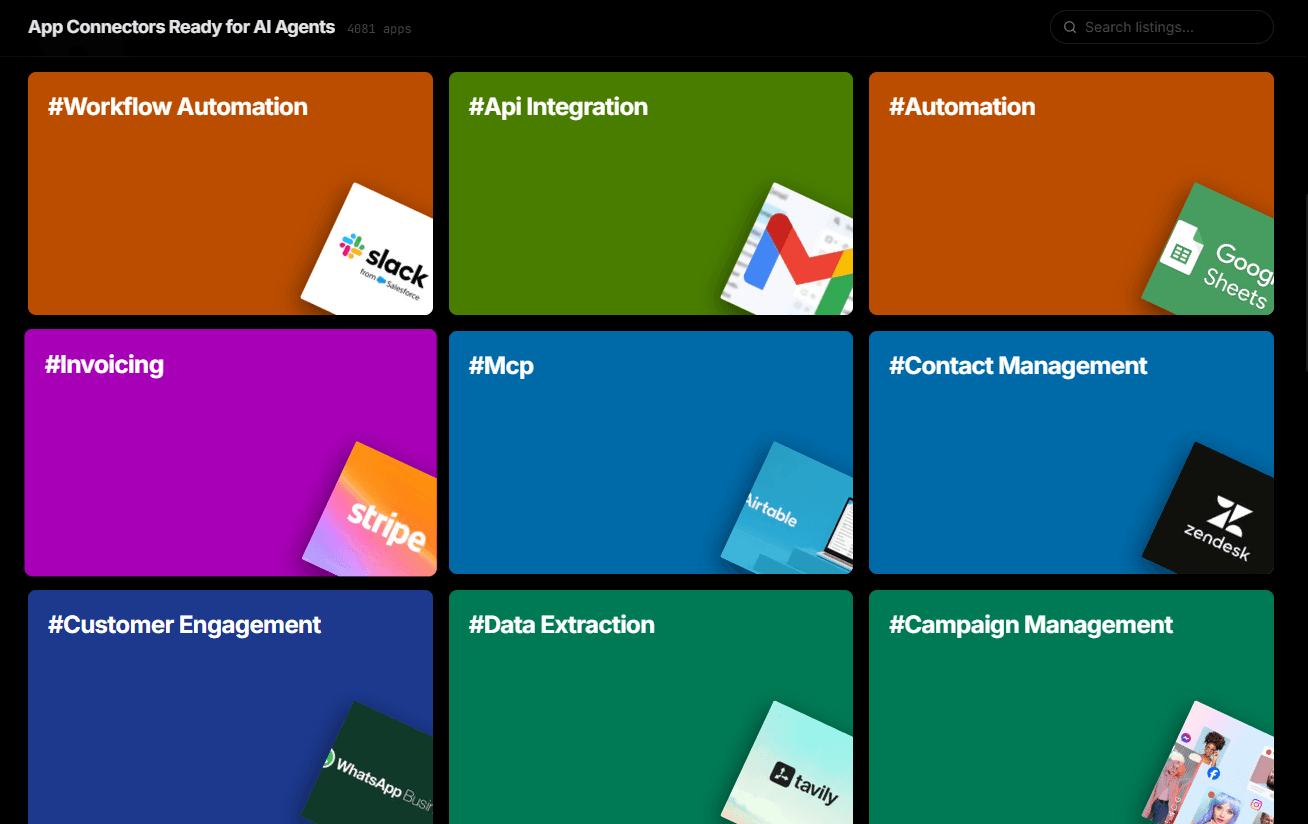
Over 4,000 integrations ready for AI agents
Explore a vast library of pre-built integrations, optimized and ready to deploy.
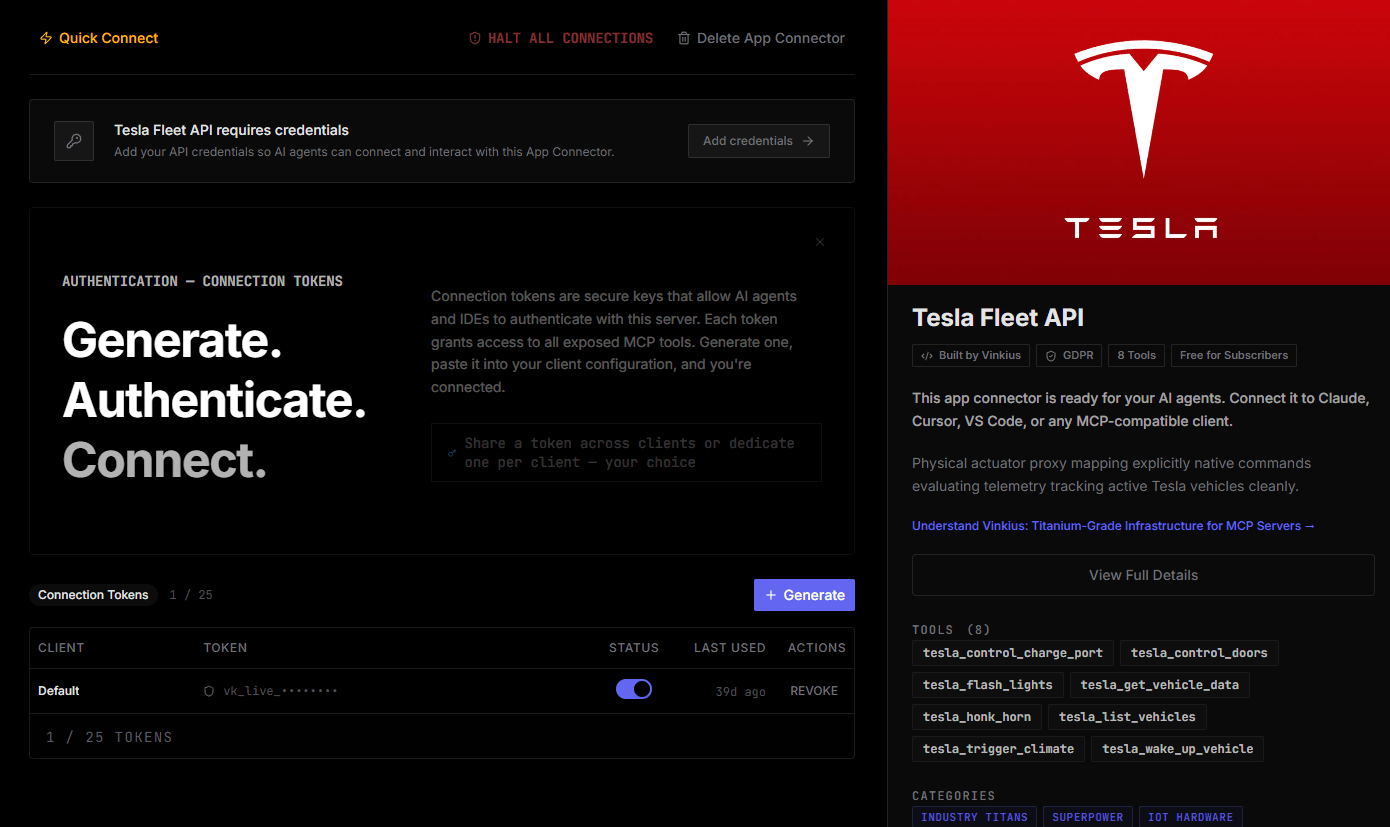
Connect securely in under 30 seconds
Generate tokens to authenticate and link external services in a single step.
Complete visibility into every agent action
Audit live requests, latency, success rates, and active security compliance policies.
Optimize spending and track token ROI
Analyze real-time token consumption and cost metrics detailed by connection.
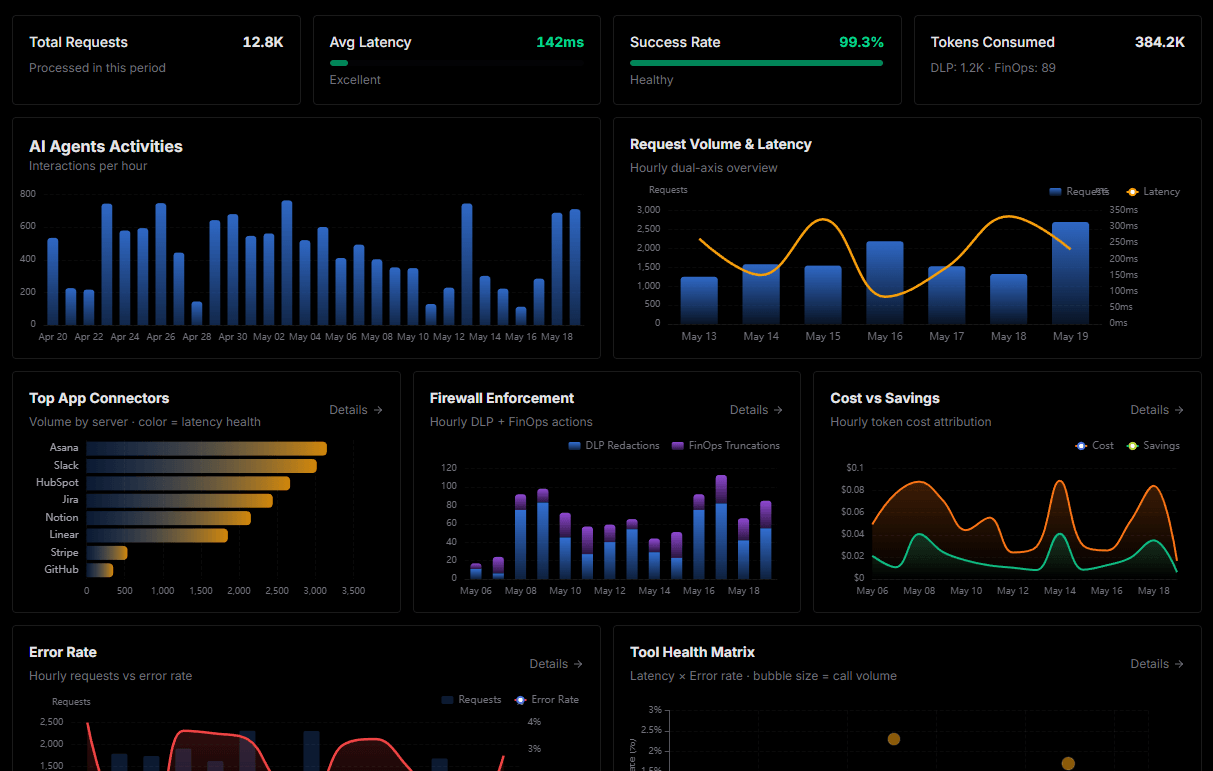
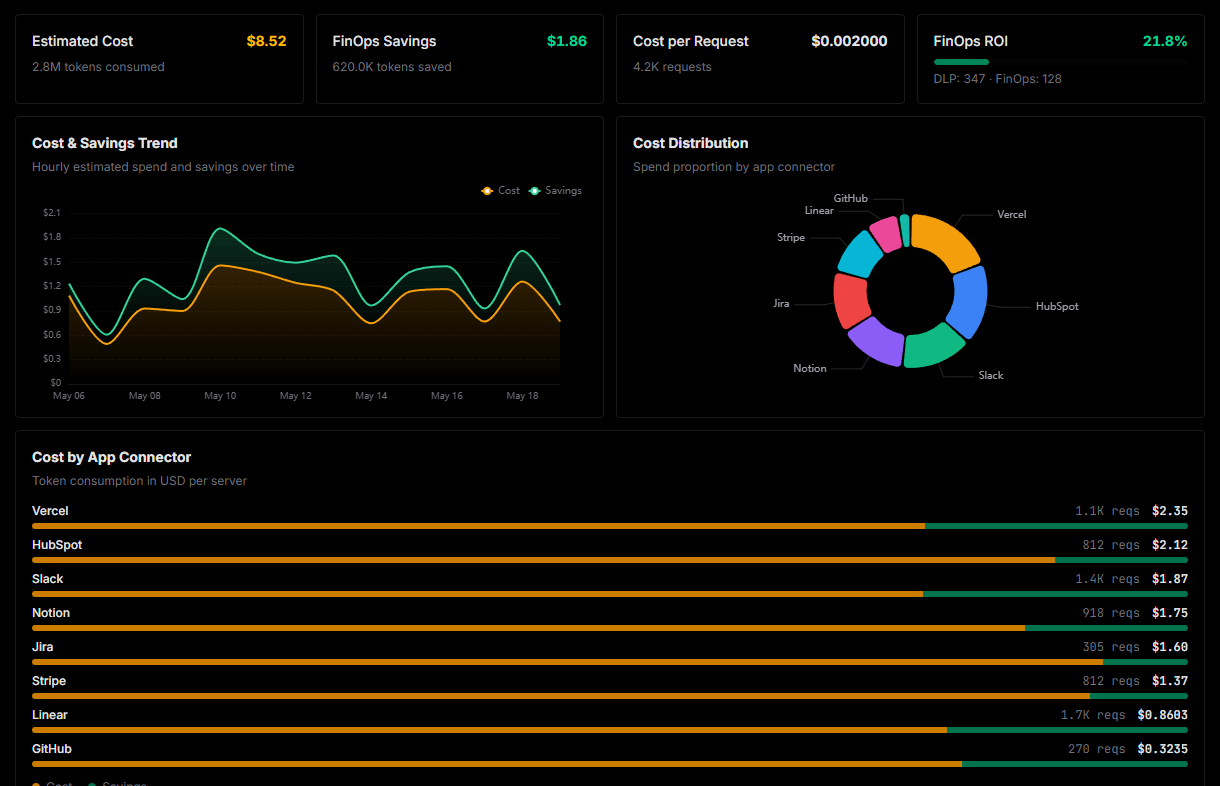
Explore our live AI Agents Analytics dashboard to see it all working
This dashboard is included when you connect Taranis using Vinkius. You will never be left in the dark about what your AI agents are doing with your tools.
Taranis and 4,000+ other AI tools. No hosting, no code, ready to use.
Professionals who connect Taranis to Claude Desktop through Vinkius don't need to write code, manage servers, or worry about security. Everything is pre-configured, secure, and runs automatically in the background.
Raw MCP | Vinkius | |
|---|---|---|
| Ready-to-use MCPs | Find and configure each manually | 4,000+ MCPs ready to use |
| Connection Setup | Manual coding & server setup | 1-click instant connection |
| Server Hosting | You host it yourself (needs 24/7 uptime) | 100% hosted & managed by Vinkius |
| Security & Privacy | Stored in plaintext config files | Bank-grade encrypted vault |
| Activity Visibility | Blind execution (no logs or tracking) | Live dashboard with real-time logs |
| Cost Control | Runaway AI token spend risk | Automatic budget limits |
| Revoking Access | Must delete files or code to stop | 1-click disconnect button |
How Vinkius secures
Taranis for Claude Desktop
Every request between Claude Desktop and Taranis is protected by our secure gateway. We automatically keep your sensitive data private, prevent unauthorized access, and let you disconnect instantly at any time.
Frequently asked questions
Can my AI detect specific weed species in my soybean field from Taranis imagery?
Yes! Use the get_weed_detections tool with your field ID to get AI-detected weed infestations with species-level identification. Returns weed locations, estimated coverage area, species classification, growth stage, and herbicide resistance indicators. For a comprehensive view of all threats (weeds, diseases, pests, nutrients), use get_detections without a type filter.
How do I get scouting recommendations based on the latest flight imagery?
Use the get_scouting_recommendations tool with your field ID. Taranis AI analyzes the latest imagery, detected threats, crop growth stage, and field history to generate specific action items including ground truth verification locations, recommended scouting patterns, treatment suggestions, and priority levels. You can also use get_threats first to see the overall threat severity before reviewing recommendations.
What resolution imagery does Taranis capture and how often are flights conducted?
Taranis captures ultra-high-resolution imagery at sub-millimeter to centimeter level resolution using specialized drone and fixed-wing aircraft. Flight frequency depends on your monitoring plan and crop growth stage — typically every 7-14 days during critical growth periods. Use get_flights to see all flight history for a field, and get_flight_imagery to access specific imagery products (orthomosaics, DSM, NDVI maps) from any flight mission.
How does Claude Desktop discover MCP tools?
When Claude Desktop starts, it reads the claude_desktop_config.json file and connects to each configured MCP server. It calls the tools/list endpoint to fetch the schema for every available tool, then surfaces them as clickable options in the chat interface via the 🔌 icon.
What happens if the MCP server is temporarily unavailable?
Claude Desktop handles disconnections gracefully. if the server is unreachable at startup, the tools simply won't appear. Once the server becomes available again, restarting Claude Desktop will re-establish the connection. There is no timeout penalty or error loop.
Can I connect multiple MCP servers simultaneously?
Yes. You can add as many servers as you need in the mcpServers section of the config file. Each server appears as a separate tool provider, and Claude can use tools from multiple servers in a single conversation turn.
Is there a limit on the number of tools per server?
Claude Desktop can handle hundreds of tools per server. However, for optimal LLM performance, Vinkius servers are designed to expose focused, well-documented tool sets rather than overwhelming the model with too many options.
Does Claude Desktop support Streamable HTTP transport?
Yes. Claude Desktop supports both SSE (Server-Sent Events) and the newer Streamable HTTP transport that Vinkius uses. Simply provide the server URL. Claude auto-negotiates the transport protocol.
Server not appearing after restart
Ensure the JSON is valid (no trailing commas). Check the file path: ~/Library/Application Support/Claude/claude_desktop_config.json (macOS) or %APPDATA%\\Claude\\ (Windows).
Authentication error
Verify your Vinkius token is correct. Go to cloud.vinkius.com to regenerate it if needed.
Tools not showing in chat
Click the 🔌 icon at the bottom of the chat input. If it shows 0 tools, the server may still be connecting. wait a few seconds.
Explore More MCP Servers
View all →
Nubank MX
14 toolsManage your Nubank Mexico banking from any AI agent — check balances, review transactions, send SPEI transfers, pay bills, and track spending analytics.
BlazeMeter
10 toolsAutomate continuous performance testing via BlazeMeter — manage workspaces, trigger load tests, and analyze active run metrics securely via AI.

TeamUp
10 toolsManage events, customers, coaches, memberships, and payments for your TeamUp-powered fitness studio through natural conversation.

Gmail
12 toolsManage your inbox from AI — read, search, organize, and reply to emails across your Gmail efficiently.