
Bring Web Automation
to Cursor
Create your Vinkius account to connect Apify to Cursor and start using all 10 AI tools in minutes. Fully managed, enterprise secure, and ready to use without writing a single line of code. No hosting, no server setup — just connect and start using.
 GDPR Free for Subscribers
Compatible with every major AI agent and IDE
 Gemini
What is the Apify MCP Server?
Connect your Apify workspace to your AI agent and seamlessly direct full-stack web scraping and data extraction workflows through natural conversation.
What you can do
- Discover & Run Actors — Browse all scraper bots (Actors) available in your account. Fire them off asynchronously or synchronously for fast, targeted scraping
- Extract Datasets — Pull robust structured data formats out of completed runs. Retrieve detailed JSON records directly into the agent's context window
- Fetch Key-Value Stores — Programmatically read snapshots, cached HTML pages, or screenshots from the Apify Key-Value repositories mapped to a run
- Job Control & Scalability — Stop hanging scraper jobs, queue new dynamic URLs mid-run, or inspect deep usage analytics, compute units, and webhooks limits
How it works
- Subscribe to this server
- Enter your Personal Apify API Token
- Start exploring and interacting with data extraction routines securely via Claude or Cursor
Who is this for?
- Data Engineers — trigger scheduled extraction logic seamlessly and map Apify objects within a conversational QA check
- Market Researchers — command the AI to scrape product prices using Apify actors and compile the JSON datasets into readable markdown tables
- AI Developers — augment your agent's real-time capabilities by feeding it massive structured site data freshly scraped via headless browsers
Built-in capabilities (10)
Any data already scraped and pushed to the dataset is preserved. The run status changes to ABORTED. Use this to stop runaway scrapes or when sufficient data has been collected. Graceful shutdown depends on the actor implementation. Abort an active Apify actor run
Essential for monitoring consumption and avoiding overage charges. Check Apify account subscription limits and compute unit usage
The datasetId is found in the run object (defaultDatasetId). Supports pagination via limit (max items per page) and offset (starting position). Returns an array of JSON objects containing the scraped data fields. Use limit=1000 for bulk downloads. Export structured JSON data from an Apify dataset
Key-value stores hold arbitrary data like screenshots (OUTPUT), configuration files, or intermediate results. The storeId comes from the run object (defaultKeyValueStoreId). Common keys include "OUTPUT", "INPUT", and "SCREENSHOT". Retrieve an item from an Apify actor key-value store
Poll this endpoint to track long-running scrapes. Check the status and metadata of a specific Apify actor run
Includes owned actors and those from the Apify Store that have been saved. Each entry contains the actorId, name, description, and default run configuration. Use the actorId to trigger runs. List all accessible actors in the Apify account
RUN.SUCCEEDED, ACTOR.RUN.FAILED), target URLs, and associated actor IDs. Webhooks enable event-driven architectures by notifying external systems when actor runs complete or fail. List all configured webhooks in the Apify account
Pass the queueId (from the run object) and a JSON string array of request objects, e.g., [{"url":"https://...","uniqueKey":"..."}]. This enables dynamic crawling where new pages are discovered and added during execution. Dynamically push new URLs to an active Apify request queue
Pass the actorId (e.g., "apify/web-scraper" or a custom ID) and a JSON string with the input configuration (start URLs, proxy settings, max pages, etc.). Returns immediately with a runId. Use ap.get_run to poll for completion and ap.get_dataset_items to retrieve extracted data. Start an Apify actor asynchronously with custom JSON input
run_actor but waits for the actor to finish before returning. The response includes the full run object with defaultDatasetId for immediate data retrieval. Best for short-lived actors (under 5 minutes). For long-running scrapes, use the async ap.run_actor instead. Run an Apify actor and block until completion (synchronous)
Why Cursor?
Cursor's Agent mode turns Apify into an in-editor superpower. Ask Cursor to generate code using live data from Apify and it fetches, processes, and writes. all in a single agentic loop. 10 tools appear alongside file editing and terminal access, creating a unified development environment grounded in real-time information.
- —
Agent mode turns Cursor into an autonomous coding assistant that can read files, run commands, and call MCP tools without switching context
- —
Cursor's Composer feature can generate entire files using real-time data fetched through MCP. no copy-pasting from external dashboards
- —
MCP tools appear alongside built-in tools like file reading and terminal access, creating a unified agentic environment
- —
VS Code extension compatibility means your existing workflow, keybindings, and extensions all work alongside MCP tools
Apify in Cursor
Why run Apify with Vinkius?
The Apify connection runs on our fully managed, secure cloud infrastructure. We handle the hosting, maintenance, and security so you don't have to deal with servers or code. All 10 tools are ready to work instantly without any complex setup.
You stay in complete control of your data. Your AI only accesses the information you approve, keeping your sensitive passwords and private details completely safe. Plus, with automatic optimizations, your AI works faster and more efficiently.
* Every connection is hosted and maintained by Vinkius. We handle the security, updates, and infrastructure so you don't have to write code or manage servers. See our infrastructure
Over 4,000 integrations ready for AI agents
Explore a vast library of pre-built integrations, optimized and ready to deploy.
Connect securely in under 30 seconds
Generate tokens to authenticate and link external services in a single step.
Complete visibility into every agent action
Audit live requests, latency, success rates, and active security compliance policies.
Optimize spending and track token ROI
Analyze real-time token consumption and cost metrics detailed by connection.
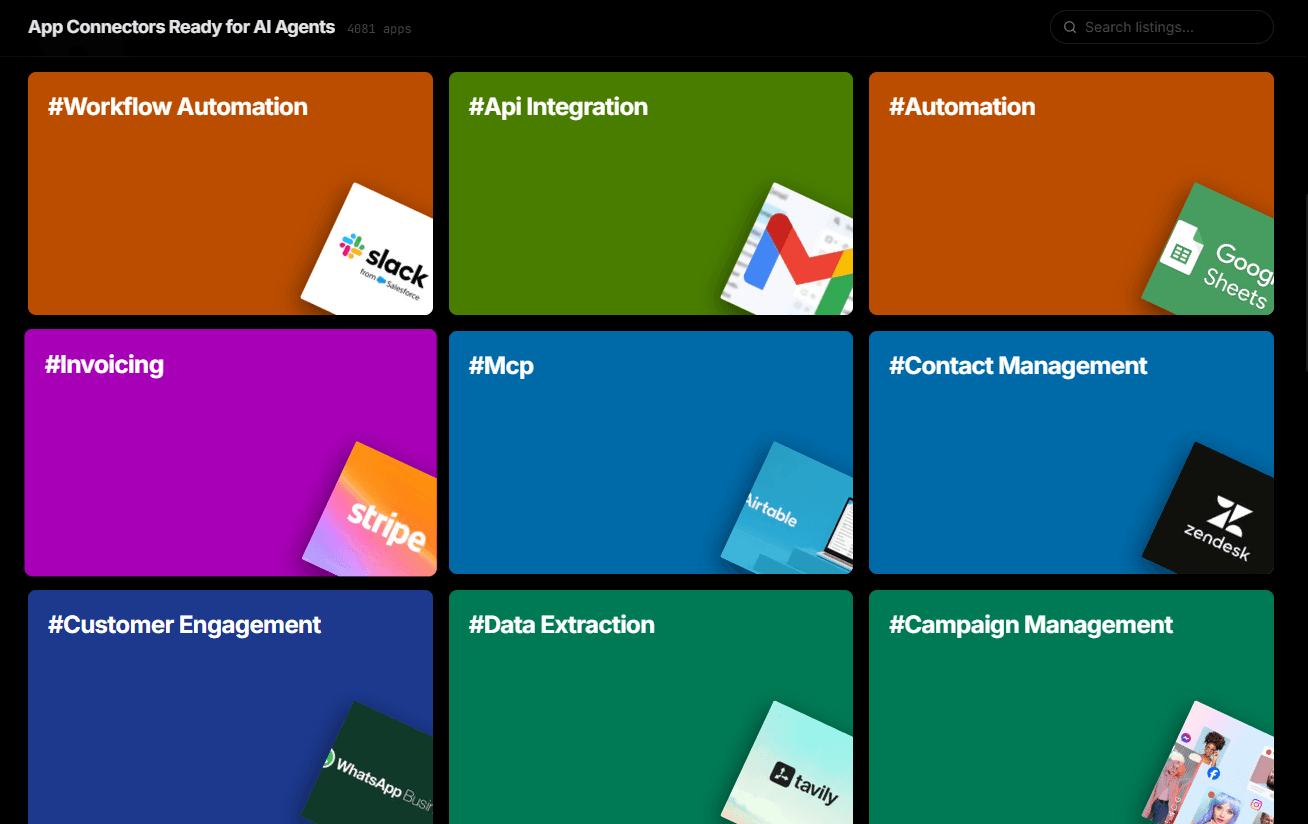
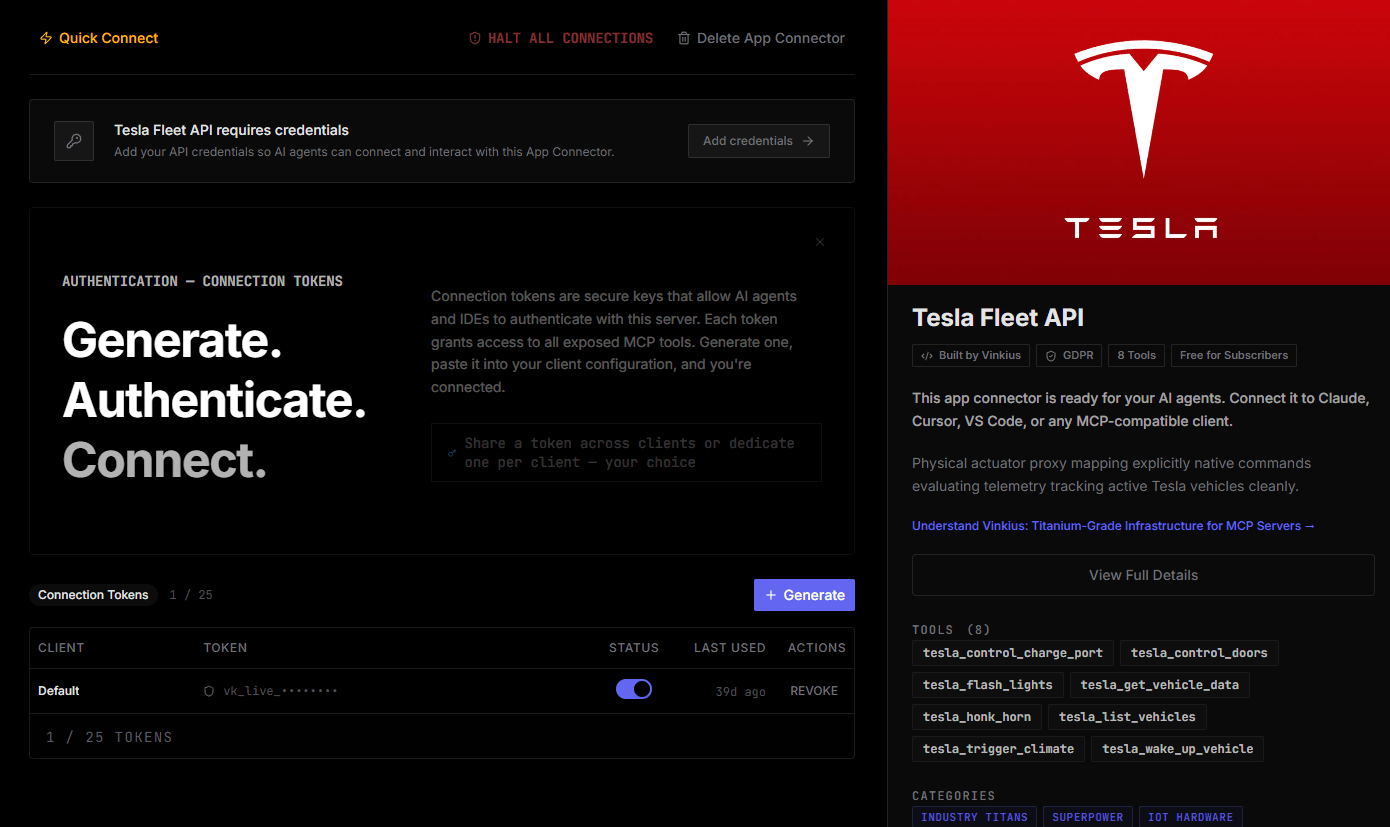
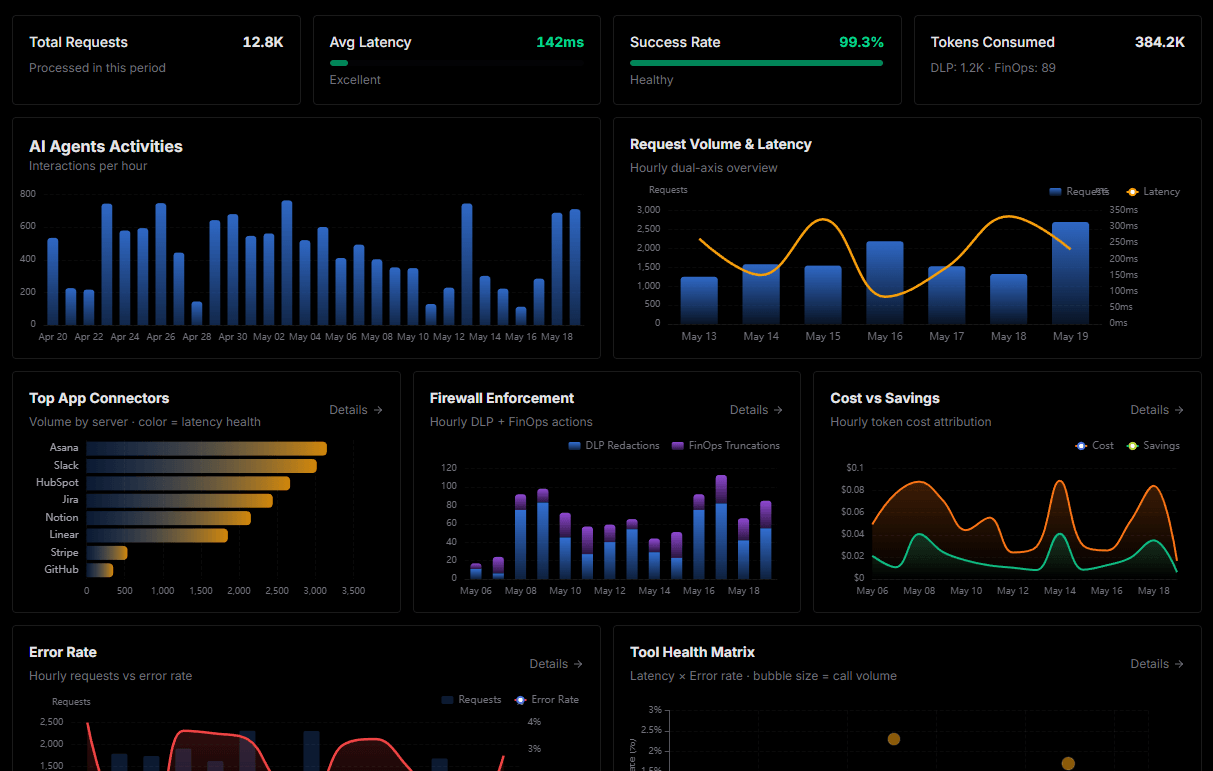
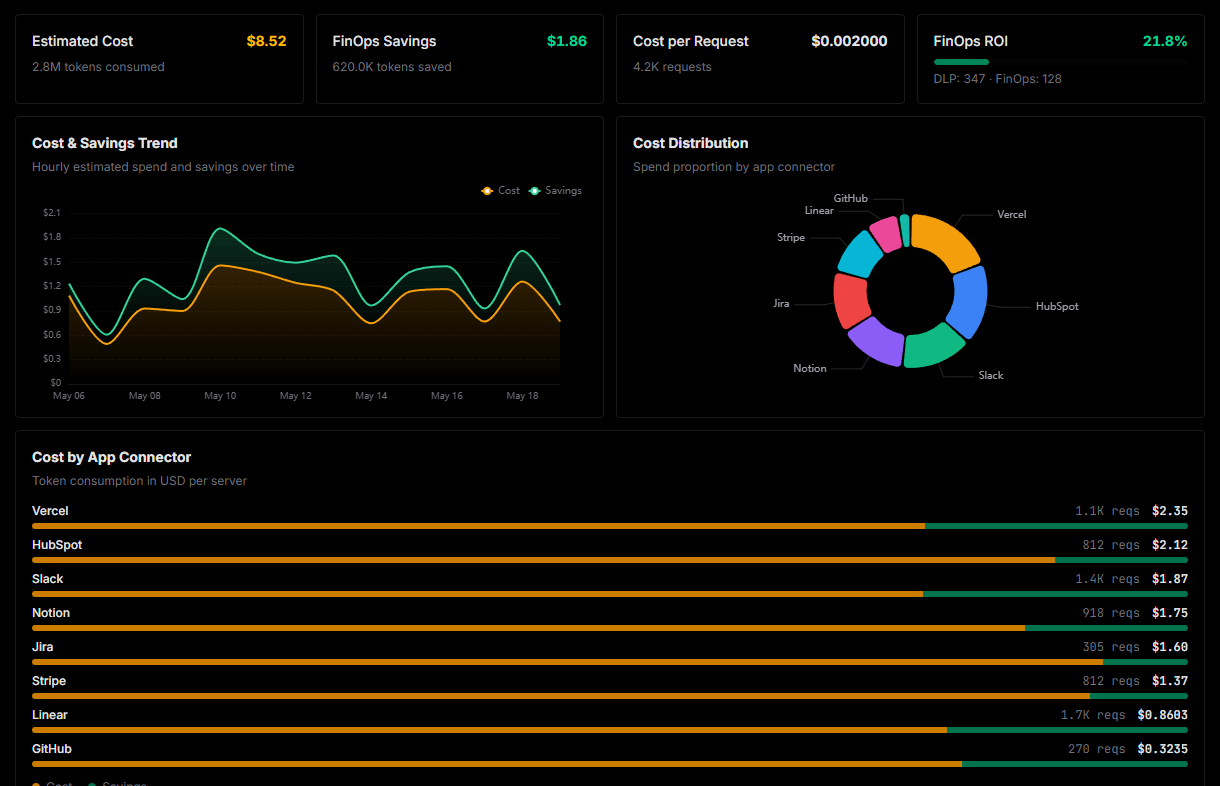
Explore our live AI Agents Analytics dashboard to see it all working
This dashboard is included when you connect Apify using Vinkius. You will never be left in the dark about what your AI agents are doing with your tools.
Apify and 4,000+ other AI tools. No hosting, no code, ready to use.
Professionals who connect Apify to Cursor through Vinkius don't need to write code, manage servers, or worry about security. Everything is pre-configured, secure, and runs automatically in the background.
Raw MCP | Vinkius | |
|---|---|---|
| Ready-to-use MCPs | Find and configure each manually | 4,000+ MCPs ready to use |
| Connection Setup | Manual coding & server setup | 1-click instant connection |
| Server Hosting | You host it yourself (needs 24/7 uptime) | 100% hosted & managed by Vinkius |
| Security & Privacy | Stored in plaintext config files | Bank-grade encrypted vault |
| Activity Visibility | Blind execution (no logs or tracking) | Live dashboard with real-time logs |
| Cost Control | Runaway AI token spend risk | Automatic budget limits |
| Revoking Access | Must delete files or code to stop | 1-click disconnect button |
How Vinkius secures
Apify for Cursor
Every request between Cursor and Apify is protected by our secure gateway. We automatically keep your sensitive data private, prevent unauthorized access, and let you disconnect instantly at any time.
Frequently asked questions
How can the AI agent run a scrape on a list of product URLs?
First, find your specific scraping Actor ID via list_actors. Then, prompt your agent to execute run_actor, providing the target URLs formatted as a structured JSON input payload. It returns a 'Run ID'. You can poll this run via get_run, and once it succeeds, the agent calls get_dataset_items to pull all acquired data straight to your window.
Can the agent interact with run configurations mid-way during crawling?
Yes. If an Apify crawler is currently executing and utilizes a Request Queue, you can instruct your agent to call push_to_queue. Doing so dynamically ships new URLs to the active queue instance, extending the current web crawl without needing to stop or restart the Actor.
Can my AI automatically detect scraping timeouts and debug the failure?
Absolutely. Because your agent can track real execution flows with get_run, it's aware if it transitions to TIMED-OUT or FAILED states. Subsequently, you can ask the agent to examine the KV Store log outputs ensuring the underlying issue (e.g. captcha block, blocking proxy) is identified immediately.
What is Agent mode and why does it matter for MCP?
Agent mode is Cursor's autonomous execution mode where the AI can perform multi-step tasks: reading files, editing code, running terminal commands, and calling MCP tools. Without Agent mode, Cursor operates in a simpler ask-and-answer mode that doesn't support tool calling. Always ensure you're in Agent mode when working with MCP servers.
Where does Cursor store MCP configuration?
Cursor looks for MCP server configurations in a mcp.json file. You can configure servers at the project level (.cursor/mcp.json in your project root) or globally (~/.cursor/mcp.json). Project-level configs take precedence.
Can Cursor use MCP tools in inline edits?
No. MCP tools are only available in Agent mode through the chat panel. Inline completions and Tab suggestions do not trigger MCP tool calls. This is by design. tool calls require user visibility and approval.
How do I verify MCP tools are loaded?
Open Settings → Features → MCP and look for your server name. A green indicator means the server is connected. You can also check Agent mode's available tools by clicking the tools dropdown in the chat panel.
Tools not appearing in Cursor
Ensure you are in Agent mode (not Ask mode). MCP tools only work in Agent mode.
Server shows as disconnected
Check Settings → Features → MCP and verify the server status. Try clicking the refresh button.
Explore More MCP Servers
View all →
Wasabi
10 toolsManage buckets, objects, and versioning on Wasabi — the hot cloud storage for high-performance data residency.

Markdown Frontmatter Harvester
1 toolsScan local Obsidian or Hugo vaults and extract all YAML frontmatter (tags, dates, status) into a single structured JSON. Let your AI query your scattered notes metadata instantly.

Algolia Analytics
10 toolsSearch performance intelligence — audit CTR, conversions, and top searches via AI.

Uber
9 toolsAI ride management: estimate prices, track trips, and manage locations via agents.