
Bring Academic Research
to Cursor
Learn how to connect MIT DBLP to Cursor and start using 16 AI agent tools in minutes. Fully managed, enterprise secure, and ready to use without writing a single line of code.
 GDPR Free for Subscribers
Compatible with every major AI agent and IDE
 Gemini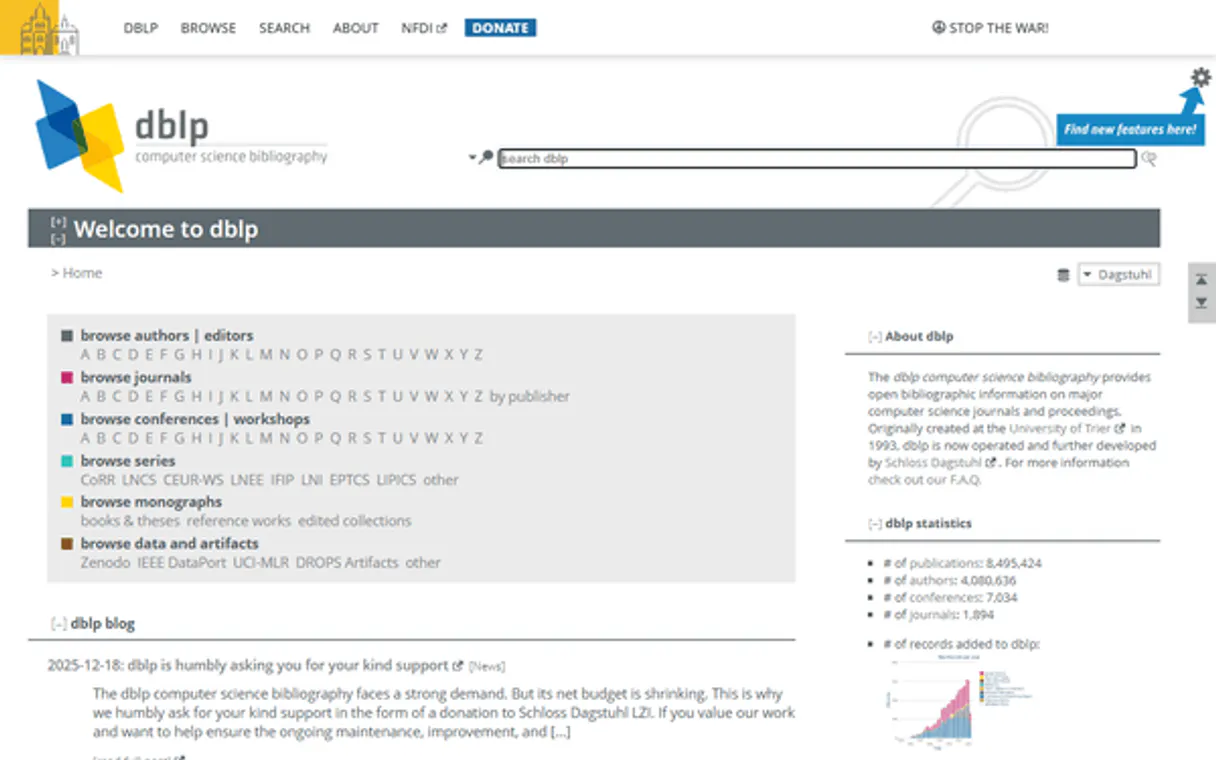
What is the MIT DBLP MCP Server?
Connect to the DBLP Computer Science Bibliography — the most comprehensive index of CS research, maintained by Schloss Dagstuhl.
What you can do
- Full-Text Search — Search 6M+ CS publications across all venues
- Author Profiles — Explore researcher profiles and publication histories
- Venue Browsing — Search conferences (NeurIPS, ICML, SIGMOD, OSDI) and journals (JACM, TOCS)
- Co-Author Networks — Discover collaboration patterns between researchers
- AI/ML Papers — Dedicated search for NeurIPS, ICML, ICLR, and AAAI papers
- Systems Papers — Dedicated search for OSDI, SOSP, SIGCOMM, NSDI papers
- Theory Papers — Dedicated search for STOC, FOCS, SODA papers
- Database Papers — Dedicated search for SIGMOD, VLDB, ICDE papers
- Author Statistics — Publication counts, venue distribution, and year-over-year trends
Who is this for?
- CS Researchers — literature reviews and related work discovery
- PhD Students — find the latest papers in your area
- Faculty — track research output and collaboration networks
- Hiring Committees — evaluate candidate publication records
Built-in capabilities (16)
The PID can be found in DBLP URLs (e.g. for "https://dblp.org/pid/b/YoshuaBengio" the PID is "b/YoshuaBengio"). Get author profile by DBLP PID
Returns up to 40 most recent publications with full metadata. Use the author name as it appears on DBLP. Get all publications by a specific author
Essential for evaluating research productivity and impact. Get publication statistics for an author
Returns a ranked list of collaborators ordered by number of joint publications. Essential for understanding research collaboration patterns. Get co-author network of a researcher
g. "journals/cacm/Knuth74", "conf/nips/VaswaniSPUJGKP17"). The key uniquely identifies every record in DBLP. Get publication details by DBLP key
Use conference abbreviations (ICML, NeurIPS, SIGMOD) or full journal names. Get venue details (conference or journal)
Essential for exploring what was published at a particular conference edition (e.g. NeurIPS 2024). Get papers published at a specific venue
These are the premier conferences for artificial intelligence and machine learning research. Search AI and machine learning papers at top venues
Returns author names, DBLP profile URLs, and disambiguation notes. DBLP meticulously disambiguates authors with the same name. Search computer science authors on DBLP
Useful for tracking research trends over time or finding papers from a specific conference edition. Search publications filtered by year
Search database papers at top venues
Combine a venue name with an optional topic query to find relevant papers at a particular venue. Search for papers within a specific venue
Covers all major conferences (NeurIPS, ICML, SIGMOD, VLDB, OSDI) and journals (JACM, TOCS, VLDBJ). Returns titles, authors, venues, years, DOIs, and DBLP keys. Search 6M+ computer science publications on DBLP
Search systems papers at top venues
Search theoretical CS papers at top venues
Returns venue names, DBLP URLs, and types. Search CS conferences and journals
Why Cursor?
Cursor's Agent mode turns MIT DBLP into an in-editor superpower. Ask Cursor to generate code using live data from MIT DBLP and it fetches, processes, and writes. all in a single agentic loop. 16 tools appear alongside file editing and terminal access, creating a unified development environment grounded in real-time information.
- —
Agent mode turns Cursor into an autonomous coding assistant that can read files, run commands, and call MCP tools without switching context
- —
Cursor's Composer feature can generate entire files using real-time data fetched through MCP. no copy-pasting from external dashboards
- —
MCP tools appear alongside built-in tools like file reading and terminal access, creating a unified agentic environment
- —
VS Code extension compatibility means your existing workflow, keybindings, and extensions all work alongside MCP tools
MIT DBLP in Cursor
MIT DBLP and 4,000+ other MCP servers. One platform. One governance layer.
Teams that connect MIT DBLP to Cursor through Vinkius don't need to source, host, or maintain individual MCP servers. Every tool call runs inside a hardened runtime with credential isolation, DLP, and a signed audit chain.
Raw MCP | Vinkius | |
|---|---|---|
| Server catalog | Find and host yourself | 4,000+ managed |
| Infrastructure | Self-hosted | Sandboxed V8 isolates |
| Credential handling | Plaintext in config | Vault + runtime injection |
| Data loss prevention | None | Configurable DLP policies |
| Kill switch | None | Global instant shutdown |
| Financial circuit breakers | None | Per-server limits + alerts |
| Audit trail | None | Ed25519 signed logs |
| SIEM log streaming | None | Splunk, Datadog, Webhook |
| Honeytokens | None | Canary alerts on leak |
| Custom domains | Not applicable | DNS challenge verified |
| GDPR compliance | Manual effort | Automated purge + export |
Why teams choose Vinkius for MIT DBLP in Cursor
The MIT DBLP MCP Server runs on Vinkius-managed infrastructure inside AWS — a purpose-built runtime with per-request V8 isolates, Ed25519 signed audit chains, and sub-40ms cold starts. All 16 tools execute in hardened sandboxes optimized for native MCP execution.
Your AI agents in Cursor only access the data you authorize, with DLP that blocks sensitive information from ever reaching the model, kill switch for instant shutdown, and up to 60% token savings. Enterprise-grade infrastructure, zero maintenance.
* Every MCP server runs on Vinkius-managed infrastructure inside AWS - a purpose-built runtime with per-request V8 isolates, Ed25519 signed audit chains, and sub-40ms cold starts optimized for native MCP execution. See our infrastructure
How Vinkius secures
MIT DBLP for Cursor
Every tool call from Cursor to the MIT DBLP MCP Server is protected by DLP redaction, cryptographic audit chains, V8 sandbox isolation, kill switch, and financial circuit breakers.
Frequently asked questions
Do I need an API key?
No. The DBLP API is completely free and public. No authentication required.
What venues does DBLP cover?
DBLP indexes all major CS conferences (NeurIPS, ICML, SIGMOD, OSDI, STOC) and journals (JACM, TOCS, IEEE TPAMI). It covers over 6 million publications from thousands of venues worldwide.
Can I find co-author networks?
Yes. DBLP maintains detailed co-author relationships. You can explore an author's collaborators, see shared publications, and map research networks across institutions.
What is Agent mode and why does it matter for MCP?
Agent mode is Cursor's autonomous execution mode where the AI can perform multi-step tasks: reading files, editing code, running terminal commands, and calling MCP tools. Without Agent mode, Cursor operates in a simpler ask-and-answer mode that doesn't support tool calling. Always ensure you're in Agent mode when working with MCP servers.
Where does Cursor store MCP configuration?
Cursor looks for MCP server configurations in a mcp.json file. You can configure servers at the project level (.cursor/mcp.json in your project root) or globally (~/.cursor/mcp.json). Project-level configs take precedence.
Can Cursor use MCP tools in inline edits?
No. MCP tools are only available in Agent mode through the chat panel. Inline completions and Tab suggestions do not trigger MCP tool calls. This is by design. tool calls require user visibility and approval.
How do I verify MCP tools are loaded?
Open Settings → Features → MCP and look for your server name. A green indicator means the server is connected. You can also check Agent mode's available tools by clicking the tools dropdown in the chat panel.
Tools not appearing in Cursor
Ensure you are in Agent mode (not Ask mode). MCP tools only work in Agent mode.
Server shows as disconnected
Check Settings → Features → MCP and verify the server status. Try clicking the refresh button.
Explore More MCP Servers
View all →
NVIDIA Vision
9 toolsGenerate images, analyze visuals, detect objects, and caption images via NVIDIA Vision APIs.

NREL Energy Data
10 toolsAccess renewable energy and fuel data via NREL — track fuel stations, solar resources, and utility rates directly from your AI agent.

Deterministic 50/30/20 Budget Engine
1 toolsTransform your AI into a hyper-precise financial controller. Mathematically enforce the 50/30/20 budgeting rule on pre-categorized expense pipelines to detect exact capital deviations.
IBGE Economia — CNAE Activities
5 toolsNavigate Brazil's entire economic taxonomy: 1,332 CNAE activity codes across 21 sectors, 87 divisions, 285 groups — the definitive resource for business classification, compliance, and market analysis.