
Bring Academic Research
to Pydantic AI
Learn how to connect MIT DBLP to Pydantic AI and start using 16 AI agent tools in minutes. Fully managed, enterprise secure, and ready to use without writing a single line of code.
 GDPR Free for Subscribers
Compatible with every major AI agent and IDE
 Gemini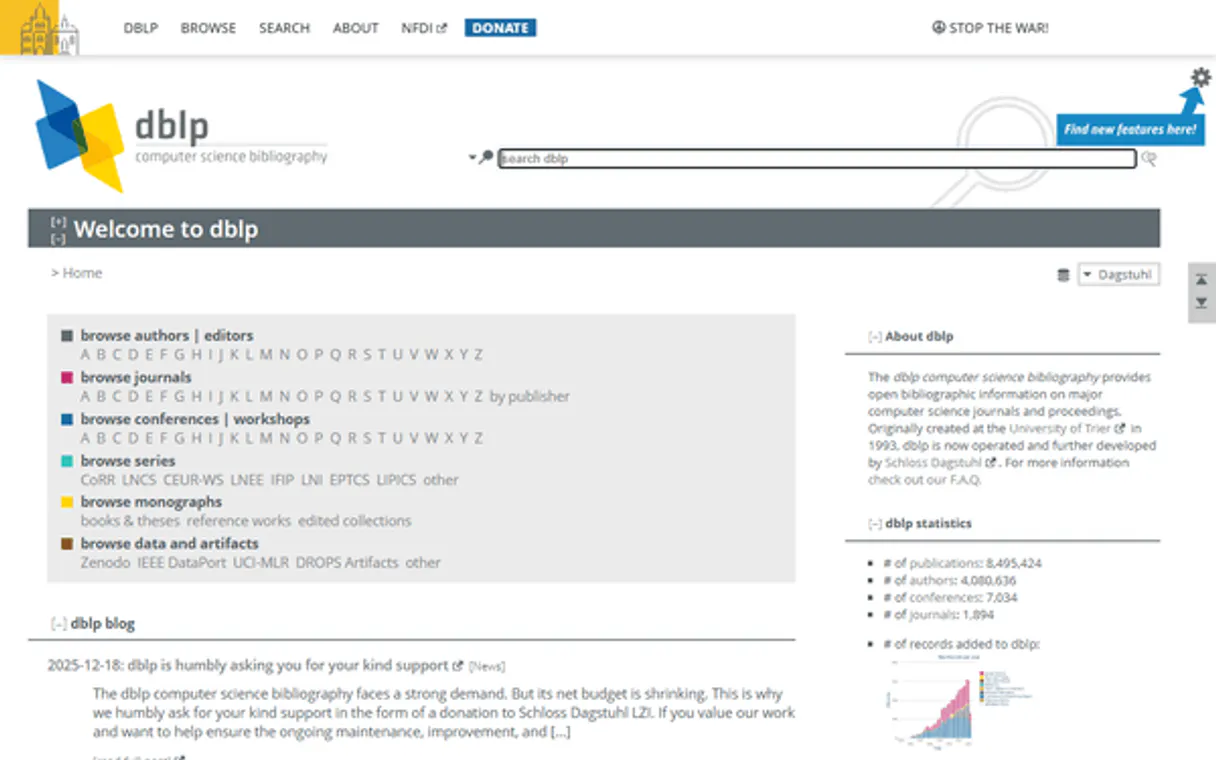
What is the MIT DBLP MCP Server?
Connect to the DBLP Computer Science Bibliography — the most comprehensive index of CS research, maintained by Schloss Dagstuhl.
What you can do
- Full-Text Search — Search 6M+ CS publications across all venues
- Author Profiles — Explore researcher profiles and publication histories
- Venue Browsing — Search conferences (NeurIPS, ICML, SIGMOD, OSDI) and journals (JACM, TOCS)
- Co-Author Networks — Discover collaboration patterns between researchers
- AI/ML Papers — Dedicated search for NeurIPS, ICML, ICLR, and AAAI papers
- Systems Papers — Dedicated search for OSDI, SOSP, SIGCOMM, NSDI papers
- Theory Papers — Dedicated search for STOC, FOCS, SODA papers
- Database Papers — Dedicated search for SIGMOD, VLDB, ICDE papers
- Author Statistics — Publication counts, venue distribution, and year-over-year trends
Who is this for?
- CS Researchers — literature reviews and related work discovery
- PhD Students — find the latest papers in your area
- Faculty — track research output and collaboration networks
- Hiring Committees — evaluate candidate publication records
Built-in capabilities (16)
The PID can be found in DBLP URLs (e.g. for "https://dblp.org/pid/b/YoshuaBengio" the PID is "b/YoshuaBengio"). Get author profile by DBLP PID
Returns up to 40 most recent publications with full metadata. Use the author name as it appears on DBLP. Get all publications by a specific author
Essential for evaluating research productivity and impact. Get publication statistics for an author
Returns a ranked list of collaborators ordered by number of joint publications. Essential for understanding research collaboration patterns. Get co-author network of a researcher
g. "journals/cacm/Knuth74", "conf/nips/VaswaniSPUJGKP17"). The key uniquely identifies every record in DBLP. Get publication details by DBLP key
Use conference abbreviations (ICML, NeurIPS, SIGMOD) or full journal names. Get venue details (conference or journal)
Essential for exploring what was published at a particular conference edition (e.g. NeurIPS 2024). Get papers published at a specific venue
These are the premier conferences for artificial intelligence and machine learning research. Search AI and machine learning papers at top venues
Returns author names, DBLP profile URLs, and disambiguation notes. DBLP meticulously disambiguates authors with the same name. Search computer science authors on DBLP
Useful for tracking research trends over time or finding papers from a specific conference edition. Search publications filtered by year
Search database papers at top venues
Combine a venue name with an optional topic query to find relevant papers at a particular venue. Search for papers within a specific venue
Covers all major conferences (NeurIPS, ICML, SIGMOD, VLDB, OSDI) and journals (JACM, TOCS, VLDBJ). Returns titles, authors, venues, years, DOIs, and DBLP keys. Search 6M+ computer science publications on DBLP
Search systems papers at top venues
Search theoretical CS papers at top venues
Returns venue names, DBLP URLs, and types. Search CS conferences and journals
Why Pydantic AI?
Pydantic AI validates every MIT DBLP tool response against typed schemas, catching data inconsistencies at build time. Connect 16 tools through Vinkius and switch between OpenAI, Anthropic, or Gemini without changing your integration code. full type safety, structured output guarantees, and dependency injection for testable agents.
- —
Full type safety: every MCP tool response is validated against Pydantic models, catching data inconsistencies before they reach your application
- —
Model-agnostic architecture. switch between OpenAI, Anthropic, or Gemini without changing your MIT DBLP integration code
- —
Structured output guarantee: Pydantic AI ensures tool results conform to defined schemas, eliminating runtime type errors
- —
Dependency injection system cleanly separates your MIT DBLP connection logic from agent behavior for testable, maintainable code
MIT DBLP in Pydantic AI
MIT DBLP and 4,000+ other MCP servers. One platform. One governance layer.
Teams that connect MIT DBLP to Pydantic AI through Vinkius don't need to source, host, or maintain individual MCP servers. Every tool call runs inside a hardened runtime with credential isolation, DLP, and a signed audit chain.
Raw MCP | Vinkius | |
|---|---|---|
| Server catalog | Find and host yourself | 4,000+ managed |
| Infrastructure | Self-hosted | Sandboxed V8 isolates |
| Credential handling | Plaintext in config | Vault + runtime injection |
| Data loss prevention | None | Configurable DLP policies |
| Kill switch | None | Global instant shutdown |
| Financial circuit breakers | None | Per-server limits + alerts |
| Audit trail | None | Ed25519 signed logs |
| SIEM log streaming | None | Splunk, Datadog, Webhook |
| Honeytokens | None | Canary alerts on leak |
| Custom domains | Not applicable | DNS challenge verified |
| GDPR compliance | Manual effort | Automated purge + export |
Why teams choose Vinkius for MIT DBLP in Pydantic AI
The MIT DBLP MCP Server runs on Vinkius-managed infrastructure inside AWS — a purpose-built runtime with per-request V8 isolates, Ed25519 signed audit chains, and sub-40ms cold starts. All 16 tools execute in hardened sandboxes optimized for native MCP execution.
Your AI agents in Pydantic AI only access the data you authorize, with DLP that blocks sensitive information from ever reaching the model, kill switch for instant shutdown, and up to 60% token savings. Enterprise-grade infrastructure, zero maintenance.
* Every MCP server runs on Vinkius-managed infrastructure inside AWS - a purpose-built runtime with per-request V8 isolates, Ed25519 signed audit chains, and sub-40ms cold starts optimized for native MCP execution. See our infrastructure
How Vinkius secures
MIT DBLP for Pydantic AI
Every tool call from Pydantic AI to the MIT DBLP MCP Server is protected by DLP redaction, cryptographic audit chains, V8 sandbox isolation, kill switch, and financial circuit breakers.
Frequently asked questions
Do I need an API key?
No. The DBLP API is completely free and public. No authentication required.
What venues does DBLP cover?
DBLP indexes all major CS conferences (NeurIPS, ICML, SIGMOD, OSDI, STOC) and journals (JACM, TOCS, IEEE TPAMI). It covers over 6 million publications from thousands of venues worldwide.
Can I find co-author networks?
Yes. DBLP maintains detailed co-author relationships. You can explore an author's collaborators, see shared publications, and map research networks across institutions.
How does Pydantic AI discover MCP tools?
Create an MCPServerHTTP instance with the server URL. Pydantic AI connects, discovers all tools, and generates typed Python interfaces automatically.
Does Pydantic AI validate MCP tool responses?
Yes. When you define result types as Pydantic models, every tool response is validated against the schema. Invalid data raises a clear error instead of silently corrupting your pipeline.
Can I switch LLM providers without changing MCP code?
Absolutely. Pydantic AI abstracts the model layer. your MIT DBLP MCP integration works identically with OpenAI, Anthropic, Google, or any supported provider.
MCPServerHTTP not found
Update: pip install --upgrade pydantic-ai
Explore More MCP Servers
View all →
Bookeo
9 toolsManage bookings, customers, products, payments, and availability for your Bookeo-powered fitness or activity business through natural conversation.

Corpay One
7 toolsSimplify business payments with automated AP processing, virtual cards, and vendor management that saves your finance team hours.

Road511
8 toolsAccess real-time US and Canada traffic data via Road511 — track incidents, monitor cameras, check road conditions, and analyze trends from any AI agent.

MINDBODY Health & Wellness
10 toolsManage your wellness business via MINDBODY — track class schedules, client profiles, and visit history directly via AI.