
Bring Pgvector
to Cursor
Create your Vinkius account to connect Supabase Vector to Cursor and start using all 7 AI tools in minutes. Fully managed, enterprise secure, and ready to use without writing a single line of code. No hosting, no server setup — just connect and start using.
 GDPR Free for Subscribers
Compatible with every major AI agent and IDE
 Gemini
What is the Supabase Vector MCP Server?
Integrate the powerful AI-native PostgreSQL extensions of Supabase Vector straight into your conversational LLM workflows. By authenticating your environment natively with the service_role key, your AI assistant bypasses row-level security constraints to operate as an unrestricted database administrator. Perform advanced similarity searches using the pgvector extension, parse and manipulate multi-dimensional embeddings, and execute foundational CRUD operations via simple natural language commands. Streamline RAG (Retrieval-Augmented Generation) setups and semantic engineering directly, avoiding the need for external dashboards or manual SQL querying.
What you can do
- Semantic Vector Matching — Seamlessly query unstructured contextual similarities performing embedding comparisons by executing
match_vectorsutilizing custom postgres RPC parameters locally. - Database Structural Interaction — Systematically browse schema availability utilizing
list_tablesand extract specific data arrays effortlessly throughquery_table_rows. - Content State Manipulations — Seamlessly orchestrate data inputs invoking
insert_table_rowsor explicitly clear legacy assignments logically mapping identifiers withdelete_table_rows. - Custom Functional Logic — Launch sophisticated PL/pgSQL algorithms statically configured in your Supabase backend directly with
call_postgres_function.
How it works
- Set up the Supabase Vector MCP module as an active integration inside your CLI environment.
- In the configuration matrix, bind your exact deployed
SUPABASE_URLalongside your powerful validationSUPABASE_SERVICE_KEY. - Instruct your AI securely: "Match the current context to my 'documents_embeddings' function extracting the 5 most similar articles, then call the active review RPC."
Who is this for?
- AI & Data Engineers — Rapidly iterate embedding architectures testing embedding models and distance metrics strictly without opening external validation platforms.
- PostgreSQL Database Administrators — Diagnose semantic accuracy directly from the prompt line configuring inputs organically and adjusting values via conversational arrays.
- Backend Developers — Evaluate robust vector databases quickly debugging your semantic infrastructure and RAG deployments natively directly in your active workspace.
Built-in capabilities (7)
Calls a custom Postgres function (RPC) with parameters
This action is irreversible. Deletes rows from a table based on a column value
Retrieves a specific row by matching a column value
Provide a JSON array of row objects. Inserts new rows into a specific table
Lists all tables in the Supabase project
Requires a valid RPC function name and an embedding array. Performs a vector similarity search via Postgres RPC
Provide table name and optional select/limit. Queries rows from a specific table
Why Cursor?
Cursor's Agent mode turns Supabase Vector into an in-editor superpower. Ask Cursor to generate code using live data from Supabase Vector and it fetches, processes, and writes. all in a single agentic loop. 7 tools appear alongside file editing and terminal access, creating a unified development environment grounded in real-time information.
- —
Agent mode turns Cursor into an autonomous coding assistant that can read files, run commands, and call MCP tools without switching context
- —
Cursor's Composer feature can generate entire files using real-time data fetched through MCP. no copy-pasting from external dashboards
- —
MCP tools appear alongside built-in tools like file reading and terminal access, creating a unified agentic environment
- —
VS Code extension compatibility means your existing workflow, keybindings, and extensions all work alongside MCP tools
Supabase Vector in Cursor
Why run Supabase Vector with Vinkius?
The Supabase Vector connection runs on our fully managed, secure cloud infrastructure. We handle the hosting, maintenance, and security so you don't have to deal with servers or code. All 7 tools are ready to work instantly without any complex setup.
You stay in complete control of your data. Your AI only accesses the information you approve, keeping your sensitive passwords and private details completely safe. Plus, with automatic optimizations, your AI works faster and more efficiently.
* Every connection is hosted and maintained by Vinkius. We handle the security, updates, and infrastructure so you don't have to write code or manage servers. See our infrastructure
Over 4,000 integrations ready for AI agents
Explore a vast library of pre-built integrations, optimized and ready to deploy.
Connect securely in under 30 seconds
Generate tokens to authenticate and link external services in a single step.
Complete visibility into every agent action
Audit live requests, latency, success rates, and active security compliance policies.
Optimize spending and track token ROI
Analyze real-time token consumption and cost metrics detailed by connection.
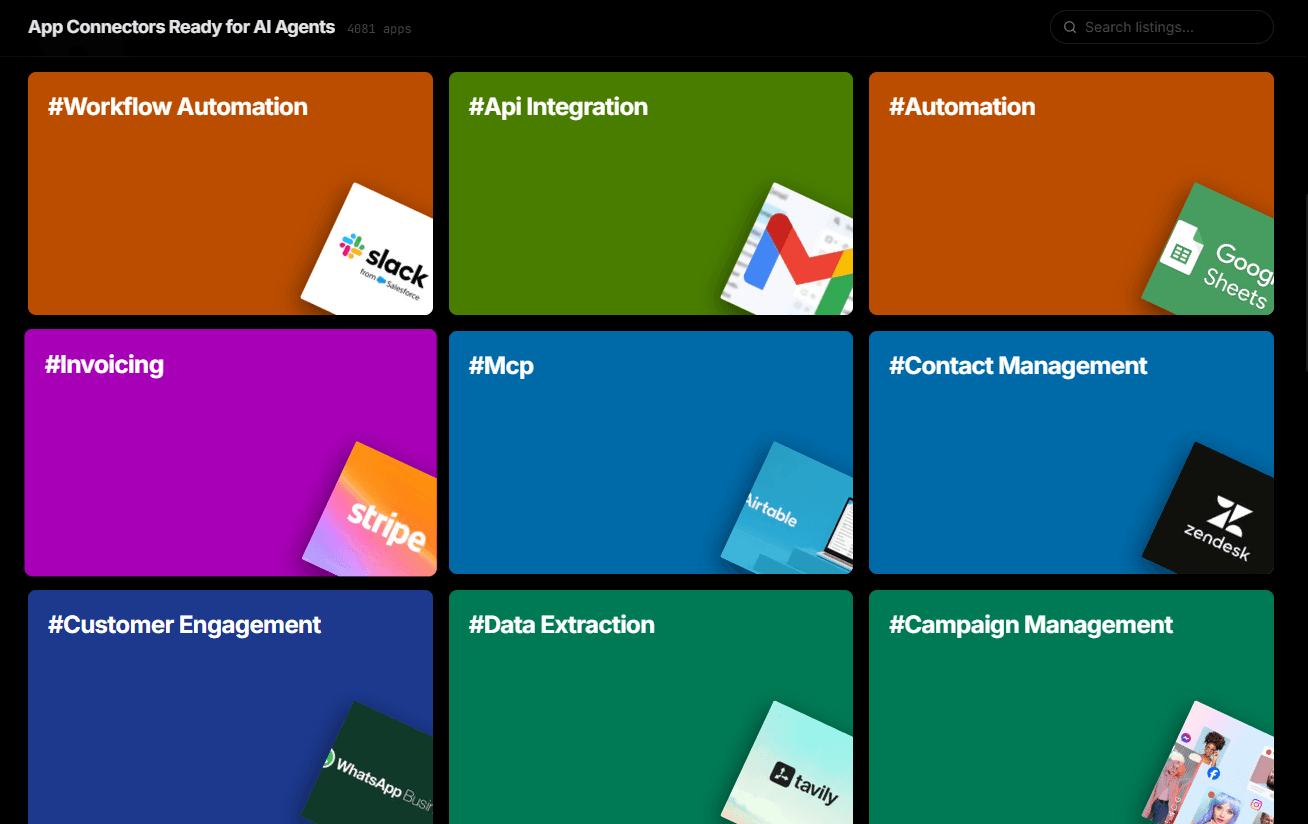
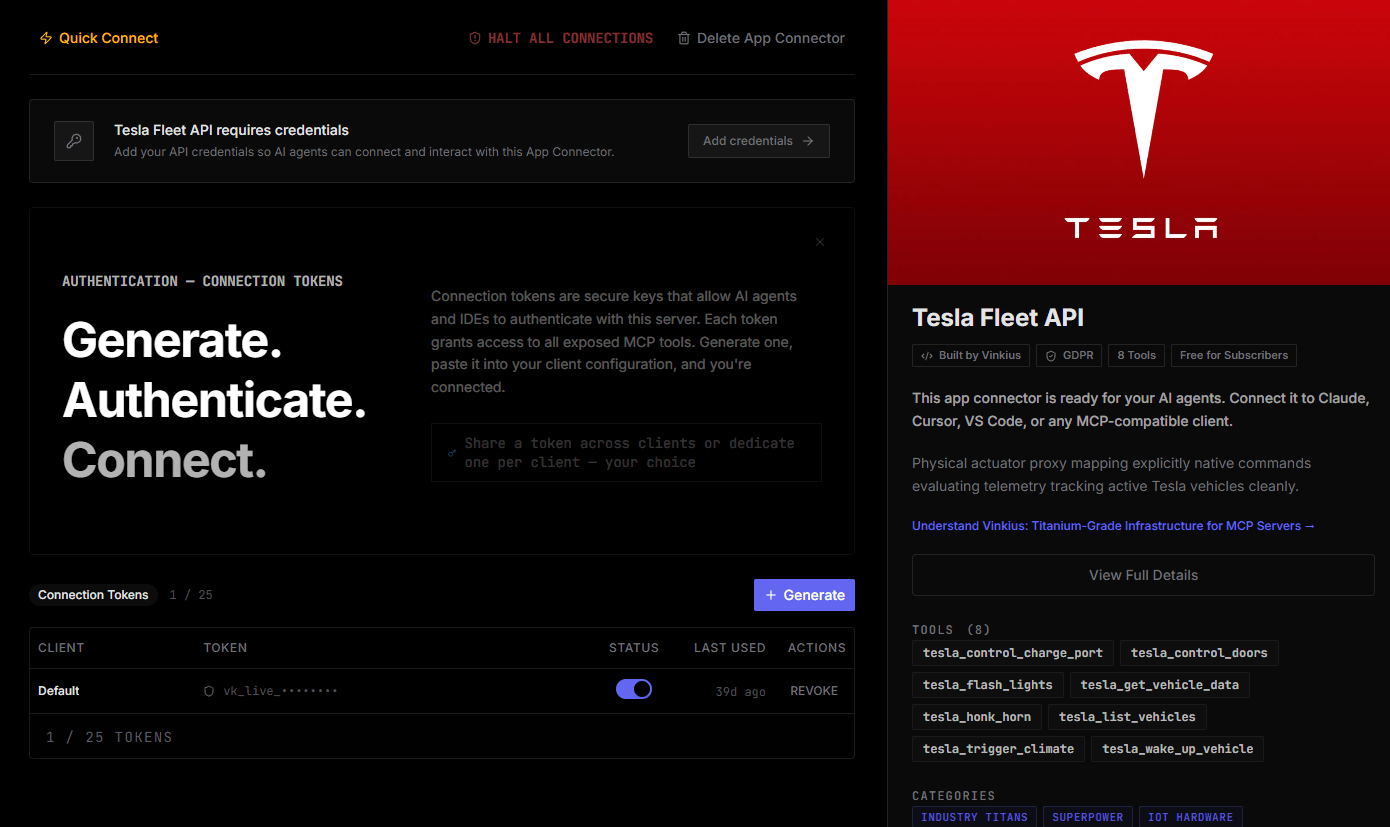
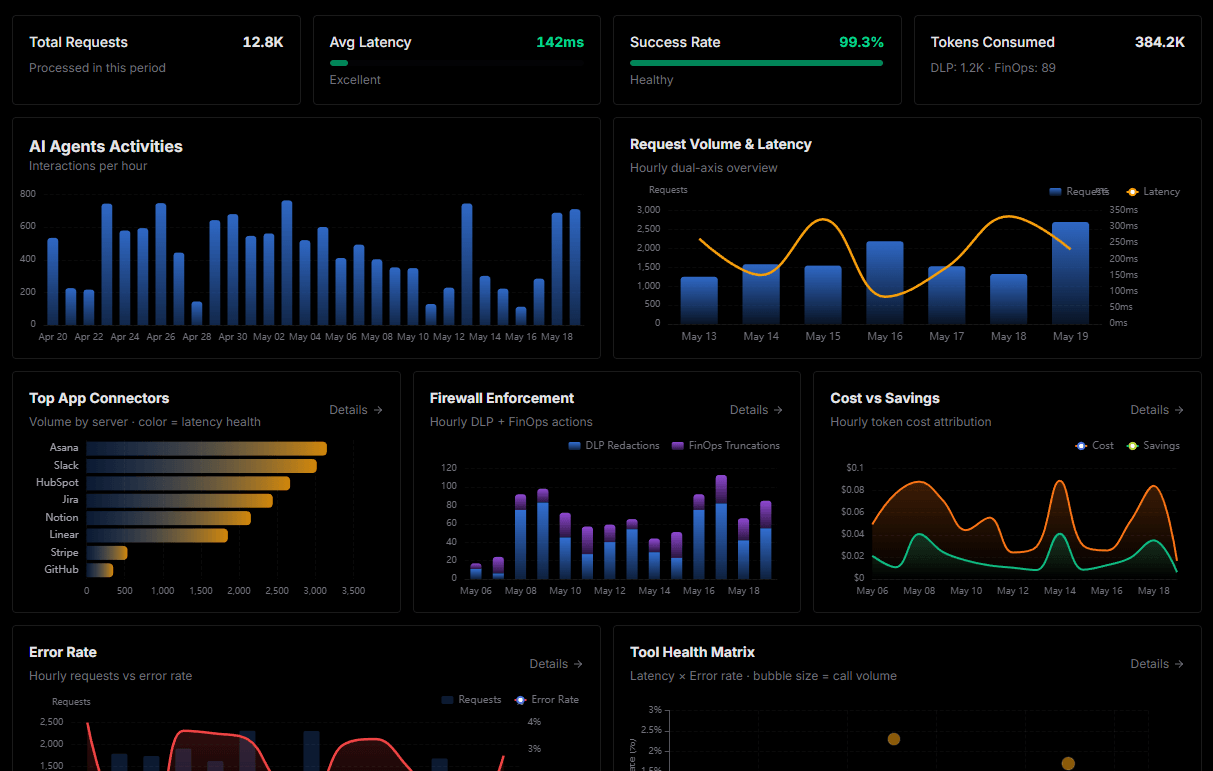
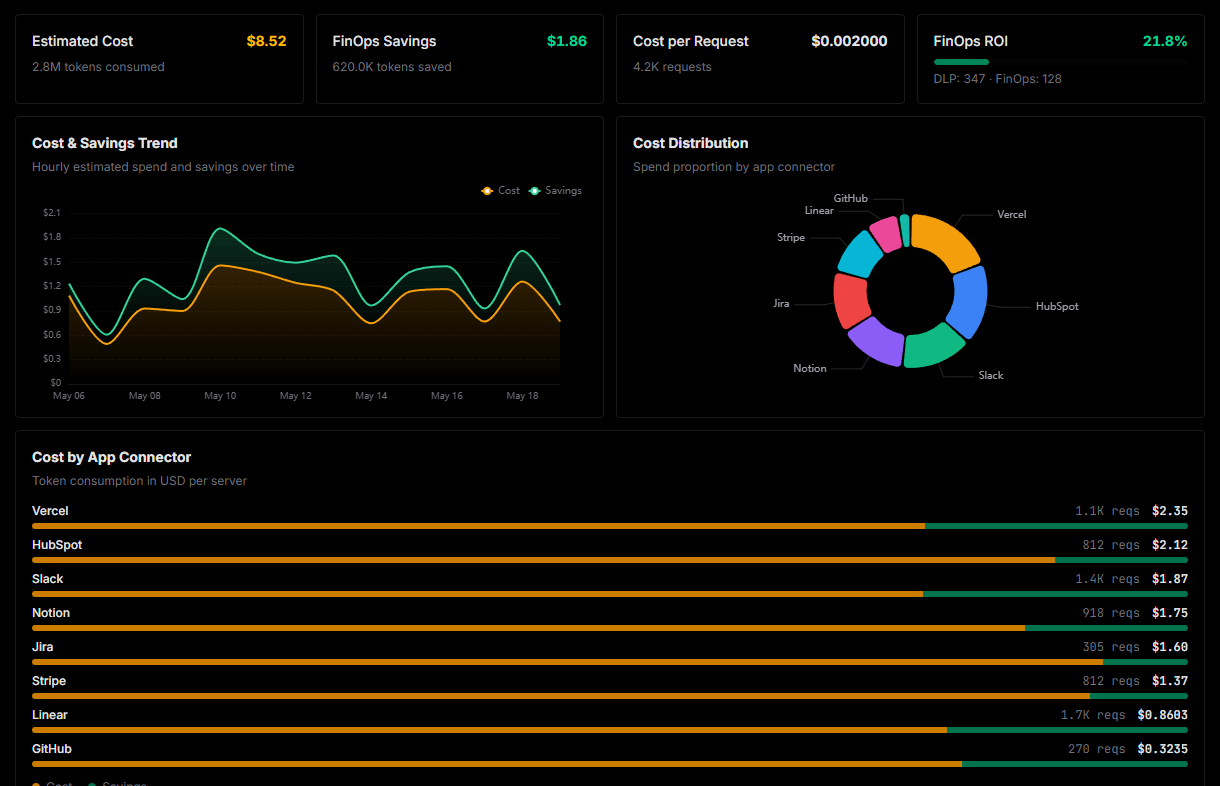
Explore our live AI Agents Analytics dashboard to see it all working
This dashboard is included when you connect Supabase Vector using Vinkius. You will never be left in the dark about what your AI agents are doing with your tools.
Supabase Vector and 4,000+ other AI tools. No hosting, no code, ready to use.
Professionals who connect Supabase Vector to Cursor through Vinkius don't need to write code, manage servers, or worry about security. Everything is pre-configured, secure, and runs automatically in the background.
Raw MCP | Vinkius | |
|---|---|---|
| Ready-to-use MCPs | Find and configure each manually | 4,000+ MCPs ready to use |
| Connection Setup | Manual coding & server setup | 1-click instant connection |
| Server Hosting | You host it yourself (needs 24/7 uptime) | 100% hosted & managed by Vinkius |
| Security & Privacy | Stored in plaintext config files | Bank-grade encrypted vault |
| Activity Visibility | Blind execution (no logs or tracking) | Live dashboard with real-time logs |
| Cost Control | Runaway AI token spend risk | Automatic budget limits |
| Revoking Access | Must delete files or code to stop | 1-click disconnect button |
How Vinkius secures
Supabase Vector for Cursor
Every request between Cursor and Supabase Vector is protected by our secure gateway. We automatically keep your sensitive data private, prevent unauthorized access, and let you disconnect instantly at any time.
Frequently asked questions
Are embedding arrays processed efficiently during intensive vector similarity matching?
The integration specifically manages large semantic arrays seamlessly by calling lightweight Postgres RPC configurations locally natively internally securely.
How is risk managed securely when manipulating and clearing root analytical vectors?
Executing delete_table_rows operates systematically relying inherently on exactly structured string conditions implicitly naturally precisely eliminating ambiguity securely effectively actively strictly smoothly securely precisely correctly reliably locally dynamically successfully effortlessly intelligently gracefully elegantly safely accurately directly comprehensively natively.
Which distance metrics does the vector search support?
pgvector supports cosine similarity, inner product, and L2 (Euclidean) distance. The metric used depends on how your RPC function and index are configured in PostgreSQL — the AI passes arguments accordingly.
What is Agent mode and why does it matter for MCP?
Agent mode is Cursor's autonomous execution mode where the AI can perform multi-step tasks: reading files, editing code, running terminal commands, and calling MCP tools. Without Agent mode, Cursor operates in a simpler ask-and-answer mode that doesn't support tool calling. Always ensure you're in Agent mode when working with MCP servers.
Where does Cursor store MCP configuration?
Cursor looks for MCP server configurations in a mcp.json file. You can configure servers at the project level (.cursor/mcp.json in your project root) or globally (~/.cursor/mcp.json). Project-level configs take precedence.
Can Cursor use MCP tools in inline edits?
No. MCP tools are only available in Agent mode through the chat panel. Inline completions and Tab suggestions do not trigger MCP tool calls. This is by design. tool calls require user visibility and approval.
How do I verify MCP tools are loaded?
Open Settings → Features → MCP and look for your server name. A green indicator means the server is connected. You can also check Agent mode's available tools by clicking the tools dropdown in the chat panel.
Tools not appearing in Cursor
Ensure you are in Agent mode (not Ask mode). MCP tools only work in Agent mode.
Server shows as disconnected
Check Settings → Features → MCP and verify the server status. Try clicking the refresh button.
Explore More MCP Servers
View all →
Airtable
7 toolsQuery databases, manage records, and orchestrate workflows across your connected Airtable bases with full flexibility.

Squarespace
6 toolsEquip your AI with read-only superpowers over your Squarespace platform. Scan transactions, track orders, and audit inventory effortlessly.

Cloudflare Tunnel
17 toolsManage Cloudflare Tunnels directly from your AI agent — list, create, and configure secure Zero Trust connections to your private infrastructure.

BotGenuity
6 toolsCreate and manage AI chatbots with custom knowledge bases that answer customer questions accurately around the clock.