
Bring Flight Tracking
to LangChain
Create your Vinkius account to connect AirLabs to LangChain and start using all 12 AI tools in minutes. Fully managed, enterprise secure, and ready to use without writing a single line of code. No hosting, no server setup — just connect and start using.
 GDPR Free for Subscribers
Compatible with every major AI agent and IDE
 Gemini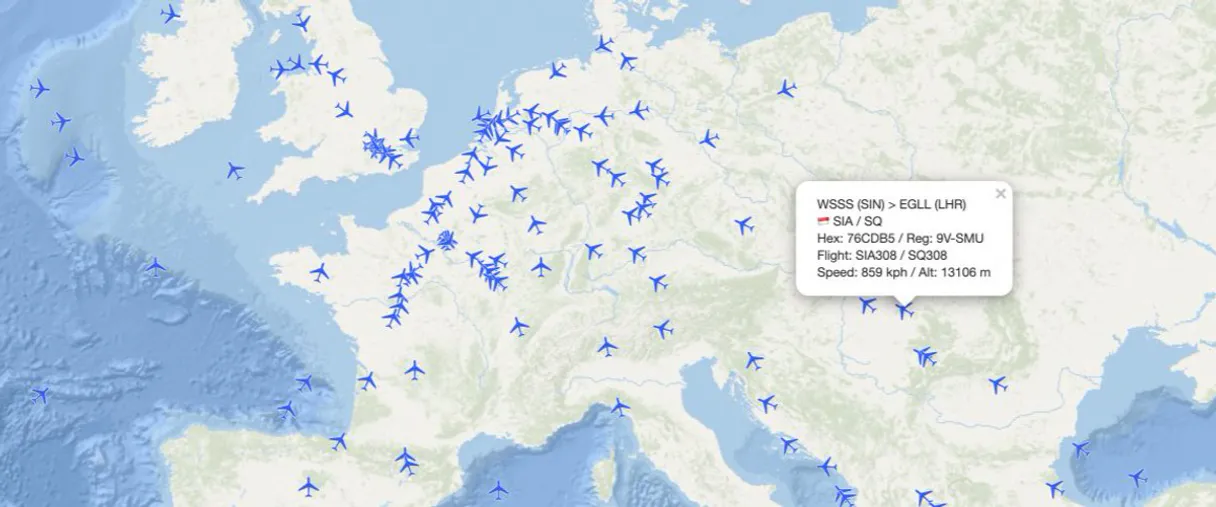
What is the AirLabs MCP Server?
Connect your AirLabs Data API aviation platform to any AI agent and take full control of real-time flight tracking, airport intelligence, airline research, and schedule analysis through natural conversation.
What you can do
- Real-Time Flight Tracking — Search active flights worldwide by airline, flight number, aircraft registration, or geographic area
- Flight Schedules — Access complete timetables for airlines and airport pairs with frequency and days of operation
- Flight Information — Get detailed status for specific flights including gates, terminals, and timing data
- Airport Database — Search 50,000+ airports worldwide by country, city, IATA/ICAO code, or name
- Airline Database — Research airlines globally with fleet sizes, hub airports, and operational status
- Route Networks — Analyze complete route portfolios for any airline with origin-destination pairs
- Fleet Composition — Examine airline fleets with aircraft types, registrations, ages, and operational status
- Nearby Airports — Find airports near any geographic coordinate with distance calculations
- Airport Delays — Check current delay statistics and on-time performance for any airport
- Aircraft Lookup — Research individual aircraft by hex code with registration and specification details
- Airport Autocomplete — Quick airport search with type-ahead suggestions for user-friendly identification
- Airport Flight Boards — Monitor all arrivals or departures at any airport with complete flight lists
How it works
- Subscribe to this server
- Enter your AirLabs API key (from your account dashboard)
- Start tracking global aviation from Claude, Cursor, or any MCP-compatible client
No more navigating flight tracking websites or manually parsing aviation data feeds. Your AI acts as a dedicated aviation data analyst and operations coordinator.
Who is this for?
- Aviation Enthusiasts — track any flight worldwide, research aircraft, and explore airline fleets
- Travel Planners — check schedules, monitor flights, and assess airport delays for trip planning
- Airline Analysts — analyze competitor route networks, fleet composition, and operational performance
- Airport Operators — monitor flight activity, delay trends, and operational efficiency
Built-in capabilities (12)
Returns matching airports ranked by relevance with IATA/ICAO codes, full names, cities, countries, and airport types. Ideal for building airport search interfaces, type-ahead functionality, and airport identification when the user only knows part of the airport name or code. Essential for travel application development, airport search workflows, and user-friendly airport identification. AI agents should use this when users type partial airport names or codes and need quick suggestions, or when the exact airport code is unknown but a partial name is provided. Search airports by name or code with autocomplete suggestions
Returns aircraft registration number, ICAO type code, manufacturer and model, owner/operator, registration country, year built, engine type and count, and current operational status. The hex code is a unique identifier assigned to each aircraft transponder and can be found in flight tracking data. Essential for aviation enthusiasts, aircraft tracking, fleet verification, and detailed aircraft research. AI agents use this when users have an aircraft hex code from flight tracking data and need to look up the full aircraft registration and specifications. Get information about a specific aircraft by hex code
Returns all aircraft in the airline fleet with registration numbers, aircraft types (manufacturer and model), ICAO aircraft type codes, age in years, delivery dates, engine types, and current operational status (active, stored, retired). Essential for fleet analysis, aviation industry research, competitor intelligence, aircraft utilization studies, and airline operational profiling. AI agents use this when users ask "show me the Delta fleet", "what aircraft does Emirates operate", or need to analyze fleet composition, average fleet age, and aircraft diversity for a specific airline. Get the complete fleet composition of an airline
Returns route pairs (origin-destination airports), frequency of service, days of operation, aircraft types deployed on each route, and whether the route is seasonal or year-round. Essential for route network analysis, airline competitive intelligence, aviation market research, travel itinerary planning, and airline hub/spoke structure analysis. AI agents should reference this when users ask "show me all United routes", "what routes does Ryanair operate", or need to understand an airline route network for competitive analysis or travel planning. Get all routes operated by a specific airline
Supports filtering by country code, IATA code, ICAO code, airline name, or callsign. Returns airline details including IATA/ICAO codes, full name, country of registration, callsign, fleet size, founding year, hub airports, airline type (scheduled, cargo, charter), and operational status (active, inactive). Essential for airline industry research, competitor analysis, travel planning context, aviation market intelligence, and airline profile generation. AI agents should use this when users ask "show me all airlines in the US", "tell me about Lufthansa", "what airlines fly from Dubai", or need airline metadata to contextualize flight and fleet data. Search and retrieve airline database information
Returns average departure and arrival delays in minutes, delay trends compared to historical averages, on-time performance percentages, cancellation rates, and weather-related delay indicators. Essential for travel planning, delay prediction, passenger communication, airline operations coordination, and airport performance monitoring. AI agents should reference this when users ask "are there delays at JFK", "how is LAX performing today", or need to assess airport operational conditions that may affect flight schedules. Get current delay statistics for a specific airport
Supports filtering by country code, city name, IATA code, ICAO code, airport name, or timezone. Returns airport details including IATA/ICAO codes, full name, location (city, state, country), geographic coordinates (latitude, longitude, elevation), timezone, airport type (large, medium, small), and operational status. Essential for airport identification, travel planning, geographic aviation research, multi-airport city analysis, and flight briefing preparation. AI agents should reference this when users ask "show me all airports in Germany", "find airports in Tokyo", "what is the ICAO code for Heathrow", or need airport metadata to contextualize flight queries. Search and retrieve airport database information
g., "UA123" for United 123). Returns complete flight details including airline information, aircraft type and registration, departure and arrival airports with terminals and gates, scheduled and estimated/actual times, current flight status, delay indicators, and baggage claim information. Critical for passenger travel updates, detailed flight status queries, airline operations coordination, and travel itinerary verification. AI agents should use this when users ask "tell me about flight UA123", "what is the status of BA178", or need detailed information for a specific flight number. Get detailed information for a specific flight
Supports filtering by airline IATA code (e.g., "UA" for United), flight number, aircraft registration (hex code), altitude range, speed, or geographic bounding box (lat/lng coordinates). Returns flight identification (flight IATA/ICAO codes), airline details, aircraft hex code and registration, departure and arrival airports with IATA/ICAO codes, scheduled and estimated/actual times, current position (latitude, longitude), altitude in meters, ground speed in km/h, heading direction, vertical speed, squawk code, and flight status (en-route, landed, scheduled, cancelled). Essential for real-time flight tracking, passenger pickup coordination, aviation operations monitoring, and live flight dashboards. AI agents should use this when users ask "show me all United flights", "track flights in this area", or need to search flights by airline, registration, or geographic area. Search for real-time active flights worldwide
Returns comprehensive flight lists with airline, flight number, aircraft type, origin/destination airport, scheduled and estimated/actual times, terminal and gate information, baggage claim (for arrivals), and current flight status (en-route, landed, scheduled, delayed, cancelled, diverted). Supports type parameter to filter by "departure" or "arrival" flights. Essential for airport operations management, passenger pickup coordination, ground handling planning, flight activity monitoring, and arrival/departure board displays. AI agents should reference this when users ask "what flights are departing from JFK", "show me all arrivals at LHR", or need to monitor airport traffic for a specific airport. Get all arriving or departing flights at a specific airport
Returns all airports (large international, regional, and general aviation) within the search radius with distances from the coordinate, IATA/ICAO codes, names, locations, and airport types. Essential for travel planning, alternate airport identification, geographic aviation research, emergency diversion planning, and multi-airport city analysis. AI agents should use this when users ask "what airports are near these coordinates", "find airports within 100km of this location", or need to identify the nearest airports to a specific point for travel or logistics purposes. Find airports near a specific geographic location
Returns scheduled flights with airline, flight number, aircraft type, departure and arrival airports, scheduled times, frequency of service, days of operation, and aircraft registration if assigned. Supports filtering by airline IATA code, departure airport IATA, arrival airport IATA, date range, and flight number. Essential for travel planning, route analysis, schedule reliability studies, airline timetable research, and flight itinerary preparation. AI agents should reference this when users ask "what is the schedule from JFK to LAX", "show me all Delta flights from ATL", or need to analyze flight schedules between airports. Get flight schedules and timetables for airlines and airports
Why LangChain?
LangChain's ecosystem of 500+ components combines seamlessly with AirLabs through native MCP adapters. Connect 12 tools via Vinkius and use ReAct agents, Plan-and-Execute strategies, or custom agent architectures. with LangSmith tracing giving full visibility into every tool call, latency, and token cost.
- —
The largest ecosystem of integrations, chains, and agents. combine AirLabs MCP tools with 500+ LangChain components
- —
Agent architecture supports ReAct, Plan-and-Execute, and custom strategies with full MCP tool access at every step
- —
LangSmith tracing gives you complete visibility into tool calls, latencies, and token usage for production debugging
- —
Memory and conversation persistence let agents maintain context across AirLabs queries for multi-turn workflows
AirLabs in LangChain
Why run AirLabs with Vinkius?
The AirLabs connection runs on our fully managed, secure cloud infrastructure. We handle the hosting, maintenance, and security so you don't have to deal with servers or code. All 12 tools are ready to work instantly without any complex setup.
You stay in complete control of your data. Your AI only accesses the information you approve, keeping your sensitive passwords and private details completely safe. Plus, with automatic optimizations, your AI works faster and more efficiently.
* Every connection is hosted and maintained by Vinkius. We handle the security, updates, and infrastructure so you don't have to write code or manage servers. See our infrastructure
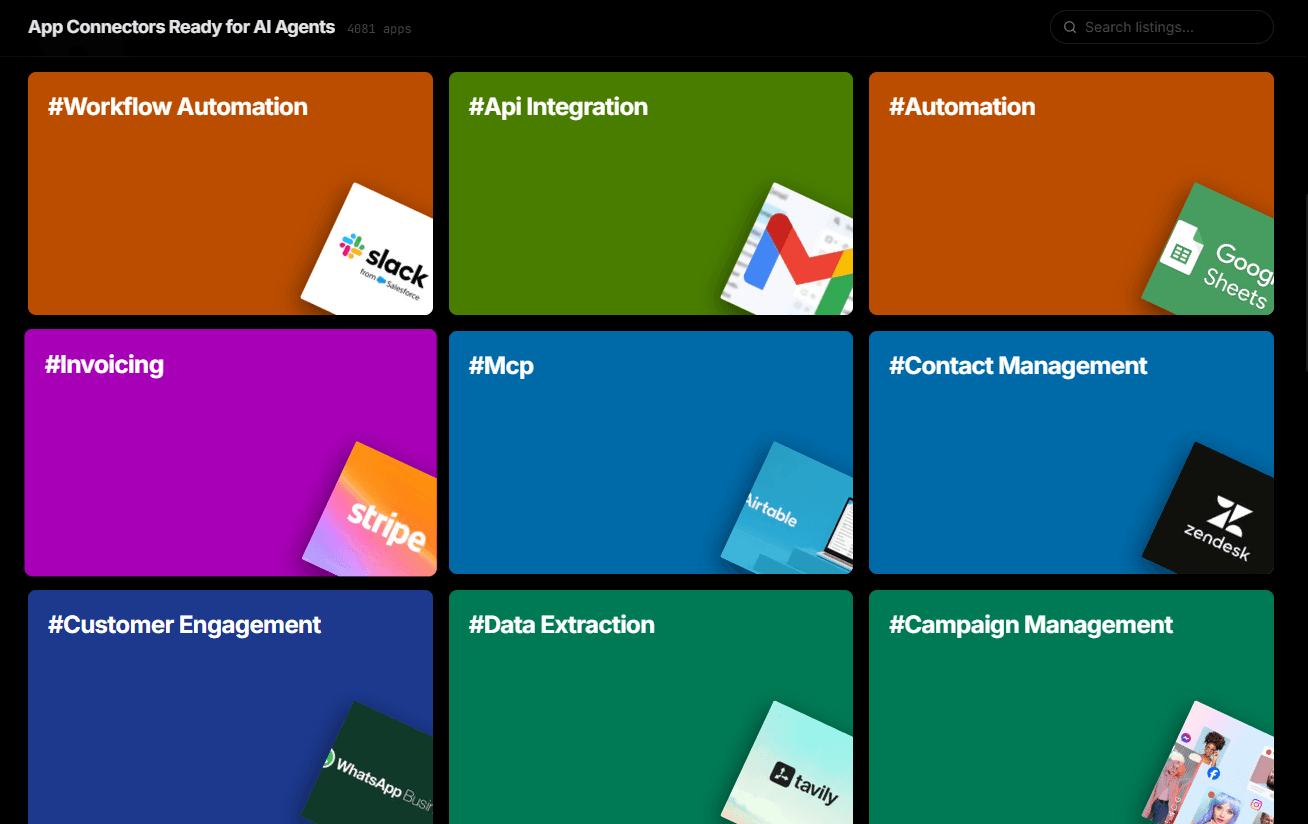
Over 4,000 integrations ready for AI agents
Explore a vast library of pre-built integrations, optimized and ready to deploy.
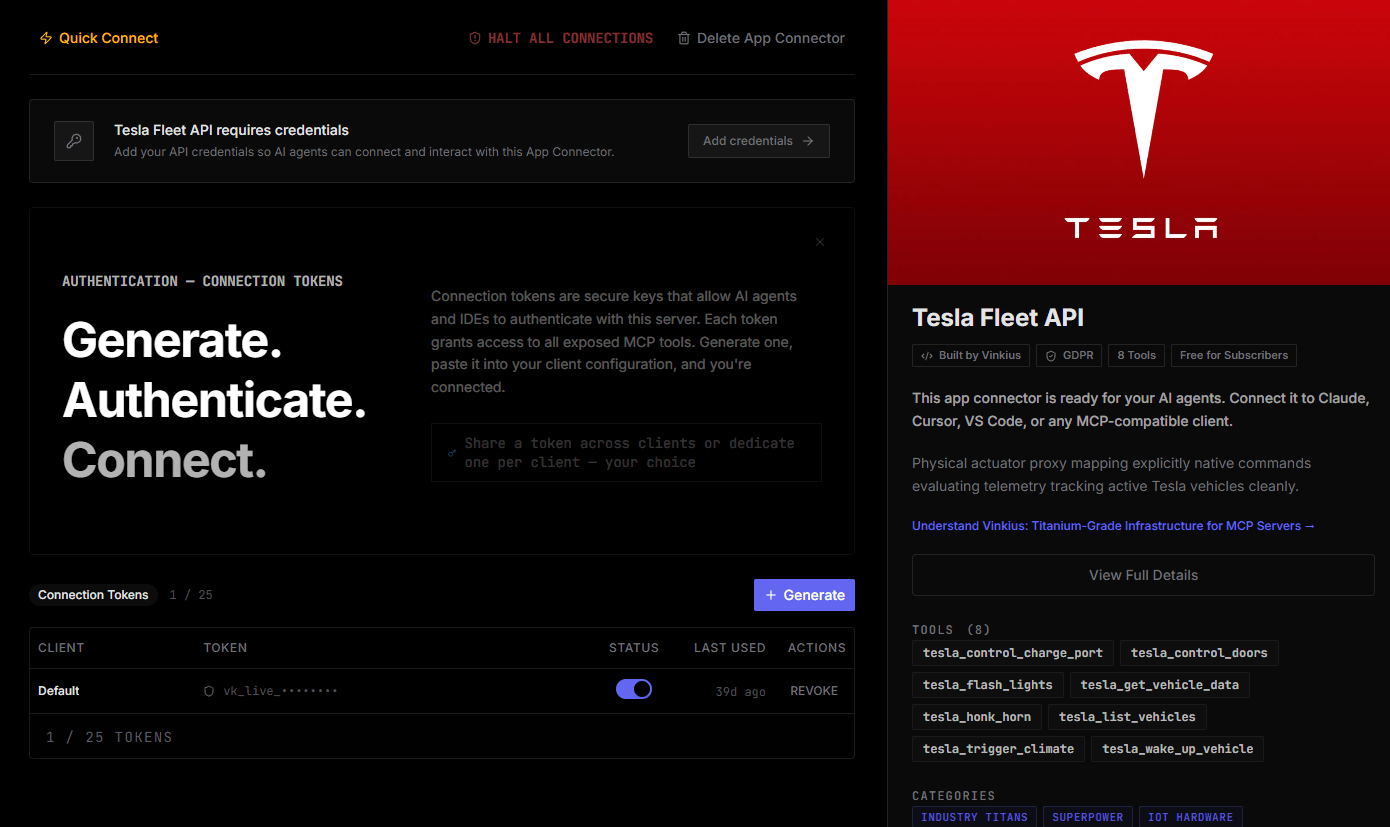
Connect securely in under 30 seconds
Generate tokens to authenticate and link external services in a single step.
Complete visibility into every agent action
Audit live requests, latency, success rates, and active security compliance policies.
Optimize spending and track token ROI
Analyze real-time token consumption and cost metrics detailed by connection.
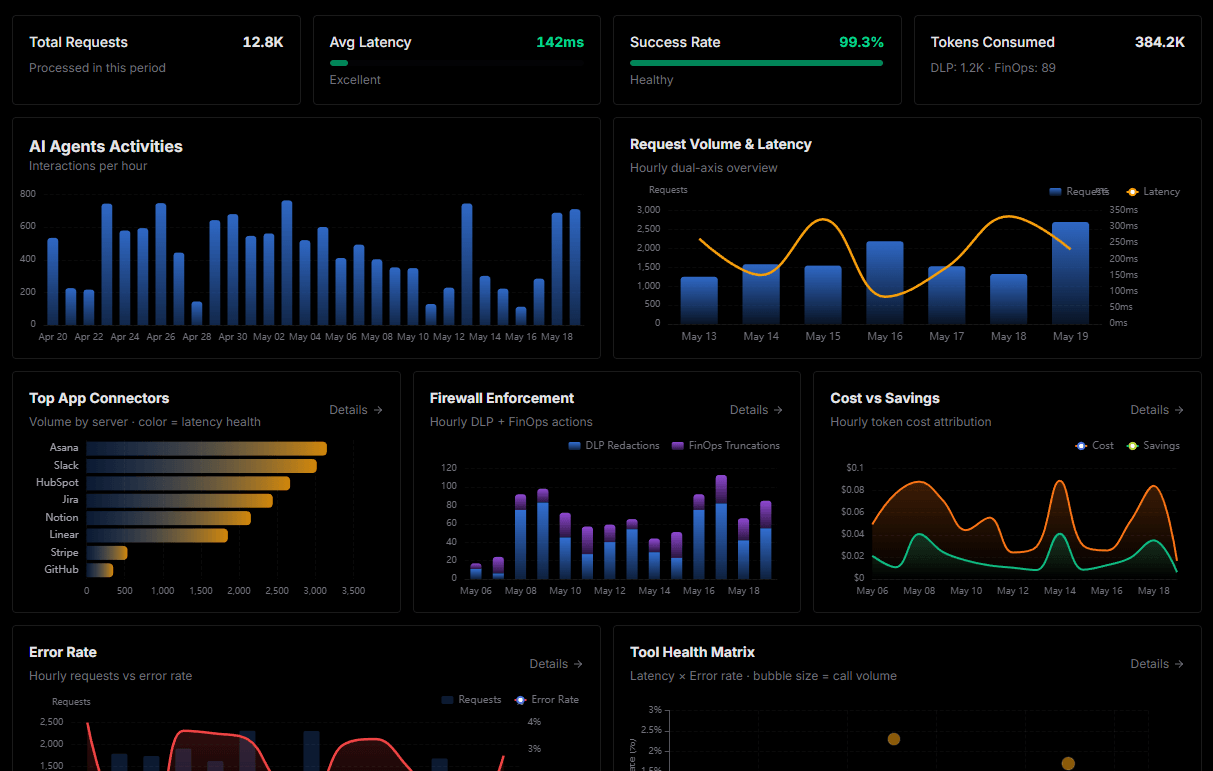
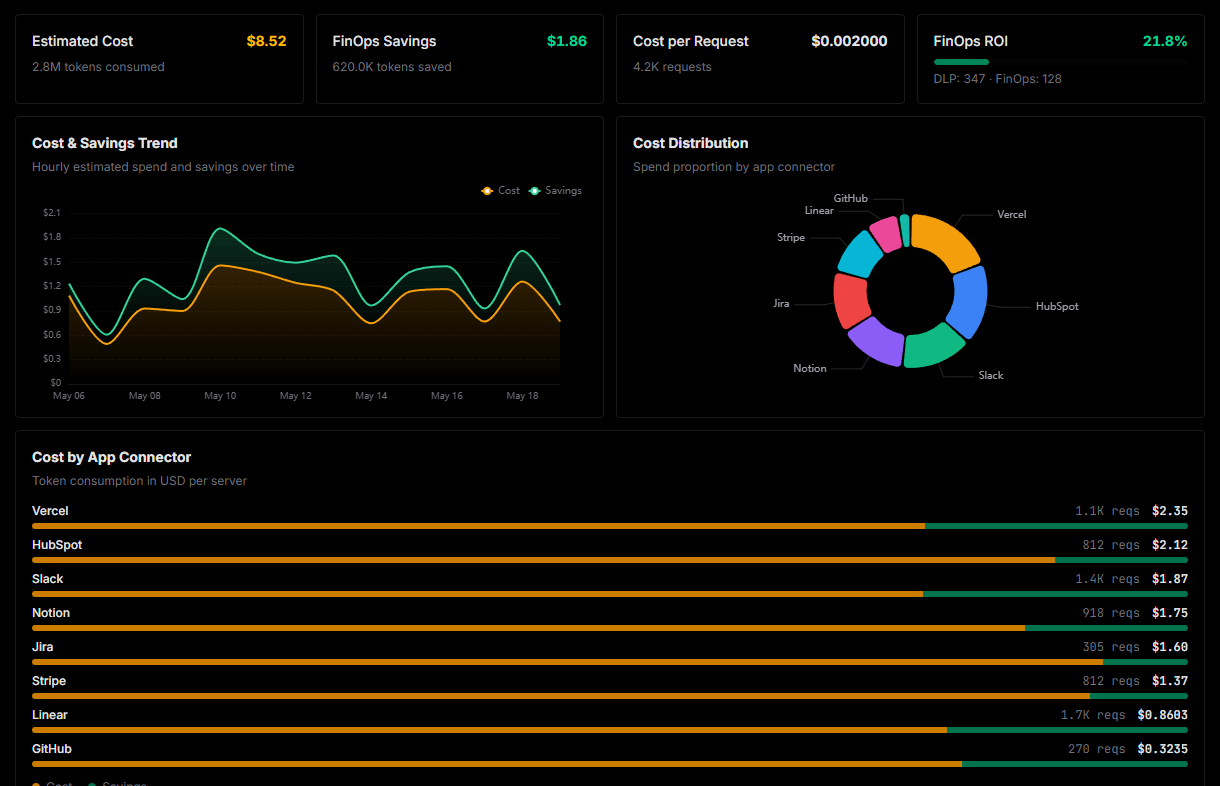
Explore our live AI Agents Analytics dashboard to see it all working
This dashboard is included when you connect AirLabs using Vinkius. You will never be left in the dark about what your AI agents are doing with your tools.
AirLabs and 4,000+ other AI tools. No hosting, no code, ready to use.
Professionals who connect AirLabs to LangChain through Vinkius don't need to write code, manage servers, or worry about security. Everything is pre-configured, secure, and runs automatically in the background.
Raw MCP | Vinkius | |
|---|---|---|
| Ready-to-use MCPs | Find and configure each manually | 4,000+ MCPs ready to use |
| Connection Setup | Manual coding & server setup | 1-click instant connection |
| Server Hosting | You host it yourself (needs 24/7 uptime) | 100% hosted & managed by Vinkius |
| Security & Privacy | Stored in plaintext config files | Bank-grade encrypted vault |
| Activity Visibility | Blind execution (no logs or tracking) | Live dashboard with real-time logs |
| Cost Control | Runaway AI token spend risk | Automatic budget limits |
| Revoking Access | Must delete files or code to stop | 1-click disconnect button |
How Vinkius secures
AirLabs for LangChain
Every request between LangChain and AirLabs is protected by our secure gateway. We automatically keep your sensitive data private, prevent unauthorized access, and let you disconnect instantly at any time.
Frequently asked questions
Can my AI search for all active flights operated by a specific airline like United or Delta?
Yes! Use the get_flights tool with the airline IATA code parameter (e.g., "UA" for United, "DL" for Delta, "BA" for British Airways). Your AI agent will return all currently active flights with flight numbers, aircraft types, departure and arrival airports, current positions, altitudes, speeds, and flight statuses. For a complete list of all routes that an airline operates, use get_airline_routes with the same airline IATA code. This gives you both real-time operational data and the full route network.
How do I check flight schedules between two specific airports for travel planning?
Use the get_schedules tool with the airline IATA code, and optionally the departure airport IATA (dep_iata) and arrival airport IATA (arr_iata) parameters. For example, to see all schedules from JFK to LAX, you would specify dep_iata="JFK" and arr_iata="LAX". The API will return all scheduled flights with airlines, flight numbers, aircraft types, departure and arrival times, and days of operation. You can also filter by a specific date to see schedules for your exact travel day.
Can I look up the complete fleet composition and aircraft details for an airline?
Absolutely! Use the get_airline_fleet tool with the airline IATA code (e.g., "UA" for United, "EK" for Emirates). Your AI will return the complete fleet with all aircraft registrations, types (Boeing 737, Airbus A380, etc.), ages, delivery dates, and operational status. This is perfect for fleet analysis, understanding airline strategy, comparing competitor fleets, or researching aircraft utilization patterns.
How does LangChain connect to MCP servers?
Use langchain-mcp-adapters to create an MCP client. LangChain discovers all tools and wraps them as native LangChain tools compatible with any agent type.
Which LangChain agent types work with MCP?
All agent types including ReAct, OpenAI Functions, and custom agents work with MCP tools. The tools appear as standard LangChain tools after the adapter wraps them.
Can I trace MCP tool calls in LangSmith?
Yes. All MCP tool invocations appear as traced steps in LangSmith, showing input parameters, response payloads, latency, and token usage.
MultiServerMCPClient not found
Install: pip install langchain-mcp-adapters
Explore More MCP Servers
View all →
Zoho Campaign
13 toolsAI email marketing: manage campaigns, contacts, and mailing lists via agents.

Bollinger Bands Engine
1 toolsCalculate moving standard deviation and Bollinger Bands for financial time-series deterministically.

Postmark Alternative
9 toolsAutomate transactional email via Postmark — send emails, retrieve templates, inspect bounces, and manage your delivery analytics directly from any AI agent.

Cloudbeds
10 toolsManage hotel reservations, guests, rooms, housekeeping, availability, and revenue dashboard for your Cloudbeds property through natural conversation.