
Bring Indoor Positioning
to Pydantic AI
Create your Vinkius account to connect IndoorAtlas (Indoor Positioning) to Pydantic AI and start using all 10 AI tools in minutes. Fully managed, enterprise secure, and ready to use without writing a single line of code. No hosting, no server setup — just connect and start using.
 GDPR Free for Subscribers
Compatible with every major AI agent and IDE
 Gemini
What is the IndoorAtlas (Indoor Positioning) MCP Server?
Connect your IndoorAtlas account to any AI agent and take full control of your smart building infrastructure and indoor positioning services through natural conversation.
What you can do
- Venue Management — List all registered indoor venues and retrieve detailed metadata including geographic anchor points and floor counts directly from your agent
- Floorplan Orchestration — Upload new floor plans as GeoJSON and manage geo-referencing to real-world coordinates for accurate indoor positioning
- Map Generation — Trigger the radio map generation process to compute positioning models from signal fingerprint data and floor geometry
- Analytics & Sessions — Retrieve historical positioning sessions and trace data to analyze occupancy patterns, dwell times, and path optimization
- Wi-Fi Positioning — Determine indoor location from Wi-Fi scans using the Positioning API to receive estimated coordinates and floor levels
- Calibration Audit — Inspect fingerprinting walk paths to assess calibration coverage and identify areas needing additional signal mapping
How it works
- Subscribe to this server
- Enter your IndoorAtlas API Key
- Start managing your indoor spaces from Claude, Cursor, or any MCP-compatible client
Who is this for?
- Smart Building Developers — integrate indoor location services into AI agents and monitor venue calibration statuses
- GIS Analysts — manage indoor floor plans and coordinate geo-referencing through natural conversation without complex GIS software
- Operations Managers — audit occupancy analytics and positioning session data to optimize building usage and visitor flows
Built-in capabilities (10)
The venue serves as the top-level container for floor plans and positioning data. After creation, upload floor plan images and calibrate for positioning accuracy. Create a new indoor venue in the IndoorAtlas platform by specifying the building name, geographic coordinates of the entrance, and initial configuration parameters for indoor positioning deployment
Returns GeoJSON LineString features representing calibration paths. Use to assess calibration coverage and identify areas of the floor that need additional fingerprinting for better positioning accuracy. Retrieve the fingerprinting walk paths recorded for a specific floor plan as GeoJSON, showing the routes surveyors walked while collecting Wi-Fi/BLE signal data for positioning calibration
Returns the complete position trace as a series of timestamped fixes. Use for path visualization, behavioral analysis, and positioning quality assessment. Large sessions may contain thousands of position fixes. Retrieve the full positioning trace data for a specific IndoorAtlas session, including timestamped coordinate fixes, floor transitions, accuracy metrics, and sensor readings throughout the session duration
Returns the venue configuration including coordinate reference, building dimensions, and mapping completeness metrics. Use to inspect a venue before deploying positioning or wayfinding features. Retrieve detailed metadata for a specific IndoorAtlas venue including its geographic anchor point, floor count, total mapped area, calibration status, and associated floor plan identifiers
Returns an array of floor plan metadata objects ordered by floor number. Each entry includes the plan dimensions, pixel-to-meter scale, and whether radio map generation has been completed. List all floor plans uploaded to a specific IndoorAtlas venue, returning floor plan IDs, floor numbers, dimensions, geo-alignment status, and map generation readiness for each level of the building
Returns a paginated list of positioning sessions. Each session represents a continuous period of indoor tracking by a single device. Use for occupancy analytics, dwell time analysis, and path optimization studies. List historical indoor positioning sessions recorded by IndoorAtlas, returning session IDs, start/end times, venue associations, and device information for analytics and path replay
Returns an array of venue objects. Each venue represents a physical building that has been set up for indoor positioning. Use to discover available venues before requesting floor plans or positioning data. List all indoor venues registered in your IndoorAtlas organization, returning venue IDs, names, geographic coordinates, and configuration status for each mapped building or facility
Returns estimated coordinates with uncertainty radius. Use for server-side positioning when mobile SDK integration is not feasible. Determine indoor position from a Wi-Fi access point scan using the IndoorAtlas Positioning API, submitting observed signal strengths to receive a calculated latitude, longitude, floor level, and accuracy estimate
This is a critical step — positioning will not work on a floor until map generation completes successfully. The process is asynchronous and may take several minutes depending on floor plan complexity. Trigger the IndoorAtlas radio map generation process for a specific floor plan, initiating the server-side computation that creates the positioning model from fingerprint data and floor plan geometry
After upload, trigger map generation to enable positioning on this floor. Upload a new floor plan to an IndoorAtlas venue as a GeoJSON document, geo-referencing the indoor map image to real-world coordinates for accurate positioning overlay
Why Pydantic AI?
Pydantic AI validates every IndoorAtlas (Indoor Positioning) tool response against typed schemas, catching data inconsistencies at build time. Connect 10 tools through Vinkius and switch between OpenAI, Anthropic, or Gemini without changing your integration code. full type safety, structured output guarantees, and dependency injection for testable agents.
- —
Full type safety: every MCP tool response is validated against Pydantic models, catching data inconsistencies before they reach your application
- —
Model-agnostic architecture. switch between OpenAI, Anthropic, or Gemini without changing your IndoorAtlas (Indoor Positioning) integration code
- —
Structured output guarantee: Pydantic AI ensures tool results conform to defined schemas, eliminating runtime type errors
- —
Dependency injection system cleanly separates your IndoorAtlas (Indoor Positioning) connection logic from agent behavior for testable, maintainable code
IndoorAtlas (Indoor Positioning) in Pydantic AI
Why run IndoorAtlas (Indoor Positioning) with Vinkius?
The IndoorAtlas (Indoor Positioning) connection runs on our fully managed, secure cloud infrastructure. We handle the hosting, maintenance, and security so you don't have to deal with servers or code. All 10 tools are ready to work instantly without any complex setup.
You stay in complete control of your data. Your AI only accesses the information you approve, keeping your sensitive passwords and private details completely safe. Plus, with automatic optimizations, your AI works faster and more efficiently.
* Every connection is hosted and maintained by Vinkius. We handle the security, updates, and infrastructure so you don't have to write code or manage servers. See our infrastructure
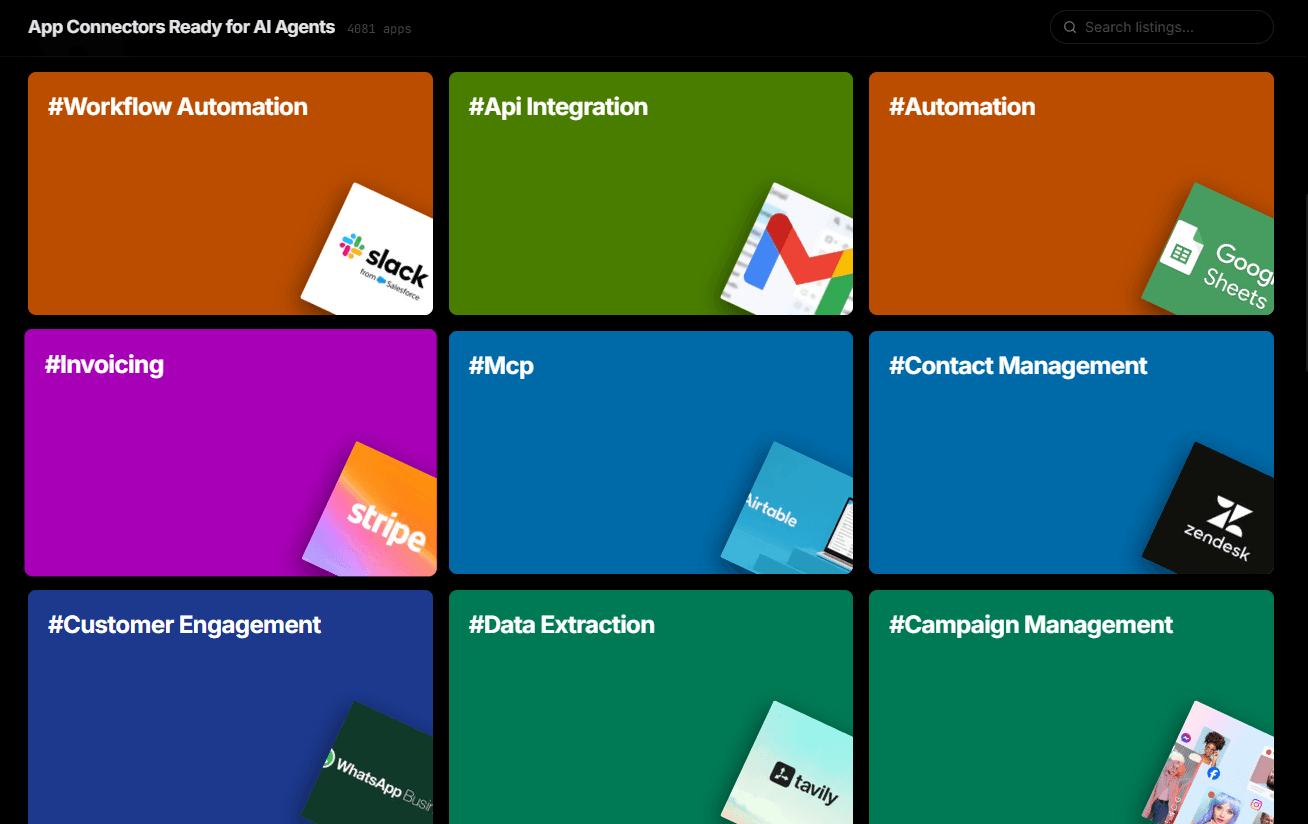
Over 4,000 integrations ready for AI agents
Explore a vast library of pre-built integrations, optimized and ready to deploy.
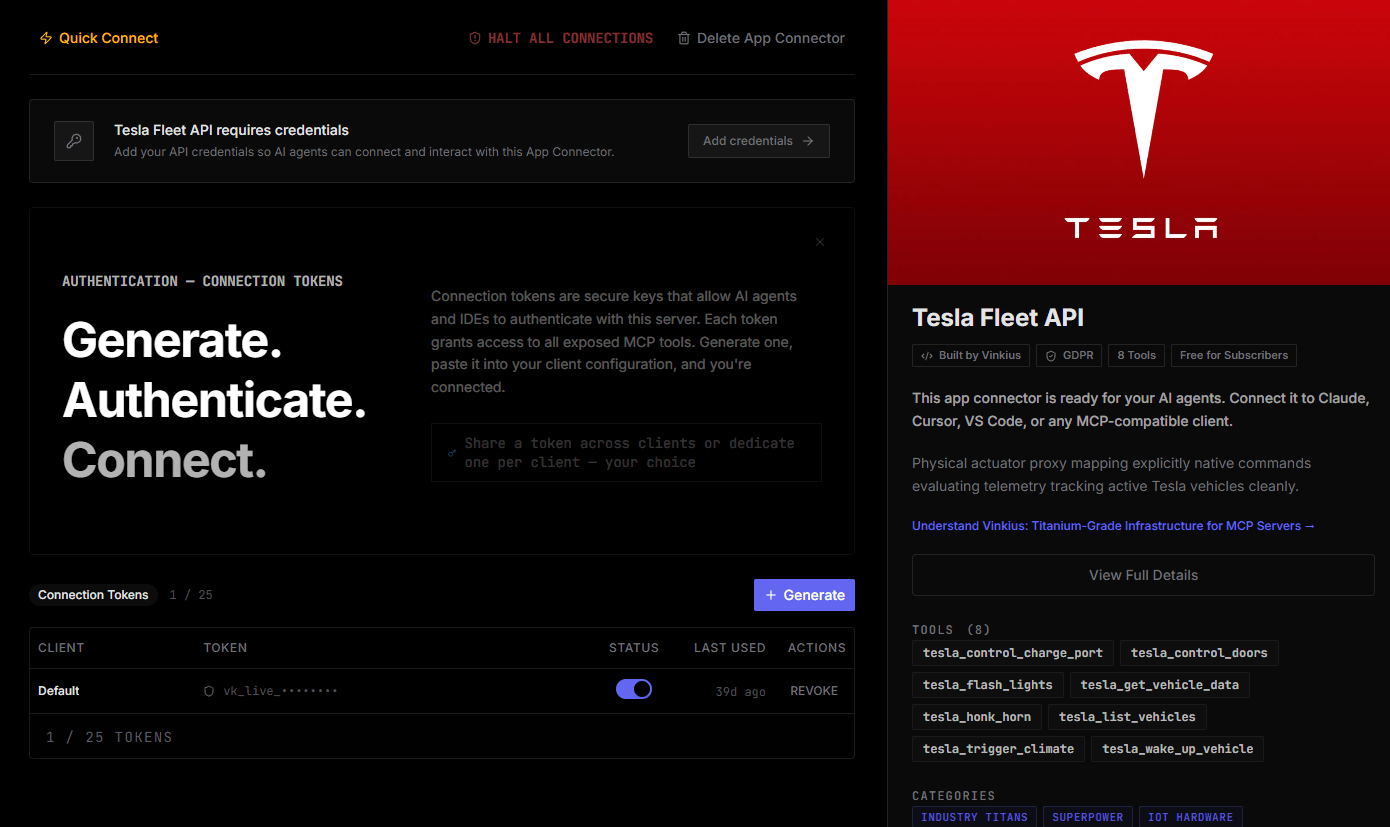
Connect securely in under 30 seconds
Generate tokens to authenticate and link external services in a single step.
Complete visibility into every agent action
Audit live requests, latency, success rates, and active security compliance policies.
Optimize spending and track token ROI
Analyze real-time token consumption and cost metrics detailed by connection.
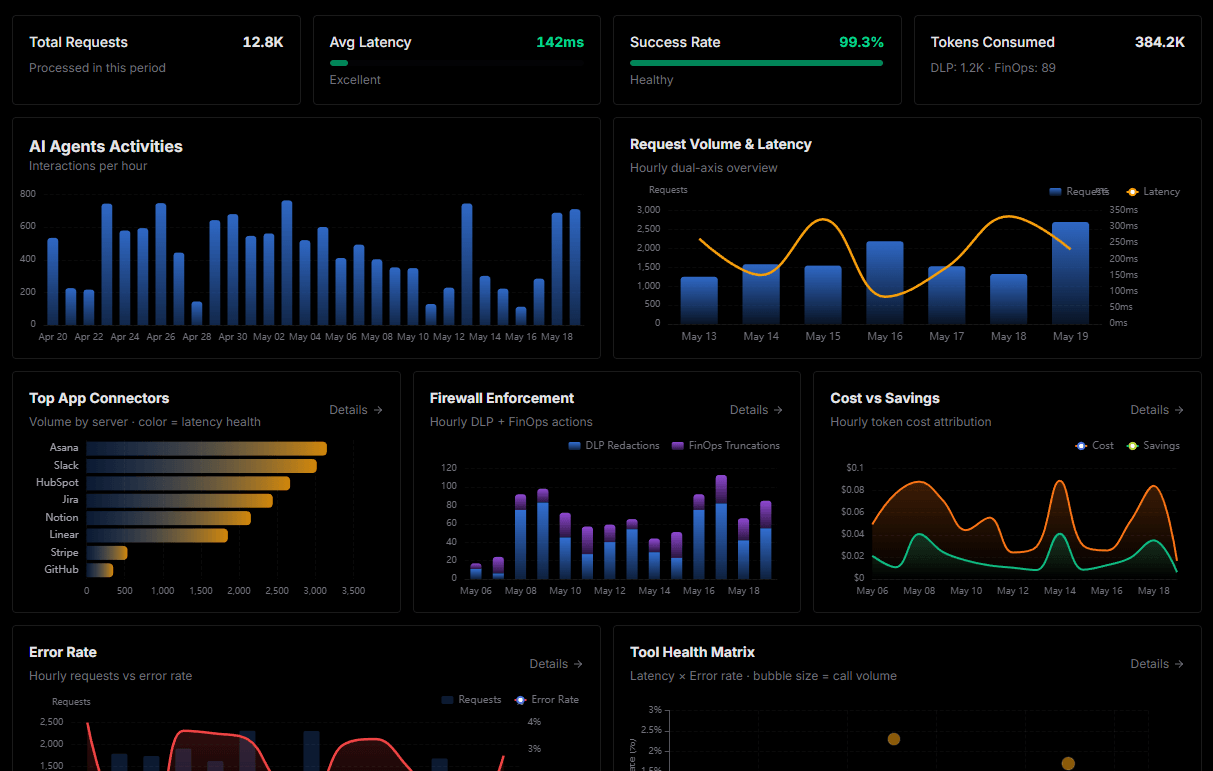
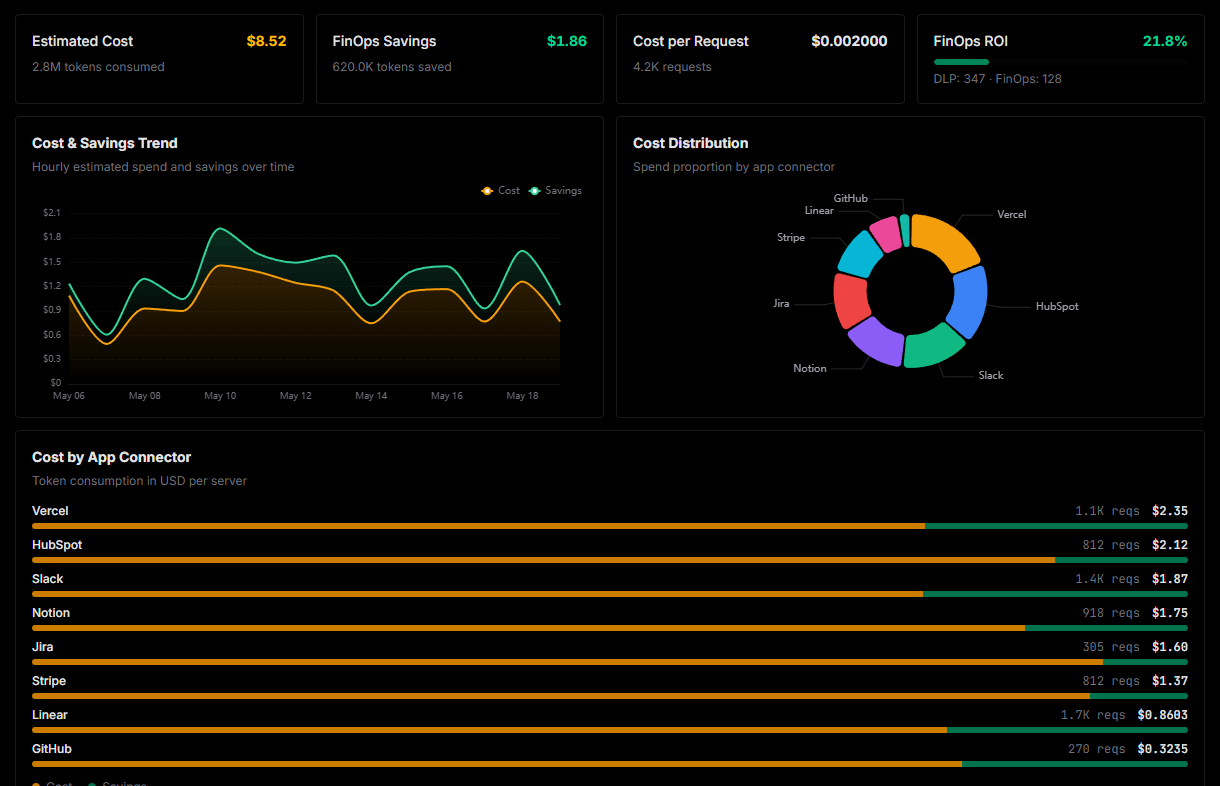
Explore our live AI Agents Analytics dashboard to see it all working
This dashboard is included when you connect IndoorAtlas (Indoor Positioning) using Vinkius. You will never be left in the dark about what your AI agents are doing with your tools.
IndoorAtlas (Indoor Positioning) and 4,000+ other AI tools. No hosting, no code, ready to use.
Professionals who connect IndoorAtlas (Indoor Positioning) to Pydantic AI through Vinkius don't need to write code, manage servers, or worry about security. Everything is pre-configured, secure, and runs automatically in the background.
Raw MCP | Vinkius | |
|---|---|---|
| Ready-to-use MCPs | Find and configure each manually | 4,000+ MCPs ready to use |
| Connection Setup | Manual coding & server setup | 1-click instant connection |
| Server Hosting | You host it yourself (needs 24/7 uptime) | 100% hosted & managed by Vinkius |
| Security & Privacy | Stored in plaintext config files | Bank-grade encrypted vault |
| Activity Visibility | Blind execution (no logs or tracking) | Live dashboard with real-time logs |
| Cost Control | Runaway AI token spend risk | Automatic budget limits |
| Revoking Access | Must delete files or code to stop | 1-click disconnect button |
How Vinkius secures
IndoorAtlas (Indoor Positioning) for Pydantic AI
Every request between Pydantic AI and IndoorAtlas (Indoor Positioning) is protected by our secure gateway. We automatically keep your sensitive data private, prevent unauthorized access, and let you disconnect instantly at any time.
Frequently asked questions
How do I start the map generation process for a new floor plan?
Use the trigger_map_generation tool with your Floorplan ID. This initiates the server-side computation that creates the positioning model. It's a critical step before indoor positioning can work on that level.
Can I determine a position using Wi-Fi scans through my agent?
Yes. The position_from_wifi_scan tool allows you to submit observed Wi-Fi signal strengths. Your agent will return estimated coordinates and floor level, which is perfect for server-side positioning logic.
How can I analyze visitor traffic patterns in our building?
Use the list_positioning_sessions tool to retrieve historical traces. Your agent can help you analyze occupancy patterns and dwell times by processing the timestamped coordinate fixes from past sessions.
How does Pydantic AI discover MCP tools?
Create an MCPServerHTTP instance with the server URL. Pydantic AI connects, discovers all tools, and generates typed Python interfaces automatically.
Does Pydantic AI validate MCP tool responses?
Yes. When you define result types as Pydantic models, every tool response is validated against the schema. Invalid data raises a clear error instead of silently corrupting your pipeline.
Can I switch LLM providers without changing MCP code?
Absolutely. Pydantic AI abstracts the model layer. your IndoorAtlas (Indoor Positioning) MCP integration works identically with OpenAI, Anthropic, Google, or any supported provider.
MCPServerHTTP not found
Update: pip install --upgrade pydantic-ai
Explore More MCP Servers
View all →
Apple App Store
8 toolsManage your iOS apps and TestFlight builds with Apple App Store Connect — track reviews, versions, and sales via AI.
MENU TIGER
10 toolsCreate digital restaurant menus with QR code ordering, table management, and payment integration that modernize the dining experience.

Semrush
8 toolsGrant your AI agent access to Semrush's massive SEO database to analyze competitor backlink profiles, track domain ranks, and research profitable keywords contextually.
Zoho Bookings
7 toolsAutomate appointment scheduling via Zoho Bookings — manage appointments, services, and staff with AI.