
Bring Nft
to VS Code Copilot
Learn how to connect OpenSea to VS Code Copilot and start using 35 AI agent tools in minutes. Fully managed, enterprise secure, and ready to use without writing a single line of code.
 GDPR Free for Subscribers
Compatible with every major AI agent and IDE
 Gemini
What is the OpenSea MCP Server?
Connect OpenSea to your AI agent to navigate the NFT ecosystem with ease. From tracking trending collections to deep-diving into specific token traits, this server provides real-time access to the largest digital marketplace.
What you can do
- Market Insights — Get trending and top collections, or fetch comprehensive stats like volume and floor prices using
get_trending_collectionsandget_collection_stats. - NFT Deep-Dive — Retrieve full metadata, rarity, and ownership details for any NFT with
get_nftandget_nft_metadata. - Collection Analysis — List collection traits, holders, and detailed fee structures via
get_collection_traitsandget_collection_holders. - Wallet Monitoring — Check account profiles and fungible token balances for any wallet address with
get_accountandget_token_balances. - Multi-Chain Support — Query data across all blockchains supported by OpenSea using
get_chains.
How it works
- Subscribe to this server
- Enter your OpenSea API Key
- Start analyzing the NFT market from Claude, Cursor, or any MCP-compatible client
No more manual searching through marketplace tabs. Your AI acts as a dedicated floor price tracker and portfolio analyst.
Who is this for?
- Web3 Developers — instantly retrieve NFT metadata and contract details directly from the code editor.
- NFT Collectors & Traders — monitor floor prices, volume trends, and collection holders without leaving the chat.
- Data Analysts — automate the retrieval of collection statistics and trait distributions for market research.
Built-in capabilities (35)
Off-chain cancellation of an order
Get data to buy an NFT
Get data to accept an offer
Get an OpenSea account profile
Get the lowest price listing for a specific NFT
Get the highest offer for a specific NFT
Get all blockchain chains supported by OpenSea
Get detailed information about a collection
Get a list of wallet addresses holding items in a collection
Get comprehensive statistics for a collection
List all available traits in a collection
Get stages, supply, and minting details for a specific drop
List featured, upcoming, or recently minted drops
Get metadata, traits, ownership, and rarity for a single NFT
Get detailed metadata including image URLs and external links for an NFT
List all owners of a specific NFT
Get NFTs owned by a specific wallet
Get all NFTs in a specific collection
Get all NFTs for a specific smart contract
Retrieve order details
Get a price quote for swapping tokens
Get metadata for a fungible token
Get fungible token balances for a specific wallet
Get top collections
Check the status of a submitted swap or fulfillment
Get trending collections
List collections
Get historical marketplace events
Get all active listings for a collection
Get all active offers for a collection
Create a collection or trait-wide offer
Create a new listing
Create an offer on a single item
Get executable transaction data for a swap
Search across collections, NFTs, tokens, and accounts
Why VS Code Copilot?
GitHub Copilot Agent mode brings OpenSea data directly into your VS Code workflow. With a project-scoped config, the entire team shares access to 35 tools. Copilot queries live data, generates typed code, and writes tests from actual API responses, all without leaving the editor.
- —
VS Code is used by over 70% of developers. adding MCP tools to Copilot means your team can leverage external data without leaving their primary editor
- —
Project-scoped MCP configs (
.vscode/mcp.json) let you commit server configurations to your repository, ensuring the entire team shares the same tool access - —
Copilot's Agent mode integrates MCP tools seamlessly with file editing, terminal commands, and workspace search in a single agentic loop
- —
GitHub's enterprise compliance and audit features extend to MCP tool usage, providing visibility into how AI interacts with external services
OpenSea in VS Code Copilot
OpenSea and 4,000+ other MCP servers. One platform. One governance layer.
Teams that connect OpenSea to VS Code Copilot through Vinkius don't need to source, host, or maintain individual MCP servers. Every tool call runs inside a hardened runtime with credential isolation, DLP, and a signed audit chain.
Raw MCP | Vinkius | |
|---|---|---|
| Server catalog | Find and host yourself | 4,000+ managed |
| Infrastructure | Self-hosted | Sandboxed V8 isolates |
| Credential handling | Plaintext in config | Vault + runtime injection |
| Data loss prevention | None | Configurable DLP policies |
| Kill switch | None | Global instant shutdown |
| Financial circuit breakers | None | Per-server limits + alerts |
| Audit trail | None | Ed25519 signed logs |
| SIEM log streaming | None | Splunk, Datadog, Webhook |
| Honeytokens | None | Canary alerts on leak |
| Custom domains | Not applicable | DNS challenge verified |
| GDPR compliance | Manual effort | Automated purge + export |
Why teams choose Vinkius for OpenSea in VS Code Copilot
The OpenSea MCP Server runs on Vinkius-managed infrastructure inside AWS — a purpose-built runtime with per-request V8 isolates, Ed25519 signed audit chains, and sub-40ms cold starts. All 35 tools execute in hardened sandboxes optimized for native MCP execution.
Your AI agents in VS Code Copilot only access the data you authorize, with DLP that blocks sensitive information from ever reaching the model, kill switch for instant shutdown, and up to 60% token savings. Enterprise-grade infrastructure, zero maintenance.
* Every MCP server runs on Vinkius-managed infrastructure inside AWS - a purpose-built runtime with per-request V8 isolates, Ed25519 signed audit chains, and sub-40ms cold starts optimized for native MCP execution. See our infrastructure
How Vinkius secures
OpenSea for VS Code Copilot
Every tool call from VS Code Copilot to the OpenSea MCP Server is protected by DLP redaction, cryptographic audit chains, V8 sandbox isolation, kill switch, and financial circuit breakers.
Frequently asked questions
Can I check the floor price and volume for a specific NFT collection?
Yes! Use the get_collection_stats tool with the collection slug. The agent will return real-time metrics including floor price, total volume, and sales counts.
How do I retrieve the image and metadata for a specific NFT?
You can use the get_nft_metadata tool by providing the chain, contract address, and token ID. It returns detailed metadata including image URLs and external links.
Can I see which wallets hold the most items in a collection?
Yes, the get_collection_holders tool provides a list of wallet addresses that currently hold items within a specific collection slug.
Which VS Code version supports MCP?
MCP support requires VS Code 1.99 or later with the GitHub Copilot extension. Ensure both are updated to the latest version. Older versions of Copilot may not expose the Agent mode toggle.
How do I switch to Agent mode?
Open the Copilot Chat panel and look for two mode options: "Ask" and "Agent". Click "Agent" to enable autonomous tool calling. In Ask mode, Copilot provides conversational answers but cannot invoke MCP tools.
Can I restrict which MCP tools Copilot can access?
Yes. VS Code shows a tool consent dialog before any MCP tool is invoked for the first time. You can also configure tool access policies at the organization level through GitHub Copilot settings.
Does MCP work in VS Code Remote or Codespaces?
Yes. MCP servers configured via .vscode/mcp.json work in Remote SSH, WSL, and GitHub Codespaces environments. The MCP connection is established from the remote host, so ensure the server URL is accessible from that environment.
MCP tools not available
Ensure you are in Agent mode in Copilot Chat. MCP tools only appear in Agent mode.
Explore More MCP Servers
View all →
DeepSeek
12 toolsAccess powerful open-weight language models for reasoning, code generation, and complex problem solving at competitive cost.
FunnelCockpit
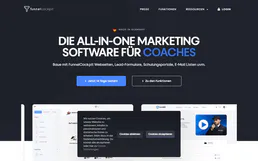
10 toolsBuild high-converting sales funnels, landing pages, and email sequences with an all-in-one German marketing platform.

Postmark
10 toolsEquip your AI to send emails, monitor delivery stats, track bounces, and manage Postmark templates directly from your chat.

GrowthBook
15 toolsManage feature flags and experiments via GrowthBook — control environments, toggle features, and organize projects directly from your AI agent.