
Bring Sensor Monitoring
to Windsurf
Create your Vinkius account to connect Particle IoT to Windsurf and start using all 8 AI tools in minutes. Fully managed, enterprise secure, and ready to use without writing a single line of code. No hosting, no server setup — just connect and start using.
 GDPR Free for Subscribers
Compatible with every major AI agent and IDE
 Gemini
What is the Particle IoT MCP Server?
Connect your Particle IoT API to any AI agent and take full control of your IoT device fleet, sensor monitoring, remote actuator control, and event management through natural conversation.
What you can do
- Device Management — List all connected devices, check online status, rename devices, and manage ownership
- Sensor Monitoring — Read real-time sensor data from cloud variables (temperature, humidity, soil moisture, etc.)
- Remote Control — Execute cloud functions to control actuators, trigger calibrations, and change device modes
- Event Publishing — Broadcast custom events to the cloud for logging, alerting, and webhook integration
- Health Monitoring — Ping devices to verify connectivity and troubleshoot communication issues
- Fleet Overview — Get comprehensive views of your entire IoT deployment and device status
How it works
- Subscribe to this server
- Enter your Particle Access Token (from Particle Console or CLI)
- Start controlling your IoT devices from Claude, Cursor, or any MCP-compatible client
No more manual device checking or complex API calls. Your AI acts as a dedicated IoT fleet manager and sensor analyst.
Who is this for?
- Agriculture Tech — monitor soil moisture, control irrigation pumps, and receive crop alerts remotely
- Smart Home — read environmental sensors, control actuators, and automate home systems
- Industrial IoT — manage sensor networks, monitor equipment status, and trigger maintenance functions
- Developers — prototype IoT applications, test device functions, and integrate with external systems
Built-in capabilities (8)
Functions are defined in the device firmware and can control actuators (turn on pump, open valve), trigger calibrations, change device modes, or perform system tasks. Accepts a single string argument (max 63 characters) to pass to the function. Returns the function execution result code. Essential for remote device control, automation, and actuator management. AI agents should use this when users ask "turn on the water pump on device X", "trigger calibration on sensor Y", or need to remotely control any function exposed by a device. Execute a cloud function on a specific Particle IoT device
Essential for understanding device capabilities before interacting with it. AI agents should reference this when users ask "what variables does device X expose", "what functions can I call on device Y", or need to understand the specific interface of a device. Get detailed information about a specific Particle IoT device
Returns device IDs, names, online status, firmware versions, and last connection times. Essential for device inventory management, monitoring connection health, and selecting specific devices for interaction. AI agents should use this when users ask "show me all my devices", "list connected sensors", or need to identify available devices before reading variables or calling functions. List all Particle IoT devices connected to your account
Returns current online/offline status and last heard time. Essential for connectivity diagnostics, health monitoring, and verifying device availability before attempting to read variables or call functions. AI agents should reference this when users ask "is device X online", "check connectivity for sensor Y", or need to troubleshoot device communication issues. Check if a specific Particle IoT device is online and responsive
Events are broadcast to all subscribed listeners and can be used for inter-device communication, logging, alerting, or triggering external workflows via webhooks. Requires an event name and optional data string (max 255 bytes for data). Essential for sending alerts, logging custom data, and integrating with external systems like IFTTT or custom dashboards. AI agents should use this when users ask "send a low moisture alert", "publish a system status event", or need to broadcast data from the cloud to devices or webhooks. Publish a custom event to the Particle Cloud
Variables are defined in the device firmware and can represent sensor readings (temperature, humidity, soil moisture), system status, or configuration values. Returns the variable name, data type, and current value. Essential for real-time sensor monitoring, data collection, and system state verification. AI agents should use this when users ask "what is the temperature from sensor X", "read soil moisture from device Y", or need to get the current value of any sensor or status variable. Read the current value of a cloud variable from a specific device
This name appears in the console and API responses, making it easier to identify devices. Essential for device organization, fleet management, and improving readability of device lists. AI agents should use this when users ask "rename device X to Greenhouse Sensor 1", "change the name of device Y to Pump Controller", or need to update device naming for better organization. Rename a specific Particle IoT device
This action is irreversible for the current account and should be used when transferring device ownership or decommissioning devices. Essential for device lifecycle management, transferring devices, and account cleanup. AI agents should use this when users ask "remove device X from my account", "unclaim sensor Y so I can sell it", or need to manage device ownership. WARNING: This requires confirmation as it removes access to the device. Remove a Particle IoT device from your account
Why Windsurf?
Windsurf's Cascade agent chains multiple Particle IoT tool calls autonomously. query data, analyze results, and generate code in a single agentic session. Paste Vinkius Edge URL, reload, and all 8 tools are immediately available. Real-time tool feedback appears inline, so you see API responses directly in your editor.
- —
Windsurf's Cascade agent autonomously chains multiple tool calls in sequence, solving complex multi-step tasks without manual intervention
- —
Purpose-built for agentic workflows. Cascade understands context across your entire codebase and integrates MCP tools natively
- —
JSON-based configuration means zero code changes: paste a URL, reload, and all 8 tools are immediately available
- —
Real-time tool feedback is displayed inline, so you see API responses directly in your editor without switching contexts
Particle IoT in Windsurf
Why run Particle IoT with Vinkius?
The Particle IoT connection runs on our fully managed, secure cloud infrastructure. We handle the hosting, maintenance, and security so you don't have to deal with servers or code. All 8 tools are ready to work instantly without any complex setup.
You stay in complete control of your data. Your AI only accesses the information you approve, keeping your sensitive passwords and private details completely safe. Plus, with automatic optimizations, your AI works faster and more efficiently.
* Every connection is hosted and maintained by Vinkius. We handle the security, updates, and infrastructure so you don't have to write code or manage servers. See our infrastructure
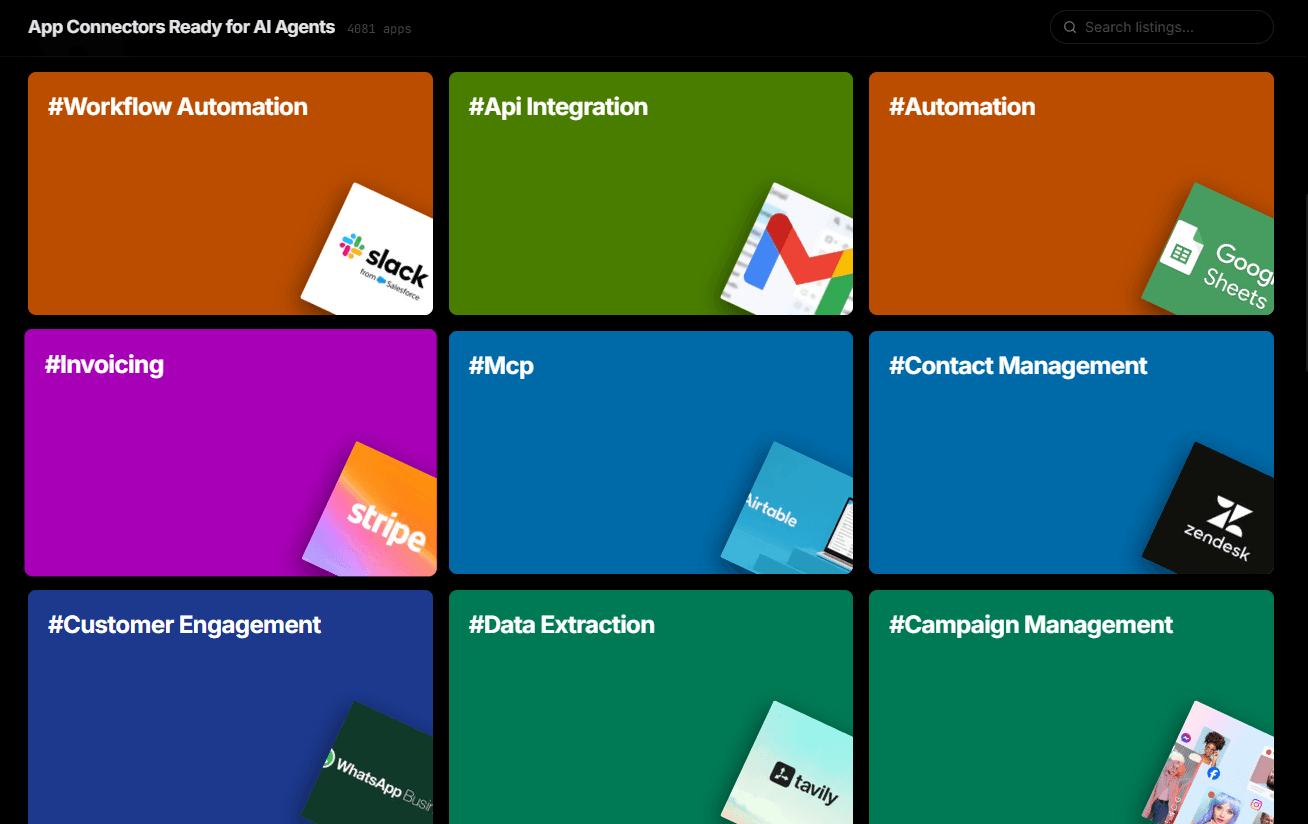
Over 4,000 integrations ready for AI agents
Explore a vast library of pre-built integrations, optimized and ready to deploy.
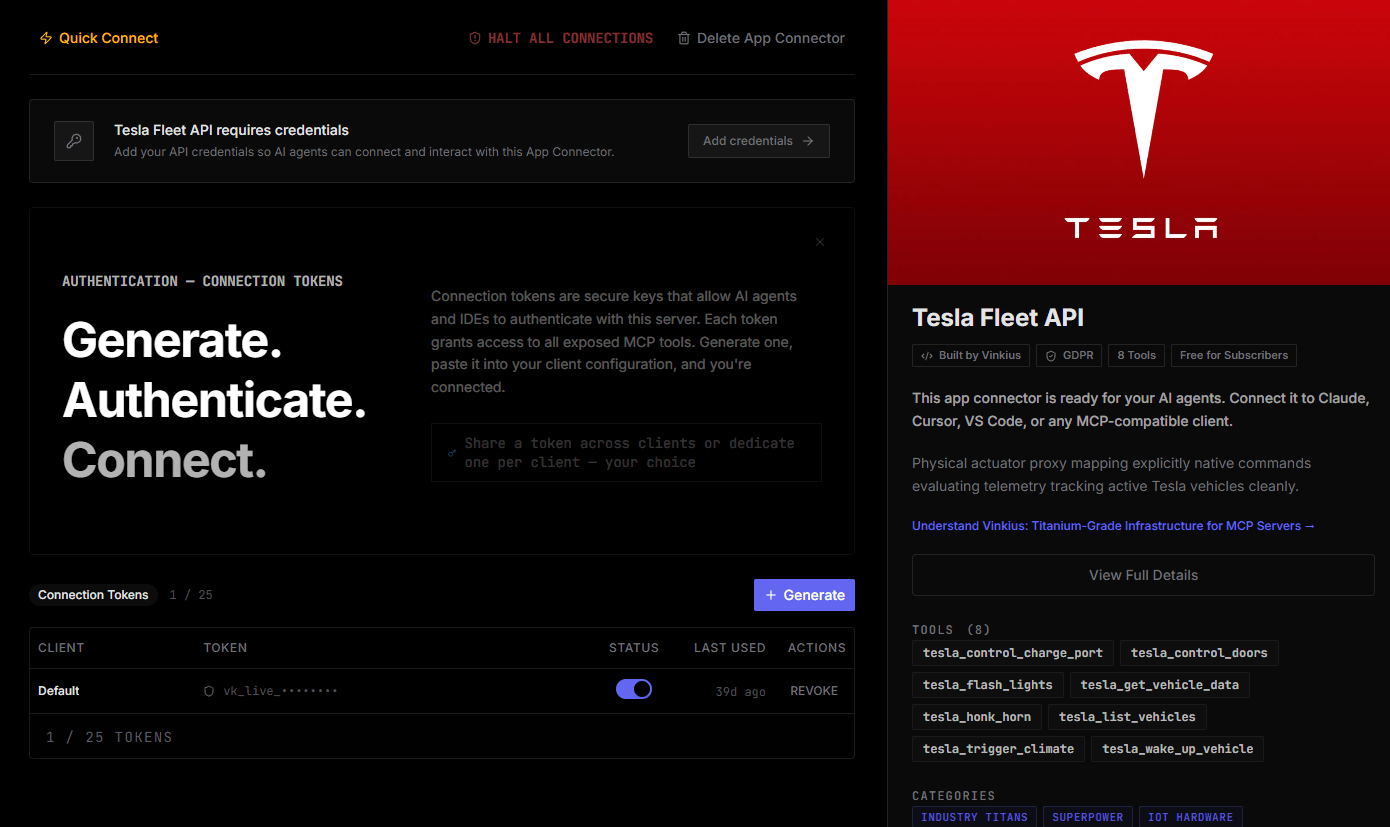
Connect securely in under 30 seconds
Generate tokens to authenticate and link external services in a single step.
Complete visibility into every agent action
Audit live requests, latency, success rates, and active security compliance policies.
Optimize spending and track token ROI
Analyze real-time token consumption and cost metrics detailed by connection.
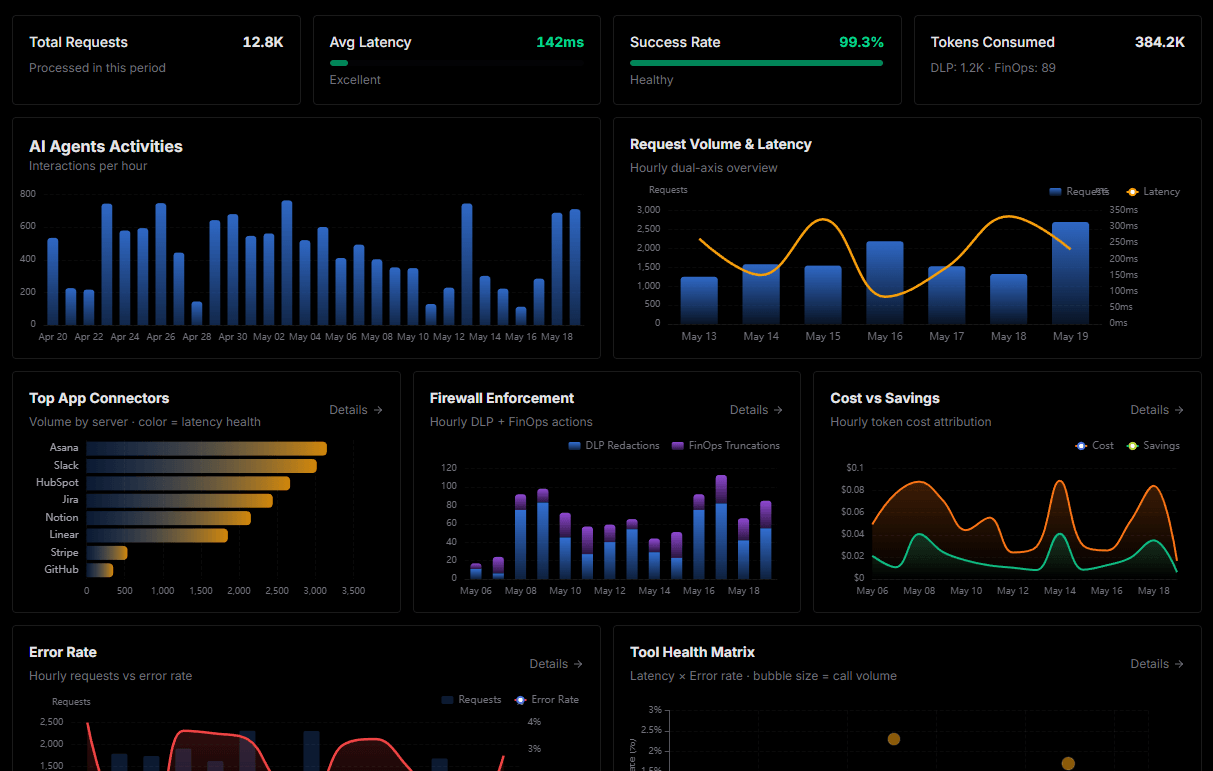
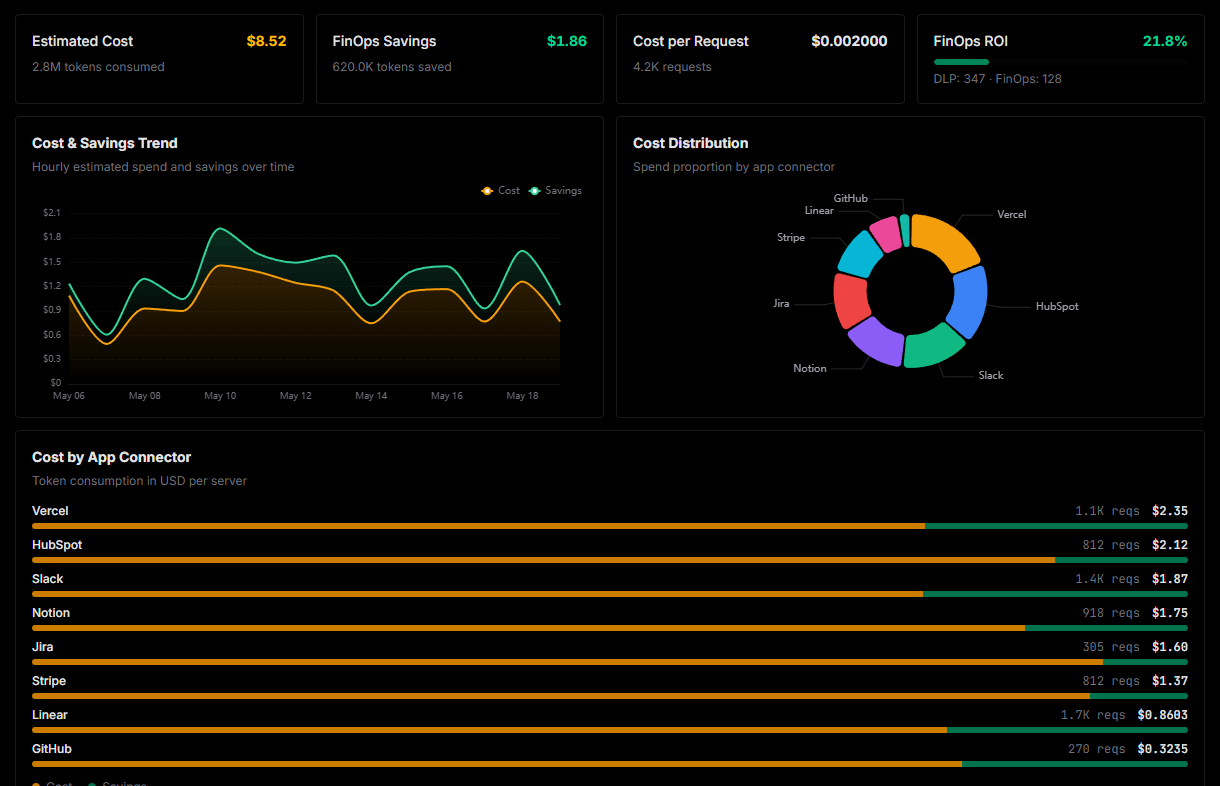
Explore our live AI Agents Analytics dashboard to see it all working
This dashboard is included when you connect Particle IoT using Vinkius. You will never be left in the dark about what your AI agents are doing with your tools.
Particle IoT and 4,000+ other AI tools. No hosting, no code, ready to use.
Professionals who connect Particle IoT to Windsurf through Vinkius don't need to write code, manage servers, or worry about security. Everything is pre-configured, secure, and runs automatically in the background.
Raw MCP | Vinkius | |
|---|---|---|
| Ready-to-use MCPs | Find and configure each manually | 4,000+ MCPs ready to use |
| Connection Setup | Manual coding & server setup | 1-click instant connection |
| Server Hosting | You host it yourself (needs 24/7 uptime) | 100% hosted & managed by Vinkius |
| Security & Privacy | Stored in plaintext config files | Bank-grade encrypted vault |
| Activity Visibility | Blind execution (no logs or tracking) | Live dashboard with real-time logs |
| Cost Control | Runaway AI token spend risk | Automatic budget limits |
| Revoking Access | Must delete files or code to stop | 1-click disconnect button |
How Vinkius secures
Particle IoT for Windsurf
Every request between Windsurf and Particle IoT is protected by our secure gateway. We automatically keep your sensitive data private, prevent unauthorized access, and let you disconnect instantly at any time.
Frequently asked questions
Can my AI read sensor data from my Particle devices?
Yes! Use the read_variable tool with your device ID and the variable name (e.g., temperature, humidity, soilMoisture). Your device must expose this variable in its firmware using Particle.variable(). The AI will return the current sensor value in real-time. You can find available variables using get_device_info.
How do I remotely turn on a pump or actuator connected to a Particle device?
Use the call_function tool with your device ID and the function name (e.g., pumpOn, valveOpen). The function must be exposed in your device firmware using Particle.function(). You can pass an optional argument (like duration or intensity) to control the actuator behavior. Check available functions with get_device_info.
Can I check if my IoT device is online and responding?
Yes! Use the ping_device tool to instantly check the online status of any Particle device. You can also use get_devices to see the online status of all your devices at once. If a device shows as offline, it may be powered off, disconnected from Wi-Fi, or experiencing firmware issues.
How does Windsurf discover MCP tools?
Windsurf reads the mcp_config.json file on startup and connects to each configured server via Streamable HTTP. Tools are listed in the MCP panel and available to Cascade automatically.
Can Cascade chain multiple MCP tool calls?
Yes. Cascade is an agentic system. it can plan and execute multi-step workflows, calling several tools in sequence to accomplish complex tasks without manual prompting between steps.
Does Windsurf support multiple MCP servers?
Yes. Add as many servers as needed in mcp_config.json. Each server's tools appear in the MCP panel and Cascade can use tools from different servers in a single flow.
Server not connecting
Check Settings → MCP for the server status. Try toggling it off and on.
Explore More MCP Servers
View all →
LEAP Legal
18 toolsManage law practice via LEAP Legal Software — matters, contacts, time tracking, bills, payments, tasks, documents, and calendar.

Epic Games Store Intelligence
8 toolsThe definitive server for the Epic ecosystem — track free games, catalog trends, and store promotions via AI.

World Bank Education & Health
5 toolsRetrieve global life expectancy, infant mortality, literacy rates, and social welfare statistics without any authentication.

crowd.dev (LFX CDP)
10 toolsEquip your AI agent to manage community members, activities, and organizations directly via the crowd.dev (LFX) API.