
Camunda (BPMN Engine) MCP Server for VS Code CopilotGive VS Code Copilot instant access to 25 tools to Activate Jobs, Assign User Task, Complete Job, and more
 GDPR Free for Subscribers
GitHub Copilot in VS Code is the most widely adopted AI coding assistant, embedded directly into the world's most popular code editor. With MCP support in Agent mode, Copilot can access external data and APIs to generate context-aware code grounded in real-time information.
Ask AI about this MCP Server for VS Code Copilot
The Camunda (BPMN Engine) MCP Server for VS Code Copilot is a standout in the Developer Tools category — giving your AI agent 25 tools to work with, ready to go from day one.
Vinkius delivers Streamable HTTP and SSE to any MCP client
 Gemini
{
"mcpServers": {
"camunda-bpmn-engine": {
"url": "https://edge.vinkius.com/[YOUR_TOKEN_HERE]/mcp"
}
}
}Vinkius Desktop App
The modern way to manage MCP Servers — no config files, no terminal commands. Install Camunda (BPMN Engine) and 4,000+ MCP Servers from a single visual interface.
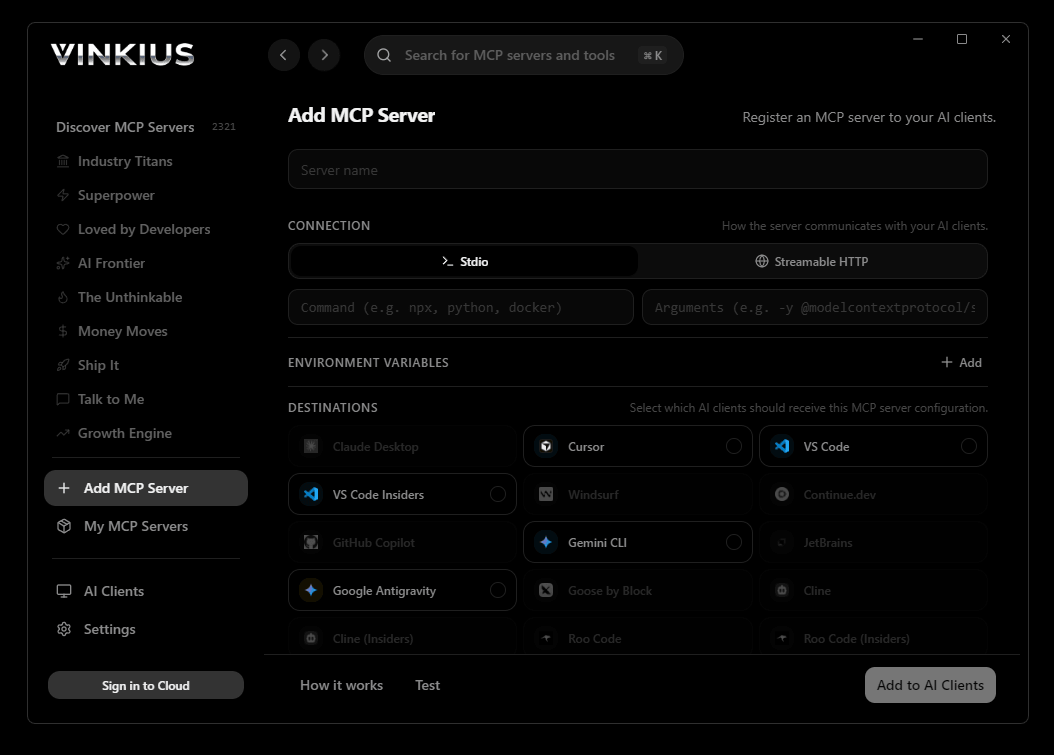

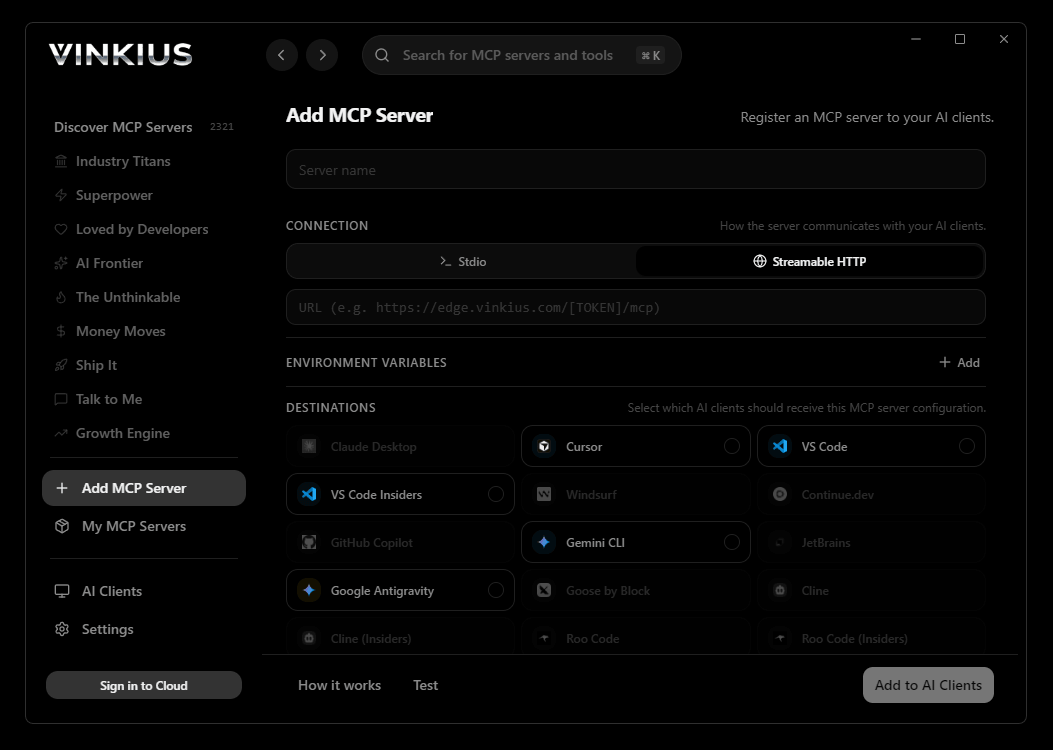
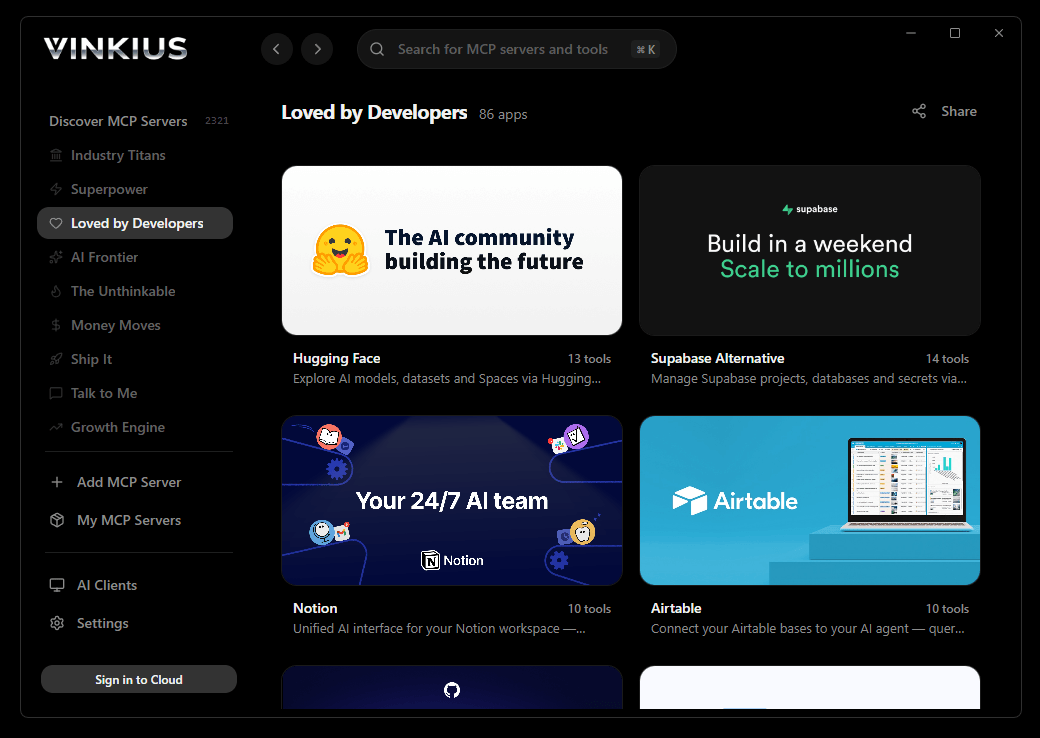

* Every MCP server runs on Vinkius-managed infrastructure inside AWS - a purpose-built runtime with per-request V8 isolates, Ed25519 signed audit chains, and sub-40ms cold starts optimized for native MCP execution. See our infrastructure
About Camunda (BPMN Engine) MCP Server
Connect your Camunda engine to any AI agent to automate and monitor complex business workflows through natural language.
GitHub Copilot Agent mode brings Camunda (BPMN Engine) data directly into your VS Code workflow. With a project-scoped config, the entire team shares access to 25 tools. Copilot queries live data, generates typed code, and writes tests from actual API responses, all without leaving the editor.
What you can do
- Process Management — Deploy BPMN, DMN, or Form resources and start new process instances with custom variables.
- Human Task Orchestration — Search for pending user tasks, assign them to specific users, and complete them to move workflows forward.
- Incident Monitoring — Identify and inspect process incidents and jobs to troubleshoot bottlenecks or failures in real-time.
- Definition Inspection — Retrieve BPMN XML definitions and search through deployed process definitions to understand workflow logic.
- Cluster Topology — Monitor the health and topology of your Camunda cluster directly from your conversation.
The Camunda (BPMN Engine) MCP Server exposes 25 tools through the Vinkius. Connect it to VS Code Copilot in under two minutes — credentials fully managed, no infrastructure to provision, no vendor lock-in. Your configuration, your data, your control.
All 25 Camunda (BPMN Engine) tools available for VS Code Copilot
When VS Code Copilot connects to Camunda (BPMN Engine) through Vinkius, your AI agent gets direct access to every tool listed below — spanning bpmn, workflow-automation, process-orchestration, and more. Every call runs in a secure, isolated environment with full audit visibility. Beyond a simple connection, you get real-time monitoring of agent activity, enterprise governance, and optimized token usage.
Activate jobs on Camunda (BPMN Engine)
Activate (poll) jobs for workers
Assign user task on Camunda (BPMN Engine)
Assign a user task to a specific user
Complete job on Camunda (BPMN Engine)
Complete an activated job
Complete user task on Camunda (BPMN Engine)
Complete a user task with variables
Deploy resources on Camunda (BPMN Engine)
Deploy BPMN, DMN, or Form resources
Fail job on Camunda (BPMN Engine)
Mark a job as failed (triggers retries or incidents)
Get incident on Camunda (BPMN Engine)
Get incident details
Get process definition xml on Camunda (BPMN Engine)
Retrieve the BPMN XML of a process definition
Get process instance on Camunda (BPMN Engine)
Get details of a specific process instance
Get topology on Camunda (BPMN Engine)
Get cluster topology and partition status
Get user task on Camunda (BPMN Engine)
Get details of a specific user task
Get user task form on Camunda (BPMN Engine)
Retrieve the linked form for a user task
Get variable on Camunda (BPMN Engine)
Get a specific variable value
Search groups on Camunda (BPMN Engine)
Search for user groups
Search incidents on Camunda (BPMN Engine)
Search for process incidents
Search jobs on Camunda (BPMN Engine)
Search for job instances
Search process definitions on Camunda (BPMN Engine)
Search for deployed process definitions
Search process instances on Camunda (BPMN Engine)
Search for process instances
Search tenants on Camunda (BPMN Engine)
Search for tenants (Multi-tenancy)
Search user tasks on Camunda (BPMN Engine)
Search for human tasks
Search users on Camunda (BPMN Engine)
Search for users
Search variables on Camunda (BPMN Engine)
Search for process or local variables
Start process instance on Camunda (BPMN Engine)
Start a new process instance
Throw job error on Camunda (BPMN Engine)
Throw a BPMN error from a job
Unassign user task on Camunda (BPMN Engine)
Unassign a user task
Connect Camunda (BPMN Engine) to VS Code Copilot via MCP
Follow these steps to wire Camunda (BPMN Engine) into VS Code Copilot. The entire setup takes under two minutes — your credentials stay safe behind Vinkius.
Create MCP config
.vscode/mcp.json file in your project rootAdd the server config
Enable Agent mode
Start using Camunda (BPMN Engine)
Why Use VS Code Copilot with the Camunda (BPMN Engine) MCP Server
GitHub Copilot for Visual Studio Code provides unique advantages when paired with Camunda (BPMN Engine) through the Model Context Protocol.
VS Code is used by over 70% of developers. adding MCP tools to Copilot means your team can leverage external data without leaving their primary editor
Project-scoped MCP configs (`.vscode/mcp.json`) let you commit server configurations to your repository, ensuring the entire team shares the same tool access
Copilot's Agent mode integrates MCP tools seamlessly with file editing, terminal commands, and workspace search in a single agentic loop
GitHub's enterprise compliance and audit features extend to MCP tool usage, providing visibility into how AI interacts with external services
Camunda (BPMN Engine) + VS Code Copilot Use Cases
Practical scenarios where VS Code Copilot combined with the Camunda (BPMN Engine) MCP Server delivers measurable value.
Live API integration: Copilot can query an MCP server, inspect the response schema, and generate typed API client code in the same step
DevSecOps workflows: security teams can give developers access to domain intelligence tools directly in their editor for real-time vulnerability assessment during code review
Data pipeline development: Copilot fetches sample data via MCP and generates transformation scripts, validators, and test fixtures from actual API responses
Documentation generation: Copilot queries available tools and auto-generates README sections, API reference docs, and usage examples
Example Prompts for Camunda (BPMN Engine) in VS Code Copilot
Ready-to-use prompts you can give your VS Code Copilot agent to start working with Camunda (BPMN Engine) immediately.
"Start a new instance of the 'order-fulfillment' process with orderId 550."
"Search for all pending user tasks assigned to 'admin'."
"Show me the BPMN XML for process definition 2251799813685250."
Troubleshooting Camunda (BPMN Engine) MCP Server with VS Code Copilot
Common issues when connecting Camunda (BPMN Engine) to VS Code Copilot through Vinkius, and how to resolve them.
MCP tools not available
Camunda (BPMN Engine) + VS Code Copilot FAQ
Common questions about integrating Camunda (BPMN Engine) MCP Server with VS Code Copilot.
Which VS Code version supports MCP?
How do I switch to Agent mode?
Can I restrict which MCP tools Copilot can access?
Does MCP work in VS Code Remote or Codespaces?
.vscode/mcp.json work in Remote SSH, WSL, and GitHub Codespaces environments. The MCP connection is established from the remote host, so ensure the server URL is accessible from that environment.Explore More MCP Servers
View all →
HashiCorp Vault
50 toolsSecurely manage secrets, tokens, and encryption keys via HashiCorp Vault — read KV secrets, generate dynamic credentials, and monitor system health.

pgvector (Vector Database)
6 toolsRun vector similarity searches, manage embedding tables, and build AI-powered retrieval pipelines — all directly inside your existing PostgreSQL database.
Oracle NetSuite
9 toolsManage financials, sales orders, inventory, and customer records on Oracle NetSuite — the leading cloud ERP.

Landbot
8 toolsEmpower your AI to generate, route, and interact with conversational chatbots and customers naturally.