
CERN Open Data MCP Server for CrewAIGive CrewAI instant access to 16 tools to Check Cern Opendata Status, Get Glossary, Get Portal Statistics, and more
 GDPR Free for Subscribers
Connect your CrewAI agents to CERN Open Data through Vinkius, pass the Edge URL in the `mcps` parameter and every CERN Open Data tool is auto-discovered at runtime. No credentials to manage, no infrastructure to maintain.
Ask AI about this MCP Server for CrewAI
The CERN Open Data MCP Server for CrewAI is a standout in the The Unthinkable category — giving your AI agent 16 tools to work with, ready to go from day one.
Vinkius delivers Streamable HTTP and SSE to any MCP client
 Gemini
from crewai import Agent, Task, Crew
agent = Agent(
role="CERN Open Data Specialist",
goal="Help users interact with CERN Open Data effectively",
backstory=(
"You are an expert at leveraging CERN Open Data tools "
"for automation and data analysis."
),
# Your Vinkius token. get it at cloud.vinkius.com
mcps=["https://edge.vinkius.com/[YOUR_TOKEN_HERE]/mcp"],
)
task = Task(
description=(
"Explore all available tools in CERN Open Data "
"and summarize their capabilities."
),
agent=agent,
expected_output=(
"A detailed summary of 16 available tools "
"and what they can do."
),
)
crew = Crew(agents=[agent], tasks=[task])
result = crew.kickoff()
print(result)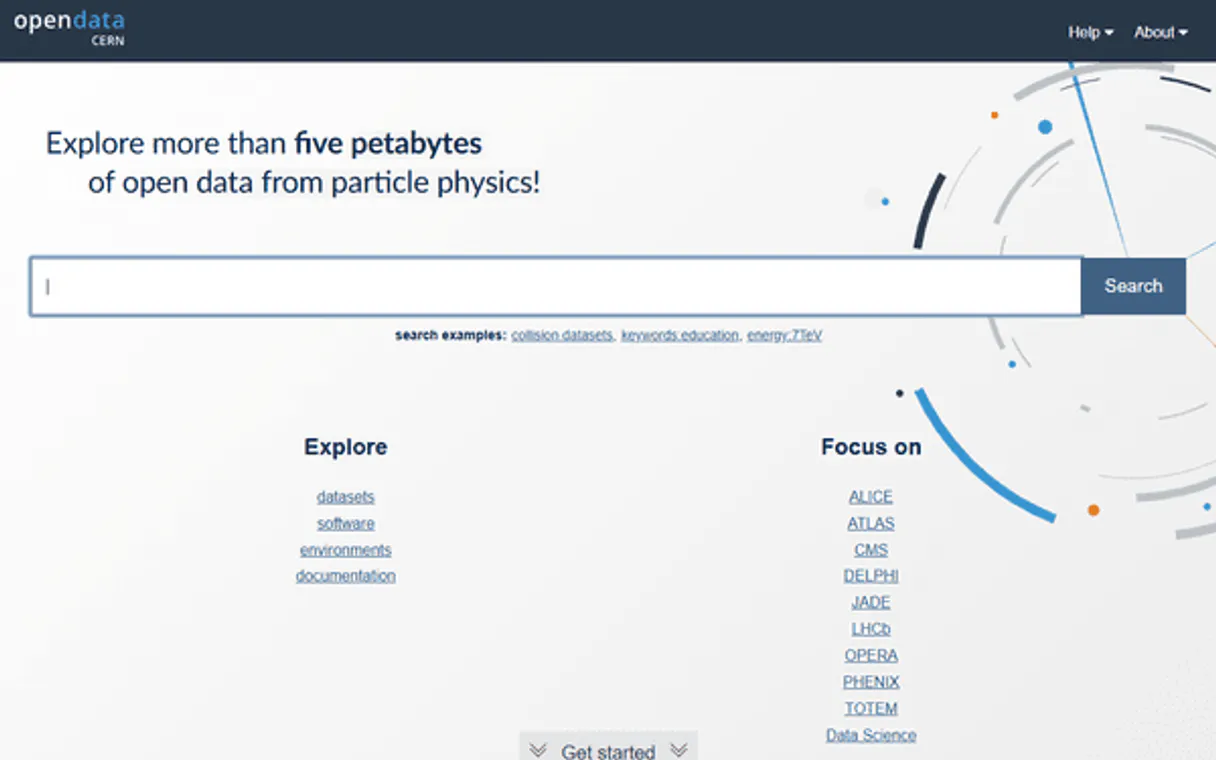
* Every MCP server runs on Vinkius-managed infrastructure inside AWS - a purpose-built runtime with per-request V8 isolates, Ed25519 signed audit chains, and sub-40ms cold starts optimized for native MCP execution. See our infrastructure
About CERN Open Data MCP Server
Connect to the CERN Open Data Portal and access the world's largest repository of open particle physics data — over 66,000 datasets from the Large Hadron Collider and LEP experiments.
When paired with CrewAI, CERN Open Data becomes a first-class tool in your multi-agent workflows. Each agent in the crew can call CERN Open Data tools autonomously, one agent queries data, another analyzes results, a third compiles reports, all orchestrated through Vinkius with zero configuration overhead.
What you can do
- Dataset Discovery — Search across 66,000+ records with powerful filters for experiment (CMS, ATLAS, ALICE, LHCb, DELPHI, OPERA), collision type (pp, e+e−, Pb-Pb), collision energy (7–13.6 TeV), and physics category
- Physics Categories — Browse datasets by research topic including Higgs boson, Exotica (Dark Matter, Gravitons, Extra Dimensions, Leptoquarks), B physics, heavy-ion collisions, and more
- Record Intelligence — Retrieve complete metadata for any record: abstracts, authors with ORCID, DOI, event counts, file listings with ROOT/EOS URIs, and processing configurations
- Portal Analytics — Get comprehensive statistics across all facets: experiments, collision types, energies, file formats, years, and event count distributions
- Physics Glossary — Search 1,000+ glossary entries for definitions of particle physics terms, detector components, and analysis techniques
- Software & Documentation — Find analysis frameworks, reconstruction software, guides, and supplementary materials needed to reproduce published results
The CERN Open Data MCP Server exposes 16 tools through the Vinkius. Connect it to CrewAI in under two minutes — credentials fully managed, no infrastructure to provision, no vendor lock-in. Your configuration, your data, your control.
All 16 CERN Open Data tools available for CrewAI
When CrewAI connects to CERN Open Data through Vinkius, your AI agent gets direct access to every tool listed below — spanning particle-physics, open-data, research-datasets, and more. Every call runs in a secure, isolated environment with full audit visibility. Beyond a simple connection, you get real-time monitoring of agent activity, enterprise governance, and optimized token usage.
Check cern opendata status on CERN Open Data
Use this to verify the integration is working correctly before performing data queries. The API uses the InvenioRDM REST framework. Verify CERN Open Data API connectivity and portal status
Get glossary on CERN Open Data
Returns term names, definitions, and associated experiments. Covers fundamental particles, detector components, analysis techniques, and physics phenomena. Use this to explain technical physics terms like "luminosity", "transverse momentum", "pseudorapidity", "b-tagging", or "muon spectrometer". Invaluable for science communication and educational contexts. Search the CERN particle physics glossary for term definitions
Get portal statistics on CERN Open Data
), record types (Dataset, Documentation, Software, Glossary, Supplementaries), data-taking years, keywords, availability status, and event count distributions. This is the single most informative endpoint for understanding the scope and composition of available CERN data. Get comprehensive CERN Open Data portal statistics and facets
Get record on CERN Open Data
Returns the full title, abstract, experiment, authors with ORCID identifiers, collision parameters, publication dates, DOI, file distribution summary (number of files, events, size), usage instructions, and a direct link. Use this after finding a record via search to obtain complete details. Example: recid "1" returns the CMS BTau primary dataset. Get detailed metadata for a specific CERN Open Data record
Get record by doi on CERN Open Data
Returns the resolved record ID, title, experiment, type, and direct link if found. Useful when you have a DOI from a publication or reference and need to find the corresponding open dataset. DOIs follow the format "10.7483/OPENDATA.CMS.XXX". Returns a "not found" result if the DOI does not match any record. Resolve a DOI to a CERN Open Data record
List categories on CERN Open Data
Returns category names and dataset counts. Categories span the full range of particle physics research: Higgs boson searches, exotic particles (Dark Matter, Extra Dimensions, Gravitons), B physics, heavy-ion collisions, and more. Subcategories within Exotica and Higgs Physics provide finer granularity. List all physics categories and subcategories with dataset counts
List experiments on CERN Open Data
Currently includes CMS (the largest contributor with ~52,000 datasets), DELPHI (LEP era), ATLAS, ALICE, LHCb, OPERA (neutrino physics), TOTEM, JADE, and PHENIX. Use this as a starting point to understand what data is available before drilling into specific experiments. List all available CERN experiments and their dataset counts
List record files on CERN Open Data
Returns filename, size in bytes, checksum, ROOT/EOS URI for direct data access, and file format. Useful for understanding what data is available in a dataset before downloading. Large datasets may contain hundreds of ROOT files. Example: record 1 contains AOD format files from CMS BTau data. List all data files in a CERN Open Data record
Search by category on CERN Open Data
Major categories include: Exotica (~13,000 datasets, including Dark Matter, Extra Dimensions, Gravitons, Heavy Fermions, Leptoquarks), Higgs Physics (~10,400, Standard Model and Beyond Standard Model), Higgs (~10,700), Beyond 2 Generations (~1,600), 2 Fermion (~1,200), B physics and Quarkonia (~500), 4 Fermion (~380), Heavy-Ion Physics (~220). Some categories have subcategories — use the subcategory parameter for more precise filtering. Search datasets filtered by physics category
Search by collision energy on CERN Open Data
Available energies include: 13TeV (~50,500 datasets, LHC Run 2), 181-210 GeV (~11,700, LEP2), 7TeV (~1,100, LHC Run 1), 8TeV (~900, LHC Run 1), 5.02TeV (~310, heavy-ion), 2.76TeV (~120, heavy-ion), 130-140 GeV (~120, LEP), 13.6TeV (LHC Run 3). The vast majority of data comes from 13 TeV proton-proton collisions at the LHC. Search datasets filtered by collision energy
Search by collision type on CERN Open Data
Available collision types: pp (proton-proton, ~52,000 datasets), e+e- (electron-positron, ~12,700), Pb-Pb (lead-lead, ~140), pPb (proton-lead, ~140). Proton-proton collisions from the LHC dominate the dataset. Electron-positron data comes primarily from the LEP era (DELPHI). Use this to focus on a specific collision topology. Search datasets filtered by particle collision type
Search by experiment on CERN Open Data
Available experiments include CMS (~52,000 datasets), DELPHI (~12,700), ATLAS (~160), ALICE (~150), LHCb (~108), OPERA (~900), and TOTEM. Combine with a text query for targeted searches within an experiment. This is the fastest way to scope results to a single collaboration. Search datasets filtered by a specific LHC experiment
Search datasets on CERN Open Data
Supports full-text queries combined with filters for experiment, collision type, collision energy, physics category, file type, and year. Returns paginated results with metadata including record ID, title, abstract, event counts, file sizes, and direct links. Use this as the primary discovery tool for finding specific physics data. Example queries: "Higgs boson", "dark matter", "top quark pair production". Search CERN Open Data datasets with full-text query and filters
Search documentation on CERN Open Data
Returns document titles, abstracts, subtypes (Guide, Policy, About, Activities, Authors, Report, Help, Stripping), and direct links. Use this to find instructions on how to use specific datasets, understand detector configurations, or learn about data processing workflows. Search CERN guides, policies, and documentation
Search software on CERN Open Data
Returns software title, description, associated experiment, and subtypes (Analysis, Framework, Tool, Validation, Workflow). Use this to find reconstruction software, analysis frameworks like CMSSW, or specific analysis code associated with published physics results. Search CERN analysis software, frameworks, and tools
Search supplementaries on CERN Open Data
These ~5,900 records provide the technical context needed to reproduce physics analyses. Filter by subtype to find specific configuration types. Essential for researchers reproducing or extending published analyses. Search CERN supplementary materials and configurations
Connect CERN Open Data to CrewAI via MCP
Follow these steps to wire CERN Open Data into CrewAI. The entire setup takes under two minutes — your credentials stay safe behind Vinkius.
Install CrewAI
pip install crewaiReplace the token
[YOUR_TOKEN_HERE] with your Vinkius token from cloud.vinkius.comCustomize the agent
role, goal, and backstory to fit your use caseRun the crew
python crew.py. CrewAI auto-discovers 16 tools from CERN Open DataWhy Use CrewAI with the CERN Open Data MCP Server
CrewAI Multi-Agent Orchestration Framework provides unique advantages when paired with CERN Open Data through the Model Context Protocol.
Multi-agent collaboration lets you decompose complex workflows into specialized roles, one agent researches, another analyzes, a third generates reports, each with access to MCP tools
CrewAI's native MCP integration requires zero adapter code: pass Vinkius Edge URL directly in the `mcps` parameter and agents auto-discover every available tool at runtime
Built-in task delegation and shared memory mean agents can pass context between steps without manual state management, enabling multi-hop reasoning across tool calls
Sequential and hierarchical crew patterns map naturally to real-world workflows: enumerate subdomains → analyze DNS history → check WHOIS records → compile findings into actionable reports
CERN Open Data + CrewAI Use Cases
Practical scenarios where CrewAI combined with the CERN Open Data MCP Server delivers measurable value.
Automated multi-step research: a reconnaissance agent queries CERN Open Data for raw data, then a second analyst agent cross-references findings and flags anomalies. all without human handoff
Scheduled intelligence reports: set up a crew that periodically queries CERN Open Data, analyzes trends over time, and generates executive briefings in markdown or PDF format
Multi-source enrichment pipelines: chain CERN Open Data tools with other MCP servers in the same crew, letting agents correlate data across multiple providers in a single workflow
Compliance and audit automation: a compliance agent queries CERN Open Data against predefined policy rules, generates deviation reports, and routes findings to the appropriate team
Example Prompts for CERN Open Data in CrewAI
Ready-to-use prompts you can give your CrewAI agent to start working with CERN Open Data immediately.
"Show me the available experiments and how many datasets each one has on CERN Open Data."
"Search for Dark Matter datasets from the CMS experiment at 13 TeV."
"What does 'luminosity' mean in particle physics? Check the CERN glossary."
Troubleshooting CERN Open Data MCP Server with CrewAI
Common issues when connecting CERN Open Data to CrewAI through Vinkius, and how to resolve them.
MCP tools not discovered
Agent not using tools
Timeout errors
Rate limiting or 429 errors
CERN Open Data + CrewAI FAQ
Common questions about integrating CERN Open Data MCP Server with CrewAI.
How does CrewAI discover and connect to MCP tools?
tools/list method. This means tools are always fresh and reflect the server's current capabilities. No tool schemas need to be hardcoded.Can different agents in the same crew use different MCP servers?
mcps list, so you can assign specific servers to specific roles. For example, a reconnaissance agent might use a domain intelligence server while an analysis agent uses a vulnerability database server.What happens when an MCP tool call fails during a crew run?
Can CrewAI agents call multiple MCP tools in parallel?
process=Process.parallel, each calling different MCP tools concurrently. This is ideal for workflows where separate data sources need to be queried simultaneously.Can I run CrewAI crews on a schedule (cron)?
crew.kickoff() method runs synchronously by default, making it straightforward to integrate into existing pipelines.Explore More MCP Servers
View all →
ANP (Revendedores de Combustíveis)
2 toolsAccess official Brazilian fuel and LPG reseller data from ANP — query gas stations and cooking gas providers by location or CNPJ.

Unkey API Management
8 toolsManage and verify your user API keys via Unkey — create, revoke, and track usage directly from any AI agent.
GeTui / 个推
10 toolsMassive notification push and LBS platform in China — manage campaigns, devices, and reports via AI.
Salesforce Sales Cloud
10 toolsManage leads, opportunities, accounts, contacts, and your entire sales pipeline through natural conversation with your Salesforce CRM.