
Coder (Remote Dev) MCP Server for CursorGive Cursor instant access to 84 tools to Add License, Auth Workspace Agent, Cancel Workspace Build, and more
 GDPR Free for Subscribers
Cursor is an AI-first code editor built on VS Code that integrates LLM-powered coding assistance directly into the development workflow. Its Agent mode enables autonomous multi-step coding tasks, and MCP support lets agents access external data sources and APIs during code generation.
Ask AI about this MCP Server for Cursor
The Coder (Remote Dev) MCP Server for Cursor is a standout in the Loved By Devs category — giving your AI agent 84 tools to work with, ready to go from day one.
Vinkius delivers Streamable HTTP and SSE to any MCP client
 Gemini
{
"mcpServers": {
"coder-remote-dev": {
"url": "https://edge.vinkius.com/[YOUR_TOKEN_HERE]/mcp"
}
}
}Vinkius Desktop App
The modern way to manage MCP Servers — no config files, no terminal commands. Install Coder (Remote Dev) and 4,000+ MCP Servers from a single visual interface.
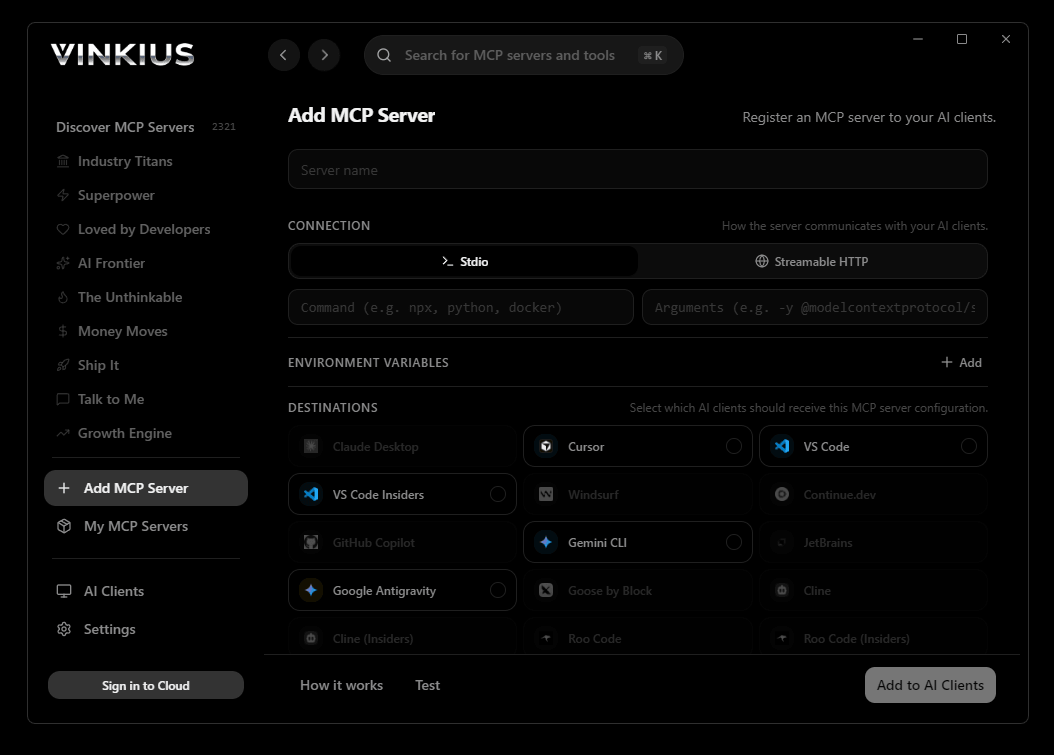

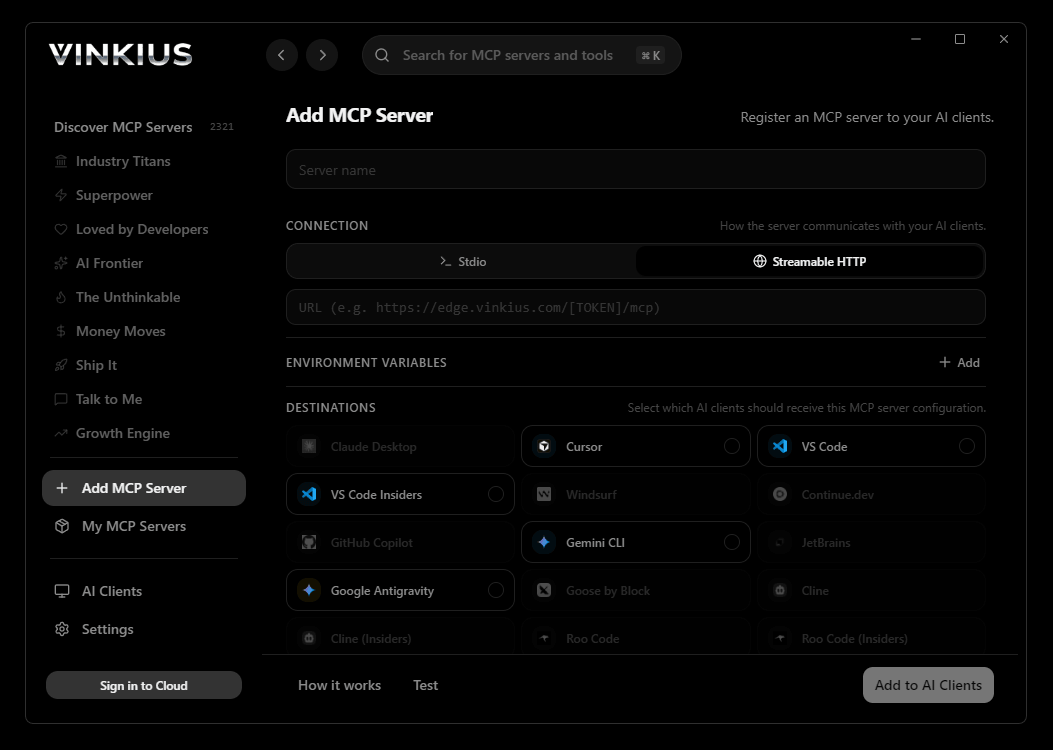
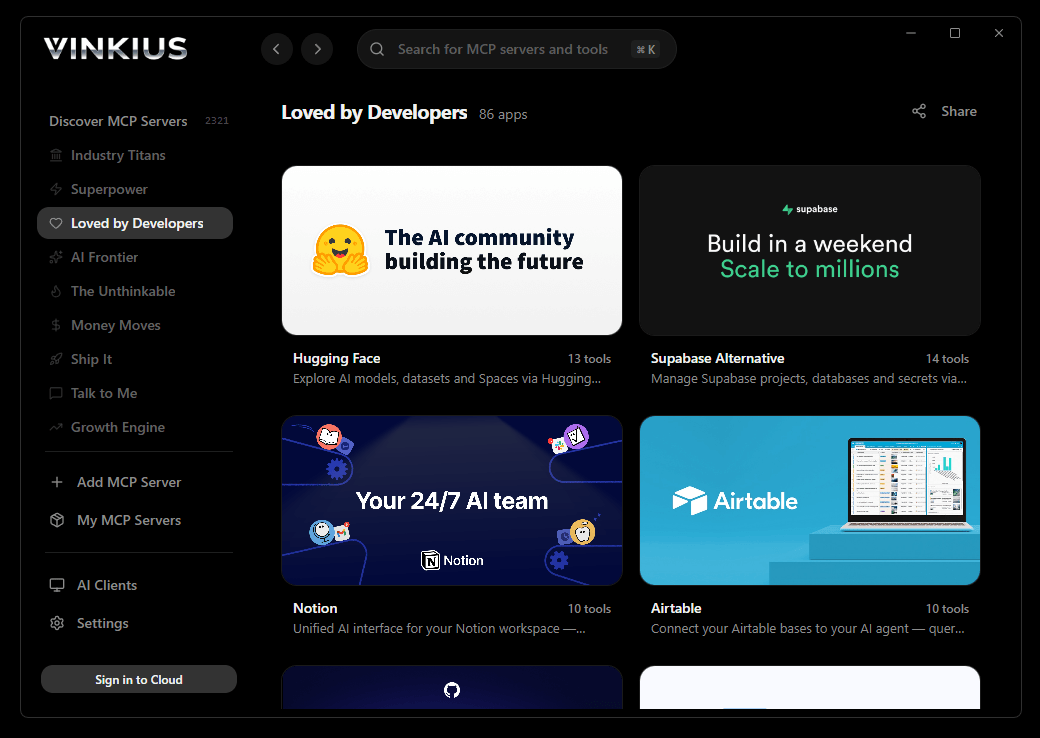

* Every MCP server runs on Vinkius-managed infrastructure inside AWS - a purpose-built runtime with per-request V8 isolates, Ed25519 signed audit chains, and sub-40ms cold starts optimized for native MCP execution. See our infrastructure
About Coder (Remote Dev) MCP Server
Connect your Coder deployment to any AI agent to orchestrate remote development infrastructure and monitor workspace health through natural language.
Cursor's Agent mode turns Coder (Remote Dev) into an in-editor superpower. Ask Cursor to generate code using live data from Coder (Remote Dev) and it fetches, processes, and writes. all in a single agentic loop. 84 tools appear alongside file editing and terminal access, creating a unified development environment grounded in real-time information.
What you can do
- Deployment Monitoring — Retrieve build info, deployment statistics, and check for available updates to keep your infrastructure current.
- AI Bridge Management — List connected AI clients, available models, and active sessions to understand how AI is being utilized in your workspaces.
- Agent Operations — Stream logs from specific workspace agents and manage application statuses to troubleshoot remote environments instantly.
- Infrastructure Config — Access SSH configurations and deployment settings to ensure seamless connectivity for your engineering team.
- Session Insights — Fetch threads and interceptions from AI sessions to audit and optimize AI-assisted development workflows.
The Coder (Remote Dev) MCP Server exposes 84 tools through the Vinkius. Connect it to Cursor in under two minutes — credentials fully managed, no infrastructure to provision, no vendor lock-in. Your configuration, your data, your control.
All 84 Coder (Remote Dev) tools available for Cursor
When Cursor connects to Coder (Remote Dev) through Vinkius, your AI agent gets direct access to every tool listed below — spanning remote-development, workspace-management, coder, and more. Every call runs in a secure, isolated environment with full audit visibility. Beyond a simple connection, you get real-time monitoring of agent activity, enterprise governance, and optimized token usage.
Add license on Coder (Remote Dev)
Add an enterprise license
Auth workspace agent on Coder (Remote Dev)
Authenticate agent using cloud provider identity
Cancel workspace build on Coder (Remote Dev)
Cancel a pending or running build
Check auth on Coder (Remote Dev)
Check if user has permission to perform actions
Create chat on Coder (Remote Dev)
Start a new AI chat session
Create chat message on Coder (Remote Dev)
Send a message to a chat session
Create group on Coder (Remote Dev)
Create a group in an organization
Create organization on Coder (Remote Dev)
Create an organization
Create user on Coder (Remote Dev)
Create a user
Create user secret on Coder (Remote Dev)
Create a user secret
Create user task on Coder (Remote Dev)
Create a long-running AI task for a user
Create user token on Coder (Remote Dev)
Create a user token
Create workspace on Coder (Remote Dev)
Create a workspace
Create workspace port share on Coder (Remote Dev)
Create a port share for a workspace
Delete license on Coder (Remote Dev)
Delete an enterprise license
Delete user on Coder (Remote Dev)
Delete a user
Download file on Coder (Remote Dev)
Download a file by ID
Get agent connection on Coder (Remote Dev)
Get DERP and connection details for an agent
Get agent containers on Coder (Remote Dev)
List running containers and devcontainers
Get agent debug logs on Coder (Remote Dev)
Get the last 10MiB of agent logs (local agent API)
Get agent debug magicsock on Coder (Remote Dev)
Get Tailscale magicsock debug info (local agent API)
Get agent debug manifest on Coder (Remote Dev)
Get the startup manifest from the server (local agent API)
Get agent external auth on Coder (Remote Dev)
Get external authentication tokens for the agent
Get agent logs on Coder (Remote Dev)
Stream logs from a specific agent
Get ai session threads on Coder (Remote Dev)
Get threads for an AI session
Get api root on Coder (Remote Dev)
Get basic API information
Get app auth redirect on Coder (Remote Dev)
Redirect to a URI with an encrypted API key
Get app host on Coder (Remote Dev)
Get the base host for applications
Get appearance on Coder (Remote Dev)
Get dashboard branding and banners
Get audit logs on Coder (Remote Dev)
Get a paginated list of audit logs
Get build info on Coder (Remote Dev)
Get Coder build info
Get chat messages on Coder (Remote Dev)
Get messages for a chat session
Get deployment config on Coder (Remote Dev)
Get deployment configuration
Get deployment stats on Coder (Remote Dev)
Get deployment statistics
Get external auth device on Coder (Remote Dev)
Initiate device-based OAuth
Get insights daus on Coder (Remote Dev)
Get Daily Active User stats
Get insights templates on Coder (Remote Dev)
Get usage data for templates
Get insights user activity on Coder (Remote Dev)
Get activity duration per user
Get notifications inbox on Coder (Remote Dev)
List user notifications
Get notifications settings on Coder (Remote Dev)
Get global notification settings
Get notifications templates on Coder (Remote Dev)
List available notification templates
Get prebuild settings on Coder (Remote Dev)
Get prebuild settings
Get ssh config on Coder (Remote Dev)
Get SSH configuration
Get update check on Coder (Remote Dev)
Check for Coder updates
Get user profile on Coder (Remote Dev)
Get user profile
Get workspace on Coder (Remote Dev)
Get workspace metadata
Get workspace acl on Coder (Remote Dev)
Get workspace ACLs
Get workspace build on Coder (Remote Dev)
Get details of a specific build
Get workspace build logs on Coder (Remote Dev)
Get logs for a specific build
Get workspace build params on Coder (Remote Dev)
List parameters used for the build
List ai clients on Coder (Remote Dev)
List connected AI Bridge clients
List ai interceptions on Coder (Remote Dev)
List AI interceptions
List ai models on Coder (Remote Dev)
List available AI models
List ai sessions on Coder (Remote Dev)
List active AI Bridge sessions
List chats on Coder (Remote Dev)
List user chat sessions
List external auth on Coder (Remote Dev)
List linked external accounts (e.g., GitHub)
List groups on Coder (Remote Dev)
List groups
List licenses on Coder (Remote Dev)
List enterprise licenses
List org members on Coder (Remote Dev)
List members of an organization
List org provisioner daemons on Coder (Remote Dev)
List active provisioner daemons
List org provisioner jobs on Coder (Remote Dev)
List jobs for the organization provisioners
List org roles on Coder (Remote Dev)
List assignable roles in an organization
List organizations on Coder (Remote Dev)
List organizations
List tasks on Coder (Remote Dev)
Manage long-running AI tasks
List template examples on Coder (Remote Dev)
List starter template examples
List template versions on Coder (Remote Dev)
List versions for a template
List templates on Coder (Remote Dev)
List all templates
List user secrets on Coder (Remote Dev)
List user secrets
List user tokens on Coder (Remote Dev)
List user tokens
List users on Coder (Remote Dev)
List users
List workspace port shares on Coder (Remote Dev)
List port shares for a workspace
List workspaces on Coder (Remote Dev)
g., owner:me). List workspaces
Login user on Coder (Remote Dev)
Authenticate a user with email and password
Register agent log source on Coder (Remote Dev)
Register a new log source
Send agent logs on Coder (Remote Dev)
Send logs to the server
Update agent app status on Coder (Remote Dev)
Update status of an application running on the agent
Update appearance on Coder (Remote Dev)
Update dashboard branding and banners
Update organization on Coder (Remote Dev)
Update an organization
Update prebuild settings on Coder (Remote Dev)
Update prebuild settings
Update user profile on Coder (Remote Dev)
Update user profile
Update workspace acl on Coder (Remote Dev)
Update workspace ACLs
Update workspace autostart on Coder (Remote Dev)
Update workspace autostart schedule
Update workspace autoupdates on Coder (Remote Dev)
Update workspace autoupdates schedule
Upload file on Coder (Remote Dev)
Upload a file (tar or zip)
Connect Coder (Remote Dev) to Cursor via MCP
Follow these steps to wire Coder (Remote Dev) into Cursor. The entire setup takes under two minutes — your credentials stay safe behind Vinkius.
Open MCP Settings
Cmd+Shift+P (macOS) or Ctrl+Shift+P (Windows/Linux) → search "MCP Settings"Add the server config
mcp.json file that opensSave the file
Start using Coder (Remote Dev)
Why Use Cursor with the Coder (Remote Dev) MCP Server
Cursor AI Code Editor provides unique advantages when paired with Coder (Remote Dev) through the Model Context Protocol.
Agent mode turns Cursor into an autonomous coding assistant that can read files, run commands, and call MCP tools without switching context
Cursor's Composer feature can generate entire files using real-time data fetched through MCP. no copy-pasting from external dashboards
MCP tools appear alongside built-in tools like file reading and terminal access, creating a unified agentic environment
VS Code extension compatibility means your existing workflow, keybindings, and extensions all work alongside MCP tools
Coder (Remote Dev) + Cursor Use Cases
Practical scenarios where Cursor combined with the Coder (Remote Dev) MCP Server delivers measurable value.
Code generation with live data: ask Cursor to generate a security report module using live DNS and subdomain data fetched through MCP
Automated documentation: have Cursor query your API's tool schemas and generate TypeScript interfaces or OpenAPI specs automatically
Infrastructure-as-code: Cursor can fetch domain configurations and generate corresponding Terraform or CloudFormation templates
Test scaffolding: ask Cursor to pull real API responses via MCP and generate unit test fixtures from actual data
Example Prompts for Coder (Remote Dev) in Cursor
Ready-to-use prompts you can give your Cursor agent to start working with Coder (Remote Dev) immediately.
"Show me the current Coder deployment statistics and build info."
"List all active AI Bridge sessions and their available models."
"Get the SSH configuration for my Coder instance."
Troubleshooting Coder (Remote Dev) MCP Server with Cursor
Common issues when connecting Coder (Remote Dev) to Cursor through Vinkius, and how to resolve them.
Tools not appearing in Cursor
Server shows as disconnected
Coder (Remote Dev) + Cursor FAQ
Common questions about integrating Coder (Remote Dev) MCP Server with Cursor.
What is Agent mode and why does it matter for MCP?
Where does Cursor store MCP configuration?
mcp.json file. You can configure servers at the project level (.cursor/mcp.json in your project root) or globally (~/.cursor/mcp.json). Project-level configs take precedence.Can Cursor use MCP tools in inline edits?
How do I verify MCP tools are loaded?
Explore More MCP Servers
View all →
LaunchDarkly
9 toolsManage LaunchDarkly feature flags, environments, assignments and deployments smoothly through conversational AI.

Orbit
Manage community relationships via Orbit — list members, track activities, and add notes directly from any AI agent.

NeonCRM
10 toolsManage non-profit operations via NeonCRM — track donations, memberships, and events directly from your AI agent.
Better Stack
10 toolsAutomate incident management via Better Stack — monitor uptime, manage incidents, and control on-call schedules securely from your AI agent.