
EBI PDBe MCP Server for CursorGive Cursor instant access to 16 tools to Get Assemblies, Get Binding Sites, Get Cofactors, and more
 GDPR Free for Subscribers
Cursor is an AI-first code editor built on VS Code that integrates LLM-powered coding assistance directly into the development workflow. Its Agent mode enables autonomous multi-step coding tasks, and MCP support lets agents access external data sources and APIs during code generation.
Ask AI about this MCP Server for Cursor
The EBI PDBe MCP Server for Cursor is a standout in the The Unthinkable category — giving your AI agent 16 tools to work with, ready to go from day one.
Vinkius delivers Streamable HTTP and SSE to any MCP client
 Gemini
{
"mcpServers": {
"ebi-pdbe": {
"url": "https://edge.vinkius.com/[YOUR_TOKEN_HERE]/mcp"
}
}
}Vinkius Desktop App
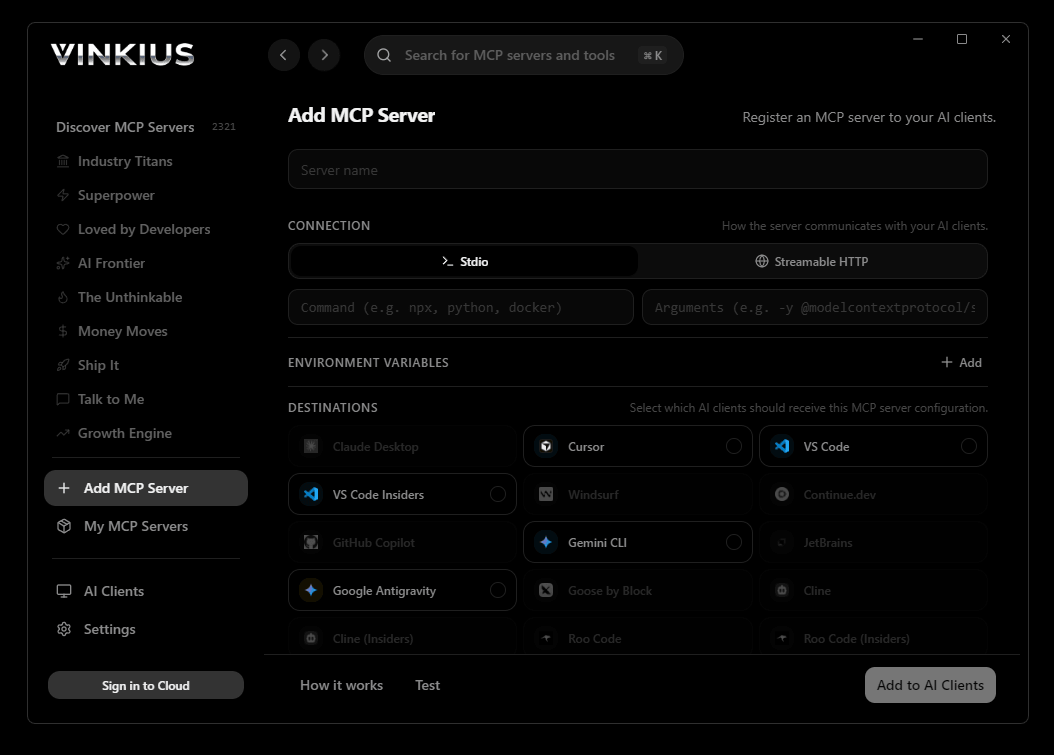
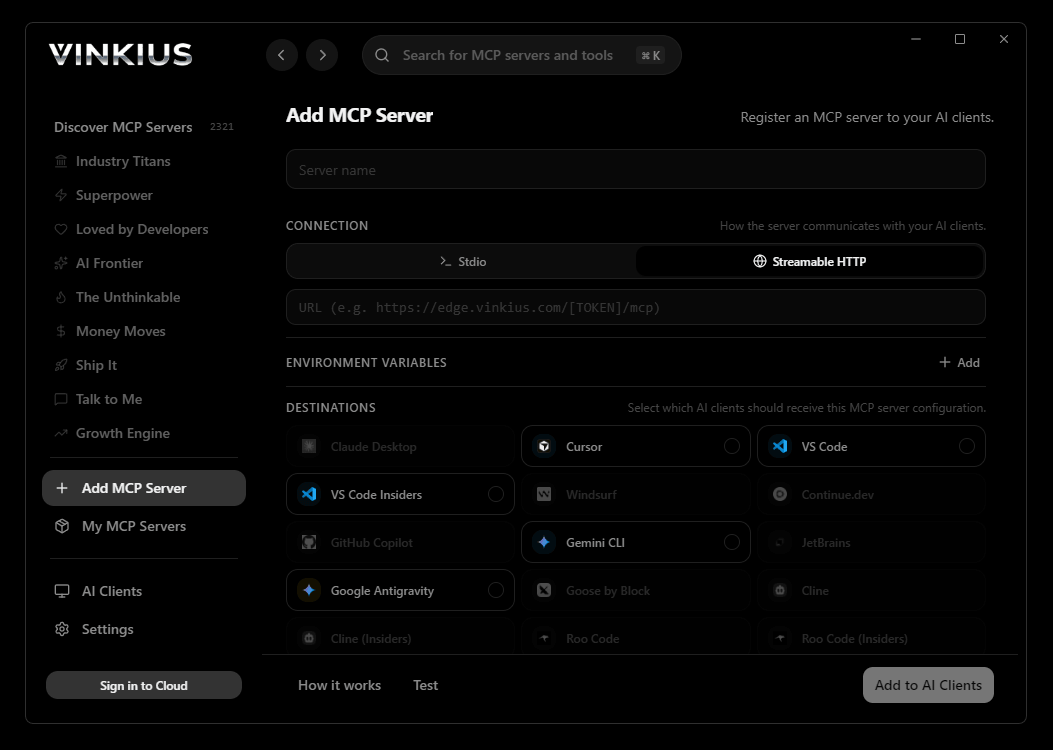
The modern way to manage MCP Servers — no config files, no terminal commands. Install EBI PDBe and 4,000+ MCP Servers from a single visual interface.



* Every MCP server runs on Vinkius-managed infrastructure inside AWS - a purpose-built runtime with per-request V8 isolates, Ed25519 signed audit chains, and sub-40ms cold starts optimized for native MCP execution. See our infrastructure
About EBI PDBe MCP Server
Connect to the PDBe (Protein Data Bank in Europe) API and access the world's most comprehensive repository of experimentally determined 3D macromolecular structures.
Cursor's Agent mode turns EBI PDBe into an in-editor superpower. Ask Cursor to generate code using live data from EBI PDBe and it fetches, processes, and writes. all in a single agentic loop. 16 tools appear alongside file editing and terminal access, creating a unified development environment grounded in real-time information.
What you can do
- Structure Summaries — Get titles, authors, deposition dates, resolution, and experimental methods for any PDB entry
- Molecular Entities — Retrieve protein chains, nucleic acids, ligands, their sequences, source organisms, and gene names
- Binding Sites & Ligands — Access ligand binding pocket residues, small molecule ligands with formulas and weights
- Quality Assessment — Check resolution, R-factors, and overall quality scores for structure reliability
- UniProt Mappings — Map between UniProt sequence positions and PDB residue numbers
- Biological Assemblies — Understand quaternary structure — monomer, dimer, tetramer, or higher-order complexes
- Structure Search — Full-text Solr search across 200+ PDB metadata fields
- Publications — Find primary citations, PubMed IDs, and related structural studies
The EBI PDBe MCP Server exposes 16 tools through the Vinkius. Connect it to Cursor in under two minutes — credentials fully managed, no infrastructure to provision, no vendor lock-in. Your configuration, your data, your control.
All 16 EBI PDBe tools available for Cursor
When Cursor connects to EBI PDBe through Vinkius, your AI agent gets direct access to every tool listed below — spanning pdb, protein-structure, 3d-structures, and more. Every call runs in a secure, isolated environment with full audit visibility. Beyond a simple connection, you get real-time monitoring of agent activity, enterprise governance, and optimized token usage.
Get assemblies on EBI PDBe
Returns assembly IDs, composition (which entities and how many copies), preferred assembly flag, and form description. Critical for understanding whether a protein functions as a monomer, dimer, tetramer, or higher-order complex. Get biological assembly information (quaternary structure)
Get binding sites on EBI PDBe
Critical for drug discovery, molecular docking, and understanding protein-ligand interactions. Get ligand binding site residues and interactions
Get cofactors on EBI PDBe
Cofactors like heme, NAD+, FAD, and metal ions are essential for enzyme catalysis and protein function. Get cofactor and prosthetic group annotations
Get experiment on EBI PDBe
Get experimental method details for a structure
Get ligand monomers on EBI PDBe
Returns chemical component IDs, names, molecular formulas, molecular weights, and their chain/residue positions. Essential for drug discovery and understanding protein-small molecule interactions. Get small molecule ligands bound in the structure
Get modified residues on EBI PDBe
Shows the parent compound ID and modification name. Get non-standard amino acids and nucleotides
Get molecules on EBI PDBe
Returns entity IDs, molecule types, names, chain assignments, sequence lengths, molecular weights, source organisms, and gene names. Get molecular entities (chains, polymers) in a structure
Get mutated residues on EBI PDBe
Shows the original residue, mutated residue, chain, and position. Essential for understanding how the crystallized construct differs from the native protein. Get engineered mutations vs. wild-type sequence
Get publications on EBI PDBe
Useful for finding the primary citation and methodology papers for a structure. Get associated journal publications and PubMed IDs
Get quality scores on EBI PDBe
The first thing a structural biologist checks when evaluating a structure for reliability. Get global quality metrics for a structure
Get related entries on EBI PDBe
Useful for discovering alternative conformations, mutants, or complexes of the same protein that have been structurally characterized. Get related PDB entries citing the same publications
Get residue listing on EBI PDBe
Shows residue names, numbers (both PDB and author numbering), organized by entity and chain. Returns a sample of the first 20 residues per chain for efficiency. Get full residue-level inventory per chain
Get secondary structure on EBI PDBe
Shows the count of helices and strands per chain, organized by molecular entity. Essential for understanding protein fold topology. Get helix, sheet, and coil assignments per residue
Get summary on EBI PDBe
Use a 4-character PDB ID such as 1cbs, 4hhb, 6lu7. Get PDB entry summary with title, authors, and resolution
Get uniprot mapping on EBI PDBe
Returns UniProt accessions, chain assignments, and start/end position mappings. Essential for cross-referencing between protein sequence databases and 3D structural data. Get UniProt to PDB residue mappings
Search structures on EBI PDBe
Use natural language queries like "insulin receptor kinase", "SARS-CoV-2 spike protein", "cryo-EM resolution<3", or specific organism names. Returns PDB IDs, titles, methods, resolutions, and organisms. Search PDB structures with full-text queries
Connect EBI PDBe to Cursor via MCP
Follow these steps to wire EBI PDBe into Cursor. The entire setup takes under two minutes — your credentials stay safe behind Vinkius.
Open MCP Settings
Cmd+Shift+P (macOS) or Ctrl+Shift+P (Windows/Linux) → search "MCP Settings"Add the server config
mcp.json file that opensSave the file
Start using EBI PDBe
Why Use Cursor with the EBI PDBe MCP Server
Cursor AI Code Editor provides unique advantages when paired with EBI PDBe through the Model Context Protocol.
Agent mode turns Cursor into an autonomous coding assistant that can read files, run commands, and call MCP tools without switching context
Cursor's Composer feature can generate entire files using real-time data fetched through MCP. no copy-pasting from external dashboards
MCP tools appear alongside built-in tools like file reading and terminal access, creating a unified agentic environment
VS Code extension compatibility means your existing workflow, keybindings, and extensions all work alongside MCP tools
EBI PDBe + Cursor Use Cases
Practical scenarios where Cursor combined with the EBI PDBe MCP Server delivers measurable value.
Code generation with live data: ask Cursor to generate a security report module using live DNS and subdomain data fetched through MCP
Automated documentation: have Cursor query your API's tool schemas and generate TypeScript interfaces or OpenAPI specs automatically
Infrastructure-as-code: Cursor can fetch domain configurations and generate corresponding Terraform or CloudFormation templates
Test scaffolding: ask Cursor to pull real API responses via MCP and generate unit test fixtures from actual data
Example Prompts for EBI PDBe in Cursor
Ready-to-use prompts you can give your Cursor agent to start working with EBI PDBe immediately.
"Show me the structure summary and quality of the SARS-CoV-2 main protease (6lu7)."
"What ligands are bound in the hemoglobin structure 4hhb?"
"Search for cryo-EM structures of ribosome complexes."
Troubleshooting EBI PDBe MCP Server with Cursor
Common issues when connecting EBI PDBe to Cursor through Vinkius, and how to resolve them.
Tools not appearing in Cursor
Server shows as disconnected
EBI PDBe + Cursor FAQ
Common questions about integrating EBI PDBe MCP Server with Cursor.
What is Agent mode and why does it matter for MCP?
Where does Cursor store MCP configuration?
mcp.json file. You can configure servers at the project level (.cursor/mcp.json in your project root) or globally (~/.cursor/mcp.json). Project-level configs take precedence.Can Cursor use MCP tools in inline edits?
How do I verify MCP tools are loaded?
Explore More MCP Servers
View all →
Browserbear
10 toolsAutomate browser tasks via Browserbear — take screenshots, scrape data, and run multi-step automations directly from any AI agent.

Scrapfly
12 toolsScrape web data at scale with a managed API that handles proxies, browser rendering, and anti-bot bypassing automatically.

Relevance AI
11 toolsAutomate autonomous AI agents via Relevance AI — manage tools, trigger tasks, and monitor results directly.

BlogIn
7 toolsKeep your team informed with internal blog posts, company updates, and knowledge sharing that everyone actually reads.