
Harvard WHO Health MCP Server for Claude DesktopGive Claude Desktop instant access to 16 tools to Compare Countries, Get Countries, Get Dimensions, and more
 GDPR Free for Subscribers
Claude Desktop is Anthropic's native application for interacting with Claude AI models on macOS and Windows. It was the first consumer application to ship with built-in MCP support, making it the reference implementation for the Model Context Protocol standard.
Ask AI about this MCP Server for Claude Desktop
The Harvard WHO Health MCP Server for Claude Desktop is a standout in the Data Analytics category — giving your AI agent 16 tools to work with, ready to go from day one.
Vinkius delivers Streamable HTTP and SSE to any MCP client
 Gemini
{
"mcpServers": {
"harvard-who-health": {
// Your Vinkius token. get it at cloud.vinkius.com
"url": "https://edge.vinkius.com/[YOUR_TOKEN_HERE]/mcp"
}
}
}Vinkius Desktop App
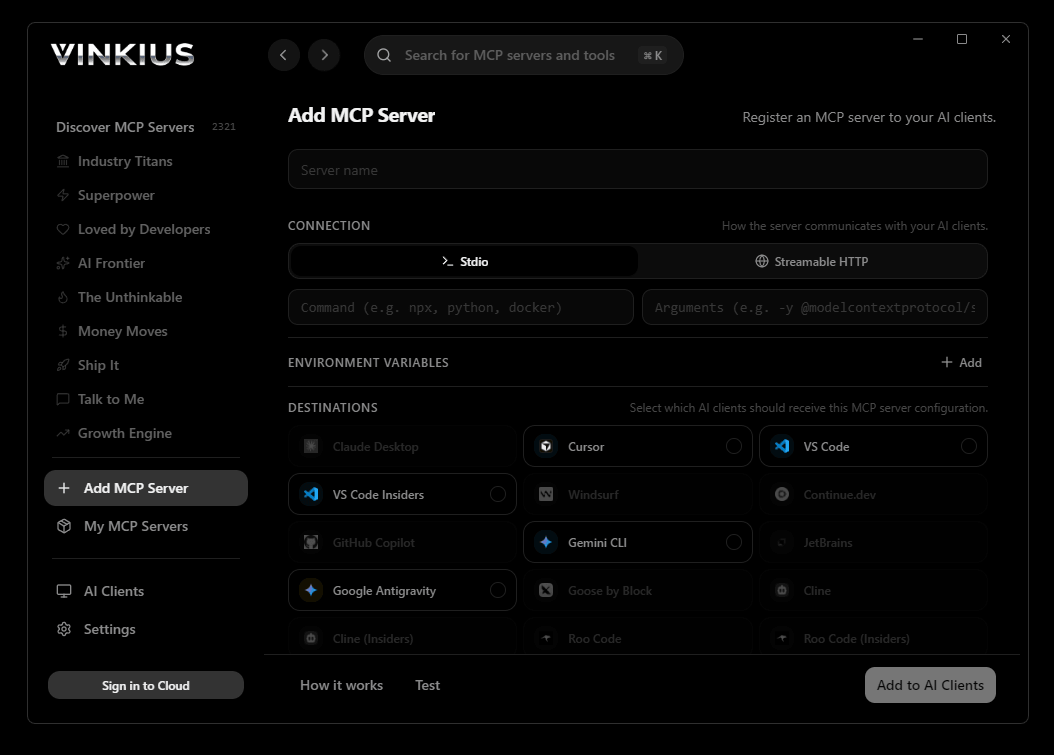
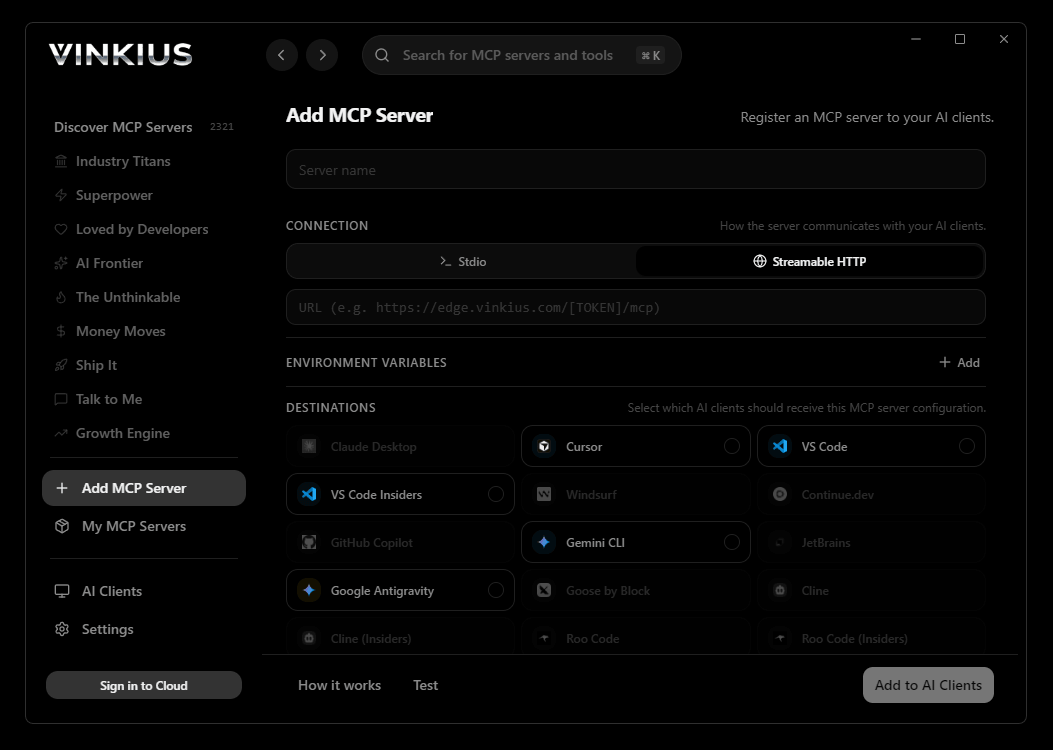
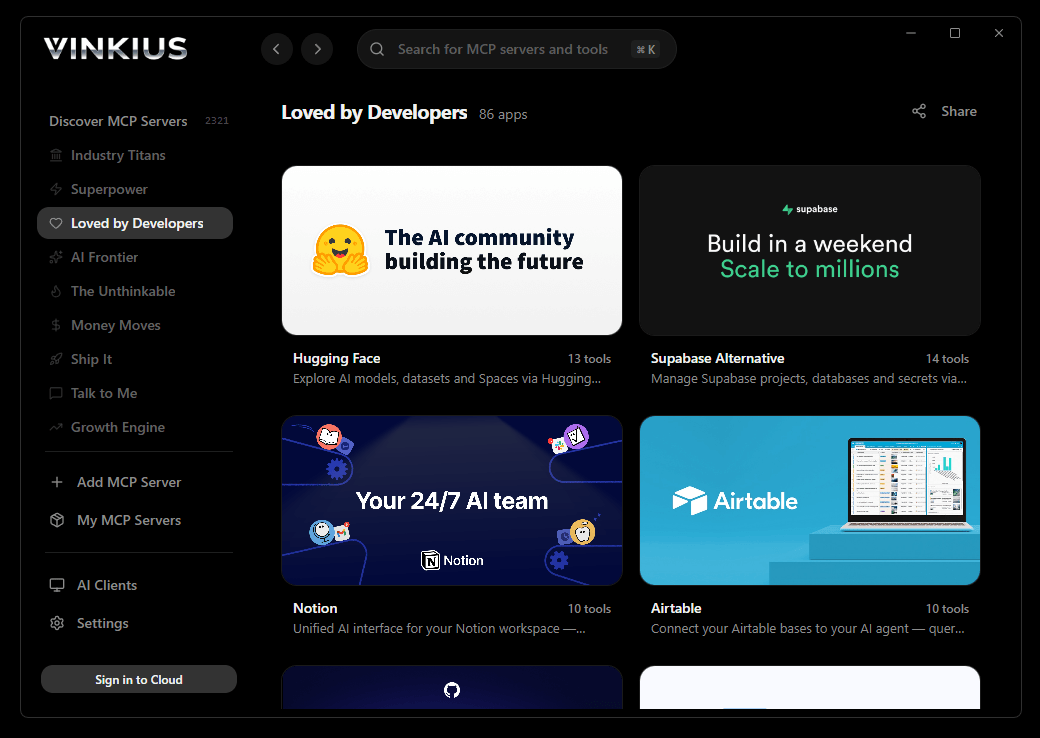
The modern way to manage MCP Servers — no config files, no terminal commands. Install Harvard WHO Health and 4,000+ MCP Servers from a single visual interface.


* Every MCP server runs on Vinkius-managed infrastructure inside AWS - a purpose-built runtime with per-request V8 isolates, Ed25519 signed audit chains, and sub-40ms cold starts optimized for native MCP execution. See our infrastructure
About Harvard WHO Health MCP Server
Connect to the WHO Global Health Observatory (GHO) API — the world's most comprehensive source of global health statistics.
Claude Desktop is the definitive way to connect Harvard WHO Health to your AI workflow. Add Vinkius Edge URL to your config, restart the app, and Claude immediately exposes all 16 tools in the chat interface. ask a question, Claude calls the right tool, and you see the answer. Zero code, zero context switching.
What you can do
- Health Indicators — Search 1000+ indicators across all health domains
- Life Expectancy — Track life expectancy at birth by country
- Immunization — DTP3, measles, polio, BCG, and hepatitis B coverage
- Infectious Diseases — HIV/AIDS prevalence, TB incidence, malaria estimates
- NCDs — Diabetes, obesity, hypertension, tobacco, and alcohol data
- Maternal Health — Maternal mortality ratios and reproductive health
- Health Workforce — Physicians, nurses, dentists, pharmacists per 10,000 pop.
- Health Expenditure — Per capita spending in PPP dollars
- Water & Sanitation — WASH indicators for safe water and sanitation
- Country Comparison — Compare any indicator across multiple countries
The Harvard WHO Health MCP Server exposes 16 tools through the Vinkius. Connect it to Claude Desktop in under two minutes — credentials fully managed, no infrastructure to provision, no vendor lock-in. Your configuration, your data, your control.
All 16 Harvard WHO Health tools available for Claude Desktop
When Claude Desktop connects to Harvard WHO Health through Vinkius, your AI agent gets direct access to every tool listed below — spanning global-health, health-indicators, statistics, and more. Every call runs in a secure, isolated environment with full audit visibility. Beyond a simple connection, you get real-time monitoring of agent activity, enterprise governance, and optimized token usage.
Compare countries on Harvard WHO Health
Provide a comma-separated list of ISO 3-letter country codes. Returns the most recent 10 years of data for each country. Compare a health indicator across countries
Get countries on Harvard WHO Health
Returns ISO codes and country names for use with other indicator queries. Get list of WHO member countries
Get dimensions on Harvard WHO Health
Useful for understanding how to filter and disaggregate health data. Get WHO data dimensions metadata
Get health expenditure on Harvard WHO Health
This indicator measures how much each country spends on healthcare, adjusted for purchasing power. Get health expenditure data
Get health workforce on Harvard WHO Health
Supported types: "physicians", "nurses", "dentists", "pharmacists". Get health workforce density data
Get hiv aids on Harvard WHO Health
Tracks the percentage of the population living with HIV, a critical indicator for public health programs and resource allocation. Get HIV/AIDS prevalence data
Get immunization on Harvard WHO Health
Supported shortcuts: "dtp3" (diphtheria-tetanus-pertussis), "measles", "polio", "bcg", "hepb3". Or use a WHO indicator code directly. Get immunization coverage data
Get indicator data on Harvard WHO Health
g. "USA", "BRA", "GBR", "CHN", "IND"). Returns country, year, value, confidence intervals, and sex disaggregation. Get time-series data for a WHO indicator
Get life expectancy on Harvard WHO Health
This is one of the most fundamental indicators of population health. Get life expectancy data
Get malaria on Harvard WHO Health
Essential for tracking the global burden of malaria, particularly in sub-Saharan Africa and Southeast Asia. Get malaria case estimates
Get maternal health on Harvard WHO Health
This measures the number of maternal deaths per 100,000 live births, a critical indicator of reproductive health and healthcare quality. Get maternal mortality data
Get mortality on Harvard WHO Health
Common indicator codes: "NCDMORT3070" (NCD mortality), "CHILDMORTALITY" (under-5), "MATERNALMORTALITY". Use search_indicators to find specific codes. Get mortality data by cause
Get ncd on Harvard WHO Health
Supported shortcuts: "diabetes" (prevalence), "obesity" (BMI ≥30), "blood_pressure" (hypertension), "tobacco" (smoking), "alcohol" (consumption). Or use a WHO code. Get non-communicable disease data
Get tuberculosis on Harvard WHO Health
TB remains one of the top infectious disease killers worldwide, and this data tracks progress toward elimination. Get tuberculosis incidence data
Get water sanitation on Harvard WHO Health
Supported types: "water" (safely managed drinking water), "sanitation" (safely managed sanitation), "hygiene" (basic hygiene facilities). Get water and sanitation data
Search indicators on Harvard WHO Health
Returns indicator codes and names. Use the indicator code with get_indicator_data to retrieve time-series data. Search 1000+ WHO health indicators
Connect Harvard WHO Health to Claude Desktop via MCP
Follow these steps to wire Harvard WHO Health into Claude Desktop. The entire setup takes under two minutes — your credentials stay safe behind Vinkius.
Open Claude Desktop Settings
claude_desktop_config.jsonAdd the MCP Server
mcpServers sectionRestart Claude Desktop
Start using Harvard WHO Health
Why Use Claude Desktop with the Harvard WHO Health MCP Server
Claude Desktop by Anthropic provides unique advantages when paired with Harvard WHO Health through the Model Context Protocol.
Claude Desktop is the reference MCP client. it was designed alongside the protocol itself, ensuring the most complete and stable MCP implementation available
Zero-code configuration: add a server URL to a JSON file and Claude instantly discovers and exposes all available tools in the chat interface
Claude's extended thinking capability lets it reason through multi-step tool usage, chaining multiple API calls to answer complex questions
Enterprise-grade security with local config storage. your tokens never leave your machine, and connections go directly to Vinkius Edge network
Harvard WHO Health + Claude Desktop Use Cases
Practical scenarios where Claude Desktop combined with the Harvard WHO Health MCP Server delivers measurable value.
Interactive data exploration: ask Claude to query DNS records, look up WHOIS data, and cross-reference results in a single conversation
Ad-hoc security audits: type a domain name and let Claude enumerate subdomains, check DNS history, and flag configuration anomalies. all through natural language
Executive briefings: generate comprehensive domain intelligence reports by asking Claude to compile findings into a formatted summary
Learning and training: new team members can explore API capabilities conversationally without needing to read documentation
Example Prompts for Harvard WHO Health in Claude Desktop
Ready-to-use prompts you can give your Claude Desktop agent to start working with Harvard WHO Health immediately.
"Compare life expectancy between USA, Brazil, Japan, and Nigeria"
"Show diabetes prevalence data for India"
"Get measles immunization coverage for sub-Saharan African countries"
Troubleshooting Harvard WHO Health MCP Server with Claude Desktop
Common issues when connecting Harvard WHO Health to Claude Desktop through Vinkius, and how to resolve them.
Server not appearing after restart
~/Library/Application Support/Claude/claude_desktop_config.json (macOS) or %APPDATA%\\Claude\\ (Windows).Authentication error
Tools not showing in chat
Harvard WHO Health + Claude Desktop FAQ
Common questions about integrating Harvard WHO Health MCP Server with Claude Desktop.
How does Claude Desktop discover MCP tools?
claude_desktop_config.json file and connects to each configured MCP server. It calls the tools/list endpoint to fetch the schema for every available tool, then surfaces them as clickable options in the chat interface via the 🔌 icon.What happens if the MCP server is temporarily unavailable?
Can I connect multiple MCP servers simultaneously?
mcpServers section of the config file. Each server appears as a separate tool provider, and Claude can use tools from multiple servers in a single conversation turn.Is there a limit on the number of tools per server?
Does Claude Desktop support Streamable HTTP transport?
Explore More MCP Servers
View all →
LegiScan Legislation Lookup
3 toolsUniversal legislative intelligence — search bills, votes, and state laws via AI.
Ele.me Open Platform / 饿了么
10 toolsChina's massive food delivery API — manage shops, process orders, and track deliveries via AI.

Tana
10 toolsConnect your AI to Tana. Build intelligent knowledge graphs, define supertags, and capture dynamic nested nodes directly from the prompt.
World Bank Full Access
30 toolsThe ultimate Mega-Server integration: A massive 30-tool suite granting your AI zero-auth access to the entire World Bank catalog (29,506 indicators) across all 21 specific categories.