
MIT DBLP MCP Server for OpenAI Agents SDKGive OpenAI Agents SDK instant access to 16 tools to Get Author, Get Author Publications, Get Author Stats, and more
 GDPR Free for Subscribers
The OpenAI Agents SDK enables production-grade agent workflows in Python. Connect MIT DBLP through Vinkius and your agents gain typed, auto-discovered tools with built-in guardrails. no manual schema definitions required.
Ask AI about this MCP Server for OpenAI Agents SDK
The MIT DBLP MCP Server for OpenAI Agents SDK is a standout in the Knowledge Management category — giving your AI agent 16 tools to work with, ready to go from day one.
Vinkius delivers Streamable HTTP and SSE to any MCP client
 Gemini
import asyncio
from agents import Agent, Runner
from agents.mcp import MCPServerStreamableHttp
async def main():
# Your Vinkius token. get it at cloud.vinkius.com
async with MCPServerStreamableHttp(
url="https://edge.vinkius.com/[YOUR_TOKEN_HERE]/mcp"
) as mcp_server:
agent = Agent(
name="MIT DBLP Assistant",
instructions=(
"You help users interact with MIT DBLP. "
"You have access to 16 tools."
),
mcp_servers=[mcp_server],
)
result = await Runner.run(
agent, "List all available tools from MIT DBLP"
)
print(result.final_output)
asyncio.run(main())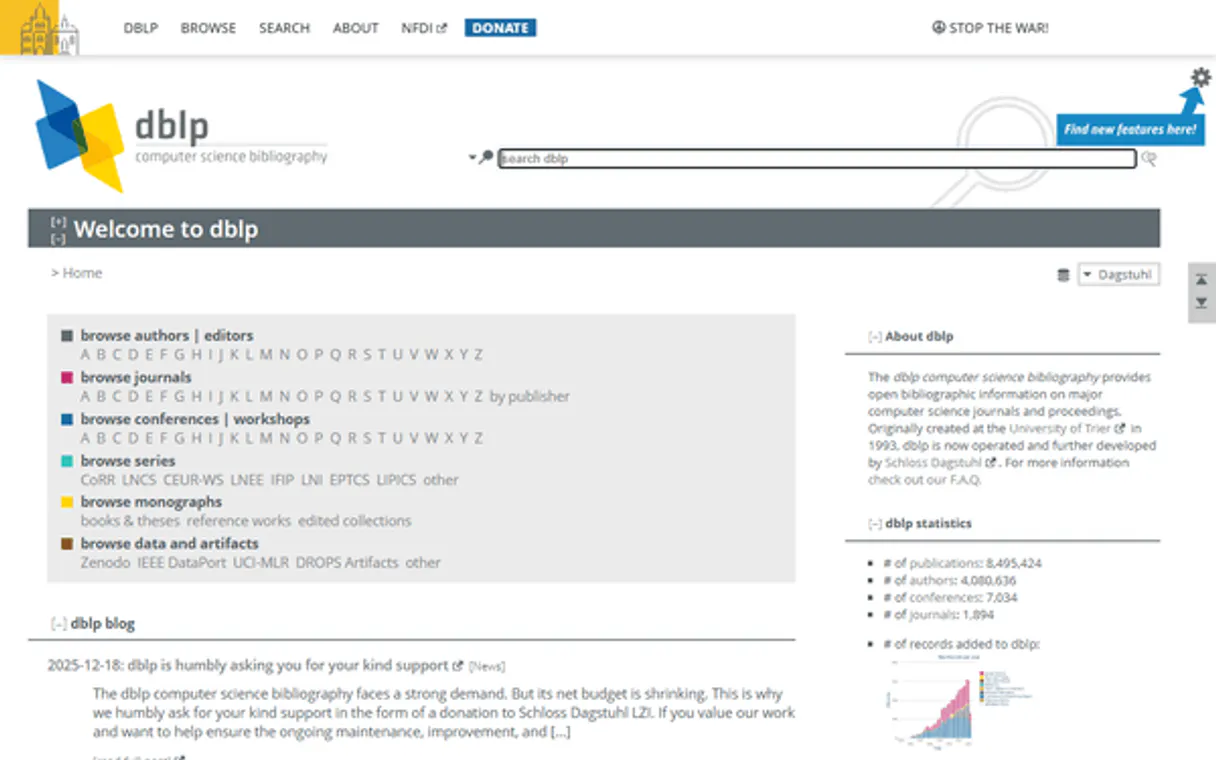
* Every MCP server runs on Vinkius-managed infrastructure inside AWS - a purpose-built runtime with per-request V8 isolates, Ed25519 signed audit chains, and sub-40ms cold starts optimized for native MCP execution. See our infrastructure
About MIT DBLP MCP Server
Connect to the DBLP Computer Science Bibliography — the most comprehensive index of CS research, maintained by Schloss Dagstuhl.
The OpenAI Agents SDK auto-discovers all 16 tools from MIT DBLP through native MCP integration. Build agents with built-in guardrails, tracing, and handoff patterns. chain multiple agents where one queries MIT DBLP, another analyzes results, and a third generates reports, all orchestrated through Vinkius.
What you can do
- Full-Text Search — Search 6M+ CS publications across all venues
- Author Profiles — Explore researcher profiles and publication histories
- Venue Browsing — Search conferences (NeurIPS, ICML, SIGMOD, OSDI) and journals (JACM, TOCS)
- Co-Author Networks — Discover collaboration patterns between researchers
- AI/ML Papers — Dedicated search for NeurIPS, ICML, ICLR, and AAAI papers
- Systems Papers — Dedicated search for OSDI, SOSP, SIGCOMM, NSDI papers
- Theory Papers — Dedicated search for STOC, FOCS, SODA papers
- Database Papers — Dedicated search for SIGMOD, VLDB, ICDE papers
- Author Statistics — Publication counts, venue distribution, and year-over-year trends
The MIT DBLP MCP Server exposes 16 tools through the Vinkius. Connect it to OpenAI Agents SDK in under two minutes — credentials fully managed, no infrastructure to provision, no vendor lock-in. Your configuration, your data, your control.
All 16 MIT DBLP tools available for OpenAI Agents SDK
When OpenAI Agents SDK connects to MIT DBLP through Vinkius, your AI agent gets direct access to every tool listed below — spanning academic-research, bibliography, computer-science, and more. Every call runs in a secure, isolated environment with full audit visibility. Beyond a simple connection, you get real-time monitoring of agent activity, enterprise governance, and optimized token usage.
Get author on MIT DBLP
The PID can be found in DBLP URLs (e.g. for "https://dblp.org/pid/b/YoshuaBengio" the PID is "b/YoshuaBengio"). Get author profile by DBLP PID
Get author publications on MIT DBLP
Returns up to 40 most recent publications with full metadata. Use the author name as it appears on DBLP. Get all publications by a specific author
Get author stats on MIT DBLP
Essential for evaluating research productivity and impact. Get publication statistics for an author
Get coauthors on MIT DBLP
Returns a ranked list of collaborators ordered by number of joint publications. Essential for understanding research collaboration patterns. Get co-author network of a researcher
Get publication on MIT DBLP
g. "journals/cacm/Knuth74", "conf/nips/VaswaniSPUJGKP17"). The key uniquely identifies every record in DBLP. Get publication details by DBLP key
Get venue on MIT DBLP
Use conference abbreviations (ICML, NeurIPS, SIGMOD) or full journal names. Get venue details (conference or journal)
Get venue publications on MIT DBLP
Essential for exploring what was published at a particular conference edition (e.g. NeurIPS 2024). Get papers published at a specific venue
Search ai papers on MIT DBLP
These are the premier conferences for artificial intelligence and machine learning research. Search AI and machine learning papers at top venues
Search authors on MIT DBLP
Returns author names, DBLP profile URLs, and disambiguation notes. DBLP meticulously disambiguates authors with the same name. Search computer science authors on DBLP
Search by year on MIT DBLP
Useful for tracking research trends over time or finding papers from a specific conference edition. Search publications filtered by year
Search database papers on MIT DBLP
Search database papers at top venues
Search in venue on MIT DBLP
Combine a venue name with an optional topic query to find relevant papers at a particular venue. Search for papers within a specific venue
Search publications on MIT DBLP
Covers all major conferences (NeurIPS, ICML, SIGMOD, VLDB, OSDI) and journals (JACM, TOCS, VLDBJ). Returns titles, authors, venues, years, DOIs, and DBLP keys. Search 6M+ computer science publications on DBLP
Search systems papers on MIT DBLP
Search systems papers at top venues
Search theory papers on MIT DBLP
Search theoretical CS papers at top venues
Search venues on MIT DBLP
Returns venue names, DBLP URLs, and types. Search CS conferences and journals
Connect MIT DBLP to OpenAI Agents SDK via MCP
Follow these steps to wire MIT DBLP into OpenAI Agents SDK. The entire setup takes under two minutes — your credentials stay safe behind Vinkius.
Install the SDK
pip install openai-agents in your Python environmentReplace the token
[YOUR_TOKEN_HERE] with your Vinkius token from cloud.vinkius.comRun the script
python agent.pyExplore tools
Why Use OpenAI Agents SDK with the MIT DBLP MCP Server
OpenAI Agents SDK provides unique advantages when paired with MIT DBLP through the Model Context Protocol.
Native MCP integration via `MCPServerSse`, pass the URL and the SDK auto-discovers all tools with full type safety
Built-in guardrails, tracing, and handoff patterns let you build production-grade agents without reinventing safety infrastructure
Lightweight and composable: chain multiple agents and MCP servers in a single pipeline with minimal boilerplate
First-party OpenAI support ensures optimal compatibility with GPT models for tool calling and structured output
MIT DBLP + OpenAI Agents SDK Use Cases
Practical scenarios where OpenAI Agents SDK combined with the MIT DBLP MCP Server delivers measurable value.
Automated workflows: build agents that query MIT DBLP, process the data, and trigger follow-up actions autonomously
Multi-agent orchestration: create specialist agents. one queries MIT DBLP, another analyzes results, a third generates reports
Data enrichment pipelines: stream data through MIT DBLP tools and transform it with OpenAI models in a single async loop
Customer support bots: agents query MIT DBLP to resolve tickets, look up records, and update statuses without human intervention
Example Prompts for MIT DBLP in OpenAI Agents SDK
Ready-to-use prompts you can give your OpenAI Agents SDK agent to start working with MIT DBLP immediately.
"Find recent AI papers on large language models at NeurIPS"
"Search for publications by Yoshua Bengio"
"Find the latest database systems papers from SIGMOD and VLDB"
Troubleshooting MIT DBLP MCP Server with OpenAI Agents SDK
Common issues when connecting MIT DBLP to OpenAI Agents SDK through Vinkius, and how to resolve them.
MCPServerStreamableHttp not found
pip install --upgrade openai-agentsAgent not calling tools
MIT DBLP + OpenAI Agents SDK FAQ
Common questions about integrating MIT DBLP MCP Server with OpenAI Agents SDK.
How does the OpenAI Agents SDK connect to MCP?
MCPServerSse(url=...) to create a server connection. The SDK auto-discovers all tools and makes them available to your agent with full type information.Can I use multiple MCP servers in one agent?
MCPServerSse instances to the agent constructor. The agent can use tools from all connected servers within a single run.Does the SDK support streaming responses?
Explore More MCP Servers
View all →
Wave Financial
10 toolsManage your accounting via Wave Financial — query businesses, invoices, customers, and transactions directly from any AI agent.
Bidsketch
10 toolsAutomate proposal creation via Bidsketch — list proposals, clients, and templates directly from any AI agent.

CoinDesk Bitcoin Price Index
8 toolsUniversal Bitcoin intelligence — get real-time BPI prices and supported currencies via AI.

Conductor (Netflix OSS)
49 toolsAutomate workflow orchestration via Netflix Conductor — manage workflow and task definitions, and start executions directly from any AI agent.