
OpenFGA (Fine-Grained Auth) MCP Server for CursorGive Cursor instant access to 16 tools to Batch Check Relations, Check Relation, Create Store, and more
 GDPR Free for Subscribers
Cursor is an AI-first code editor built on VS Code that integrates LLM-powered coding assistance directly into the development workflow. Its Agent mode enables autonomous multi-step coding tasks, and MCP support lets agents access external data sources and APIs during code generation.
Ask AI about this MCP Server for Cursor
The OpenFGA (Fine-Grained Auth) MCP Server for Cursor is a standout in the Developer Tools category — giving your AI agent 16 tools to work with, ready to go from day one.
Vinkius delivers Streamable HTTP and SSE to any MCP client
 Gemini
{
"mcpServers": {
"openfga-fine-grained-auth": {
"url": "https://edge.vinkius.com/[YOUR_TOKEN_HERE]/mcp"
}
}
}Vinkius Desktop App
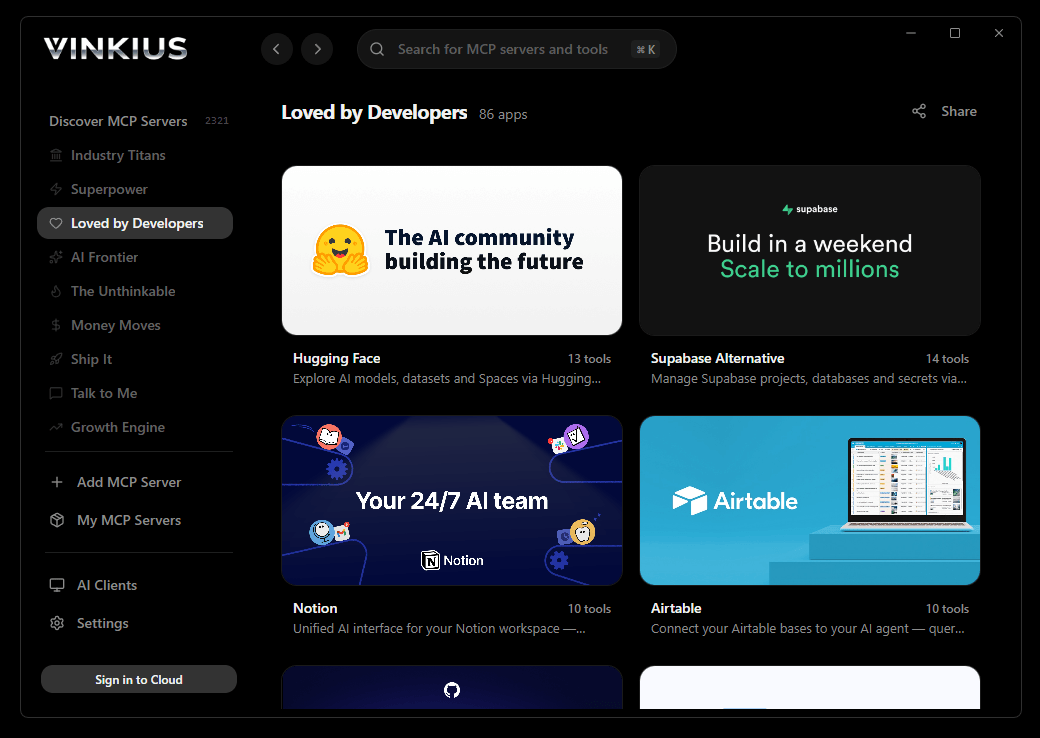
The modern way to manage MCP Servers — no config files, no terminal commands. Install OpenFGA (Fine-Grained Auth) and 4,000+ MCP Servers from a single visual interface.
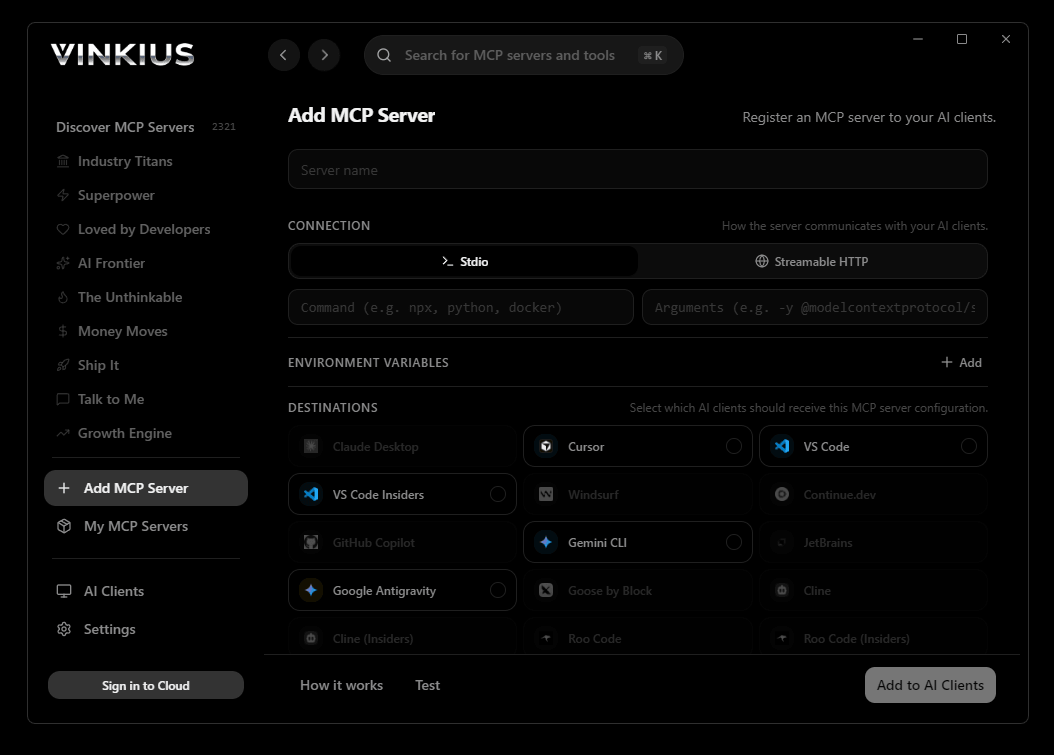

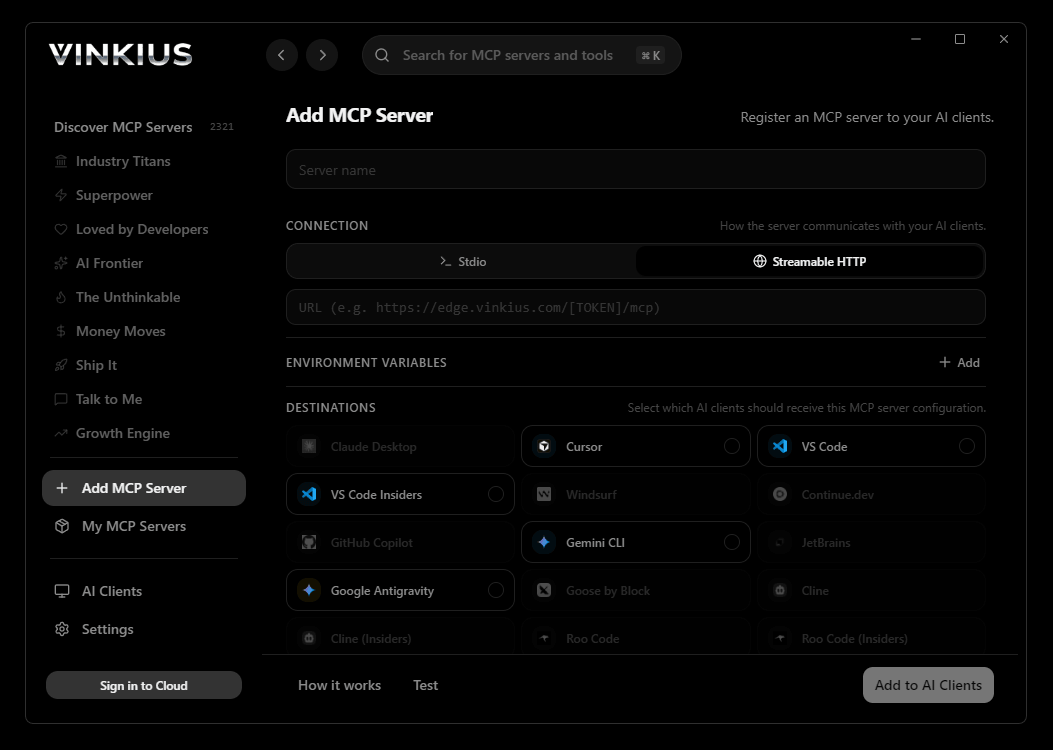

* Every MCP server runs on Vinkius-managed infrastructure inside AWS - a purpose-built runtime with per-request V8 isolates, Ed25519 signed audit chains, and sub-40ms cold starts optimized for native MCP execution. See our infrastructure
About OpenFGA (Fine-Grained Auth) MCP Server
Connect your OpenFGA instance to any AI agent to manage Relationship-Based Access Control (ReBAC) through natural conversation. OpenFGA is an open-source fine-grained authorization solution inspired by Google's Zanzibar.
Cursor's Agent mode turns OpenFGA (Fine-Grained Auth) into an in-editor superpower. Ask Cursor to generate code using live data from OpenFGA (Fine-Grained Auth) and it fetches, processes, and writes. all in a single agentic loop. 16 tools appear alongside file editing and terminal access, creating a unified development environment grounded in real-time information.
What you can do
- Store Management — Create, list, and delete isolated stores to manage authorization data for different environments or applications.
- Authorization Modeling — Define and retrieve complex authorization models using types and relations to represent your system's permissions.
- Tuple Management — Write, read, and track changes to relationship tuples that define which users have which relations to specific objects.
- Relationship Checks — Instantly evaluate whether a user has a specific relation to an object (e.g., 'can user:anne view document:1?').
- Health Monitoring — Quickly check the status of your OpenFGA instance to ensure high availability.
The OpenFGA (Fine-Grained Auth) MCP Server exposes 16 tools through the Vinkius. Connect it to Cursor in under two minutes — credentials fully managed, no infrastructure to provision, no vendor lock-in. Your configuration, your data, your control.
All 16 OpenFGA (Fine-Grained Auth) tools available for Cursor
When Cursor connects to OpenFGA (Fine-Grained Auth) through Vinkius, your AI agent gets direct access to every tool listed below — spanning authorization, rebac, access-control, and more. Every call runs in a secure, isolated environment with full audit visibility. Beyond a simple connection, you get real-time monitoring of agent activity, enterprise governance, and optimized token usage.
Batch check relations on OpenFGA (Fine-Grained Auth)
Perform multiple checks in one request
Check relation on OpenFGA (Fine-Grained Auth)
Check if a user has a relation to an object
Create store on OpenFGA (Fine-Grained Auth)
Create a new OpenFGA store
Delete store on OpenFGA (Fine-Grained Auth)
Delete an OpenFGA store
Expand relation on OpenFGA (Fine-Grained Auth)
Expand a relation into a tree
Get authorization model on OpenFGA (Fine-Grained Auth)
Get a specific authorization model
Get store on OpenFGA (Fine-Grained Auth)
Get OpenFGA store details
Health check on OpenFGA (Fine-Grained Auth)
Check OpenFGA server health
List authorization models on OpenFGA (Fine-Grained Auth)
List authorization models
List objects on OpenFGA (Fine-Grained Auth)
List all objects a user can access
List stores on OpenFGA (Fine-Grained Auth)
List all OpenFGA stores
List users on OpenFGA (Fine-Grained Auth)
List all users who have a relation to an object
Read changes on OpenFGA (Fine-Grained Auth)
Read changes to relationship tuples
Read tuples on OpenFGA (Fine-Grained Auth)
Query stored relationship tuples
Write authorization model on OpenFGA (Fine-Grained Auth)
Write a new authorization model
Write tuples on OpenFGA (Fine-Grained Auth)
Add or delete relationship tuples
Connect OpenFGA (Fine-Grained Auth) to Cursor via MCP
Follow these steps to wire OpenFGA (Fine-Grained Auth) into Cursor. The entire setup takes under two minutes — your credentials stay safe behind Vinkius.
Open MCP Settings
Cmd+Shift+P (macOS) or Ctrl+Shift+P (Windows/Linux) → search "MCP Settings"Add the server config
mcp.json file that opensSave the file
Start using OpenFGA (Fine-Grained Auth)
Why Use Cursor with the OpenFGA (Fine-Grained Auth) MCP Server
Cursor AI Code Editor provides unique advantages when paired with OpenFGA (Fine-Grained Auth) through the Model Context Protocol.
Agent mode turns Cursor into an autonomous coding assistant that can read files, run commands, and call MCP tools without switching context
Cursor's Composer feature can generate entire files using real-time data fetched through MCP. no copy-pasting from external dashboards
MCP tools appear alongside built-in tools like file reading and terminal access, creating a unified agentic environment
VS Code extension compatibility means your existing workflow, keybindings, and extensions all work alongside MCP tools
OpenFGA (Fine-Grained Auth) + Cursor Use Cases
Practical scenarios where Cursor combined with the OpenFGA (Fine-Grained Auth) MCP Server delivers measurable value.
Code generation with live data: ask Cursor to generate a security report module using live DNS and subdomain data fetched through MCP
Automated documentation: have Cursor query your API's tool schemas and generate TypeScript interfaces or OpenAPI specs automatically
Infrastructure-as-code: Cursor can fetch domain configurations and generate corresponding Terraform or CloudFormation templates
Test scaffolding: ask Cursor to pull real API responses via MCP and generate unit test fixtures from actual data
Example Prompts for OpenFGA (Fine-Grained Auth) in Cursor
Ready-to-use prompts you can give your Cursor agent to start working with OpenFGA (Fine-Grained Auth) immediately.
"List all my OpenFGA stores."
"Check if user 'anne' has the 'viewer' relation to 'document:doc1' in store 01H1..."
"Create a new OpenFGA store named 'Security-Audit-Logs'."
Troubleshooting OpenFGA (Fine-Grained Auth) MCP Server with Cursor
Common issues when connecting OpenFGA (Fine-Grained Auth) to Cursor through Vinkius, and how to resolve them.
Tools not appearing in Cursor
Server shows as disconnected
OpenFGA (Fine-Grained Auth) + Cursor FAQ
Common questions about integrating OpenFGA (Fine-Grained Auth) MCP Server with Cursor.
What is Agent mode and why does it matter for MCP?
Where does Cursor store MCP configuration?
mcp.json file. You can configure servers at the project level (.cursor/mcp.json in your project root) or globally (~/.cursor/mcp.json). Project-level configs take precedence.Can Cursor use MCP tools in inline edits?
How do I verify MCP tools are loaded?
Explore More MCP Servers
View all →
Poe
10 toolsManage AI chatbots on Poe — create bots, query other AI models, monitor messages, and track usage stats.

Traefik Hub
8 toolsCloud-native API Management & Gateway evaluating proxy topologies explicitly running Kubernetes integrations.
CoreMedia Content Cloud
10 toolsManage headless content via CoreMedia — execute GraphQL queries, retrieve articles and channels, and search global assets directly from any AI agent.
Twenty CRM
25 toolsManage your CRM data directly from AI — list people, companies, and opportunities, and create or update records in Twenty CRM.