
Stanford CrossRef MCP Server for ClineGive Cline instant access to 16 tools to Get Citations Count, Get Funder Works, Get Journal, and more
 GDPR Free for Subscribers
Cline is an autonomous AI coding agent inside VS Code that plans, executes, and iterates on tasks. Wire Stanford CrossRef through Vinkius and Cline gains direct access to every tool. from data retrieval to workflow automation. without leaving the terminal.
Ask AI about this MCP Server for Cline
The Stanford CrossRef MCP Server for Cline is a standout in the Education category — giving your AI agent 16 tools to work with, ready to go from day one.
Vinkius delivers Streamable HTTP and SSE to any MCP client
 Gemini
{
"mcpServers": {
"stanford-crossref": {
"url": "https://edge.vinkius.com/[YOUR_TOKEN_HERE]/mcp"
}
}
}Vinkius Desktop App
The modern way to manage MCP Servers — no config files, no terminal commands. Install Stanford CrossRef and 4,000+ MCP Servers from a single visual interface.
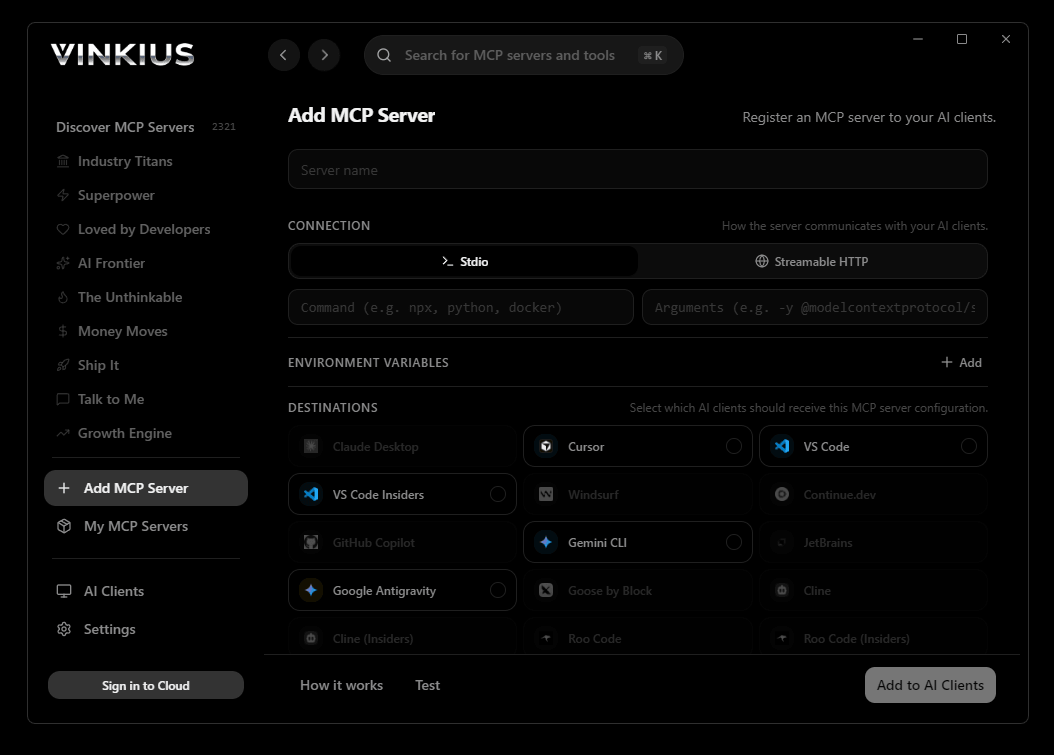

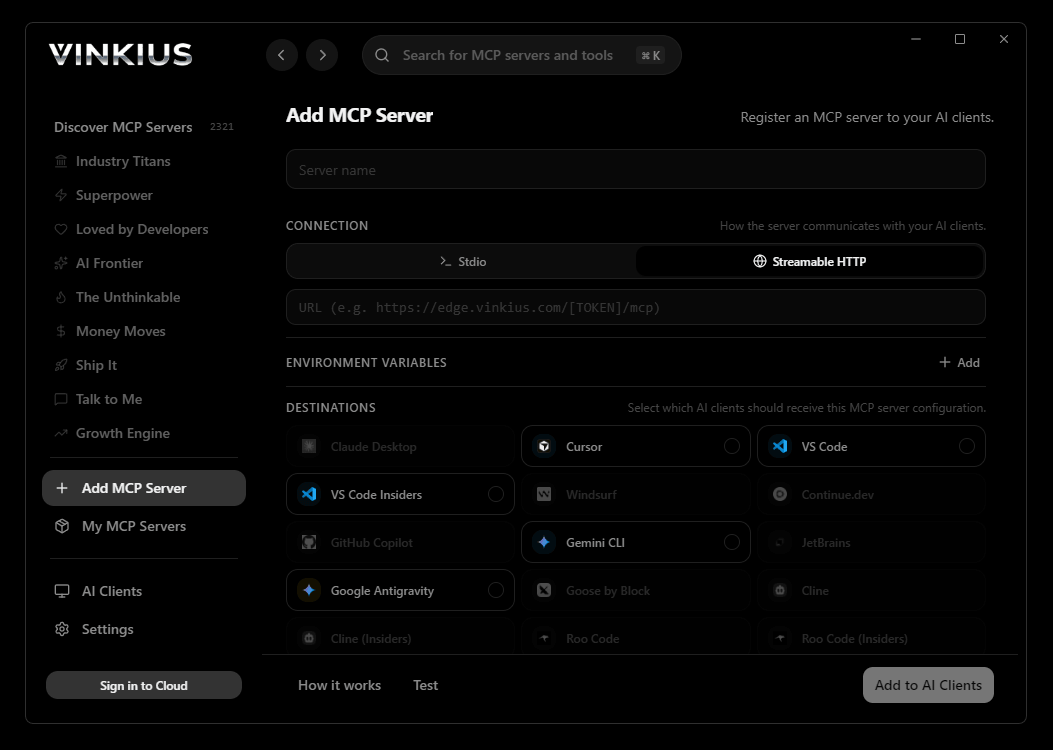


* Every MCP server runs on Vinkius-managed infrastructure inside AWS - a purpose-built runtime with per-request V8 isolates, Ed25519 signed audit chains, and sub-40ms cold starts optimized for native MCP execution. See our infrastructure
About Stanford CrossRef MCP Server
Connect to the CrossRef API — the authoritative source for DOI metadata and scholarly publishing infrastructure.
Cline operates autonomously inside VS Code. it reads your codebase, plans a strategy, and executes multi-step tasks including Stanford CrossRef tool calls without waiting for prompts between steps. Connect 16 tools through Vinkius and Cline can fetch data, generate code, and commit changes in a single autonomous run.
What you can do
- DOI Resolution — Resolve any DOI to complete bibliographic metadata
- Works Search — Search 150M+ DOI-registered works with advanced filters
- Journal Registry — Query journals by title or ISSN with coverage metrics
- Publisher Profiles — Explore academic publishers (Elsevier, Springer, Wiley)
- Funder Registry — Search funding organizations (NIH, NSF, ERC, Wellcome Trust)
- ORCID Lookup — Find works by researcher ORCID identifier
- Affiliation Search — Search works by institutional affiliation
- Citation Counts — Get citation and reference counts for any DOI
- Reference Lists — Extract complete bibliographies from published works
- Preprint Search — Find preprints registered with CrossRef
- DOI Validation — Verify whether a DOI is valid and registered
- Recent Works — Monitor the latest DOI registrations
The Stanford CrossRef MCP Server exposes 16 tools through the Vinkius. Connect it to Cline in under two minutes — credentials fully managed, no infrastructure to provision, no vendor lock-in. Your configuration, your data, your control.
All 16 Stanford CrossRef tools available for Cline
When Cline connects to Stanford CrossRef through Vinkius, your AI agent gets direct access to every tool listed below — spanning crossref, doi, metadata, and more. Every call runs in a secure, isolated environment with full audit visibility. Beyond a simple connection, you get real-time monitoring of agent activity, enterprise governance, and optimized token usage.
Get citations count on Stanford CrossRef
The "is-referenced-by-count" is the number of times other works cite this DOI. The "references-count" is how many references this work cites. Quick way to assess a paper's impact. Get citation count for a DOI
Get funder works on Stanford CrossRef
Use the funder ID from search_funders (e.g. "100000002" for NIH). Essential for understanding research funding landscapes and tracking funded output. Get works funded by a specific funding organization
Get journal on Stanford CrossRef
Returns title, publisher, subjects, total DOI count, current and backfile counts, metadata coverage percentages, and quality flags. Get journal details by ISSN
Get journal works on Stanford CrossRef
Can be filtered with an optional text query. Useful for browsing a journal's publication history or searching within a specific journal. Get articles published in a specific journal
Get publisher on Stanford CrossRef
Returns name, DOI prefix, total/current/backfile DOI counts, metadata coverage scores, and quality flags. Get publisher details with output metrics
Get reference list on Stanford CrossRef
Returns all cited references with their DOIs (when available), authors, titles, journals, and years. Essential for bibliography analysis, finding source material, and understanding a paper's intellectual foundations. Get full reference list (bibliography) for a DOI
Resolve doi on Stanford CrossRef
Returns title, authors, journal, publisher, publication date, volume, issue, pages, citation count, reference count, subject areas, and license information. The definitive tool for getting structured metadata from any DOI. Resolve a DOI to full bibliographic metadata
Search by affiliation on Stanford CrossRef
Use institution names like "Stanford University", "MIT", "Harvard Medical School". Can be combined with a topic query. Search works by institutional affiliation
Search by orcid on Stanford CrossRef
ORCID is the universal researcher identifier. Format: "0000-0002-1825-0097". Essential for finding the complete publication record of a researcher across all journals and publishers. Find works by ORCID author identifier
Search funders on Stanford CrossRef
Examples: "National Institutes of Health", "National Science Foundation", "European Research Council", "Wellcome Trust". Search funding organizations worldwide
Search journals on Stanford CrossRef
Returns journal titles, ISSNs, publishers, subject areas, total DOI counts, and metadata coverage scores. Use this to find journal identifiers and evaluate journal metrics. Search academic journals by title or ISSN
Search preprints on Stanford CrossRef
This covers preprints from bioRxiv, medRxiv, SSRN, ChemRxiv, and other preprint servers that register DOIs with CrossRef. Search registered preprints across all servers
Search publishers on Stanford CrossRef
Returns publisher names, DOI prefixes, and total DOI counts. Search academic publishers
Search recent works on Stanford CrossRef
Default is last 7 days. Use this to monitor the latest publications across all journals and publishers. Find the most recently registered DOIs
Search works on Stanford CrossRef
Supports full-text query, filters, sorting, and pagination. Filter syntax: "from-pub-date:2024-01-01", "type:journal-article", "has-orcid:true", "has-references:true", "is-update:false". Sort options: "relevance", "published", "indexed", "is-referenced-by-count". Search 150M+ DOI-registered academic works
Validate doi on Stanford CrossRef
Returns whether the DOI exists in CrossRef, along with basic metadata (title, type, publisher) if valid. Useful for quality-checking reference lists and citation data. Check if a DOI is valid and registered
Connect Stanford CrossRef to Cline via MCP
Follow these steps to wire Stanford CrossRef into Cline. The entire setup takes under two minutes — your credentials stay safe behind Vinkius.
Open Cline MCP Settings
Add remote server
Enable the server
Start using Stanford CrossRef
Why Use Cline with the Stanford CrossRef MCP Server
Cline provides unique advantages when paired with Stanford CrossRef through the Model Context Protocol.
Cline operates autonomously. it reads your codebase, plans a strategy, and executes multi-step tasks including MCP tool calls without step-by-step prompts
Runs inside VS Code, so you get MCP tool access alongside your existing extensions, terminal, and version control in a single window
Cline can create, edit, and delete files based on MCP tool responses, enabling end-to-end automation from data retrieval to code generation
Transparent execution: every tool call and file change is shown in Cline's activity log for full visibility and approval before committing
Stanford CrossRef + Cline Use Cases
Practical scenarios where Cline combined with the Stanford CrossRef MCP Server delivers measurable value.
Autonomous feature building: tell Cline to fetch data from Stanford CrossRef and scaffold a complete module with types, handlers, and tests
Codebase refactoring: use Stanford CrossRef tools to validate live data while Cline restructures your code to match updated schemas
Automated testing: Cline fetches real responses from Stanford CrossRef and generates snapshot tests or mocks based on actual payloads
Incident response: query Stanford CrossRef for real-time status and let Cline generate hotfix patches based on the findings
Example Prompts for Stanford CrossRef in Cline
Ready-to-use prompts you can give your Cline agent to start working with Stanford CrossRef immediately.
"Resolve DOI 10.1038/s41586-021-03819-2"
"Find works funded by the National Institutes of Health on gene therapy"
"Look up all publications by ORCID 0000-0002-8350-519X"
Troubleshooting Stanford CrossRef MCP Server with Cline
Common issues when connecting Stanford CrossRef to Cline through Vinkius, and how to resolve them.
Server shows error in sidebar
Stanford CrossRef + Cline FAQ
Common questions about integrating Stanford CrossRef MCP Server with Cline.
How does Cline connect to MCP servers?
Can Cline run MCP tools without approval?
Does Cline support multiple MCP servers at once?
Explore More MCP Servers
View all →
Google Maps Platform
9 toolsGet directions, place details, geocoding, and timezone data via official Google Maps APIs.

LangSmith
3 toolsObservability and evaluation platform for LLM applications — monitor traces, debug agent runs, and track performance metrics across your AI stack.
Airbyte
7 toolsMonitor your Airbyte data pipelines via AI — track sync jobs, list sources, and check connections instantly.

BookStack (Wiki)
32 toolsManage your BookStack wiki directly from your AI agent — search, read, create, and organize pages, chapters, and books with ease.