
Bring Game Servers
to Claude Code
Create your Vinkius account to connect BattleMetrics to Claude Code and start using all 12 AI tools in minutes. Fully managed, enterprise secure, and ready to use without writing a single line of code. No hosting, no server setup — just connect and start using.
 GDPR Free for Subscribers
Compatible with every major AI agent and IDE
 Gemini
What is the BattleMetrics MCP Server?
Empower your AI agent to operate as a real-time intelligence layer over the global gaming server ecosystem with BattleMetrics, the industry-standard platform for game server monitoring. By connecting BattleMetrics to your agent, you transform complex server population analytics, player lookups, and ban auditing into natural conversation. Your agent can instantly search across thousands of tracked game servers, identify specific players, analyze population trends, and review ban records without navigating dashboards.
What you can do
- Server Discovery — Search and filter game servers by name, game, or country. View live player counts, rank, IP address, and detailed metadata.
- Player Lookups — Search the global player database by name and retrieve full profiles including identifiers, playtime stats, and linked servers.
- Session Tracking — View a player's complete session history showing which servers they played on, join/leave times, and duration.
- Population Analytics — Retrieve historical player count data for any server to analyze peak hours, activity trends, and growth patterns.
- Ban Auditing — List and review bans from your organization, filter by server, and inspect ban reasons, scope, and expiry.
- Leaderboards — Access time-based leaderboards for any server to identify the most active players.
- Game Catalog — Browse all games tracked by BattleMetrics and get detailed ecosystem statistics.
How it works
- Subscribe to this server
- Enter your BattleMetrics Personal Access Token
- Start querying game servers, players, and bans through Claude, Cursor, or any MCP-compatible client
Who is this for?
- Game Server Administrators — monitor server populations, audit player behavior, and manage bans directly through AI.
- Community Managers — track player activity, identify regulars, and review session history for moderation purposes.
- Esports Analysts — analyze server population trends, player engagement patterns, and competitive server rankings.
- Game Developers — monitor live server health, player retention, and community activity across multiple titles.
Built-in capabilities (12)
Returns the ban reason, banned player identifier, timestamps, expiry date, scope (server-level or organization-wide), and the administrator who issued the ban. Requires appropriate ban:read scope on the API token. Use this after identifying a ban ID from list_bans. Get details for a specific ban
Returns details such as the game name, the number of tracked servers and players, and game-specific metadata. Use this to get an overview of a game's ecosystem on BattleMetrics. Get details about a specific tracked game
Returns the player name, associated identifiers (Steam, EOS, etc.), time played statistics, linked servers, and recent activity. Use this after identifying a player ID from list_players or session history. Get detailed profile for a specific player
Each session shows which server the player was on, when they joined, when they left, and the session duration. Useful for auditing player activity, tracking playtime, or verifying presence on a specific server. Get session history for a specific player
Returns the server name, IP address, port, current player count, max players, rank, game details, map, status, and detailed metadata. Use this when the user already has a server ID and wants deep information. Get detailed information about a specific game server
Returns player names, IDs, and playtime duration. This is useful for identifying the most active or dedicated players on any tracked game server. Use page_number for pagination. Get the time-based leaderboard for a game server
Useful for analyzing population trends, peak hours, and server activity patterns over a given time range. If start and stop are omitted, the API returns recent history. Use ISO 8601 timestamps for the date range. Get player count history for a game server over time
Each ban includes the ban reason, the banned player identifier, timestamps, expiry, and scope (server-level or organization-wide). Requires appropriate ban:read scope on the API token. Use page_number for pagination and optional server_id to filter bans from a specific server. List bans in your BattleMetrics organization
Returns each game's ID, display name, and metadata. Useful for discovering which games are available for server and player queries, and for getting the correct game identifier to use in server filters. List all games tracked by BattleMetrics
Use the search parameter to find players by name. Returns player names, IDs, and metadata. Results are paginated — use page_number to navigate. This is a powerful tool for looking up any player across all supported games. Search and list players across all tracked game servers
Use the optional search parameter to find servers by name, or filter by game and country. Returns server name, IP, port, player count, rank, and game type. Results are paginated — use page_number to navigate through results. List game servers tracked by BattleMetrics
Unlike the basic list_servers tool, this supports granular filtering by server name, game, country, minimum/maximum player count, rank range, and more. Returns matching servers with full metadata including name, IP, port, player count, rank, game type, map, and status. Use this when you need precise filtering to find specific servers. Results are paginated — use page_number to navigate. Search game servers with advanced filters
Why Claude Code?
Claude Code registers BattleMetrics as an MCP server in a single terminal command. Once connected, Claude Code discovers all 12 tools at runtime and can call them headlessly. ideal for CI/CD pipelines, cron jobs, and automated workflows where BattleMetrics data drives decisions without human intervention.
- —
Single-command setup:
claude mcp addregisters the server instantly. no config files to edit or applications to restart - —
Terminal-native workflow means MCP tools integrate seamlessly into shell scripts, CI/CD pipelines, and automated DevOps tasks
- —
Claude Code runs headlessly, enabling unattended batch processing using BattleMetrics tools in cron jobs or deployment scripts
- —
Built by the same team that created the MCP protocol, ensuring first-class compatibility and the fastest adoption of new protocol features
BattleMetrics in Claude Code
Why run BattleMetrics with Vinkius?
The BattleMetrics connection runs on our fully managed, secure cloud infrastructure. We handle the hosting, maintenance, and security so you don't have to deal with servers or code. All 12 tools are ready to work instantly without any complex setup.
You stay in complete control of your data. Your AI only accesses the information you approve, keeping your sensitive passwords and private details completely safe. Plus, with automatic optimizations, your AI works faster and more efficiently.
* Every connection is hosted and maintained by Vinkius. We handle the security, updates, and infrastructure so you don't have to write code or manage servers. See our infrastructure
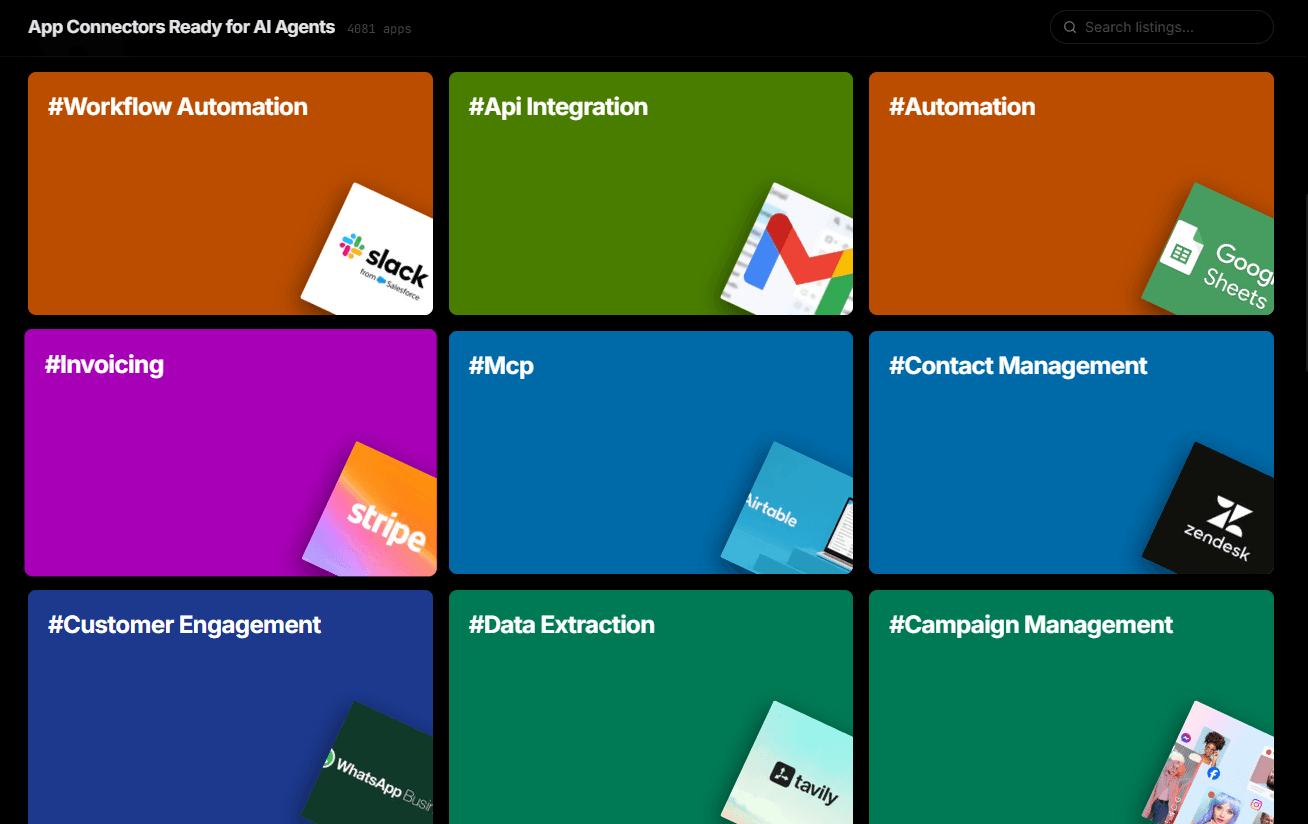
Over 4,000 integrations ready for AI agents
Explore a vast library of pre-built integrations, optimized and ready to deploy.
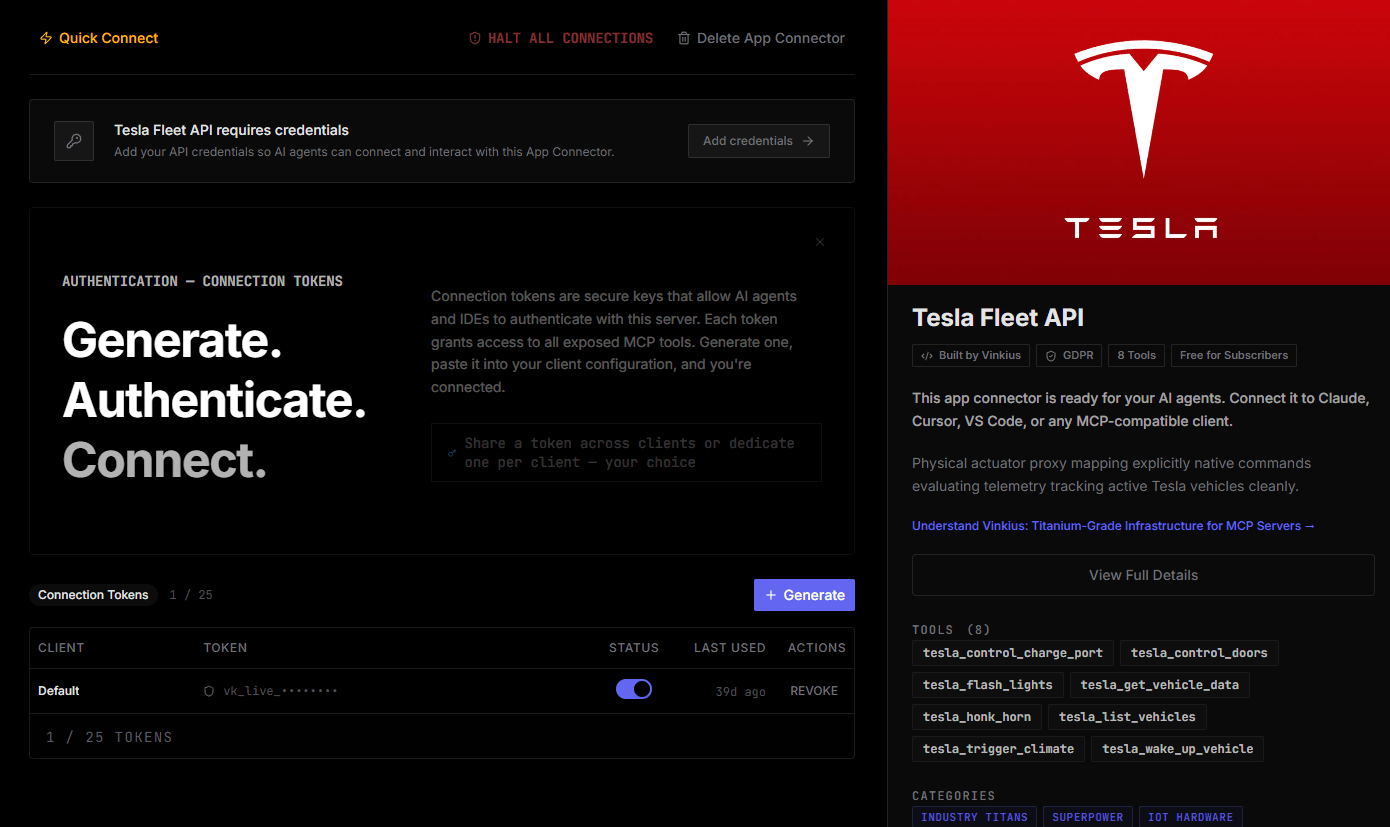
Connect securely in under 30 seconds
Generate tokens to authenticate and link external services in a single step.
Complete visibility into every agent action
Audit live requests, latency, success rates, and active security compliance policies.
Optimize spending and track token ROI
Analyze real-time token consumption and cost metrics detailed by connection.
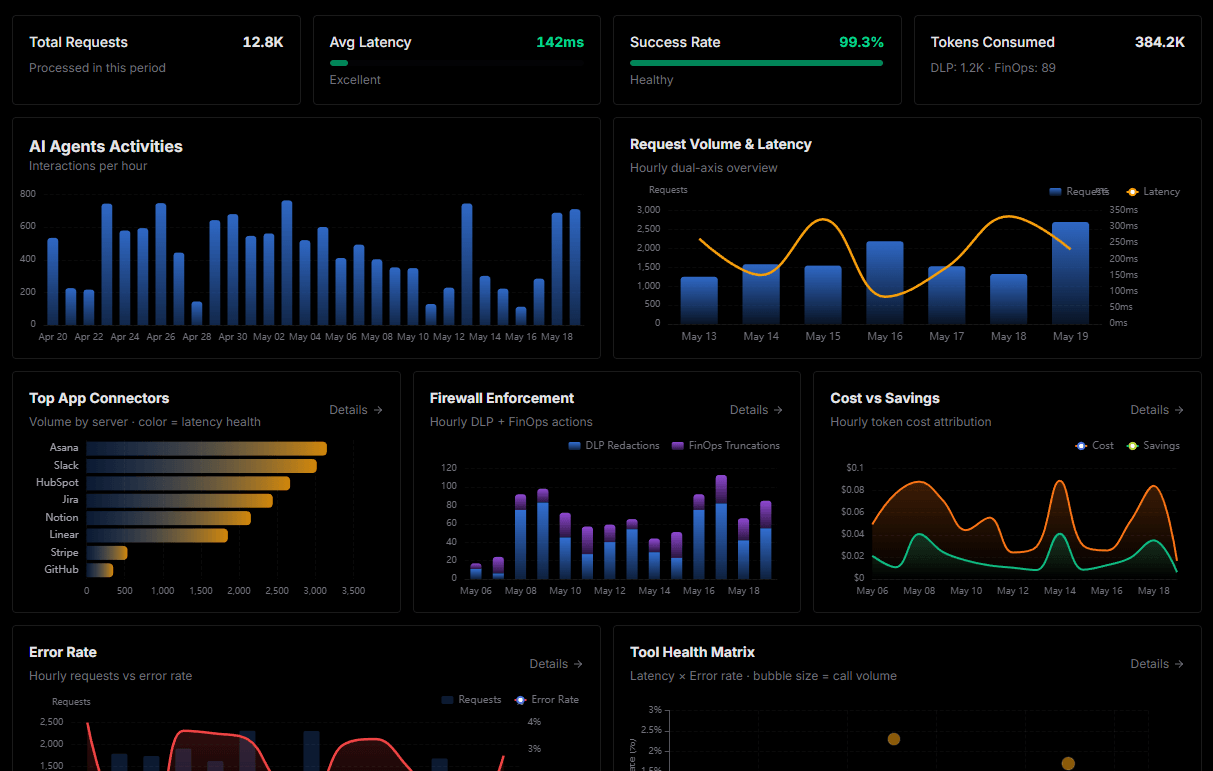
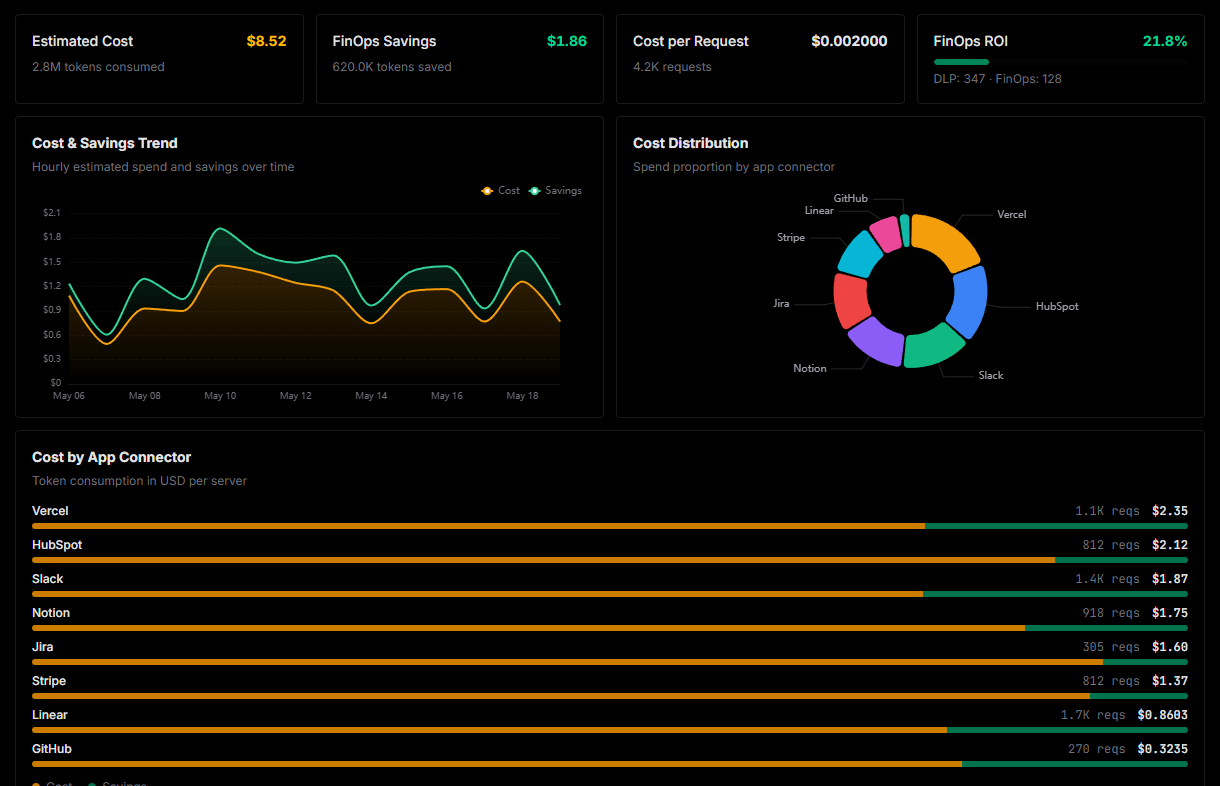
Explore our live AI Agents Analytics dashboard to see it all working
This dashboard is included when you connect BattleMetrics using Vinkius. You will never be left in the dark about what your AI agents are doing with your tools.
BattleMetrics and 4,000+ other AI tools. No hosting, no code, ready to use.
Professionals who connect BattleMetrics to Claude Code through Vinkius don't need to write code, manage servers, or worry about security. Everything is pre-configured, secure, and runs automatically in the background.
Raw MCP | Vinkius | |
|---|---|---|
| Ready-to-use MCPs | Find and configure each manually | 4,000+ MCPs ready to use |
| Connection Setup | Manual coding & server setup | 1-click instant connection |
| Server Hosting | You host it yourself (needs 24/7 uptime) | 100% hosted & managed by Vinkius |
| Security & Privacy | Stored in plaintext config files | Bank-grade encrypted vault |
| Activity Visibility | Blind execution (no logs or tracking) | Live dashboard with real-time logs |
| Cost Control | Runaway AI token spend risk | Automatic budget limits |
| Revoking Access | Must delete files or code to stop | 1-click disconnect button |
How Vinkius secures
BattleMetrics for Claude Code
Every request between Claude Code and BattleMetrics is protected by our secure gateway. We automatically keep your sensitive data private, prevent unauthorized access, and let you disconnect instantly at any time.
Frequently asked questions
How do I find a specific game server?
Use the list_servers tool with the search parameter. You can filter by server name, game type (e.g. rust, ark), or country code (e.g. US, DE). The results include server name, IP, player count, and rank. For more advanced filtering (min/max players), use the search_servers tool.
Can I track a player's activity across different servers?
Yes. Use list_players to find the player by name, then get_player to view their full profile, and get_player_sessions to see their complete session history including which servers they joined, when they connected and disconnected, and for how long.
What games does BattleMetrics support?
BattleMetrics tracks hundreds of multiplayer games including Rust, ARK, Minecraft, CS2, Valheim, DayZ, and many more. Use the list_games tool to get the complete, up-to-date catalog of all supported games with their identifiers.
How do I get details about a specific ban?
First use list_bans to find the ban and get its numeric ban ID. Then use get_ban with that ID to retrieve the complete ban record including the reason, player identifier, expiry date, scope, and issuing administrator.
How do I add an MCP server to Claude Code?
Run claude mcp add <name> --transport http "<url>" in your terminal. Claude Code registers the server and discovers all tools immediately.
Can Claude Code run MCP tools in headless mode?
Yes. Claude Code supports non-interactive execution, making it ideal for scripts, cron jobs, and CI/CD pipelines that need MCP tool access.
How do I list all connected MCP servers?
Run claude mcp in your terminal to see all registered servers and their status, or type /mcp inside an active Claude Code session.
Command not found: claude
Ensure Claude Code is installed globally: npm install -g @anthropic-ai/claude-code
Connection timeout
Check your internet connection and verify the Edge URL is reachable
Explore More MCP Servers
View all →
Enverus Energy Intelligence
10 toolsEquip your AI agent to access global energy data, track drilling rigs, and monitor well production via the Enverus API.

Baseten
6 toolsManage your Baseten AI models — orchestrate deployments, list secrets, and run serverless inference predictions autonomously.

Hookdeck (Webhook Gateway)
75 toolsManage your webhook infrastructure via Hookdeck — monitor connections, route events, and control sources directly from any AI agent.

Zoho Projects
9 toolsManage projects, tasks, and milestones via the Zoho Projects V3 API.