
Bring Enterprise Messaging
to Claude Code
Create your Vinkius account to connect DingTalk to Claude Code and start using all 10 AI tools in minutes. Fully managed, enterprise secure, and ready to use without writing a single line of code. No hosting, no server setup — just connect and start using.
 GDPR Free for Subscribers
Compatible with every major AI agent and IDE
 Gemini
What is the DingTalk MCP Server?
Connect your DingTalk (钉钉) enterprise account to any AI agent and transform your office operations through natural conversation. DingTalk is Alibaba's comprehensive B2B communication and collaboration platform used by millions of organizations for messaging, attendance tracking, approval workflows, and organizational management.
What you can do
- User Management — Query employee profiles, search users by department, and retrieve contact details instantly
- Department Exploration — Navigate organizational hierarchy, list departments and sub-departments, understand reporting structures
- Work Notifications — Send text and markdown formatted messages to employees with rich formatting and clickable links
- Attendance Tracking — Retrieve check-in/check-out records, verify timesheet data, monitor late arrivals and early departures
- Approval Workflows — Create new approval instances (leave requests, reimbursements, purchases) and track their progress
- Approval Status — Query approval process history, identify bottlenecks, and review decision chains
- Markdown Reports — Send beautifully formatted markdown reports, alerts, and summaries to team members
How it works
- Subscribe to this server
- Enter your DingTalk App Key and App Secret
- Start managing your office operations from Claude, Cursor, or any MCP-compatible client
Your AI agent becomes your office operations assistant, handling user lookups, sending formatted notifications, monitoring attendance, and tracking approvals without opening the DingTalk app.
Who is this for?
- HR Teams — Monitor attendance patterns, verify timesheets, and send policy announcements
- Department Managers — Quickly query team rosters, send formatted updates, and track approval workflows
- Operations Leaders — Navigate organizational structures, identify reporting lines, and broadcast markdown reports
- Administrators — Automate routine notifications and approval processes through conversational AI
Built-in capabilities (10)
g., leave request, reimbursement, purchase order) by creating a new approval instance. Requires the approval template code (process_code) from your DingTalk admin, form component values matching the template structure, and the originator's user ID. Returns the process instance ID for tracking. Use this to automate approval workflows directly from AI conversations. Create a new approval workflow instance in DingTalk
Returns whether the approval is pending, approved, rejected, or cancelled, along with all reviewer actions and timestamps. Use the process instance ID obtained when creating the approval or from the approval list. Critical for tracking approval progress and understanding bottlenecks. Get status and details of an approval process instance
Returns timestamps, checkout types (上班签到/下班签退), location data, and whether the attendance was normal or abnormal (late/early leave). Essential for HR teams to monitor attendance patterns, verify timesheet data, or investigate attendance discrepancies. Date format: YYYY-MM-DD. Get employee attendance/checkout records from DingTalk
Use this to understand organizational hierarchy, identify department leaders, or map the reporting structure before making decisions about notification routing. Get detailed information about a DingTalk department
Use the user ID (userid) which can be obtained from the department user list. Essential for looking up employee details before sending targeted notifications or checking organizational structure. Get DingTalk user profile information by user ID
This is the fastest way to understand the organizational structure, identify department IDs for further queries, and map team hierarchies. Use this before querying users or sub-departments to identify the correct department IDs. List all top-level departments in the DingTalk organization
Essential for exploring organizational structure, identifying team subdivisions, or mapping the complete departmental hierarchy. Start with department_id 1 to list all top-level departments in your organization. List all sub-departments under a parent department
Returns user IDs, names, avatars, and basic profile information. Useful for identifying team members before sending group notifications, checking team composition, or understanding departmental structure. Use department ID 1 for the root company directory. List all users in a specific DingTalk department
Ideal for sending structured reports, formatted alerts, or detailed notifications with clickable links. The title appears as the notification header, while the text body supports full markdown syntax including **bold**, *italic*, [hyperlinks](url), and line breaks. User IDs should be comma-separated. Send a rich formatted markdown message to DingTalk users
Supports text and markdown message types. The message appears in the recipient's DingTalk work notification feed. User IDs should be comma-separated for multiple recipients. This is ideal for sending alerts, reminders, task assignments, or status updates to team members directly through DingTalk. Send a work notification message to DingTalk users
Why Claude Code?
Claude Code registers DingTalk as an MCP server in a single terminal command. Once connected, Claude Code discovers all 10 tools at runtime and can call them headlessly. ideal for CI/CD pipelines, cron jobs, and automated workflows where DingTalk data drives decisions without human intervention.
- —
Single-command setup:
claude mcp addregisters the server instantly. no config files to edit or applications to restart - —
Terminal-native workflow means MCP tools integrate seamlessly into shell scripts, CI/CD pipelines, and automated DevOps tasks
- —
Claude Code runs headlessly, enabling unattended batch processing using DingTalk tools in cron jobs or deployment scripts
- —
Built by the same team that created the MCP protocol, ensuring first-class compatibility and the fastest adoption of new protocol features
DingTalk in Claude Code
Why run DingTalk with Vinkius?
The DingTalk connection runs on our fully managed, secure cloud infrastructure. We handle the hosting, maintenance, and security so you don't have to deal with servers or code. All 10 tools are ready to work instantly without any complex setup.
You stay in complete control of your data. Your AI only accesses the information you approve, keeping your sensitive passwords and private details completely safe. Plus, with automatic optimizations, your AI works faster and more efficiently.
* Every connection is hosted and maintained by Vinkius. We handle the security, updates, and infrastructure so you don't have to write code or manage servers. See our infrastructure
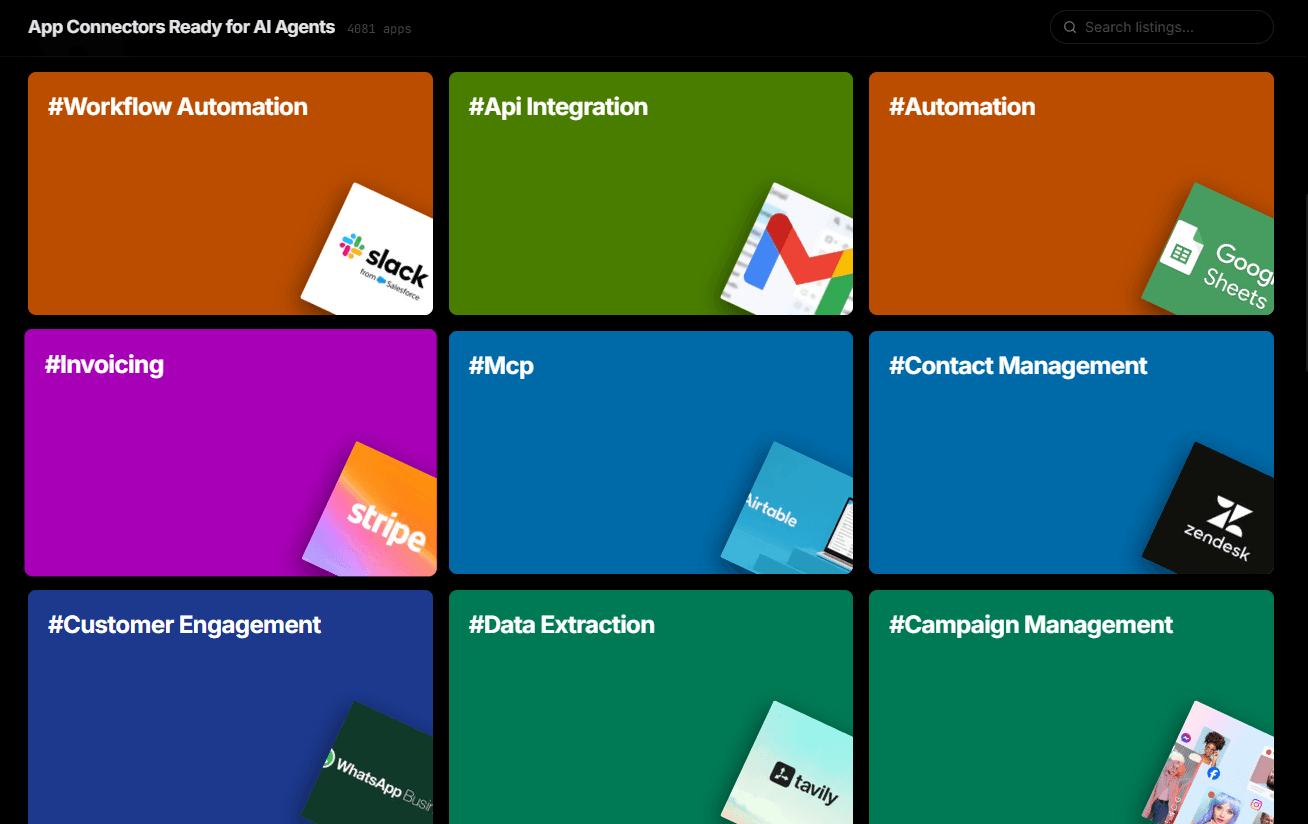
Over 4,000 integrations ready for AI agents
Explore a vast library of pre-built integrations, optimized and ready to deploy.
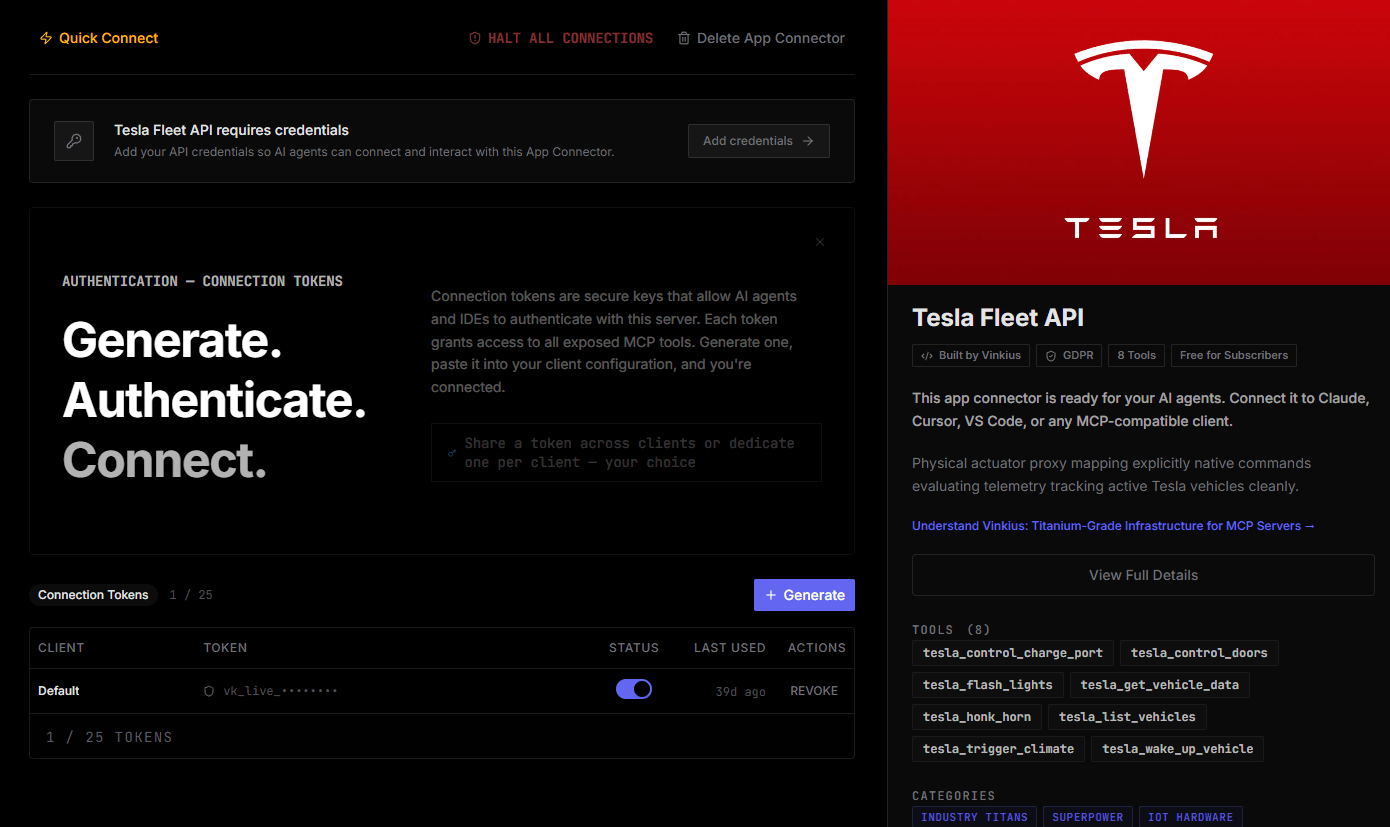
Connect securely in under 30 seconds
Generate tokens to authenticate and link external services in a single step.
Complete visibility into every agent action
Audit live requests, latency, success rates, and active security compliance policies.
Optimize spending and track token ROI
Analyze real-time token consumption and cost metrics detailed by connection.
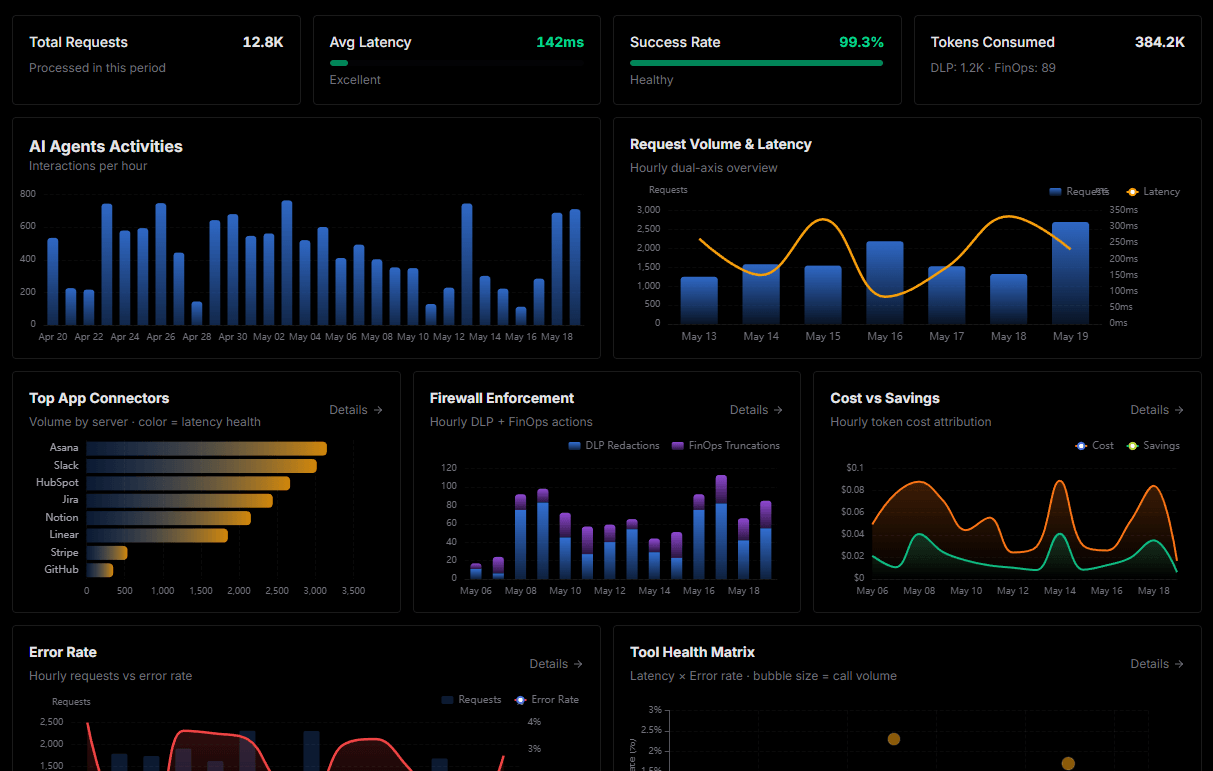
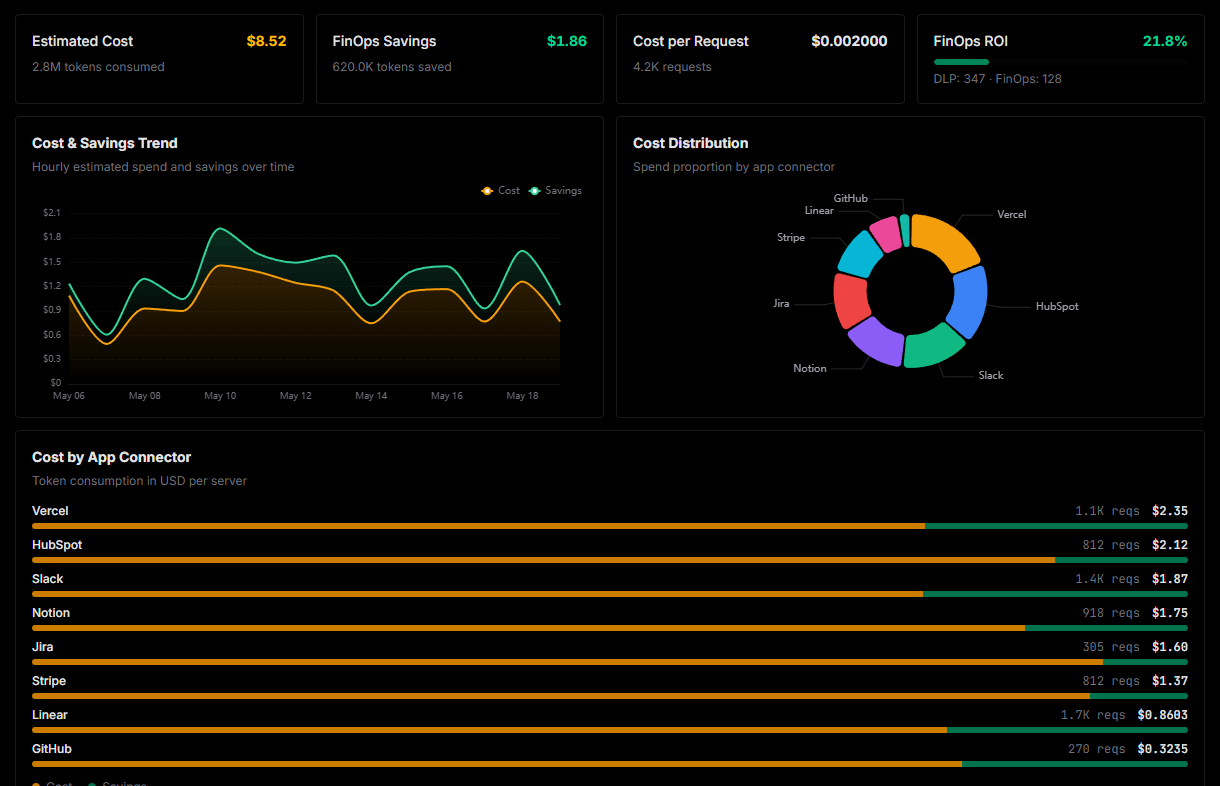
Explore our live AI Agents Analytics dashboard to see it all working
This dashboard is included when you connect DingTalk using Vinkius. You will never be left in the dark about what your AI agents are doing with your tools.
DingTalk and 4,000+ other AI tools. No hosting, no code, ready to use.
Professionals who connect DingTalk to Claude Code through Vinkius don't need to write code, manage servers, or worry about security. Everything is pre-configured, secure, and runs automatically in the background.
Raw MCP | Vinkius | |
|---|---|---|
| Ready-to-use MCPs | Find and configure each manually | 4,000+ MCPs ready to use |
| Connection Setup | Manual coding & server setup | 1-click instant connection |
| Server Hosting | You host it yourself (needs 24/7 uptime) | 100% hosted & managed by Vinkius |
| Security & Privacy | Stored in plaintext config files | Bank-grade encrypted vault |
| Activity Visibility | Blind execution (no logs or tracking) | Live dashboard with real-time logs |
| Cost Control | Runaway AI token spend risk | Automatic budget limits |
| Revoking Access | Must delete files or code to stop | 1-click disconnect button |
How Vinkius secures
DingTalk for Claude Code
Every request between Claude Code and DingTalk is protected by our secure gateway. We automatically keep your sensitive data private, prevent unauthorized access, and let you disconnect instantly at any time.
Frequently asked questions
How do I get my DingTalk App Key and App Secret?
Log in to the DingTalk Developer Console, create an Internal Enterprise Application, then navigate to App Information > Credentials to find your AppKey and AppSecret. Make sure your application has the required API permissions (User Management, Department Management, Attendance, Approval) before using these tools.
Can I send messages to external contacts or only internal employees?
This MCP server uses Internal Enterprise Application authentication, which means it can only send messages to users within your organization's DingTalk tenant. For external contacts or customer notifications, you would need a different DingTalk application type with extended permissions. All user IDs must belong to employees in your enterprise directory.
How does the attendance tracking work? What data can I retrieve?
The attendance tool retrieves check-in/check-out records from DingTalk's attendance system. For each record, you get the user ID, timestamp, checkout type (上班签到=check-in, 下班签退=check-out), location information, and whether the attendance was normal or abnormal (late, early leave, missing punch). Date ranges are specified in YYYY-MM-DD format. This data integrates with DingTalk's physical attendance devices and mobile check-in features.
How do I add an MCP server to Claude Code?
Run claude mcp add <name> --transport http "<url>" in your terminal. Claude Code registers the server and discovers all tools immediately.
Can Claude Code run MCP tools in headless mode?
Yes. Claude Code supports non-interactive execution, making it ideal for scripts, cron jobs, and CI/CD pipelines that need MCP tool access.
How do I list all connected MCP servers?
Run claude mcp in your terminal to see all registered servers and their status, or type /mcp inside an active Claude Code session.
Command not found: claude
Ensure Claude Code is installed globally: npm install -g @anthropic-ai/claude-code
Connection timeout
Check your internet connection and verify the Edge URL is reachable
Explore More MCP Servers
View all →
NASA Exoplanets — Worlds Beyond Our Solar System
4 toolsExplore 5,700+ confirmed exoplanets from NASA's Exoplanet Archive: search by discovery method, find habitable zone candidates, browse transit planets from Kepler and TESS missions, and analyze global discovery statistics spanning three decades of planet hunting.
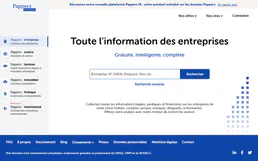
Pappers
12 toolsAccess French company data, financial filings, and legal documents from official business registries for due diligence research.

EIA Natural Gas — Gas Market Intelligence
7 toolsNatural gas market data: Henry Hub spot and futures prices, underground storage levels (the weekly report that moves markets), LNG imports/exports, production by state, pipeline flows, and consumption by sector.

Hexometer
11 toolsAutomate website monitoring via Hexometer — monitor uptime, performance, and health directly from any AI agent.