
Bring Grain Monitoring
to Claude Desktop
Create your Vinkius account to connect AgroLog to Claude Desktop and start using all 11 AI tools in minutes. Fully managed, enterprise secure, and ready to use without writing a single line of code. No hosting, no server setup — just connect and start using.
 GDPR Free for Subscribers
Compatible with every major AI agent and IDE
 Gemini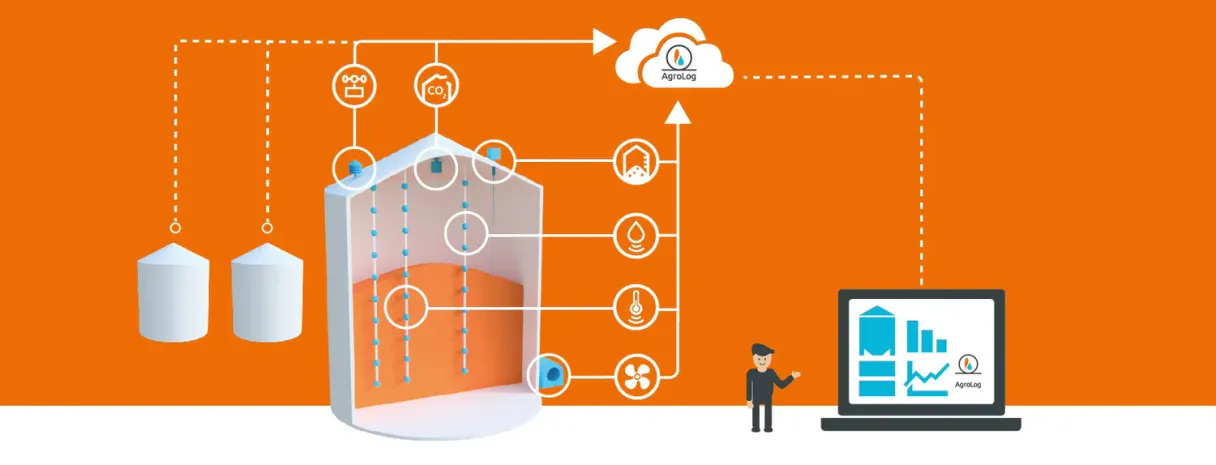
What is the AgroLog MCP Server?
Connect your AgroLog Grain Monitoring API to any AI agent and take full control of real-time temperature monitoring, moisture tracking, CO2 spoilage detection, crop level inventory, and automated aeration control through natural conversation.
What you can do
- Temperature Monitoring — Get real-time grain temperature readings from sensors in silos and bins
- Moisture Tracking — Monitor grain moisture content for safe storage and drying decisions
- CO2 Detection — Detect elevated CO2 levels as early warning signs of spoilage and mold growth
- Crop Level Inventory — Track grain volume and silo fill levels for inventory management
- Weather Station Data — Access outdoor temperature, humidity, wind speed, and rainfall data
- Device Management — List all monitoring devices and view their configuration attributes
- Relay Control — Remotely control fans, aeration systems, and dryers connected to AgroLog devices
- Alarm Monitoring — Track active alarms and alerts for proactive grain management
- Historical Telemetry — Retrieve time-series sensor data for trend analysis and reporting
- Multi-Customer Management — Manage devices across multiple farms or customer organizations
How it works
- Subscribe to this server
- Enter your AgroLog credentials (username, password, and base URL)
- Start monitoring grain conditions from Claude, Cursor, or any MCP-compatible client
No more manual silo inspections or complex monitoring software. Your AI acts as a dedicated grain storage analyst and facility management assistant.
Who is this for?
- Grain Farmers — monitor stored grain conditions, manage aeration, and prevent spoilage remotely
- Grain Elevator Operators — track temperature, moisture, and inventory across multiple bins and silos
- Facility Managers — oversee grain storage facilities with real-time sensor data and automated controls
- Agricultural Consultants — provide data-driven storage management recommendations to clients
Built-in capabilities (11)
Alarms are triggered by threshold breaches (high temperature, high moisture, elevated CO2, equipment failure) and indicate conditions requiring immediate attention. Returns alarm severity (critical, warning, info), alarm type, affected device, timestamp, and acknowledgment status. Essential for proactive grain management, quality issue detection, and operational response. AI agents should use this when users ask "show me all active alarms", "what alerts have been triggered", or need alarm data for operational monitoring. Optional device_id filters alarms for a specific device. Get active and historical alarms/alerts from the AgroLog monitoring system
Elevated CO2 levels indicate biological activity (mold growth, insect respiration, or grain respiration) and are early warning signs of spoilage before temperature changes become apparent. Returns timestamped CO2 value in ppm. Essential for early spoilage detection, grain quality monitoring, and proactive storage management. AI agents should use this when users ask "what is the CO2 level in silo 2", "check headspace gas readings for device X", or need early warning indicators of grain spoilage. Get CO2/headspace gas readings from a specific monitoring device
Crop level sensors measure the grain volume or height in silos and bins, enabling inventory management and capacity planning. Returns timestamped crop level value (percentage or distance). Essential for grain inventory tracking, bin capacity management, and logistics planning. AI agents should reference this when users ask "how full is silo 4", "check crop level for device X", or need inventory data for storage management and logistics planning. Get grain crop level (volume/quantity) readings from a specific monitoring device
Returns device IDs, names, types, and status for the specified customer. Essential for multi-farm management, service provider operations, and organizational device administration. AI agents should use this when users ask "show me all devices for customer X", "list sensors for this farm organization", or need customer-scoped device inventory in multi-tenant deployments. List all monitoring devices for a specific customer/organization in multi-tenant setups
Essential for understanding device setup, sensor positioning within silos, and device management. AI agents should reference this when users ask "show me the configuration for this sensor", "what is the calibration data for device X", or need device metadata for system administration. Get configuration attributes and metadata for a specific monitoring device
Supports custom key selection (temperature, moisture, co2, humidity, etc.) and configurable data point limits for historical analysis. Essential for trend analysis, condition monitoring over time, and creating data visualizations. AI agents should reference this when users ask "show me temperature history for device X over the last 48 hours", "get moisture trend for this sensor", or need historical telemetry data for grain management analysis. Get time-series telemetry data from a specific monitoring device with customizable keys and limits
Returns device IDs, names, types (temperature sensor, moisture sensor, weather station, crop level monitor, headspace/CO2 sensor), labels, and current status. Essential for device inventory, system overview, and selecting specific sensors for telemetry queries. AI agents should use this when users ask "show me all sensors in my grain silo", "list monitoring devices", or need to identify available devices before querying temperature, moisture, or other telemetry data. List all AgroLog monitoring devices (temperature, moisture, weather sensors) in your system
Moisture content is the most critical factor for safe grain storage — high moisture leads to mold, spoilage, and heating. Returns timestamped moisture value as percentage. Essential for grain quality assessment, drying decisions, and storage safety monitoring. AI agents should reference this when users ask "what is the moisture level in bin 5", "check grain moisture for device X", or need moisture data for storage management and drying planning. Get current grain moisture readings from a specific monitoring device
Temperature is critical for detecting spoilage, mold growth, and insect activity in stored grain. Returns timestamped temperature value in Celsius. Essential for grain quality monitoring, spoilage prevention, and ventilation scheduling. AI agents should use this when users ask "what is the temperature in silo 3", "check grain temperature for device X", or need current temperature data for storage management decisions. Device IDs can be found using get_devices. Get current grain temperature readings from a specific monitoring device
Essential for drying decisions (outdoor air conditions for natural air drying), harvest planning (rain forecasts, wind conditions), and understanding environmental impact on stored grain. Returns the latest 10 readings with timestamps. AI agents should use this when users ask "what are the current weather conditions at my facility", "show me wind speed and rainfall data", or need weather context for grain management decisions. Get weather station data (temperature, humidity, wind, rainfall) from a specific device
Accepts device ID, relay name, and desired state (true=on, false=off). Essential for remote grain management, automated ventilation scheduling, and responding to temperature/moisture alerts. AI agents should use this when users ask "turn on the fan for silo 3", "activate aeration for bin 2", or need to remotely control ventilation equipment based on sensor readings. WARNING: Always verify current conditions before changing relay states. Control relay outputs (fans, aeration, dryers) connected to an AgroLog device
Why Claude Desktop?
Claude Desktop is the definitive way to connect AgroLog to your AI workflow. Add Vinkius Edge URL to your config, restart the app, and Claude immediately exposes all 11 tools in the chat interface. ask a question, Claude calls the right tool, and you see the answer. Zero code, zero context switching.
- —
Claude Desktop is the reference MCP client. it was designed alongside the protocol itself, ensuring the most complete and stable MCP implementation available
- —
Zero-code configuration: add a server URL to a JSON file and Claude instantly discovers and exposes all available tools in the chat interface
- —
Claude's extended thinking capability lets it reason through multi-step tool usage, chaining multiple API calls to answer complex questions
- —
Enterprise-grade security with local config storage. your tokens never leave your machine, and connections go directly to Vinkius Edge network
AgroLog in Claude Desktop
Why run AgroLog with Vinkius?
The AgroLog connection runs on our fully managed, secure cloud infrastructure. We handle the hosting, maintenance, and security so you don't have to deal with servers or code. All 11 tools are ready to work instantly without any complex setup.
You stay in complete control of your data. Your AI only accesses the information you approve, keeping your sensitive passwords and private details completely safe. Plus, with automatic optimizations, your AI works faster and more efficiently.
* Every connection is hosted and maintained by Vinkius. We handle the security, updates, and infrastructure so you don't have to write code or manage servers. See our infrastructure
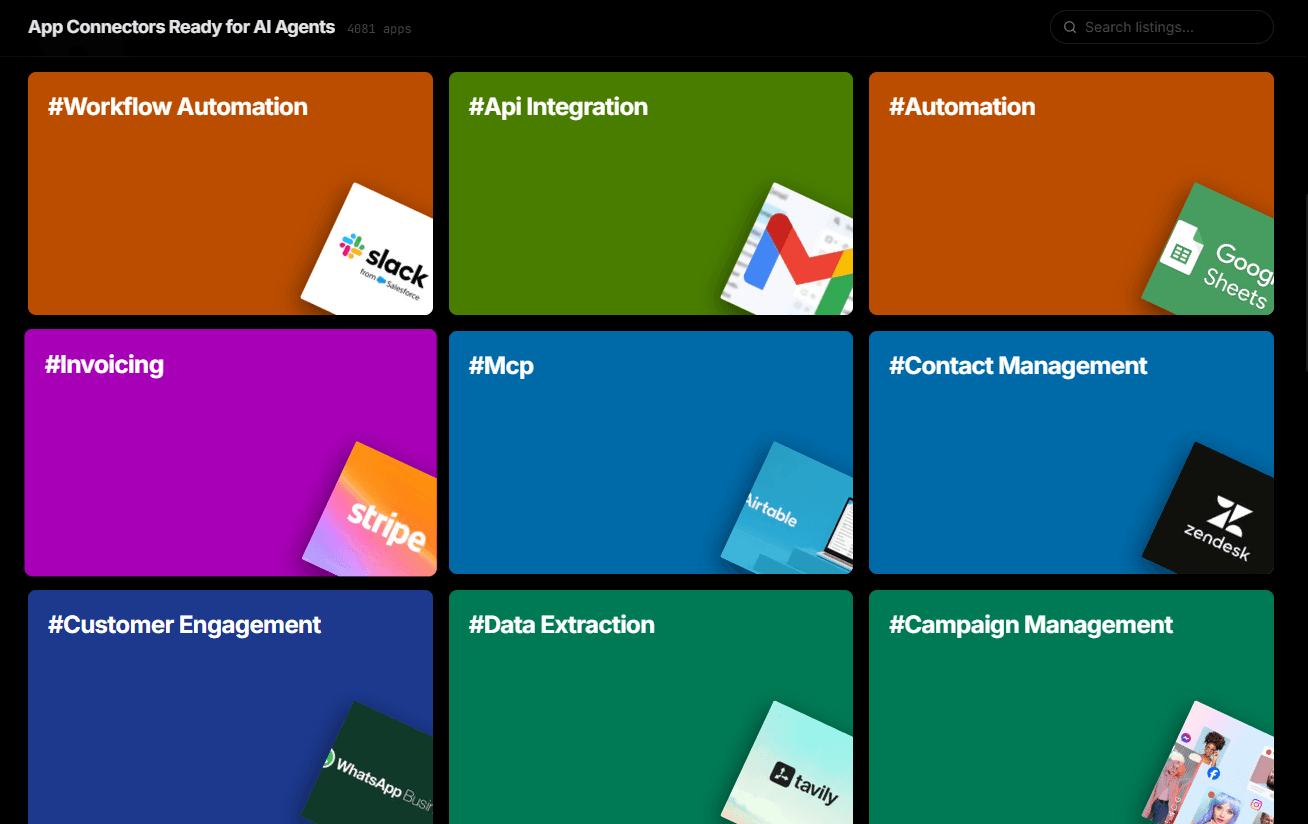
Over 4,000 integrations ready for AI agents
Explore a vast library of pre-built integrations, optimized and ready to deploy.
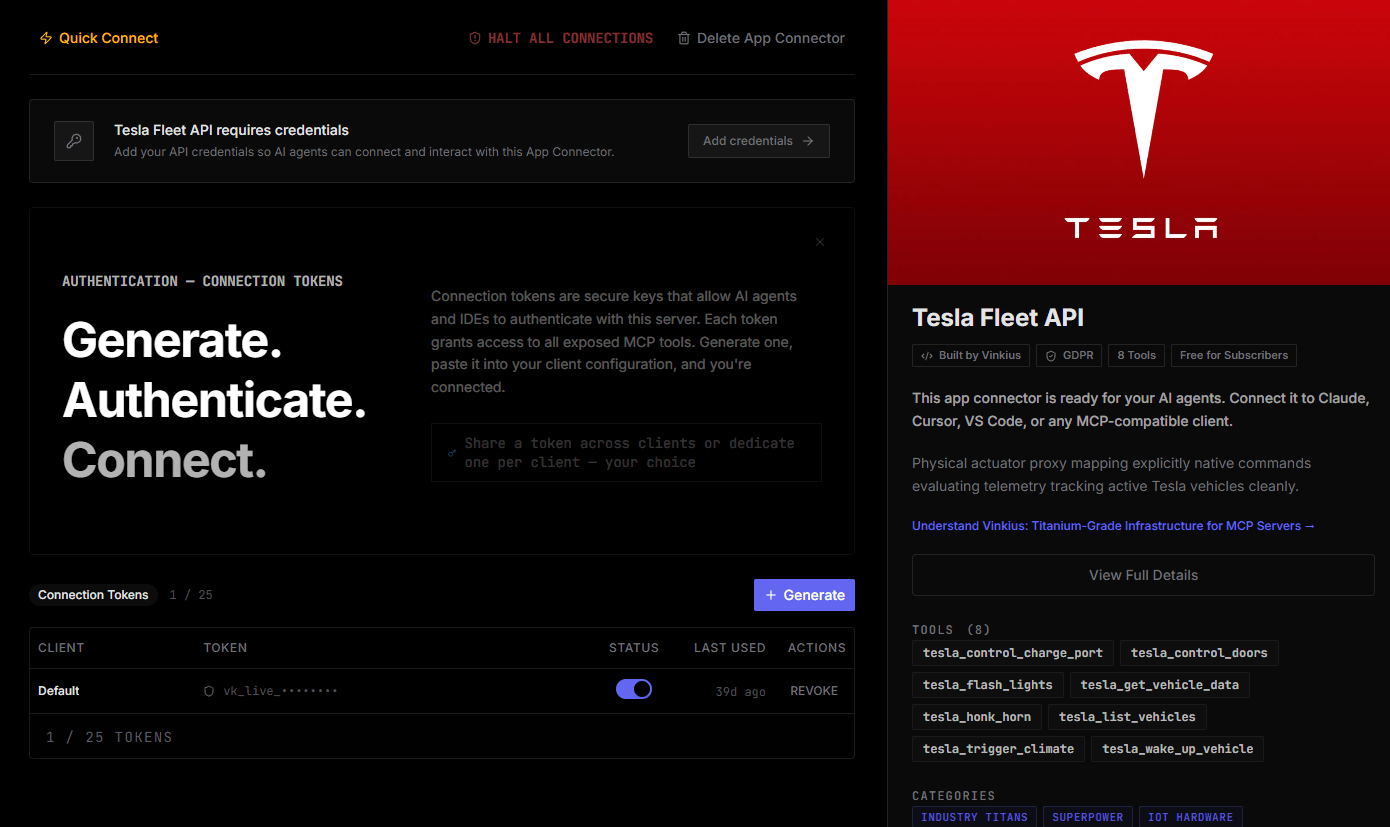
Connect securely in under 30 seconds
Generate tokens to authenticate and link external services in a single step.
Complete visibility into every agent action
Audit live requests, latency, success rates, and active security compliance policies.
Optimize spending and track token ROI
Analyze real-time token consumption and cost metrics detailed by connection.
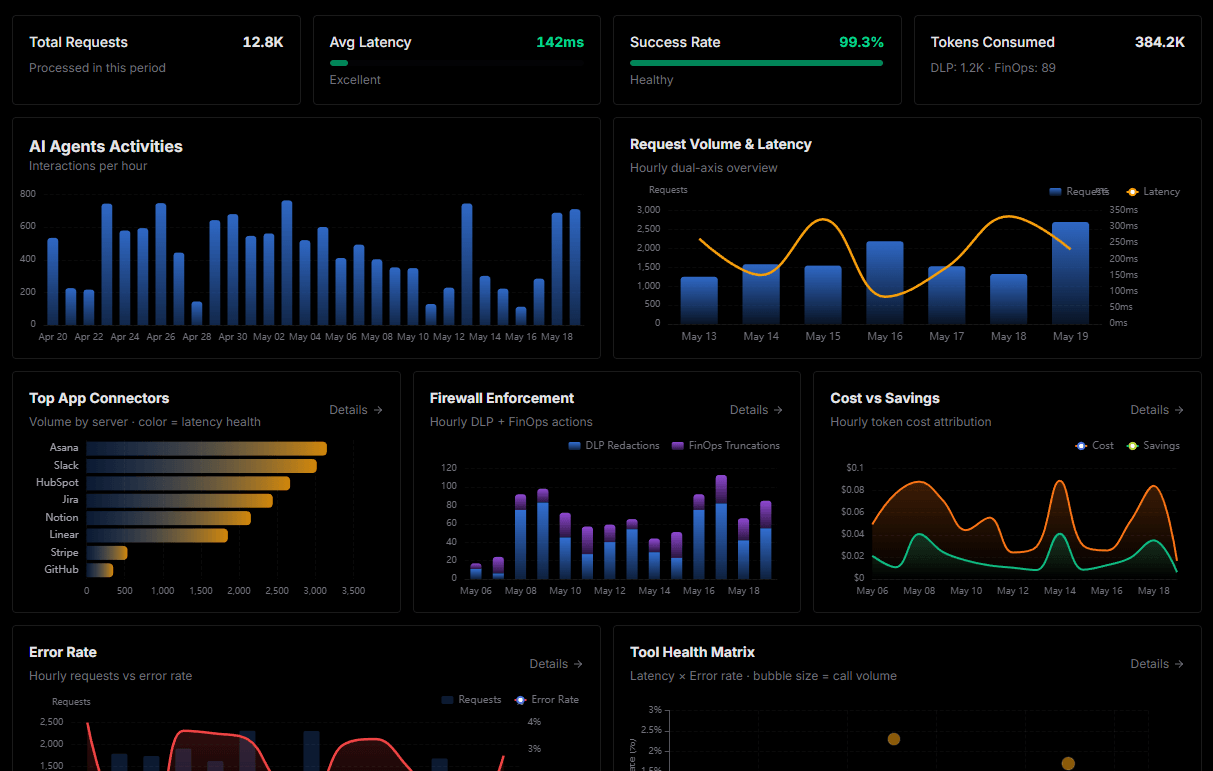
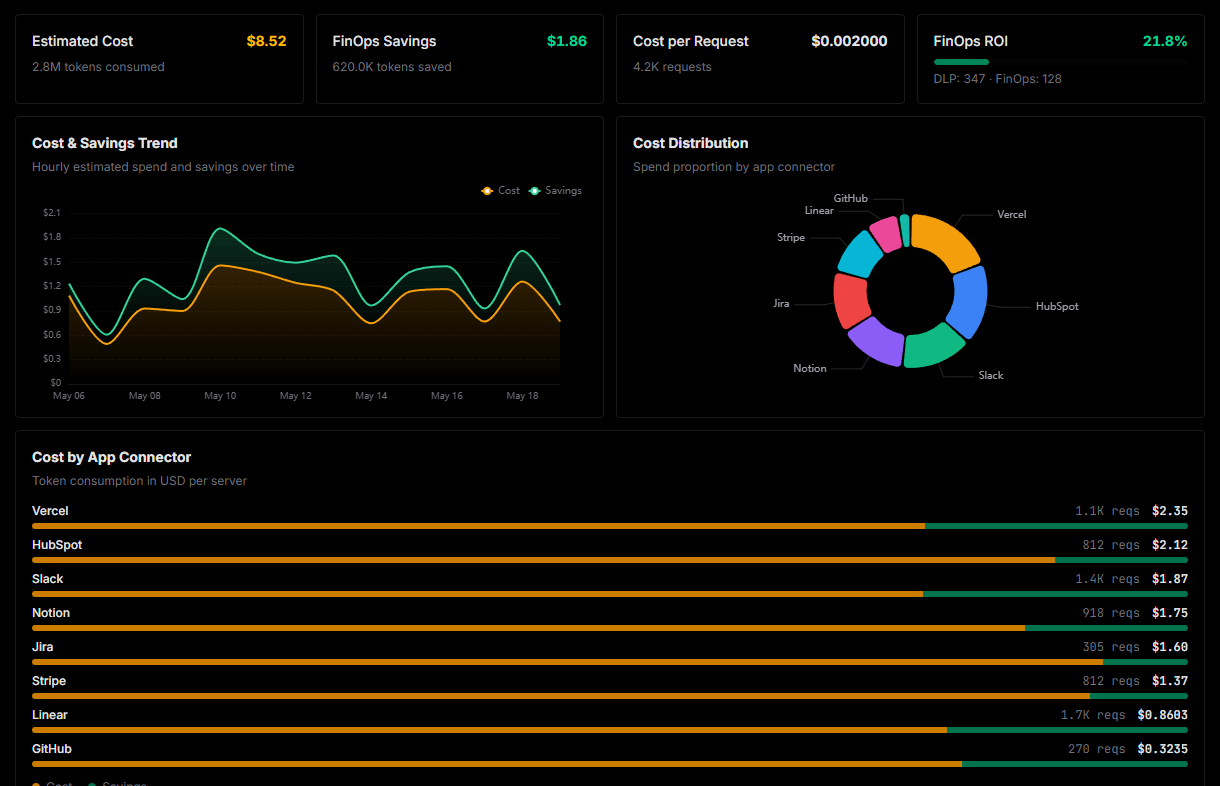
Explore our live AI Agents Analytics dashboard to see it all working
This dashboard is included when you connect AgroLog using Vinkius. You will never be left in the dark about what your AI agents are doing with your tools.
AgroLog and 4,000+ other AI tools. No hosting, no code, ready to use.
Professionals who connect AgroLog to Claude Desktop through Vinkius don't need to write code, manage servers, or worry about security. Everything is pre-configured, secure, and runs automatically in the background.
Raw MCP | Vinkius | |
|---|---|---|
| Ready-to-use MCPs | Find and configure each manually | 4,000+ MCPs ready to use |
| Connection Setup | Manual coding & server setup | 1-click instant connection |
| Server Hosting | You host it yourself (needs 24/7 uptime) | 100% hosted & managed by Vinkius |
| Security & Privacy | Stored in plaintext config files | Bank-grade encrypted vault |
| Activity Visibility | Blind execution (no logs or tracking) | Live dashboard with real-time logs |
| Cost Control | Runaway AI token spend risk | Automatic budget limits |
| Revoking Access | Must delete files or code to stop | 1-click disconnect button |
How Vinkius secures
AgroLog for Claude Desktop
Every request between Claude Desktop and AgroLog is protected by our secure gateway. We automatically keep your sensitive data private, prevent unauthorized access, and let you disconnect instantly at any time.
Frequently asked questions
Can my AI check the current temperature and moisture in my grain silo?
Yes! First use get_devices to find the device ID for your silo sensors. Then use get_temperature and get_moisture with that device ID to get current readings. Temperature above 25°C or moisture above 15% may indicate spoilage risk. For historical trends, use get_device_telemetry with keys=temperature,moisture to see how conditions have changed over time.
How do I detect early signs of grain spoilage using CO2 levels?
Use the get_co2 tool to check CO2 readings from headspace sensors in your bins. Elevated CO2 levels (above 1500 ppm) indicate biological activity from mold, insects, or grain respiration — often appearing days before temperature changes. Combine with get_alarms to check for any active spoilage alerts. If CO2 is rising, consider turning on aeration using set_relay_state to ventilate the bin and reduce spoilage risk.
Can I remotely control my aeration fans based on sensor readings?
Yes! Use the set_relay_state tool with your device ID, relay name (e.g., "fan", "aeration"), and desired state (true for ON, false for OFF). Before activating, check current conditions with get_temperature and get_moisture, and verify weather conditions with get_weather to ensure outdoor conditions are suitable for aeration. For example, avoid running aeration during high humidity or rain.
How does Claude Desktop discover MCP tools?
When Claude Desktop starts, it reads the claude_desktop_config.json file and connects to each configured MCP server. It calls the tools/list endpoint to fetch the schema for every available tool, then surfaces them as clickable options in the chat interface via the 🔌 icon.
What happens if the MCP server is temporarily unavailable?
Claude Desktop handles disconnections gracefully. if the server is unreachable at startup, the tools simply won't appear. Once the server becomes available again, restarting Claude Desktop will re-establish the connection. There is no timeout penalty or error loop.
Can I connect multiple MCP servers simultaneously?
Yes. You can add as many servers as you need in the mcpServers section of the config file. Each server appears as a separate tool provider, and Claude can use tools from multiple servers in a single conversation turn.
Is there a limit on the number of tools per server?
Claude Desktop can handle hundreds of tools per server. However, for optimal LLM performance, Vinkius servers are designed to expose focused, well-documented tool sets rather than overwhelming the model with too many options.
Does Claude Desktop support Streamable HTTP transport?
Yes. Claude Desktop supports both SSE (Server-Sent Events) and the newer Streamable HTTP transport that Vinkius uses. Simply provide the server URL. Claude auto-negotiates the transport protocol.
Server not appearing after restart
Ensure the JSON is valid (no trailing commas). Check the file path: ~/Library/Application Support/Claude/claude_desktop_config.json (macOS) or %APPDATA%\\Claude\\ (Windows).
Authentication error
Verify your Vinkius token is correct. Go to cloud.vinkius.com to regenerate it if needed.
Tools not showing in chat
Click the 🔌 icon at the bottom of the chat input. If it shows 0 tools, the server may still be connecting. wait a few seconds.
Explore More MCP Servers
View all →
Internet Archive Search
12 toolsSearch 40M+ books, videos, audio, software across the Internet Archive.

Preno
11 toolsRun your hotel or accommodation with property management that handles bookings, channel distribution, and guest communication.
Amazon S3
10 toolsCloud object storage orchestration — manage buckets, objects, and metadata via AI.

Exa
3 toolsSemantic search engine built for AI — find conceptually relevant web content, not just keyword matches. Powered by neural search technology.