
Bring Public Transport
to Claude Desktop
Create your Vinkius account to connect Lyko to Claude Desktop and start using all 12 AI tools in minutes. Fully managed, enterprise secure, and ready to use without writing a single line of code. No hosting, no server setup — just connect and start using.
 GDPR Free for Subscribers
Compatible with every major AI agent and IDE
 Gemini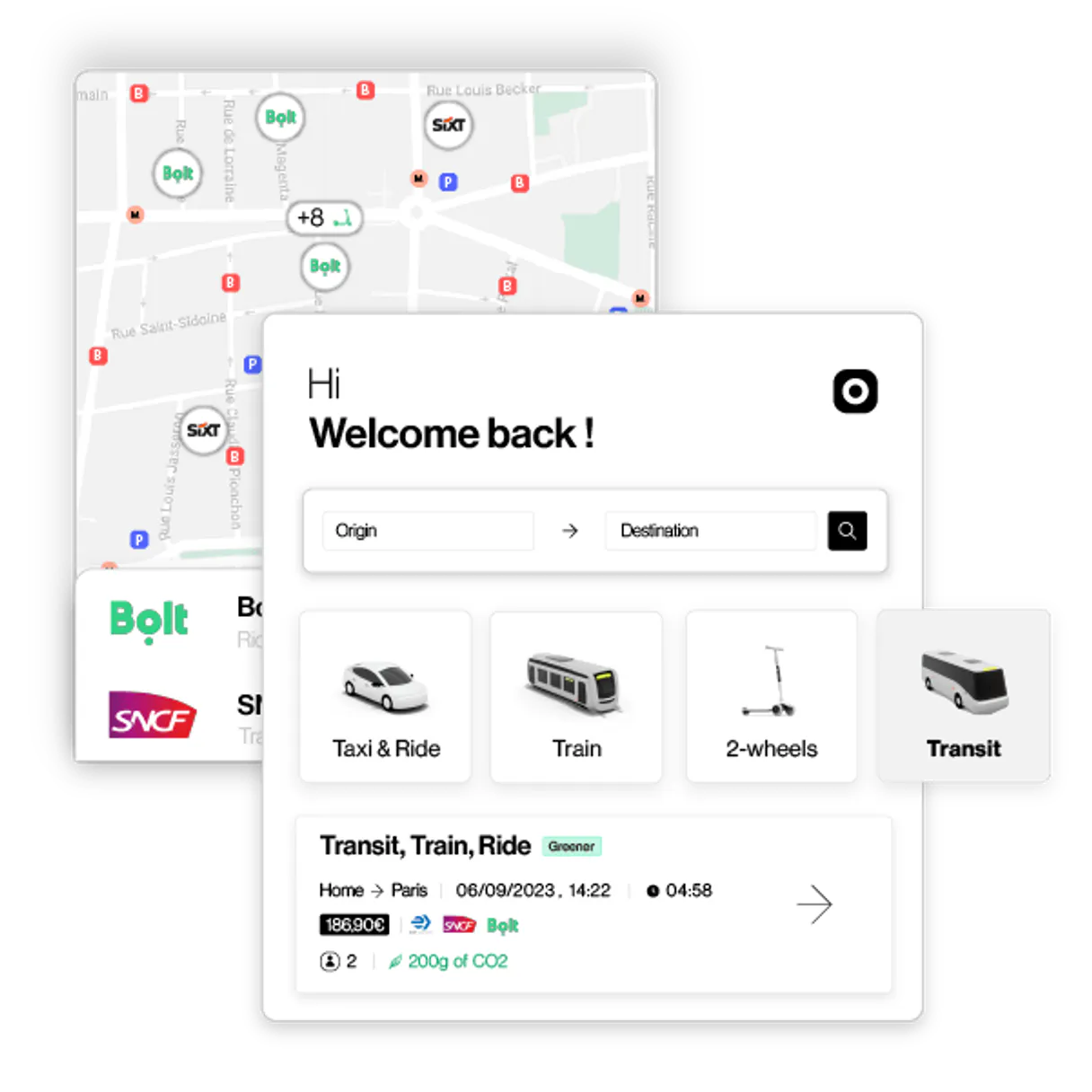
What is the Lyko MCP Server?
Connect your Lyko Transit API mobility platform to any AI agent and take full control of European public transit planning, real-time departure monitoring, and multimodal journey optimization through natural conversation.
What you can do
- Trip Planning — Plan door-to-door intermodal journeys combining buses, trains, subways, trams, ferries, bike-sharing, and walking
- Real-Time Departures — Check upcoming departures at any transit stop with ETAs, platforms, and delay indicators
- Arrival Tracking — Monitor incoming services for passenger pickup and connection coordination
- Stop Discovery — Search transit stops by name, address, or landmark across 300+ European operators
- Nearby Stops — Find all transit stops near any geographic location with distance calculations
- Stop Details — Get comprehensive stop information including served lines, accessibility, and amenities
- Line Information — Research transit lines with operator details, service hours, and route characteristics
- Line Routes — View complete stop sequences and route patterns for any transit line
- Operator Directory — Browse 300+ transit operators across Europe with coverage areas and service modes
- Network Status — Check service disruptions, planned works, strikes, and delay alerts for any operator
- GTFS Feeds — Access raw GTFS transit data for offline analysis and academic research
- Trip Booking — Book train tickets, bus passes, bike rentals, and other mobility services through Lyko Book
How it works
- Subscribe to this server
- Enter your Lyko API key (from the Developer Portal)
- Start planning European transit journeys from Claude, Cursor, or any MCP-compatible client
No more navigating multiple transit operator websites or manually parsing schedule data. Your AI acts as a dedicated European travel planner and transit operations analyst.
Who is this for?
- Travelers — plan multimodal journeys across European cities with real-time departure awareness
- Urban Explorers — discover nearby transit options and understand local transit networks
- Transit Analysts — research operator networks, service patterns, and GTFS data
- MaaS Developers — integrate booking and trip planning into mobility applications
Built-in capabilities (12)
Supports booking train tickets, bus tickets, bike-sharing rentals, car-sharing reservations, and other mobility services available through the Lyko Book platform. Returns booking confirmation, payment details, ticket information, QR codes for validation, and cancellation policies. Availability and booking capabilities vary by operator and service type. Essential for Mobility-as-a-Service integration, ticket purchasing, service reservations, and end-to-end journey planning with booking. AI agents should use this when users ask "book this train ticket", "reserve a bike for this trip", or want to complete a mobility service reservation after planning a route. Book a transit trip or mobility service through Lyko Book
Returns list of arriving services with line names and numbers, origins, scheduled and real-time arrival times (ETA), platform or bay information, delay indicators, and operator details. Essential for passenger pickup coordination, arrival monitoring, transit hub management, and real-time arrival boards. AI agents use this when users ask "when does the next train arrive at X", "show incoming services at this station", or need to track arriving services for passenger coordination. Get upcoming arrivals at a specific transit stop
Returns list of departing services with line names and numbers, destinations, scheduled and real-time departure times (ETD), platform or bay information, delay indicators, and operator details. Supports buses, trains, trams, subways, and ferries across European transit networks. Essential for passenger information displays, departure boards, travel apps, and real-time transit monitoring. AI agents should reference this when users ask "when is the next bus from stop X", "show departures from this station", or need to monitor upcoming services at a known transit stop. Get next departures from a specific transit stop
Returns line name, number, type (bus, train, tram, subway, ferry), operator, color code, route description, service hours, frequency, and accessibility information. Essential for line identification, transit network exploration, service information queries, and route planning context. AI agents should reference this when users ask "tell me about line M1", "what operator runs bus line 42", or need line metadata to understand transit service characteristics. Get information about a specific transit line
Returns route variants (e.g., direction A and B), complete stop sequences with order, scheduled frequencies, first and last service times, and any service variations (express vs. local, peak vs. off-peak). Essential for complete line visualization, stop sequence analysis, transit mapping, and understanding service patterns. AI agents use this when users ask "show me all stops on line X", "what is the full route of bus 42", or need to understand complete service patterns for a transit line. Get all routes and stops for a specific transit line
Returns nearby stops with distances from the coordinate, stop names, locations, served lines, operators, and stop types, sorted by proximity. Essential for location-based transit discovery, passenger navigation, "stops near me" features, and geographic transit analysis. AI agents use this when users ask "what stops are near my current location", "find transit stops within 500m of these coordinates", or need to discover accessible transit options from a specific point. Find transit stops near a geographic location
Returns active service disruptions, planned works, line closures, delay information, weather impacts, strike notifications, and alternative service recommendations. Essential for real-time service monitoring, disruption awareness, passenger communication, and travel planning during service changes. AI agents should reference this when users ask "are there any disruptions on SNCF trains", "is the Berlin U-Bahn running normally", or need to check service reliability before planning trips. Get current network status and service alerts for a transit operator
Returns operator names, IDs, countries, coverage areas, transport modes operated (bus, train, tram, subway, ferry), contact information, and service status. Covers 300+ operators across Europe including SNCF (France), DB (Germany), NS (Netherlands), RENFE (Spain), Trenitalia (Italy), and many regional and local operators. Essential for operator research, transit network scoping, country-specific transit analysis, and understanding service coverage. AI agents should use this when users ask "what transit operators are available in France", "list all train operators in Germany", or need to identify operators for a specific country or region. List public transit operators available in a country or region
Returns stop name, location (latitude, longitude, address), served lines and routes, stop type (bus stop, train station, tram stop, subway station, ferry terminal), operator information, accessibility features (wheelchair access, elevators), and available amenities. Essential for stop identification, accessibility planning, transit network analysis, and passenger information. AI agents should use this when users ask "tell me about this stop", "what lines serve stop X", or need detailed stop metadata to contextualize transit queries. Get detailed information about a specific transit stop
Returns feed metadata, last update timestamp, included operators, coverage area, data freshness indicators, and download or access URLs. GTFS feeds contain static schedule data, route definitions, stop locations, fare information, and service calendars. Essential for transit data analysis, offline planning applications, academic research, and transit network visualization. AI agents use this when users need access to raw GTFS data, want to analyze transit schedules offline, or require complete network definitions for planning applications. Access GTFS transit feed data for a specific operator or region
Supports multiple transport modes including buses, trains, subways, trams, ferries, bike-sharing, car-sharing, and walking combinations. Returns complete itinerary with departure and arrival times, duration, number of transfers, legs with mode details (line name, operator, vehicle type), intermediate stops, walking distances, fares if available, and real-time delay information. Essential for travel planning, multimodal journey optimization, passenger information systems, and Mobility-as-a-Service (MaaS) applications. AI agents should use this when users ask "how do I get from X to Y by public transport", "plan a trip from Paris Gare du Nord to Versailles", or need intermodal route options with timing and transfer details. Plan an intermodal trip between two locations using public transit
Returns matching stops with stop IDs, names, locations (latitude, longitude), served lines, operators, and stop types. Essential for stop discovery, journey planning interfaces, transit stop identification, and building location-based transit features. AI agents should use this when users ask "find the bus stop near Champs-Elysees", "search for stops called X", or need to identify stop IDs for use in departure/arrival queries. Search for transit stops by name or location
Why Claude Desktop?
Claude Desktop is the definitive way to connect Lyko to your AI workflow. Add Vinkius Edge URL to your config, restart the app, and Claude immediately exposes all 12 tools in the chat interface. ask a question, Claude calls the right tool, and you see the answer. Zero code, zero context switching.
- —
Claude Desktop is the reference MCP client. it was designed alongside the protocol itself, ensuring the most complete and stable MCP implementation available
- —
Zero-code configuration: add a server URL to a JSON file and Claude instantly discovers and exposes all available tools in the chat interface
- —
Claude's extended thinking capability lets it reason through multi-step tool usage, chaining multiple API calls to answer complex questions
- —
Enterprise-grade security with local config storage. your tokens never leave your machine, and connections go directly to Vinkius Edge network
Lyko in Claude Desktop
Why run Lyko with Vinkius?
The Lyko connection runs on our fully managed, secure cloud infrastructure. We handle the hosting, maintenance, and security so you don't have to deal with servers or code. All 12 tools are ready to work instantly without any complex setup.
You stay in complete control of your data. Your AI only accesses the information you approve, keeping your sensitive passwords and private details completely safe. Plus, with automatic optimizations, your AI works faster and more efficiently.
* Every connection is hosted and maintained by Vinkius. We handle the security, updates, and infrastructure so you don't have to write code or manage servers. See our infrastructure
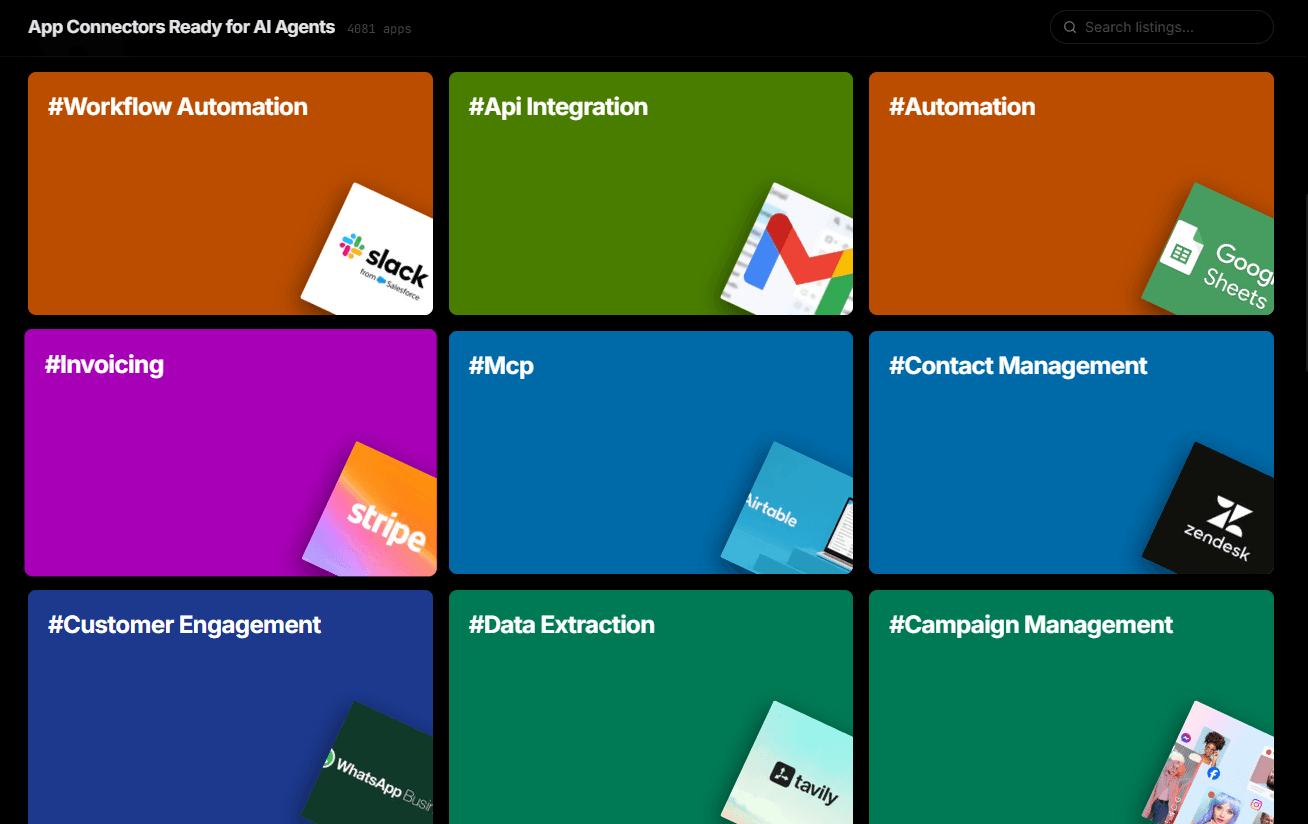
Over 4,000 integrations ready for AI agents
Explore a vast library of pre-built integrations, optimized and ready to deploy.
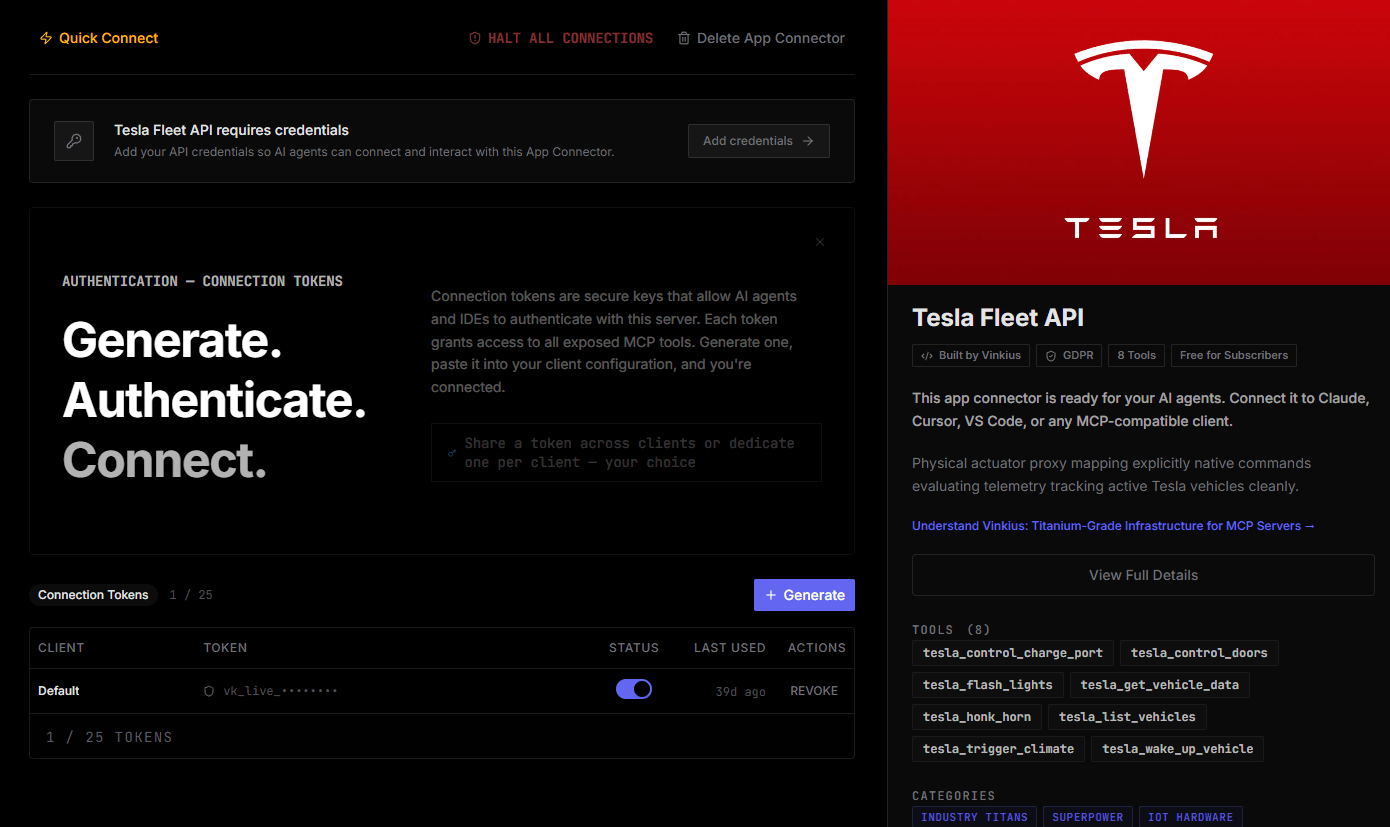
Connect securely in under 30 seconds
Generate tokens to authenticate and link external services in a single step.
Complete visibility into every agent action
Audit live requests, latency, success rates, and active security compliance policies.
Optimize spending and track token ROI
Analyze real-time token consumption and cost metrics detailed by connection.
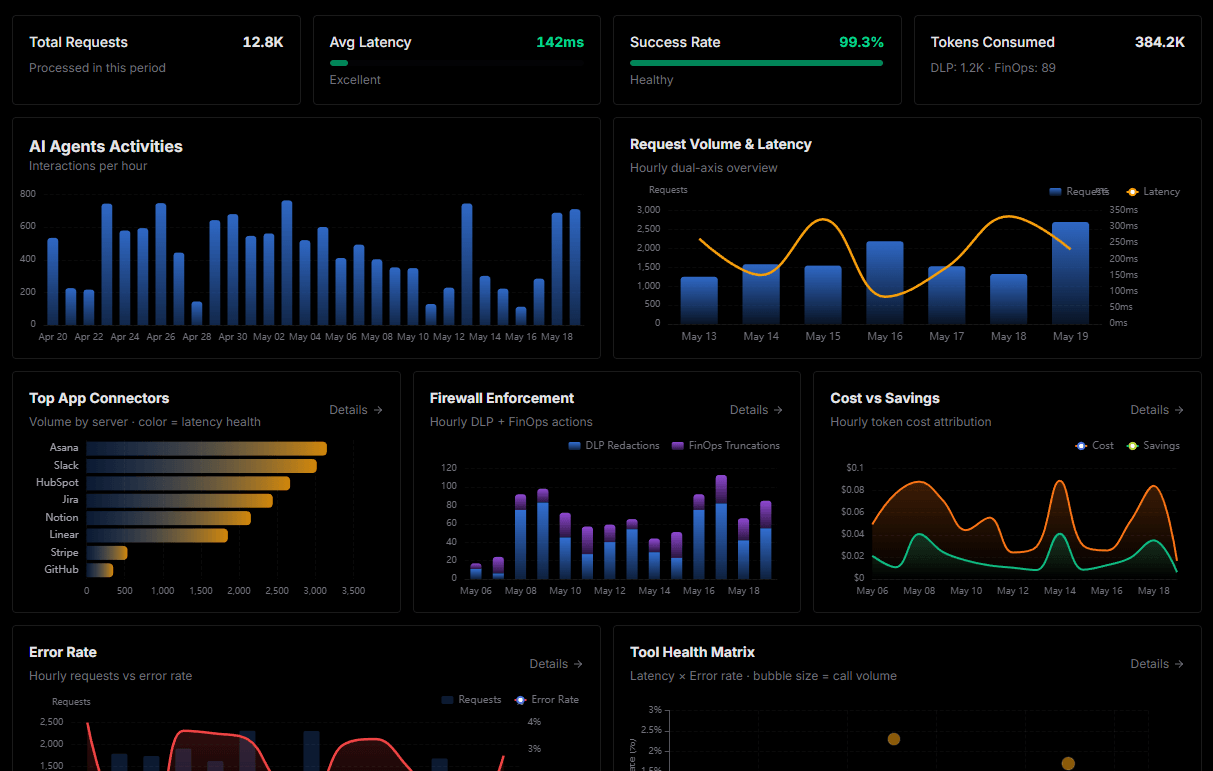
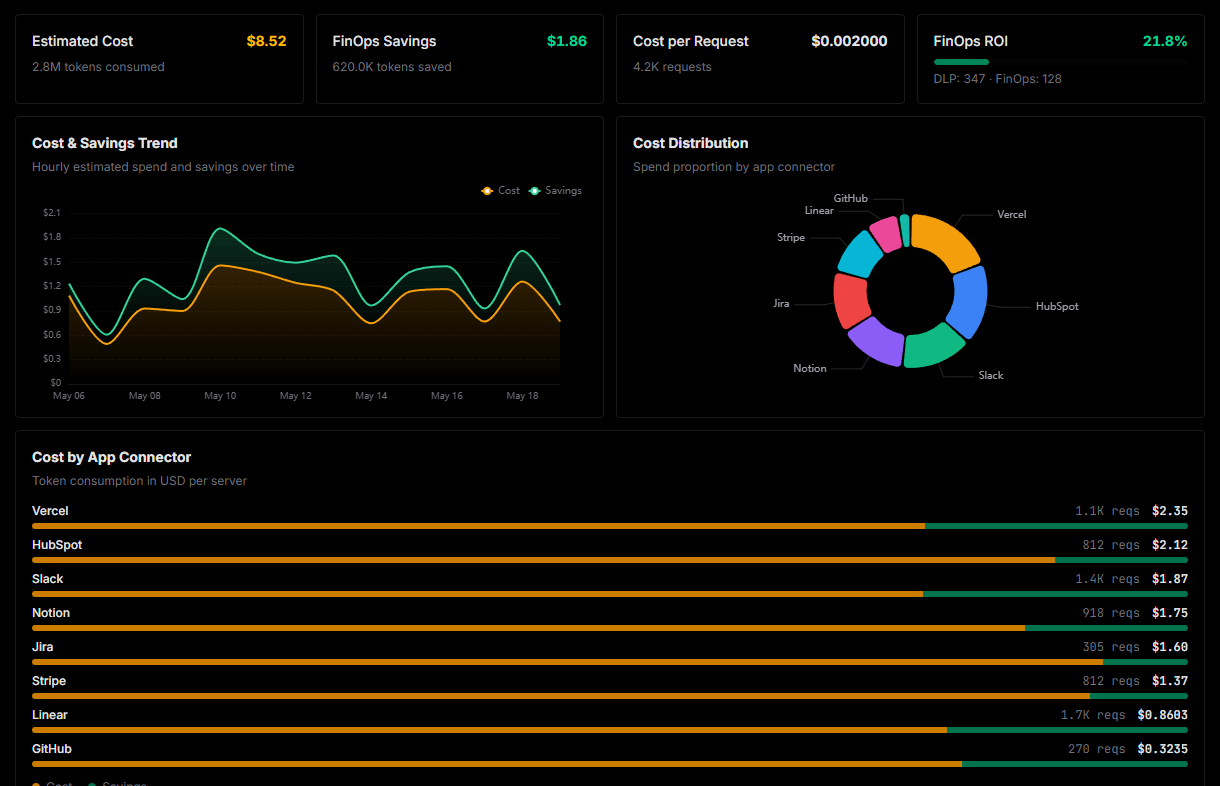
Explore our live AI Agents Analytics dashboard to see it all working
This dashboard is included when you connect Lyko using Vinkius. You will never be left in the dark about what your AI agents are doing with your tools.
Lyko and 4,000+ other AI tools. No hosting, no code, ready to use.
Professionals who connect Lyko to Claude Desktop through Vinkius don't need to write code, manage servers, or worry about security. Everything is pre-configured, secure, and runs automatically in the background.
Raw MCP | Vinkius | |
|---|---|---|
| Ready-to-use MCPs | Find and configure each manually | 4,000+ MCPs ready to use |
| Connection Setup | Manual coding & server setup | 1-click instant connection |
| Server Hosting | You host it yourself (needs 24/7 uptime) | 100% hosted & managed by Vinkius |
| Security & Privacy | Stored in plaintext config files | Bank-grade encrypted vault |
| Activity Visibility | Blind execution (no logs or tracking) | Live dashboard with real-time logs |
| Cost Control | Runaway AI token spend risk | Automatic budget limits |
| Revoking Access | Must delete files or code to stop | 1-click disconnect button |
How Vinkius secures
Lyko for Claude Desktop
Every request between Claude Desktop and Lyko is protected by our secure gateway. We automatically keep your sensitive data private, prevent unauthorized access, and let you disconnect instantly at any time.
Frequently asked questions
Can my AI plan a complete multimodal trip from my hotel to a tourist attraction using public transit?
Yes! Use the plan_trip tool with your hotel address or name as the origin and the tourist attraction as the destination. The Lyko routing engine will return complete door-to-door itineraries combining buses, trains, subways, trams, and walking segments with departure times, arrival times, total duration, number of transfers, line names, operators, walking distances, and real-time delay information. You can also specify preferred transport modes or a desired departure time. Perfect for tourist planning, business travel, and navigating unfamiliar European cities.
How do I check real-time departures and arrivals at a specific train station or bus stop?
First, use search_stops to find the stop by name (e.g., "Gare du Nord" or "Alexanderplatz"). Once you have the stop ID, use get_departures to see upcoming services with ETAs, platforms, and delay indicators, or get_arrivals to track incoming services. The results include line names, destinations, scheduled vs. real-time times, and operator information. This is perfect for passenger pickup coordination, connection planning, and monitoring service reliability.
Can I check if there are any service disruptions or strikes affecting transit operators in France or Germany?
Absolutely! Use get_operators with the country filter (e.g., "FR" for France, "DE" for Germany) to list all available operators, then use get_network_status with the operator ID (e.g., "sncf" for SNCF, "db" for Deutsche Bahn) to check current service disruptions, planned works, strike notifications, weather impacts, and line closures. This gives you real-time awareness of transit reliability across 300+ European operators. AI agents can proactively alert travelers to service issues before trip planning.
How does Claude Desktop discover MCP tools?
When Claude Desktop starts, it reads the claude_desktop_config.json file and connects to each configured MCP server. It calls the tools/list endpoint to fetch the schema for every available tool, then surfaces them as clickable options in the chat interface via the 🔌 icon.
What happens if the MCP server is temporarily unavailable?
Claude Desktop handles disconnections gracefully. if the server is unreachable at startup, the tools simply won't appear. Once the server becomes available again, restarting Claude Desktop will re-establish the connection. There is no timeout penalty or error loop.
Can I connect multiple MCP servers simultaneously?
Yes. You can add as many servers as you need in the mcpServers section of the config file. Each server appears as a separate tool provider, and Claude can use tools from multiple servers in a single conversation turn.
Is there a limit on the number of tools per server?
Claude Desktop can handle hundreds of tools per server. However, for optimal LLM performance, Vinkius servers are designed to expose focused, well-documented tool sets rather than overwhelming the model with too many options.
Does Claude Desktop support Streamable HTTP transport?
Yes. Claude Desktop supports both SSE (Server-Sent Events) and the newer Streamable HTTP transport that Vinkius uses. Simply provide the server URL. Claude auto-negotiates the transport protocol.
Server not appearing after restart
Ensure the JSON is valid (no trailing commas). Check the file path: ~/Library/Application Support/Claude/claude_desktop_config.json (macOS) or %APPDATA%\\Claude\\ (Windows).
Authentication error
Verify your Vinkius token is correct. Go to cloud.vinkius.com to regenerate it if needed.
Tools not showing in chat
Click the 🔌 icon at the bottom of the chat input. If it shows 0 tools, the server may still be connecting. wait a few seconds.
Explore More MCP Servers
View all →
CallGear
10 toolsAnalyze communication performance via CallGear — track calls, monitor advertising campaigns, and retrieve real-time stats directly from any AI agent.
Hub Planner
10 toolsManage resources, projects, and bookings via Hub Planner API.

MessageFlow
10 toolsOmnichannel communication via MessageFlow — send SMS, WhatsApp, and Email messages.
Clientjoy
8 toolsManage agency CRM and invoicing via Clientjoy — track leads, monitor invoices, and manage client projects directly from any AI agent.