
Bring Public Transport
to Cline
Create your Vinkius account to connect TfL to Cline and start using all 12 AI tools in minutes. Fully managed, enterprise secure, and ready to use without writing a single line of code. No hosting, no server setup — just connect and start using.
 GDPR Free for Subscribers
Compatible with every major AI agent and IDE
 Gemini
What is the TfL MCP Server?
Connect your TfL Unified API London public transport data platform to any AI agent and take full control of real-time Tube and bus tracking, multimodal journey planning, line status monitoring, and Santander Cycles availability through natural conversation.
What you can do
- Real-Time Arrivals — Get live arrival predictions for any Tube station, bus stop, DLR, Overground, Elizabeth line, tram, river, or cable-car stop
- Stop Point Search — Find any TfL stop point by station name, street, or landmark across all transport modes
- Line Status — Check current service status for all Tube lines, bus routes, DLR, Overground, Elizabeth line, and more
- Journey Planning — Plan door-to-door multimodal trips combining Tube, bus, DLR, Overground, Elizabeth line, tram, walking, and cycling
- Stop Details — Get comprehensive station information including accessibility, fare zones, and step-free access
- Santander Cycles — Browse all bike docking stations with real-time availability (bikes and empty docks)
- Road Status — Monitor London road conditions, closures, and disruptions for driving planning
- Place Search — Discover places and points of interest across London by category
- Transport Modes — Explore all available transport modes in the TfL network
- Vehicle Compliance — Check ULEZ and Congestion Charge compliance for registered vehicles
How it works
- Subscribe to this server
- Enter your TfL Application ID and Application Key (free from the developer portal)
- Start tracking London transport from Claude, Cursor, or any MCP-compatible client
No more navigating multiple TfL apps or manually checking arrival boards. Your AI acts as a dedicated London transport analyst and journey planning assistant.
Who is this for?
- London Commuters — track Tube and bus arrivals, check line status, and plan daily commutes
- Tourists — navigate London with multimodal journey planning and station discovery
- Cyclists — check Santander Cycles availability at docking stations across the city
- Drivers — monitor road status, disruptions, and ULEZ compliance before driving in London
Built-in capabilities (12)
g., 940GZZLUSCL for Oxford Circus Underground, or 490007653 for a bus stop). Returns predicted arrival times, line names, destination stations, time to station in minutes, vehicle IDs, expected arrival timestamps, and service types (tube, bus, dlr, elizabeth-line, overground, tram, river, cable-car). Essential for real-time arrival awareness, passenger waiting time estimation, trip timing, and connection coordination across the entire London transport network. AI agents should reference this when users ask "when is the next Northern Line train at Bank", "show upcoming buses at stop 490007653", or need real-time arrival predictions for any TfL stop point. Stop IDs can be found using search_stop_point. Get real-time arrival predictions for a specific TfL stop point
Returns dock ID, common name, precise location (latitude, longitude, address), total capacity, current available bikes, current empty docks, installation date, last update timestamp, and operational status. Essential for dock-level bike availability checks, capacity planning, and real-time bike-sharing awareness for specific docking stations. AI agents should use this when users ask "how many bikes are at dock BikePoints_1234", "tell me about the docking station at Hyde Park Corner", or need specific docking station details for bike hire planning. Get detailed information about a specific Santander Cycles docking station
Returns docking station IDs, common names, geographic coordinates, total bike capacity, number of available bikes, number of empty docks, installation date, and operational status. Covers thousands of docking stations across central London and expanding into outer boroughs. Essential for bike hire planning, dock availability awareness, cycle route planning, and understanding London's bike-sharing network coverage. AI agents should reference this when users ask "where are the nearest bike docking stations", "how many bikes are available at this dock", or need to identify bike hire options for last-mile connectivity. List all Santander Cycles (bike hire) docking stations across London
Returns multiple route options combining tube, bus, dlr, overground, elizabeth-line, tram, river, walking, and cycling. Each route includes total duration, walking distance, number of interchanges, fare estimates, CO2 savings, and detailed leg-by-leg instructions with line names, directions, station sequences, and departure/arrival times. Essential for multimodal trip planning, route comparison, accessibility-aware journey selection, and passenger information. AI agents should use this when users ask "how do I get from Paddington to Greenwich", "plan a journey from Heathrow to Tower Bridge", or need door-to-door trip planning across London's transport network. Plan a journey between two locations using TfL transport modes
Returns line IDs, line names, status severity (Good Service, Minor Delays, Severe Delays, Part Suspended, Suspended, Planned Work, Special Service), status descriptions, reason codes, and disruption details. Can query all lines system-wide or filter by specific modes (tube, bus, dlr, overground, tram, river, cable-car, elizabeth-line, national-rail). Essential for service disruption awareness, alternative route planning, passenger communication, and understanding overall TfL reliability. AI agents should reference this when users ask "is the Victoria Line running normally", "what is the status of the Overground", or need to check service reliability before planning London journeys. Get current service status for TfL lines, optionally filtered by mode
Returns modes including tube, bus, dlr, overground, elizabeth-line, tram, river, cable-car, national-rail, and walking. Essential for understanding the scope of TfL's multimodal network, mode identification for filtered queries, and transport network analysis. AI agents should reference this when users ask "what transport modes does TfL cover", "list all available modes", or need to understand the full range of London transport options before planning journeys. List all available transport modes in the TfL network
Returns place IDs, names, categories, geographic coordinates, address information, and related links. Can optionally filter by place type (e.g., "TubeStation", "BusStation", "Park", "Museum", "Hospital"). Essential for place discovery, tourist planning, accessibility research, and understanding London's infrastructure. AI agents should use this when users ask "find parks near Westminster", "search for museums in South Bank", or need to identify places and points of interest for comprehensive London trip planning. Search for places and points of interest across London
Returns disruption descriptions, affected road segments, cause types (roadworks, incidents, events, utility works), start and end dates, severity levels, and alternative route recommendations. Can query all disruptions system-wide or filter by specific road. Essential for driving disruption awareness, alternative route planning, delivery logistics, and understanding road reliability. AI agents should reference this when users ask "are there any roadworks on the A4", "what disruptions affect my drive to Heathrow", or need to check road conditions before planning driving journeys in London. Get current road disruptions and closures across London
Returns road IDs, road names, status descriptions, corridor details, and operational information. Can query all roads system-wide or filter by a specific road ID (e.g., "A1", "A40", "A205" South Circular). Essential for driving route planning, road closure awareness, understanding London road network conditions, and commuter driving decisions. AI agents should use this when users ask "what is the status of the A40", "are there any road closures on the North Circular", or need to check road conditions before driving journeys in London. Get current status of London roads, optionally filtered by specific road
Returns stop ID, common name, station type, modes served, geographic coordinates, address, accessibility information (step-free access, lift availability), fare zone, hub station affiliations, and parent/child station relationships. Essential for stop identification, accessibility planning, fare zone awareness, station navigation, and understanding station hierarchy in the TfL network. AI agents should use this when users ask "tell me about King's Cross station", "is this station step-free", or need detailed stop metadata to contextualise transit queries. Get detailed information about a specific TfL stop point
Returns vehicle registration, make, model, compliance status, charge exemptions, and registration dates. Essential for London driving compliance checks, ULEZ awareness, congestion charge planning, and vehicle registration verification. AI agents should use this when users ask "check if vehicle AB12 CDE is ULEZ compliant", "is my car exempt from Congestion Charge", or need to verify vehicle compliance before driving in central London. Get vehicle details for a registered vehicle in London (ULEZ/congestion charge)
Returns matching stop points with their IDs, common names, modes served (tube, bus, dlr, overground, tram, river, cable-car, elizabeth-line), geographic coordinates (lat/lon), and station hierarchy information. Can optionally filter by transport mode. Essential for stop discovery, journey planning interfaces, stop identification, and building location-based transit features. AI agents should use this when users ask "find the tube station near Covent Garden", "search for stops called Victoria", or need to identify stop IDs for use in arrival queries. Search for TfL stop points by name or location
Why Cline?
Cline operates autonomously inside VS Code. it reads your codebase, plans a strategy, and executes multi-step tasks including TfL tool calls without waiting for prompts between steps. Connect 12 tools through Vinkius and Cline can fetch data, generate code, and commit changes in a single autonomous run.
- —
Cline operates autonomously. it reads your codebase, plans a strategy, and executes multi-step tasks including MCP tool calls without step-by-step prompts
- —
Runs inside VS Code, so you get MCP tool access alongside your existing extensions, terminal, and version control in a single window
- —
Cline can create, edit, and delete files based on MCP tool responses, enabling end-to-end automation from data retrieval to code generation
- —
Transparent execution: every tool call and file change is shown in Cline's activity log for full visibility and approval before committing
TfL in Cline
Why run TfL with Vinkius?
The TfL connection runs on our fully managed, secure cloud infrastructure. We handle the hosting, maintenance, and security so you don't have to deal with servers or code. All 12 tools are ready to work instantly without any complex setup.
You stay in complete control of your data. Your AI only accesses the information you approve, keeping your sensitive passwords and private details completely safe. Plus, with automatic optimizations, your AI works faster and more efficiently.
* Every connection is hosted and maintained by Vinkius. We handle the security, updates, and infrastructure so you don't have to write code or manage servers. See our infrastructure
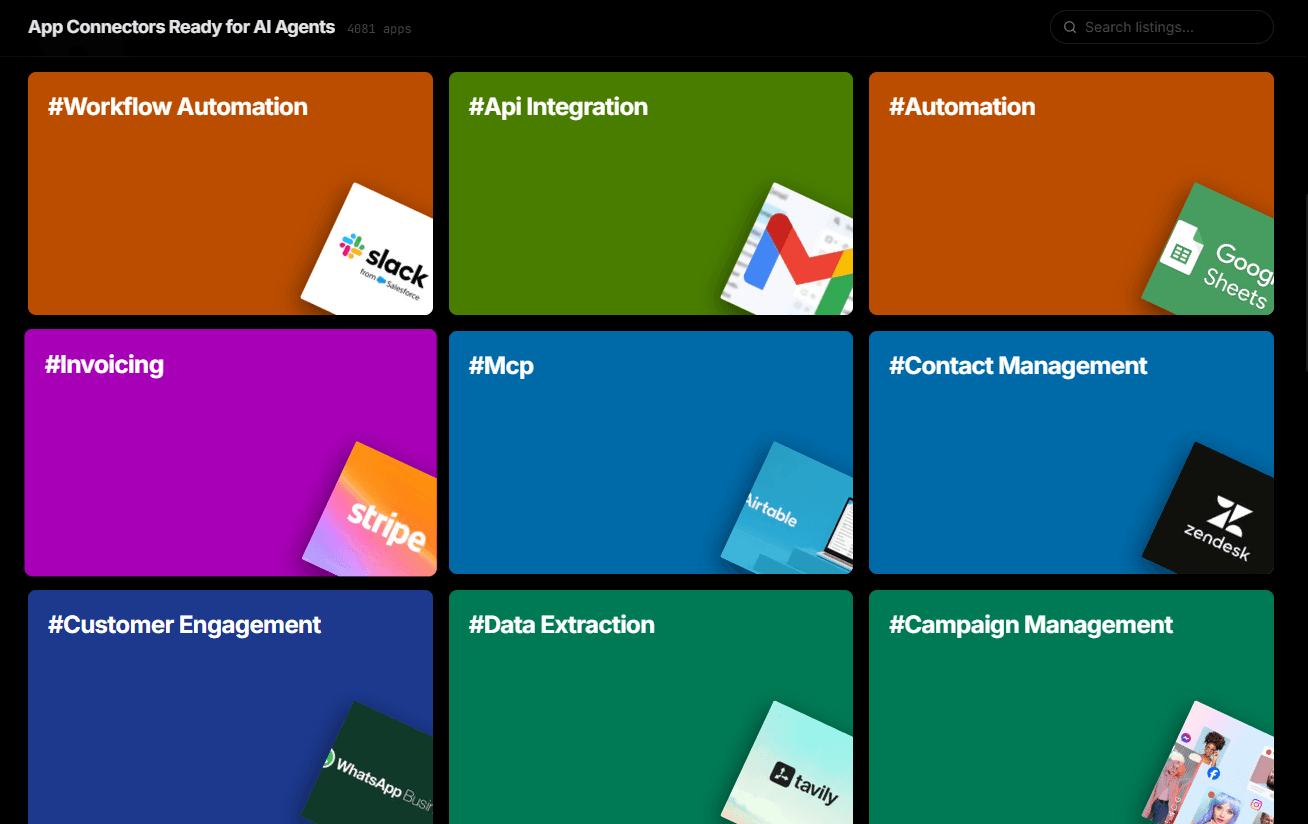
Over 4,000 integrations ready for AI agents
Explore a vast library of pre-built integrations, optimized and ready to deploy.
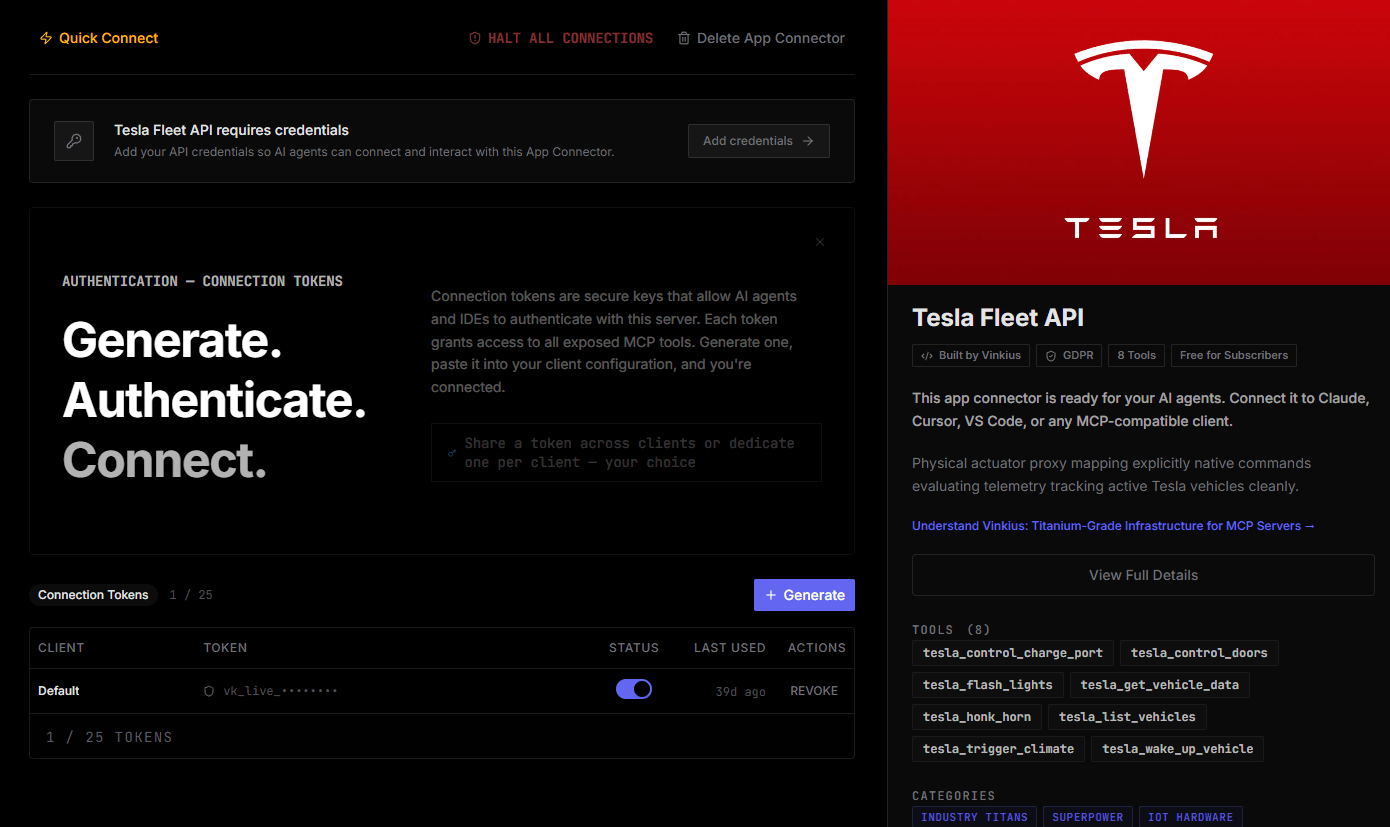
Connect securely in under 30 seconds
Generate tokens to authenticate and link external services in a single step.
Complete visibility into every agent action
Audit live requests, latency, success rates, and active security compliance policies.
Optimize spending and track token ROI
Analyze real-time token consumption and cost metrics detailed by connection.
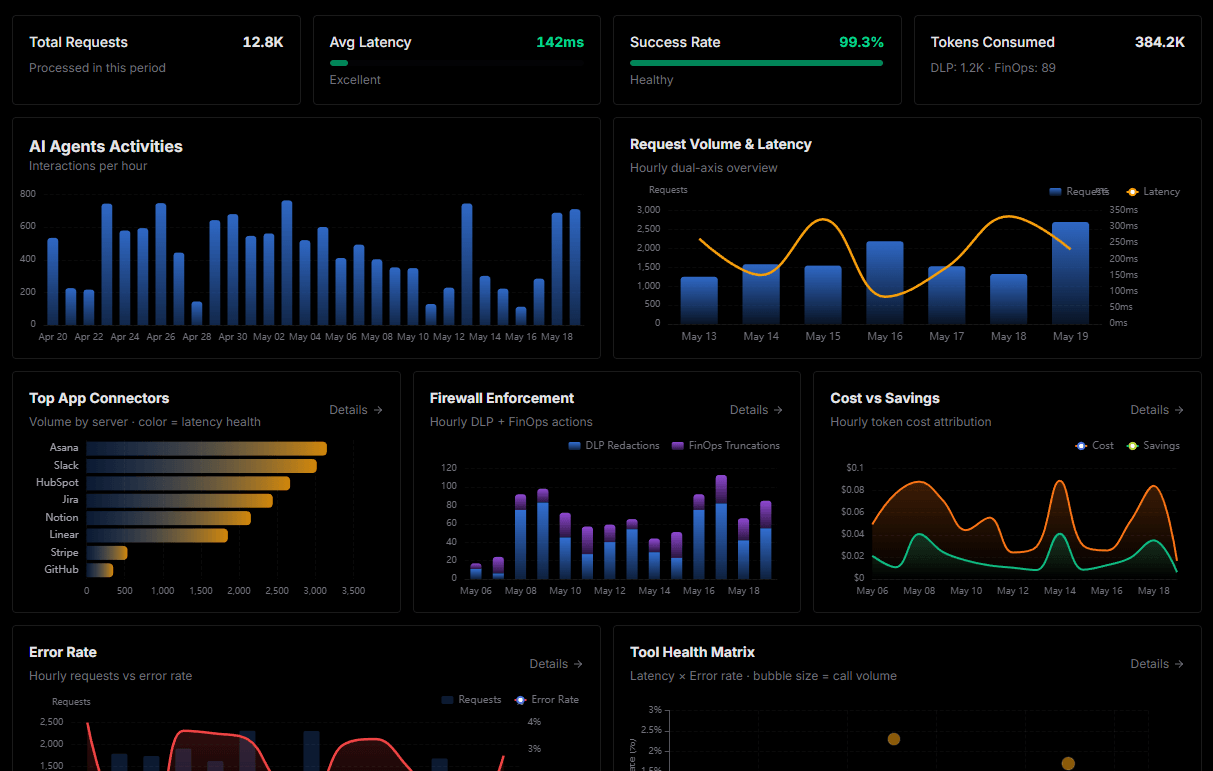
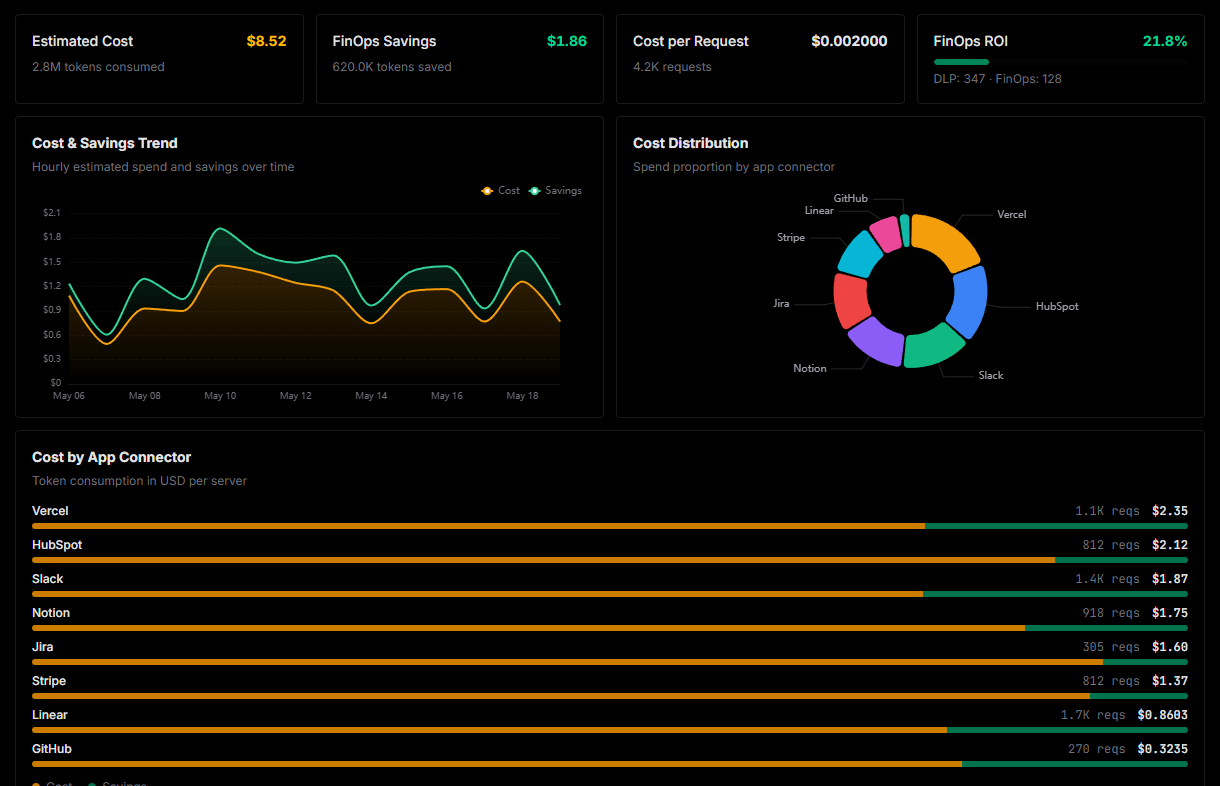
Explore our live AI Agents Analytics dashboard to see it all working
This dashboard is included when you connect TfL using Vinkius. You will never be left in the dark about what your AI agents are doing with your tools.
TfL and 4,000+ other AI tools. No hosting, no code, ready to use.
Professionals who connect TfL to Cline through Vinkius don't need to write code, manage servers, or worry about security. Everything is pre-configured, secure, and runs automatically in the background.
Raw MCP | Vinkius | |
|---|---|---|
| Ready-to-use MCPs | Find and configure each manually | 4,000+ MCPs ready to use |
| Connection Setup | Manual coding & server setup | 1-click instant connection |
| Server Hosting | You host it yourself (needs 24/7 uptime) | 100% hosted & managed by Vinkius |
| Security & Privacy | Stored in plaintext config files | Bank-grade encrypted vault |
| Activity Visibility | Blind execution (no logs or tracking) | Live dashboard with real-time logs |
| Cost Control | Runaway AI token spend risk | Automatic budget limits |
| Revoking Access | Must delete files or code to stop | 1-click disconnect button |
How Vinkius secures
TfL for Cline
Every request between Cline and TfL is protected by our secure gateway. We automatically keep your sensitive data private, prevent unauthorized access, and let you disconnect instantly at any time.
Frequently asked questions
Can my AI check when the next Tube train is arriving at my station?
Yes! First use search_stop_point with the station name (e.g., "Oxford Circus", "King's Cross") to find the stop ID. Then use get_arrivals with that stop ID to get real-time arrival predictions with line names, destinations, time to station in minutes, and platform information. This covers all TfL modes including Tube, bus, DLR, Overground, Elizabeth line, tram, river, and cable-car.
How do I plan a journey from Heathrow Airport to central London using public transport?
Use the get_journey tool with "Heathrow Airport" as the origin and your destination (e.g., "Oxford Circus", "Tower Bridge"). The TfL Journey Planner will return multiple route options combining Elizabeth line, Piccadilly line, Heathrow Express, and connecting Tube/bus services. Each option includes total duration, fare estimates, walking distances, number of interchanges, and step-by-step instructions with station sequences. You can also specify preferences for accessibility or cycling options.
Are there any Tube line closures or major disruptions right now?
Use get_line_status with modes="tube" to check all Tube line statuses, or call it without a mode filter for system-wide status across all transport modes. This returns each line's current status (Good Service, Minor Delays, Severe Delays, Part Suspended, Planned Work) with detailed descriptions and reasons. Always check this before planning any London journey to avoid unexpected disruptions.
How does Cline connect to MCP servers?
Cline reads MCP server configurations from its settings panel in VS Code. Add the server URL and Cline discovers all available tools on initialization.
Can Cline run MCP tools without approval?
By default, Cline asks for confirmation before executing tool calls. You can configure auto-approval rules for trusted servers in the settings.
Does Cline support multiple MCP servers at once?
Yes. Configure as many servers as needed. Cline can use tools from different servers within the same autonomous task execution.
Server shows error in sidebar
Click the server name to see logs. Verify the URL and token are correct.
Explore More MCP Servers
View all →
Extracta
10 toolsAutomate data extraction via Extracta — process documents into structured JSON, handle AI classification, and audit extraction history directly from any AI agent.

Wiagro
12 toolsAccess smart silobag monitoring via Wiagro — track temperature, humidity, CO2, rupture detection, and grain quality from any AI agent.

Feedly
10 toolsStay ahead of industry trends by aggregating RSS feeds, tracking topics with AI, and organizing research in focused boards.

WordPress Media Uploader
1 toolsThis MCP does exactly one thing: it downloads images from a URL and uploads them directly to your WordPress Media Library. Incredible for giving Claude the ability to generate and deploy blog cover images instantly.