
Bring Real Time Transit
to CrewAI
Create your Vinkius account to connect MTA to CrewAI and start using all 12 AI tools in minutes. Fully managed, enterprise secure, and ready to use without writing a single line of code. No hosting, no server setup — just connect and start using.
 GDPR Free for Subscribers
Compatible with every major AI agent and IDE
 Gemini
What is the MTA MCP Server?
Connect your MTA API New York City public transit data platform to any AI agent and take full control of real-time NYC Subway and MTA Bus tracking, arrival predictions, LIRR and Metro-North commuter rail monitoring, and service disruption awareness through natural conversation.
What you can do
- Subway Real-Time Feeds — Access live GTFS-RT data for all NYC Subway lines with train positions and arrival predictions
- Bus Routes — List all MTA bus routes across Manhattan, Brooklyn, Queens, Bronx, and Staten Island
- Bus Stops — Get all stops for any bus route with coordinates and sequence information
- Bus Predictions — Get real-time estimated arrival times for any bus stop
- Bus Vehicle Tracking — Track real-time GPS positions of all active MTA bus vehicles
- Service Alerts — Monitor active disruptions across Subway, buses, LIRR, and Metro-North
- Subway Stations — List all 472 NYC Subway stations with coordinates, borough, and entrance data
- LIRR Tracking — Monitor Long Island Rail Road trains with real-time positions and arrivals
- Metro-North Tracking — Track Metro-North Railroad trains serving northern NYC suburbs
- Stop-Level Bus Monitoring — Monitor buses at specific stops with targeted arrival predictions
- Estimated Arrivals — Get route-filtered arrival estimates for buses at any stop
- System Connectivity — Verify API connectivity and synchronize timestamps
How it works
- Subscribe to this server
- Enter your MTA API key (free from the Developer Portal)
- Start tracking NYC transit from Claude, Cursor, or any MCP-compatible client
No more navigating multiple MTA apps or manually checking train and bus times. Your AI acts as a dedicated NYC transit analyst and trip planning assistant.
Who is this for?
- NYC Commuters — track subway and buses, check arrivals, and monitor LIRR/Metro-North for daily commutes
- Tourists — navigate the NYC Subway system with station discovery and real-time arrival awareness
- Transit Analysts — research service patterns, vehicle positions, and system reliability across all MTA modes
- Mobility Apps — integrate real-time MTA data into journey planning and transit tracking applications
Built-in capabilities (12)
Returns predicted arrival times, route information, destinations, wait times, and delay indicators for each expected bus. Supports both multi-route stop queries and single-route filtered queries. Essential for targeted arrival predictions, route-specific wait time estimation, and passenger trip timing. AI agents should reference this when users ask "when is the next M15 at this stop", "show arrival estimates for route B46 at stop 12345", or need route-filtered arrival data at a specific bus stop. Get estimated arrival times for buses at a stop, optionally filtered by route
Returns predicted arrival times, route IDs, destination information, expected wait times, and whether buses are on schedule or delayed. Based on real-time vehicle tracking and schedule adherence. Essential for real-time bus arrival awareness, passenger waiting time estimation, trip timing, and connection coordination. AI agents should reference this when users ask "when is the next M15 bus at stop 12345", "show predictions for this stop", or need real-time arrival data for a specific bus stop. Stop IDs can be found using get_bus_stops. Get next bus arrival predictions for a specific bus stop
Returns route IDs, route names, operators (MTA New York City Bus, MTA Bus Company, private operators under MTA contract), and service area information. Covers local, limited-stop, and Select Bus Service (SBS) routes. Essential for route discovery, service area analysis, transit network understanding, and identifying route IDs for use in stop and prediction queries. AI agents should reference this when users ask "list all bus routes in Manhattan", "what routes serve Brooklyn", or need to identify route IDs for subsequent MTA Bus Time queries. List all MTA bus routes in New York City
Returns stop IDs (MonitoringRef), stop names, geographic coordinates (latitude, longitude), stop sequence order, and direction information. Essential for stop discovery, journey planning, accessibility mapping, and identifying stop IDs for use in arrival prediction queries. AI agents should use this when users ask "list all stops on the M15", "find bus stops along Broadway", or need to identify stop IDs for use in get_bus_predictions queries. List all stops for a specific MTA bus route
Returns vehicle IDs, route IDs, current positions, expected arrival times, distances from stop, and operational status. More targeted than system-wide vehicle queries. Essential for stop-level bus tracking, passenger waiting awareness, and real-time arrival estimation at specific stops. AI agents should use this when users ask "what buses are coming to this stop", "track vehicles approaching stop 12345", or need stop-specific bus position data for passenger information. Get buses currently at or approaching a specific bus stop
Returns vehicle IDs, route affiliations, latitude/longitude coordinates, heading direction, speed, recorded time, and prediction availability. Covers all MTA New York City Bus and MTA Bus Company vehicles in active service. Essential for real-time bus fleet monitoring, passenger arrival estimation, route-level service awareness, and transit operations management. AI agents should use this when users ask "where are all the buses right now", "track bus positions system-wide", or need real-time vehicle position data for fleet visualization. Get real-time positions of all active MTA bus vehicles
Returns train positions, trip updates, scheduled vs. real-time arrivals at stations, delays, track information, and service disruptions across all LIRR branches including Babylon, Ronkonkoma, Hempstead, Port Jefferson, Montauk, and more. Essential for commuter rail tracking, arrival predictions at Penn Station and Grand Central Madison, and LIRR service monitoring. AI agents should reference this when users ask "when is the next LIRR train to Penn Station", "track LIRR train positions", or need real-time commuter rail data for trip planning from Long Island into NYC. Get real-time LIRR train data from the Long Island Rail Road
Returns train positions, trip updates, scheduled vs. real-time arrivals, delays, track information, and service disruptions across all Metro-North lines including Hudson, Harlem, New Haven, Port Jervis, Pascack Valley, and more. Essential for commuter rail tracking, arrival predictions at Grand Central Madison, and Metro-North service monitoring. AI agents should use this when users ask "when is the next Metro-North train from White Plains", "track Metro-North positions", or need real-time commuter rail data for trip planning from Westchester, Connecticut, or the Hudson Valley into NYC. Get real-time Metro-North Railroad train data
Returns alert descriptions, affected lines and stations, severity levels, cause types (maintenance, incident, weather, special events, construction), start and end timestamps, and alternative service recommendations. Essential for service disruption awareness, alternative route planning, passenger communication, and understanding system reliability. AI agents should use this when users ask "are there any delays on the 4/5/6 line", "is LIRR running normally", or need to check service reliability before planning MTA journeys. Get current service alerts and disruptions across the MTA system
Returns station IDs, station names, complex IDs (for multi-line stations), borough information (Manhattan, Brooklyn, Queens, Bronx, Staten Island), structure types (underground, elevated, embankment, open cut), latitude/longitude coordinates, and North/East/South/West entrance coordinates. Essential for station discovery, rail network mapping, route planning, and identifying station codes for use in journey planning queries. AI agents should use this when users ask "list all stations in Manhattan", "what is the station code for Times Square", or need to understand the NYC Subway network geography. List all NYC Subway stations with details
Supports feed IDs grouped by line: "1" (lines 1,2,3,4,5,6,S), "2" (lines A,C,E), "3" (lines B,D,F,M), "4" (lines G), "5" (lines J,Z), "6" (lines N,Q,R,W), "7" (lines L), "11" (Staten Island Railway), "16" (Shuttle 42nd St), "21" (Shuttle Franklin Ave), "26" (Shuttle Rockaway Park). Returns train positions, trip updates, scheduled vs. real-time arrivals, delays, and service disruptions. Essential for real-time subway tracking, arrival predictions, and service monitoring across the entire NYC Subway system. AI agents should use this when users ask "when is the next 1 train", "show real-time positions for the A line", or need live subway data for trip planning. Feed IDs are required and can be found in MTA documentation. Get real-time subway feed data for specific NYC Subway lines
Returns the official server timestamp in ISO 8601 format. Useful for synchronizing local clocks with the MTA system, verifying API connectivity, testing authentication, and timestamp alignment for real-time data correlation. AI agents should use this as a connectivity check before making more complex queries, or when users need to verify API responsiveness and authentication validity. Get the current MTA Bus Time system timestamp
Why CrewAI?
When paired with CrewAI, MTA becomes a first-class tool in your multi-agent workflows. Each agent in the crew can call MTA tools autonomously, one agent queries data, another analyzes results, a third compiles reports, all orchestrated through Vinkius with zero configuration overhead.
- —
Multi-agent collaboration lets you decompose complex workflows into specialized roles, one agent researches, another analyzes, a third generates reports, each with access to MCP tools
- —
CrewAI's native MCP integration requires zero adapter code: pass Vinkius Edge URL directly in the
mcpsparameter and agents auto-discover every available tool at runtime - —
Built-in task delegation and shared memory mean agents can pass context between steps without manual state management, enabling multi-hop reasoning across tool calls
- —
Sequential and hierarchical crew patterns map naturally to real-world workflows: enumerate subdomains → analyze DNS history → check WHOIS records → compile findings into actionable reports
MTA in CrewAI
Why run MTA with Vinkius?
The MTA connection runs on our fully managed, secure cloud infrastructure. We handle the hosting, maintenance, and security so you don't have to deal with servers or code. All 12 tools are ready to work instantly without any complex setup.
You stay in complete control of your data. Your AI only accesses the information you approve, keeping your sensitive passwords and private details completely safe. Plus, with automatic optimizations, your AI works faster and more efficiently.
* Every connection is hosted and maintained by Vinkius. We handle the security, updates, and infrastructure so you don't have to write code or manage servers. See our infrastructure
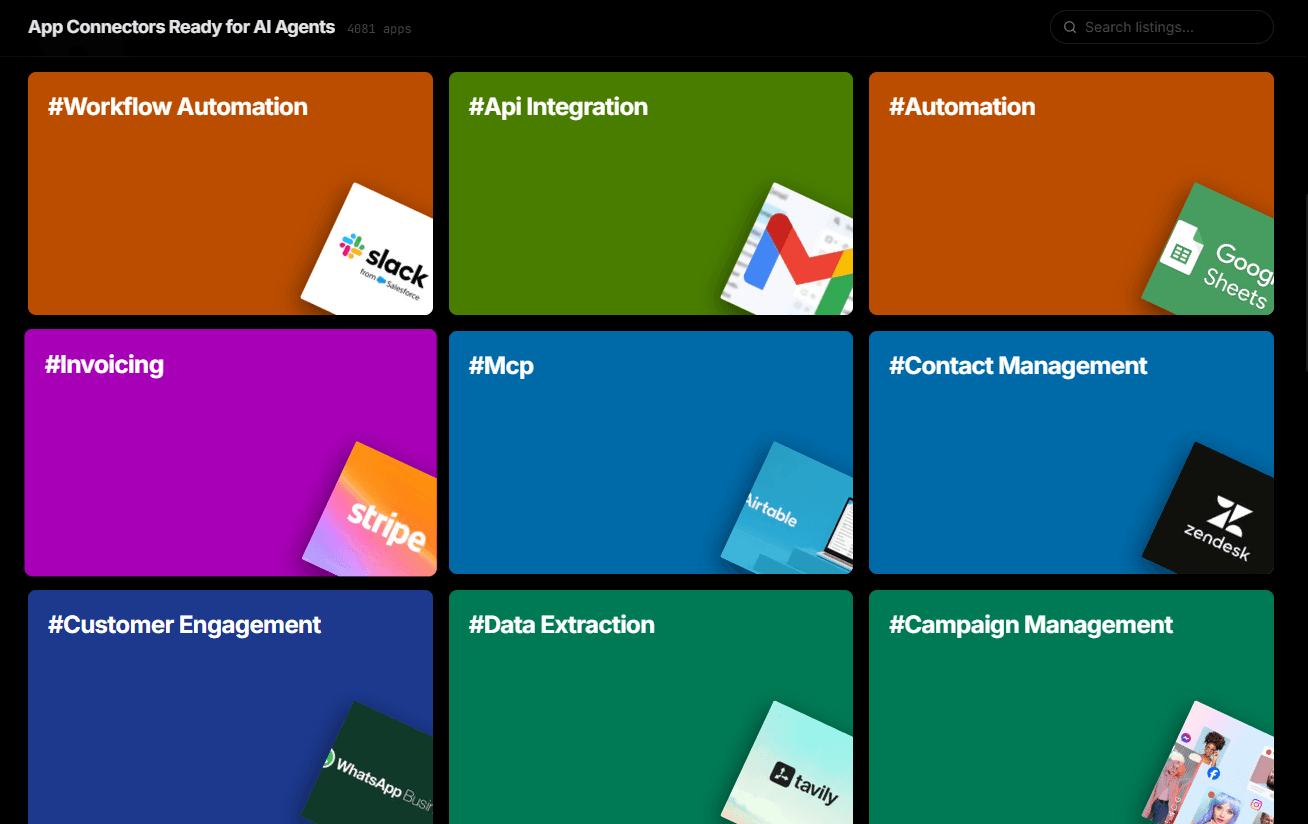
Over 4,000 integrations ready for AI agents
Explore a vast library of pre-built integrations, optimized and ready to deploy.
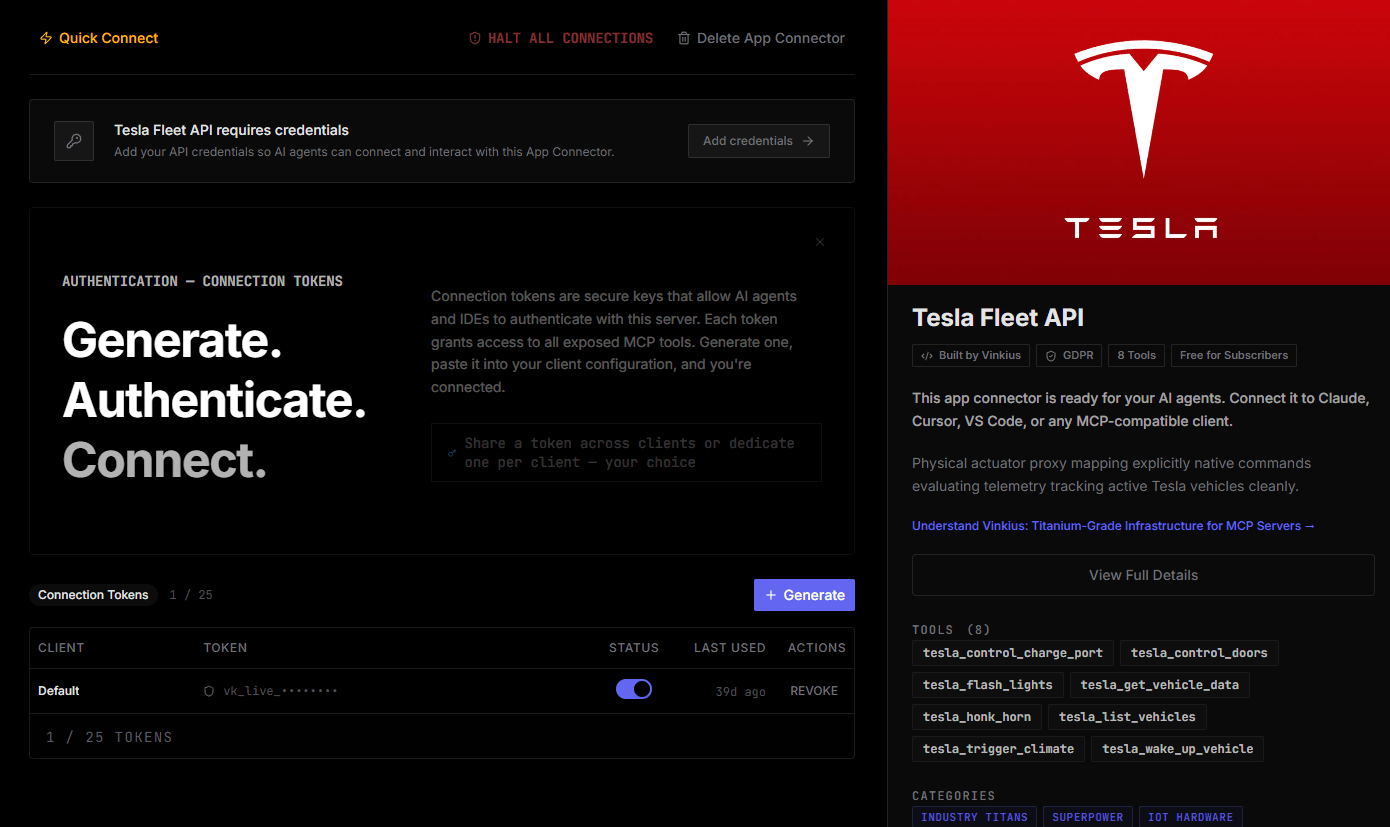
Connect securely in under 30 seconds
Generate tokens to authenticate and link external services in a single step.
Complete visibility into every agent action
Audit live requests, latency, success rates, and active security compliance policies.
Optimize spending and track token ROI
Analyze real-time token consumption and cost metrics detailed by connection.
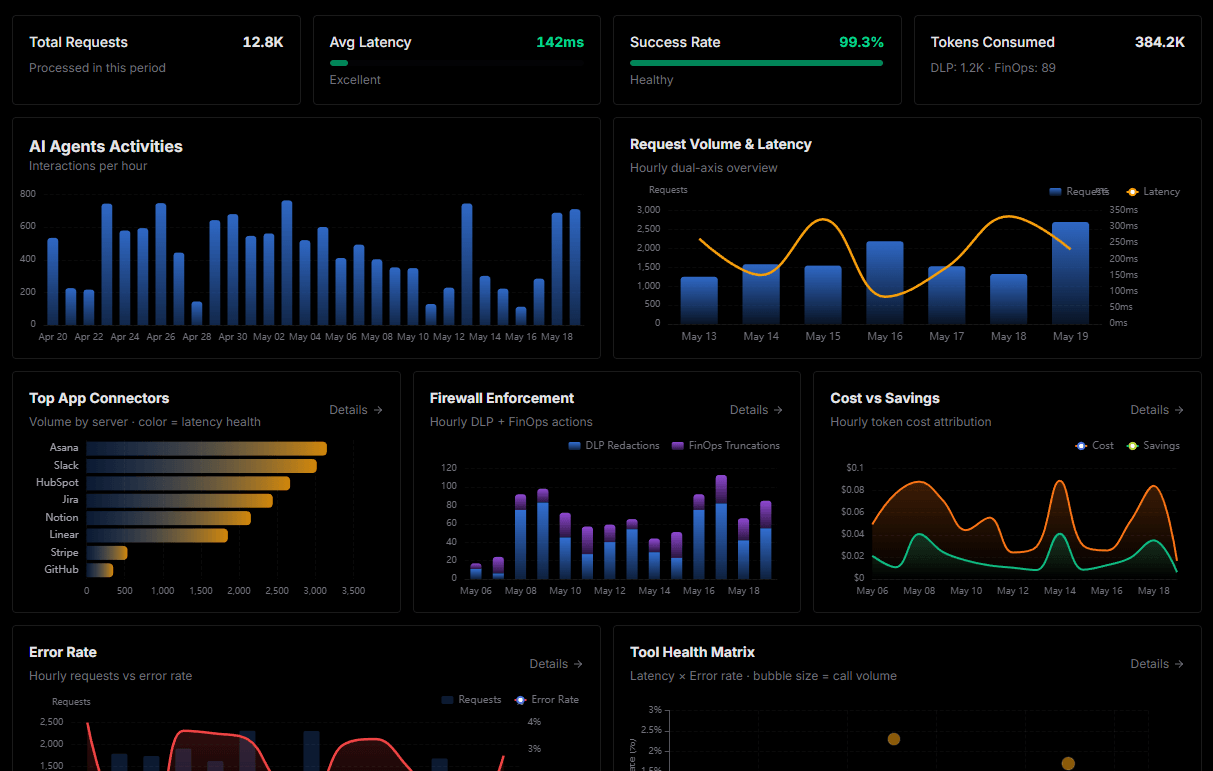
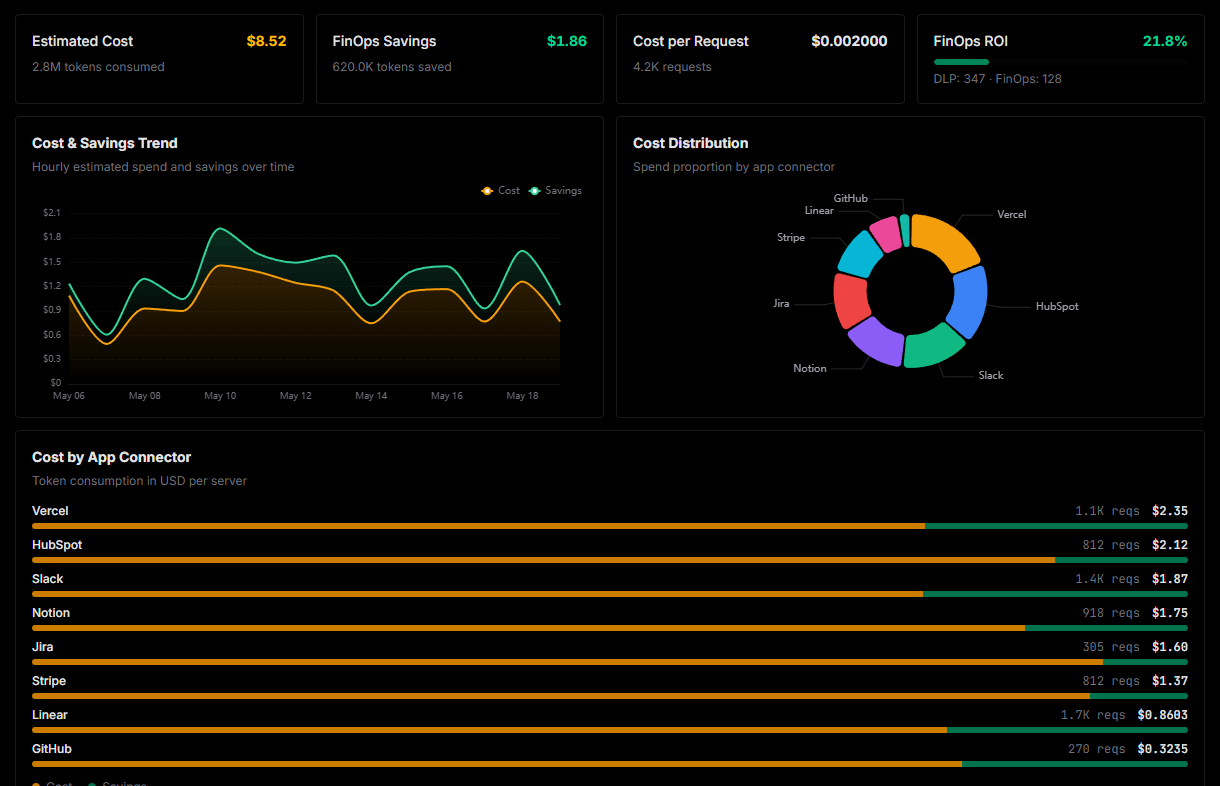
Explore our live AI Agents Analytics dashboard to see it all working
This dashboard is included when you connect MTA using Vinkius. You will never be left in the dark about what your AI agents are doing with your tools.
MTA and 4,000+ other AI tools. No hosting, no code, ready to use.
Professionals who connect MTA to CrewAI through Vinkius don't need to write code, manage servers, or worry about security. Everything is pre-configured, secure, and runs automatically in the background.
Raw MCP | Vinkius | |
|---|---|---|
| Ready-to-use MCPs | Find and configure each manually | 4,000+ MCPs ready to use |
| Connection Setup | Manual coding & server setup | 1-click instant connection |
| Server Hosting | You host it yourself (needs 24/7 uptime) | 100% hosted & managed by Vinkius |
| Security & Privacy | Stored in plaintext config files | Bank-grade encrypted vault |
| Activity Visibility | Blind execution (no logs or tracking) | Live dashboard with real-time logs |
| Cost Control | Runaway AI token spend risk | Automatic budget limits |
| Revoking Access | Must delete files or code to stop | 1-click disconnect button |
How Vinkius secures
MTA for CrewAI
Every request between CrewAI and MTA is protected by our secure gateway. We automatically keep your sensitive data private, prevent unauthorized access, and let you disconnect instantly at any time.
Frequently asked questions
Can my AI check when the next subway train is arriving at my station?
Yes! Use the get_subway_feed tool with the appropriate feed ID for your line. Feed IDs are grouped: "1" covers lines 1,2,3,4,5,6,S; "2" covers A,C,E; "3" covers B,D,F,M; "4" is G; "5" is J,Z; "6" covers N,Q,R,W; "7" is L; "11" is Staten Island Railway. This returns real-time GTFS-RT data with train positions, trip updates, scheduled vs. real-time arrivals, and delay information. For station-level predictions, combine with get_stations to find your station code first.
How do I check when the next MTA bus is arriving at a specific stop?
First use get_bus_stops with a route ID to find the stop ID (MonitoringRef) for your location. Then use get_bus_predictions with that stop ID to get real-time estimated arrival times, route information, destinations, and delay indicators. For more targeted predictions, use get_bus_estimated_arrival which allows filtering by both stop ID and route ID. Stop IDs are numeric identifiers assigned by MTA to each physical bus stop across NYC.
Are there any service disruptions affecting my subway line or bus route right now?
Use get_service_alerts to check all active service disruptions across the MTA system. This returns alerts with affected lines and stations, disruption descriptions, severity levels, cause types (maintenance, incident, weather, special events, construction), start and end timestamps, and alternative service recommendations. Covers NYC Subway, buses, LIRR, and Metro-North. Always check this before planning any journey to ensure you are aware of delays, planned work, or service changes.
How does CrewAI discover and connect to MCP tools?
CrewAI connects to MCP servers lazily. when the crew starts, each agent resolves its MCP URLs and fetches the tool catalog via the standard tools/list method. This means tools are always fresh and reflect the server's current capabilities. No tool schemas need to be hardcoded.
Can different agents in the same crew use different MCP servers?
Yes. Each agent has its own mcps list, so you can assign specific servers to specific roles. For example, a reconnaissance agent might use a domain intelligence server while an analysis agent uses a vulnerability database server.
What happens when an MCP tool call fails during a crew run?
CrewAI wraps tool failures as context for the agent. The LLM receives the error message and can decide to retry with different parameters, fall back to a different tool, or mark the task as partially complete. This resilience is critical for production workflows.
Can CrewAI agents call multiple MCP tools in parallel?
CrewAI agents execute tool calls sequentially within a single reasoning step. However, you can run multiple agents in parallel using process=Process.parallel, each calling different MCP tools concurrently. This is ideal for workflows where separate data sources need to be queried simultaneously.
Can I run CrewAI crews on a schedule (cron)?
Yes. CrewAI crews are standard Python scripts, so you can invoke them via cron, Airflow, Celery, or any task scheduler. The crew.kickoff() method runs synchronously by default, making it straightforward to integrate into existing pipelines.
MCP tools not discovered
Ensure the Edge URL is correct. CrewAI connects lazily when the crew starts. check console output.
Agent not using tools
Make the task description specific. Instead of "do something", say "Use the available tools to list contacts".
Timeout errors
CrewAI has a 10s connection timeout by default. Ensure your network can reach the Edge URL.
Rate limiting or 429 errors
Vinkius enforces per-token rate limits. Check your subscription tier and request quota in the dashboard. Upgrade if you need higher throughput.
Explore More MCP Servers
View all →
Mercado Livre Orders
7 toolsSearch sales, manage shipments, track packages, and handle cancellations on Mercado Livre.
BLS Public Data API
2 toolsAccess labor statistics — audit economic series and trends via AI.
Facturama (SAT)
14 toolsAutomate CFDI Mexico (SAT) Tax Invoices via Facturama — emit formal invoices, retrieve catalogs, and extract tax data fully relying on your AI.

Logseq (Knowledge Management)
10 toolsManage your knowledge base via Logseq — create pages, insert outliner blocks, and search across your local graph.