
Bring Openalex
to CrewAI
Learn how to connect Stanford OpenAlex to CrewAI and start using 16 AI agent tools in minutes. Fully managed, enterprise secure, and ready to use without writing a single line of code.
 GDPR Free for Subscribers
Compatible with every major AI agent and IDE
 Gemini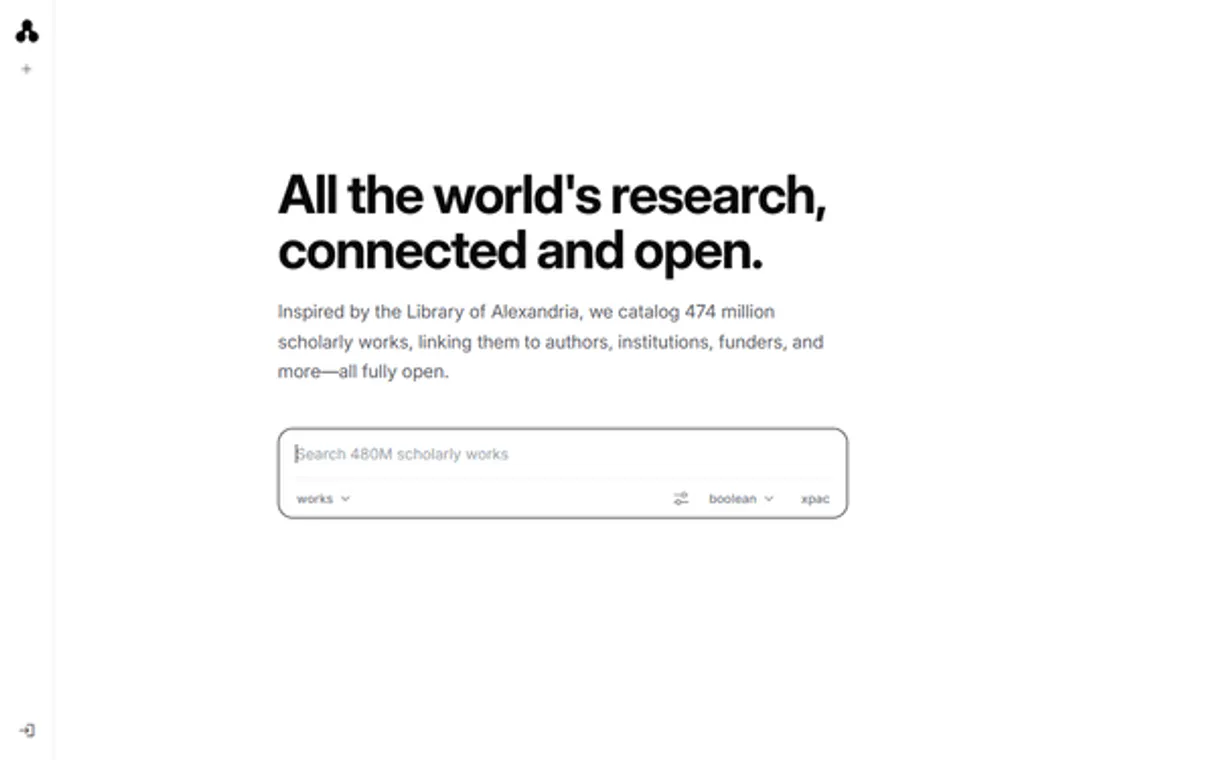
What is the Stanford OpenAlex MCP Server?
Connect to the OpenAlex API — the fully open catalog of the global research system.
What you can do
- Works — Search and analyze 250M+ academic works (papers, books, datasets, patents)
- Authors — Browse 90M+ researcher profiles with h-index, i10-index, and citation metrics
- Institutions — Explore 100K+ universities, labs, and research organizations worldwide
- Sources — Query 240K+ journals, conferences, and repositories with impact metrics
- Concepts — Navigate the 65K+ scientific concept taxonomy from broad to specific
- Funders — Discover which organizations fund specific research areas
- Publishers — Analyze the academic publishing landscape
- Topics — Explore hierarchical topic classifications across all of science
- Open Access — Find freely available research papers
How it works
- Subscribe to this server
- No API key required — OpenAlex is 100% free and open
- Start exploring the academic world from Claude, Cursor, or any MCP-compatible client
Who is this for?
- Research Administrators — benchmark institutions, track funding landscapes
- Bibliometricians — analyze publication trends, citation patterns, and research impact
- Science Policy Makers — understand research funding and output by country and institution
- Academic Librarians — explore journal metrics and open access availability
Built-in capabilities (16)
Returns name, affiliations, paper count, citation count, h-index, i10-index, 2-year mean citedness, top research concepts, and publication trends by year. The definitive tool for assessing academic impact. Get author profile with h-index, citations, and impact metrics
Returns works with titles, DOIs, years, citation counts, open access status, and primary venues. Sort by "cited_by_count:desc" for most cited or "publication_date:desc" for most recent. Get all works by a specific author
Essential for understanding the structure of a research field. Get concept details with ancestors, related concepts, and trends
Use this to understand which organizations fund specific research areas. Get funder details and funded research statistics
Get institution details with research metrics and collaborations
Essential for evaluating journal quality and coverage. Get journal or conference details with impact metrics
Accepts OpenAlex IDs (e.g. "W2741809807"), DOIs (e.g. "https://doi.org/10.1038/s41586-021-03819-2"), PubMed IDs (e.g. "pmid:34845388"), or MAG IDs. Returns title, abstract, authors with institutions, concepts, citation count, open access status, and publication details. Get academic work details by OpenAlex ID, DOI, or PubMed ID
Returns display name, ORCID, works count, citation count, h-index, i10-index, and last known institution. Filter examples: "cited_by_count:>10000", "works_count:>100", "last_known_institutions.country_code:US". Search 90M+ academic authors by name
Returns names, levels, descriptions, works counts, and citation counts. Search 65K+ scientific concepts in the knowledge hierarchy
Returns names, countries, grants counts, works funded, and citation impact. Essential for understanding research funding landscapes. Search funding organizations worldwide
Returns names, countries, types, works counts, citation counts, and homepages. Filter examples: "country_code:US", "type:education", "cited_by_count:>1000000". Search 100K+ research institutions worldwide
This is a specialized filter of the works endpoint that returns only papers with open access PDFs. Ideal for researchers who need freely accessible literature for reading, citation, or meta-analysis. Search only open access academic works
Returns names, countries, works counts, and citation counts. Useful for analyzing the publishing landscape. Search academic publishers
Returns names, ISSNs, types, works counts, citation counts, and open access status. Filter examples: "type:journal", "is_oa:true", "cited_by_count:>100000". Search 240K+ academic journals, conferences, and repositories
Returns topic names, descriptions, associated works and citations, plus the parent field and domain. Use this to map the landscape of a research area. Search topic classifications across all of science
Supports full-text search plus structured filters. Filter syntax examples: "publication_year:2024", "open_access.is_oa:true", "type:journal-article", "cited_by_count:>100". Sort options: "cited_by_count:desc", "publication_date:desc", "relevance_score:desc". Search 250M+ academic works by keyword or filter
Why CrewAI?
When paired with CrewAI, Stanford OpenAlex becomes a first-class tool in your multi-agent workflows. Each agent in the crew can call Stanford OpenAlex tools autonomously, one agent queries data, another analyzes results, a third compiles reports, all orchestrated through Vinkius with zero configuration overhead.
- —
Multi-agent collaboration lets you decompose complex workflows into specialized roles, one agent researches, another analyzes, a third generates reports, each with access to MCP tools
- —
CrewAI's native MCP integration requires zero adapter code: pass Vinkius Edge URL directly in the
mcpsparameter and agents auto-discover every available tool at runtime - —
Built-in task delegation and shared memory mean agents can pass context between steps without manual state management, enabling multi-hop reasoning across tool calls
- —
Sequential and hierarchical crew patterns map naturally to real-world workflows: enumerate subdomains → analyze DNS history → check WHOIS records → compile findings into actionable reports
Stanford OpenAlex in CrewAI
Stanford OpenAlex and 4,000+ other MCP servers. One platform. One governance layer.
Teams that connect Stanford OpenAlex to CrewAI through Vinkius don't need to source, host, or maintain individual MCP servers. Every tool call runs inside a hardened runtime with credential isolation, DLP, and a signed audit chain.
Raw MCP | Vinkius | |
|---|---|---|
| Server catalog | Find and host yourself | 4,000+ managed |
| Infrastructure | Self-hosted | Sandboxed V8 isolates |
| Credential handling | Plaintext in config | Vault + runtime injection |
| Data loss prevention | None | Configurable DLP policies |
| Kill switch | None | Global instant shutdown |
| Financial circuit breakers | None | Per-server limits + alerts |
| Audit trail | None | Ed25519 signed logs |
| SIEM log streaming | None | Splunk, Datadog, Webhook |
| Honeytokens | None | Canary alerts on leak |
| Custom domains | Not applicable | DNS challenge verified |
| GDPR compliance | Manual effort | Automated purge + export |
Why teams choose Vinkius for Stanford OpenAlex in CrewAI
The Stanford OpenAlex MCP Server runs on Vinkius-managed infrastructure inside AWS — a purpose-built runtime with per-request V8 isolates, Ed25519 signed audit chains, and sub-40ms cold starts. All 16 tools execute in hardened sandboxes optimized for native MCP execution.
Your AI agents in CrewAI only access the data you authorize, with DLP that blocks sensitive information from ever reaching the model, kill switch for instant shutdown, and up to 60% token savings. Enterprise-grade infrastructure, zero maintenance.
* Every MCP server runs on Vinkius-managed infrastructure inside AWS - a purpose-built runtime with per-request V8 isolates, Ed25519 signed audit chains, and sub-40ms cold starts optimized for native MCP execution. See our infrastructure
How Vinkius secures
Stanford OpenAlex for CrewAI
Every tool call from CrewAI to the Stanford OpenAlex MCP Server is protected by DLP redaction, cryptographic audit chains, V8 sandbox isolation, kill switch, and financial circuit breakers.
Frequently asked questions
Do I need an API key?
No. OpenAlex is 100% free and open. No registration or API key is required.
How is OpenAlex different from Semantic Scholar?
OpenAlex provides a broader ecosystem view with entities for institutions, journals, funders, publishers, and concepts — not just papers and authors. It is ideal for bibliometric analysis, institutional benchmarking, and understanding the structure of the research system. Semantic Scholar excels at AI-powered recommendations and citation graph navigation.
What replaced Microsoft Academic Graph?
OpenAlex was created as the free, open-source successor to Microsoft Academic Graph (MAG), which was discontinued in 2022. OpenAlex now contains over 250 million works and continues to grow, fully funded by grants to ensure permanent public access.
How does CrewAI discover and connect to MCP tools?
CrewAI connects to MCP servers lazily. when the crew starts, each agent resolves its MCP URLs and fetches the tool catalog via the standard tools/list method. This means tools are always fresh and reflect the server's current capabilities. No tool schemas need to be hardcoded.
Can different agents in the same crew use different MCP servers?
Yes. Each agent has its own mcps list, so you can assign specific servers to specific roles. For example, a reconnaissance agent might use a domain intelligence server while an analysis agent uses a vulnerability database server.
What happens when an MCP tool call fails during a crew run?
CrewAI wraps tool failures as context for the agent. The LLM receives the error message and can decide to retry with different parameters, fall back to a different tool, or mark the task as partially complete. This resilience is critical for production workflows.
Can CrewAI agents call multiple MCP tools in parallel?
CrewAI agents execute tool calls sequentially within a single reasoning step. However, you can run multiple agents in parallel using process=Process.parallel, each calling different MCP tools concurrently. This is ideal for workflows where separate data sources need to be queried simultaneously.
Can I run CrewAI crews on a schedule (cron)?
Yes. CrewAI crews are standard Python scripts, so you can invoke them via cron, Airflow, Celery, or any task scheduler. The crew.kickoff() method runs synchronously by default, making it straightforward to integrate into existing pipelines.
MCP tools not discovered
Ensure the Edge URL is correct. CrewAI connects lazily when the crew starts. check console output.
Agent not using tools
Make the task description specific. Instead of "do something", say "Use the available tools to list contacts".
Timeout errors
CrewAI has a 10s connection timeout by default. Ensure your network can reach the Edge URL.
Rate limiting or 429 errors
Vinkius enforces per-token rate limits. Check your subscription tier and request quota in the dashboard. Upgrade if you need higher throughput.
Explore More MCP Servers
View all →
Levenshtein Distance Engine
1 toolsCalculate the exact edit distance between two strings. Essential for fuzzy matching, spell checking, and deduplication. Stop LLMs from guessing string similarity.

BOSSDesk
10 toolsManage your IT services via BOSSDesk — track tickets, assets, and users directly from any AI agent.

Cohere (AI Platform)
7 toolsPower enterprise AI via Cohere — generate text, perform chat completions, reorder documents, and manage embeddings directly from any AI agent.

Healthchecks.io
13 toolsMonitor cron jobs and background tasks via Healthchecks.io — list checks, track pings, and manage alerts directly from any AI agent.