
Bring Honeywell Forge
to Cursor
Create your Vinkius account to connect Honeywell Forge to Cursor and start using all 11 AI tools in minutes. Fully managed, enterprise secure, and ready to use without writing a single line of code. No hosting, no server setup — just connect and start using.
 GDPR Free for Subscribers
Compatible with every major AI agent and IDE
 Gemini
What is the Honeywell Forge MCP Server?
Connect Honeywell Forge to any AI agent via MCP. Unlock 11 tools ready out of the box. Connect this MCP Server to instantly empower AI agents like Claude Code, Cursor, or any MCP-compatible client with advanced capabilities.
Built-in capabilities (11)
Acknowledgment does not resolve or clear the underlying condition—it simply records that a human has reviewed the alarm and is aware of it. This updates the alarm state from "unacknowledged" to "acknowledged" in the Forge audit log, which is important for compliance and incident-tracking workflows. Provide the exact alarm ID as returned by get_alarms. Use this during incident response to track which alarms have been seen by the operations team. Acknowledge an active alarm in Honeywell Forge
Alarms cover a wide range of conditions: security breaches (door forced, tailgating), fire and life safety (smoke detector activation, pull station), HVAC faults, and system health warnings. Each alarm record includes severity level, timestamp, source device, description, and acknowledgment status. Optionally filter by building_id to scope results to a single site. Use this to triage active incidents, audit historical events, or identify recurring fault patterns. List active and historical alarms across all buildings or a specific building
Returns comprehensive metadata including HVAC zones, floor plans, linked subsystems (access control, fire life safety, video surveillance), energy targets, and operating schedules. Use this when you need a deep-dive view of a single site before performing operations like checking alarms or querying energy usage. Get detailed information about a specific Honeywell Forge building
The response includes whether the door is currently open or closed, locked or unlocked, and any active fault conditions such as "door held open" or "forced open". This is a read-only, point-in-time snapshot—use it to verify the physical state of a door before granting access or investigating a security event. Get the real-time status of a specific door or access point
Returns aggregated consumption data including total kWh, cost estimates, demand peaks, and breakdowns by subsystem (HVAC, lighting, plug loads). Metrics may be presented as time-series data points with timestamps, allowing trend analysis and comparison against energy budgets. Use this to monitor sustainability KPIs, identify wasteful consumption patterns, or prepare energy audit reports for facility managers. Get energy consumption data for a specific building
Returns data points including zone temperature, setpoint targets, humidity levels, and HVAC equipment status (compressor running, valve position, fan speed). This data is essential for thermal comfort analysis, energy optimization, and proactive maintenance—such as identifying zones that consistently deviate from setpoints or detecting equipment degradation before failure. Use this to diagnose comfort complaints or validate HVAC scheduling changes. Get temperature and HVAC sensor data for a specific building
An access point represents a physical entry device—door, gate, turnstile, or barrier—managed by the Forge access control subsystem. Each record includes the access point ID, name, current lock state, door status (open/closed/forced), assigned access level, and the zone it belongs to. Use this to audit physical security surfaces before running lock/unlock commands or investigating door-forced alarm events. List all access control points (doors, gates, turnstiles) for a building
Each record contains the building identifier, name, address, operational status, and metadata such as time zone and total floor area. Use this tool as the entry point for any building-centric workflow—once you have the building ID you can drill down into access points, alarms, energy metrics, or video feeds. List all buildings registered in Honeywell Forge
Each record represents a camera or NVR channel with metadata including camera name, location within the building, stream URL (RTSP or HLS), resolution, current online/offline status, and recording mode (continuous, motion-triggered, scheduled). Use this to discover which cameras are available for live viewing or forensic review, and to map camera IDs to physical locations before correlating video with alarm events. List available video surveillance feeds for a building
The door will immediately engage its locking mechanism and transition to a secured state. Only authorized credentials holders can override this lock via normal badge or PIN access. Use this when securing a building after hours, during a lockdown event, or to enforce temporary access restrictions. Confirm the door identity with list_access_points before executing. Lock a specific door or access point in Honeywell Forge
The door will disengage its lock and enter a free-access state until explicitly re-locked or returned to its scheduled access control mode. Use this for emergency egress, visitor accommodation, or maintenance access. Always verify the correct access point ID before unlocking to avoid unintended security gaps. Unlock a specific door or access point in Honeywell Forge
Why Cursor?
Cursor's Agent mode turns Honeywell Forge into an in-editor superpower. Ask Cursor to generate code using live data from Honeywell Forge and it fetches, processes, and writes. all in a single agentic loop. 11 tools appear alongside file editing and terminal access, creating a unified development environment grounded in real-time information.
- —
Agent mode turns Cursor into an autonomous coding assistant that can read files, run commands, and call MCP tools without switching context
- —
Cursor's Composer feature can generate entire files using real-time data fetched through MCP. no copy-pasting from external dashboards
- —
MCP tools appear alongside built-in tools like file reading and terminal access, creating a unified agentic environment
- —
VS Code extension compatibility means your existing workflow, keybindings, and extensions all work alongside MCP tools
Honeywell Forge in Cursor
Prompt examples coming soon.
Why run Honeywell Forge with Vinkius?
The Honeywell Forge connection runs on our fully managed, secure cloud infrastructure. We handle the hosting, maintenance, and security so you don't have to deal with servers or code. All 11 tools are ready to work instantly without any complex setup.
You stay in complete control of your data. Your AI only accesses the information you approve, keeping your sensitive passwords and private details completely safe. Plus, with automatic optimizations, your AI works faster and more efficiently.
* Every connection is hosted and maintained by Vinkius. We handle the security, updates, and infrastructure so you don't have to write code or manage servers. See our infrastructure
Over 4,000 integrations ready for AI agents
Explore a vast library of pre-built integrations, optimized and ready to deploy.
Connect securely in under 30 seconds
Generate tokens to authenticate and link external services in a single step.
Complete visibility into every agent action
Audit live requests, latency, success rates, and active security compliance policies.
Optimize spending and track token ROI
Analyze real-time token consumption and cost metrics detailed by connection.
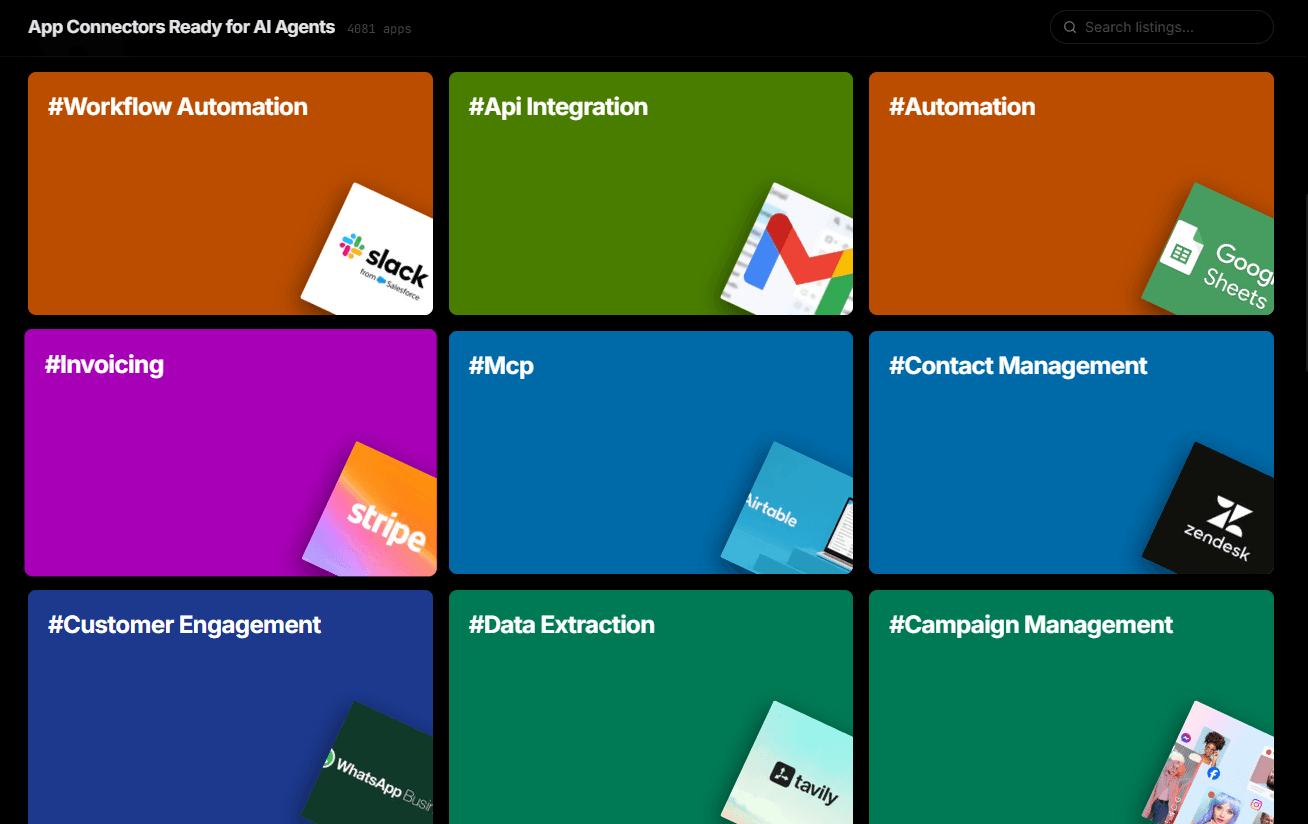
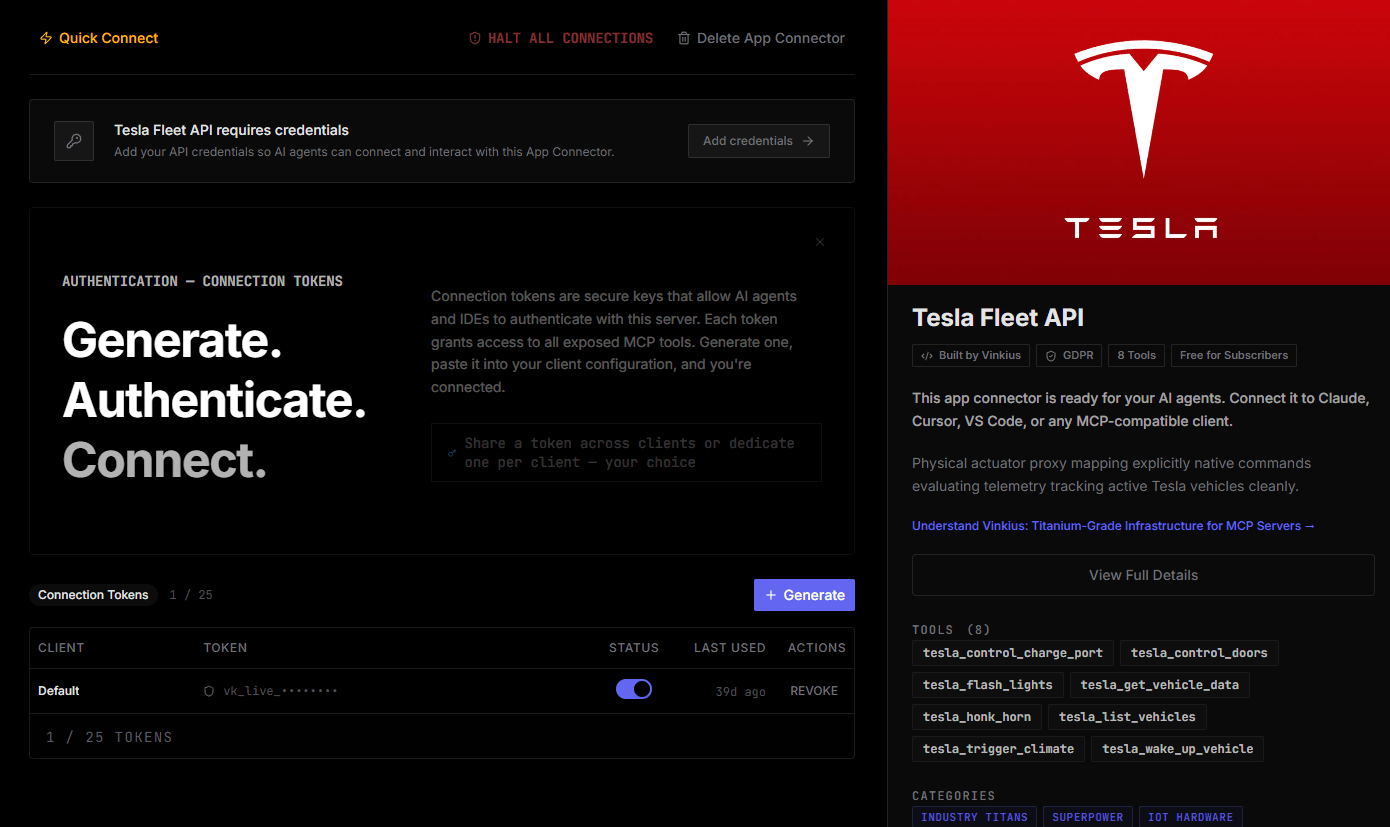
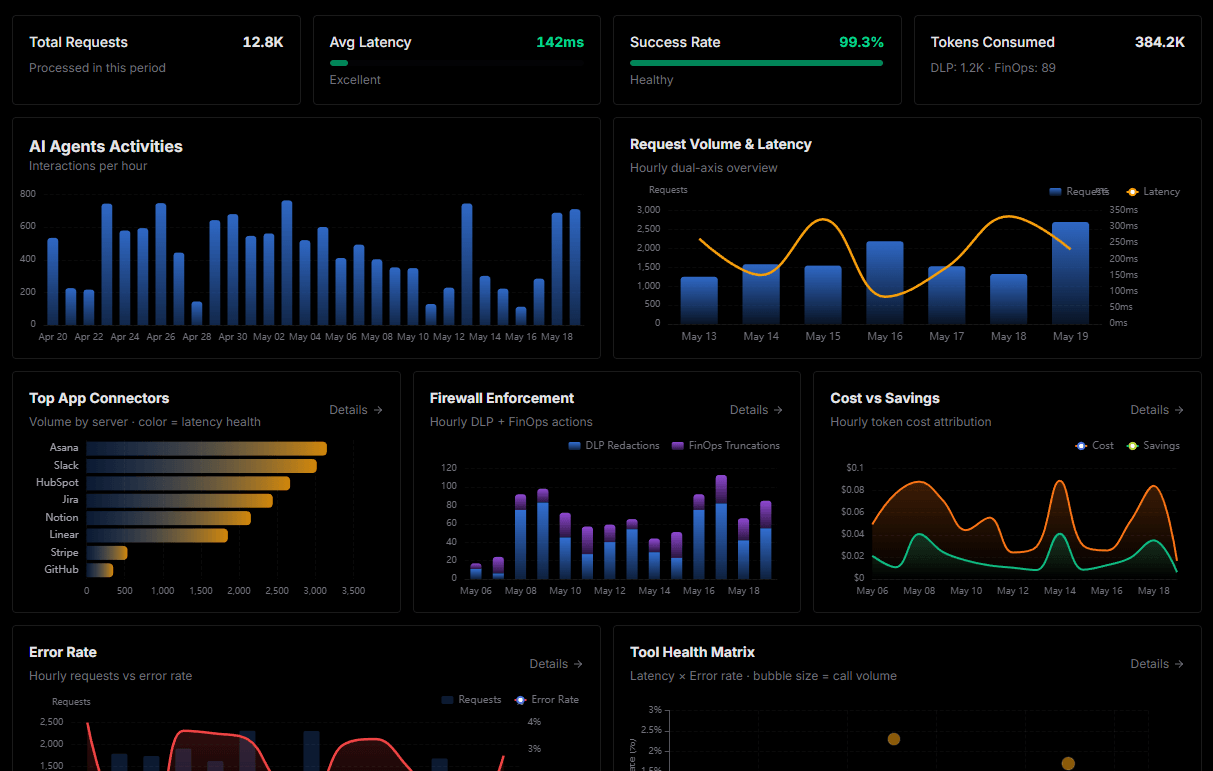
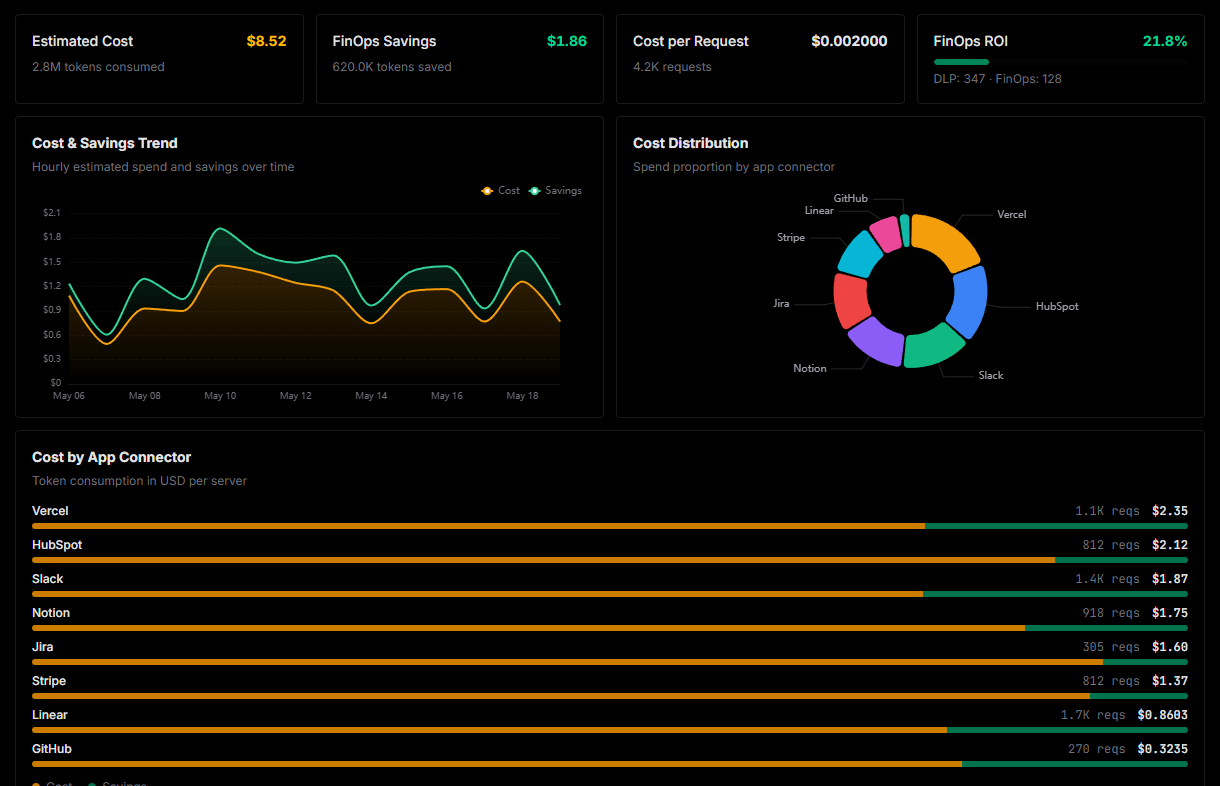
Explore our live AI Agents Analytics dashboard to see it all working
This dashboard is included when you connect Honeywell Forge using Vinkius. You will never be left in the dark about what your AI agents are doing with your tools.
Honeywell Forge and 4,000+ other AI tools. No hosting, no code, ready to use.
Professionals who connect Honeywell Forge to Cursor through Vinkius don't need to write code, manage servers, or worry about security. Everything is pre-configured, secure, and runs automatically in the background.
Raw MCP | Vinkius | |
|---|---|---|
| Ready-to-use MCPs | Find and configure each manually | 4,000+ MCPs ready to use |
| Connection Setup | Manual coding & server setup | 1-click instant connection |
| Server Hosting | You host it yourself (needs 24/7 uptime) | 100% hosted & managed by Vinkius |
| Security & Privacy | Stored in plaintext config files | Bank-grade encrypted vault |
| Activity Visibility | Blind execution (no logs or tracking) | Live dashboard with real-time logs |
| Cost Control | Runaway AI token spend risk | Automatic budget limits |
| Revoking Access | Must delete files or code to stop | 1-click disconnect button |
How Vinkius secures
Honeywell Forge for Cursor
Every request between Cursor and Honeywell Forge is protected by our secure gateway. We automatically keep your sensitive data private, prevent unauthorized access, and let you disconnect instantly at any time.
Frequently asked questions
What is Agent mode and why does it matter for MCP?
Agent mode is Cursor's autonomous execution mode where the AI can perform multi-step tasks: reading files, editing code, running terminal commands, and calling MCP tools. Without Agent mode, Cursor operates in a simpler ask-and-answer mode that doesn't support tool calling. Always ensure you're in Agent mode when working with MCP servers.
Where does Cursor store MCP configuration?
Cursor looks for MCP server configurations in a mcp.json file. You can configure servers at the project level (.cursor/mcp.json in your project root) or globally (~/.cursor/mcp.json). Project-level configs take precedence.
Can Cursor use MCP tools in inline edits?
No. MCP tools are only available in Agent mode through the chat panel. Inline completions and Tab suggestions do not trigger MCP tool calls. This is by design. tool calls require user visibility and approval.
How do I verify MCP tools are loaded?
Open Settings → Features → MCP and look for your server name. A green indicator means the server is connected. You can also check Agent mode's available tools by clicking the tools dropdown in the chat panel.
Tools not appearing in Cursor
Ensure you are in Agent mode (not Ask mode). MCP tools only work in Agent mode.
Server shows as disconnected
Check Settings → Features → MCP and verify the server status. Try clicking the refresh button.
Explore More MCP Servers
View all →
Google BigQuery
7 toolsEmpower your AI agent to query massive datasets via BigQuery — execute Standard SQL, track active jobs, and inspect table schemas natively.

Simple Analytics
5 toolsPrivacy-first web analytics without cookies. Fetch aggregated stats, export raw data, and manage your websites directly from your AI agent.

Banco Inter
8 toolsConnect to your Banco Inter Empresas digital account. Automate Pix, Boletos, balance inquiries and statements.

LiveKit
41 toolsManage real-time video, audio, and data sessions via LiveKit — create rooms, manage participants, and trigger recordings directly from your AI agent.