
Bring Legal Research
to LangChain
Create your Vinkius account to connect OpenLaws to LangChain and start using all 14 AI tools in minutes. Fully managed, enterprise secure, and ready to use without writing a single line of code. No hosting, no server setup — just connect and start using.
 GDPR Free for Subscribers
Compatible with every major AI agent and IDE
 Gemini
What is the OpenLaws MCP Server?
Connect your OpenLaws API account to any AI agent and take full control of legal research, citation validation, and legislative monitoring workflows through natural conversation.
What you can do
- Statute Search — Search federal and state statutes by keyword (BM25) across all 50 states simultaneously, or scope to specific jurisdictions
- Regulation Search — Query Code of Federal Regulations (CFR) and state regulations with fast keyword search and jurisdiction filtering
- Case Law Search — Search ~5-6 million case opinions from Harvard CAP and CourtListener, filtered by jurisdiction, court, or federal circuit
- Citation Validation — Validate and identify malformed legal citations, find original government sources for citations across 53 jurisdictions
- Constitutional Provisions — Search US Constitution and all 50 state constitutions for specific provisions and amendments
- Legislative History — Retrieve historical versions of federal statutes and generate redline comparisons between legislative sessions
- Recent Updates — Monitor recent legal updates and changes across jurisdictions for compliance tracking
How it works
- Subscribe to this server
- Enter your OpenLaws API Bearer token
- Start researching laws, validating citations, and monitoring legislative changes from Claude, Cursor, or any MCP-compatible client
No more manual legal research across fragmented government websites. Your AI acts as a dedicated legal research assistant or compliance analyst.
Who is this for?
- Legal Professionals — instantly search statutes, regulations, and case law across multiple jurisdictions without opening dozens of government websites
- Compliance Teams — monitor recent legislative updates and track regulatory changes to maintain compliance programs
- LegalTech Developers — integrate validated legal data into RAG pipelines, agentic workflows, and NLP/ML applications
- Policy Researchers — conduct 50-state surveys, analyze legislative history, and compare statutory changes over time
Built-in capabilities (14)
Use this to get the complete court opinion after finding it via search_caselaw. The response includes the full opinion text, court details, date, citations, and parties involved. Get a specific case law opinion by its ID
Use this to get the complete provision content after finding it via search_constitutions. The response includes rich text content, article/section information, and amendments history. Get a specific constitution provision by its ID
Use the jurisdiction_id from list_jurisdictions to inspect details before scoping searches. Get details of a specific jurisdiction
You can view updates across all jurisdictions or filter to a specific state/federal level. This is useful for compliance monitoring and staying current with legislative changes. Optionally specify jurisdiction ID and limit the number of results. Example: check what changed in California employment law this month, or monitor federal regulatory updates. Get recent legal updates across jurisdictions or in a specific jurisdiction
This shows exactly what changed between legislative sessions or amendment cycles. Currently available for federal laws only (USC). Optionally specify from and to version dates. If not specified, compares the two most recent versions. Use this to understand legislative changes and their impact on compliance requirements. Get redline comparison between two versions of a federal statute
Use this to get the complete regulation content after finding it via search_regulations. The response includes rich text content, citations, and regulatory context. Get a specific regulation by its ID
Use this to get the complete statute content after finding it via search_statutes. The response includes rich text content, citations, effective dates, and annotations. Get a specific statute by its ID
This allows you to see how the law has changed over time. Currently available for federal laws only (USC - United States Code). Use the statute_id from search_statutes to view the legislative history and amendments. Get historical versions of a federal statute
Jurisdictions include federal (US), all 50 states, District of Columbia, and Puerto Rico. Each jurisdiction has an ID that can be used to scope searches to specific regions. Use this to discover what jurisdictions are available before searching statutes, regulations, or caselaw. List all available legal jurisdictions in OpenLaws
Data sourced from Harvard CAP project and CourtListener (~5-6 million cases). You can filter by jurisdiction, specific court, or federal circuit. The query parameter is required. Optionally filter by jurisdiction_id and court name. Results include case opinions, court information, dates, and citations. Example: search for " Fourth Amendment privacy" or "breach of contract" cases. Search case law opinions by keyword
You can search the US Constitution and all 50 state constitutions simultaneously. The query parameter is required. Optionally filter by jurisdiction ID. Results include constitutional provisions, amendments, and relevant sections. Example: search for "free speech" or "right to privacy" across all constitutions. Search constitutions by keyword across jurisdictions
You can search all jurisdictions simultaneously or scope to a specific region. The query parameter is required and contains the search term. Optionally filter by jurisdiction ID. Results include regulation text, citations, and contextual information. Example: search for "environmental protection" or "workplace safety" regulations. Search regulations by keyword across jurisdictions
You can search all 50 states simultaneously for 50-state surveys, or scope to a specific jurisdiction. The query parameter is required and contains the search term. Optionally filter by jurisdiction ID. Results include statute text, citations, effective dates, and jurisdiction information. Example: search for "data privacy" across all jurisdictions, or "employment" in California only. Search statutes by keyword across jurisdictions
This tool helps identify malformed citations and find the authoritative source document. Supports citations from all 50 states, DC, Puerto Rico, and federal sources. The citation parameter should be a standard legal citation format (e.g., "42 U.S.C. § 1983", "Brown v. Board of Education, 347 U.S. 483"). Use this to validate citations in legal documents, spreadsheets, or databases before relying on them. Validate a legal citation and find its original source
Why LangChain?
LangChain's ecosystem of 500+ components combines seamlessly with OpenLaws through native MCP adapters. Connect 14 tools via Vinkius and use ReAct agents, Plan-and-Execute strategies, or custom agent architectures. with LangSmith tracing giving full visibility into every tool call, latency, and token cost.
- —
The largest ecosystem of integrations, chains, and agents. combine OpenLaws MCP tools with 500+ LangChain components
- —
Agent architecture supports ReAct, Plan-and-Execute, and custom strategies with full MCP tool access at every step
- —
LangSmith tracing gives you complete visibility into tool calls, latencies, and token usage for production debugging
- —
Memory and conversation persistence let agents maintain context across OpenLaws queries for multi-turn workflows
OpenLaws in LangChain
Why run OpenLaws with Vinkius?
The OpenLaws connection runs on our fully managed, secure cloud infrastructure. We handle the hosting, maintenance, and security so you don't have to deal with servers or code. All 14 tools are ready to work instantly without any complex setup.
You stay in complete control of your data. Your AI only accesses the information you approve, keeping your sensitive passwords and private details completely safe. Plus, with automatic optimizations, your AI works faster and more efficiently.
* Every connection is hosted and maintained by Vinkius. We handle the security, updates, and infrastructure so you don't have to write code or manage servers. See our infrastructure
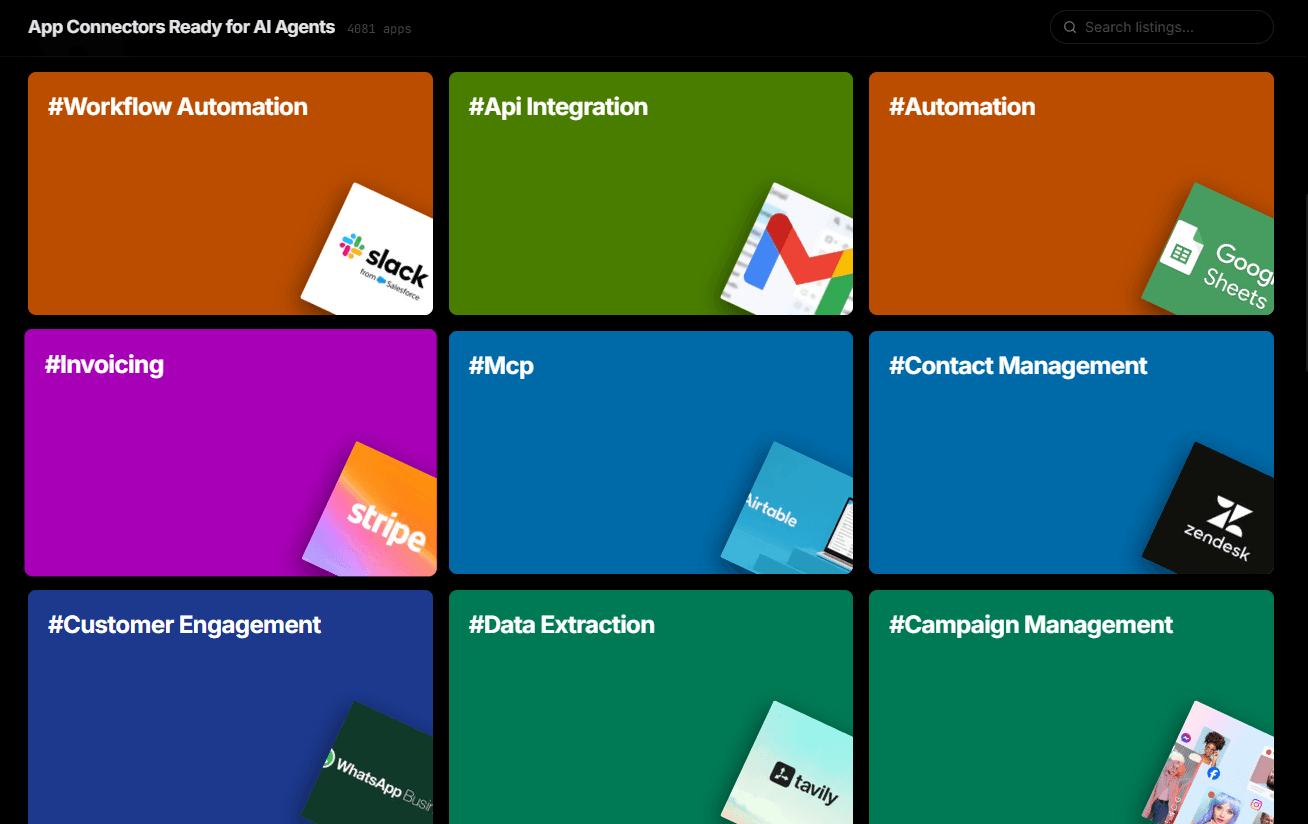
Over 4,000 integrations ready for AI agents
Explore a vast library of pre-built integrations, optimized and ready to deploy.
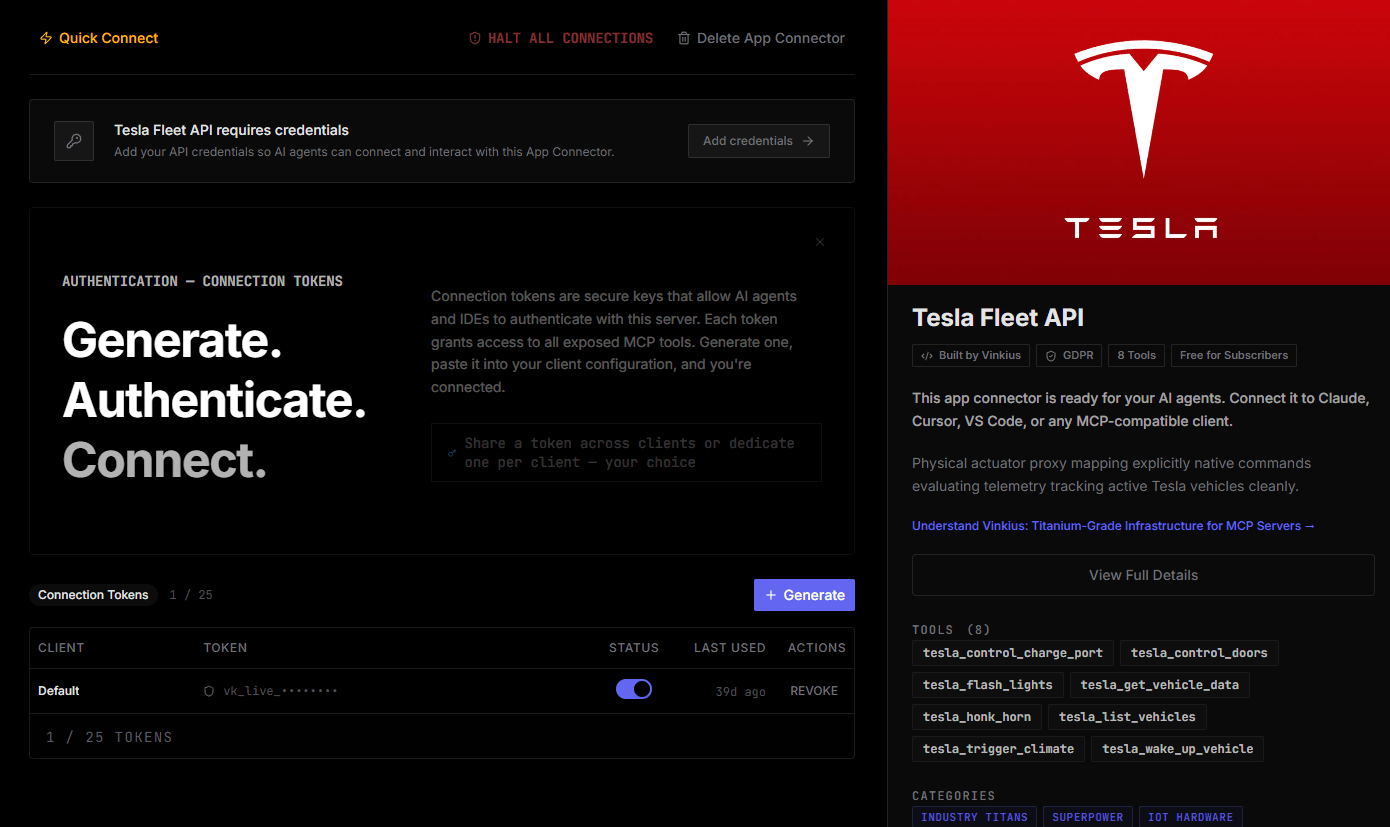
Connect securely in under 30 seconds
Generate tokens to authenticate and link external services in a single step.
Complete visibility into every agent action
Audit live requests, latency, success rates, and active security compliance policies.
Optimize spending and track token ROI
Analyze real-time token consumption and cost metrics detailed by connection.
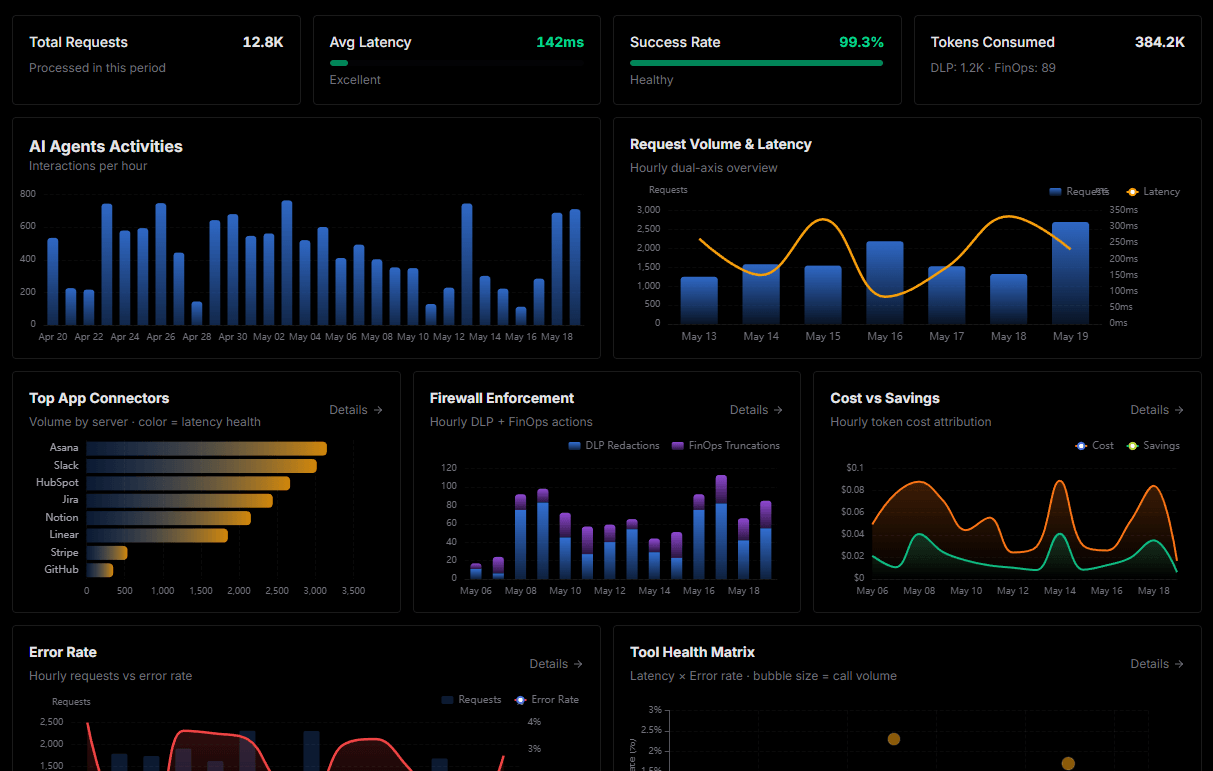
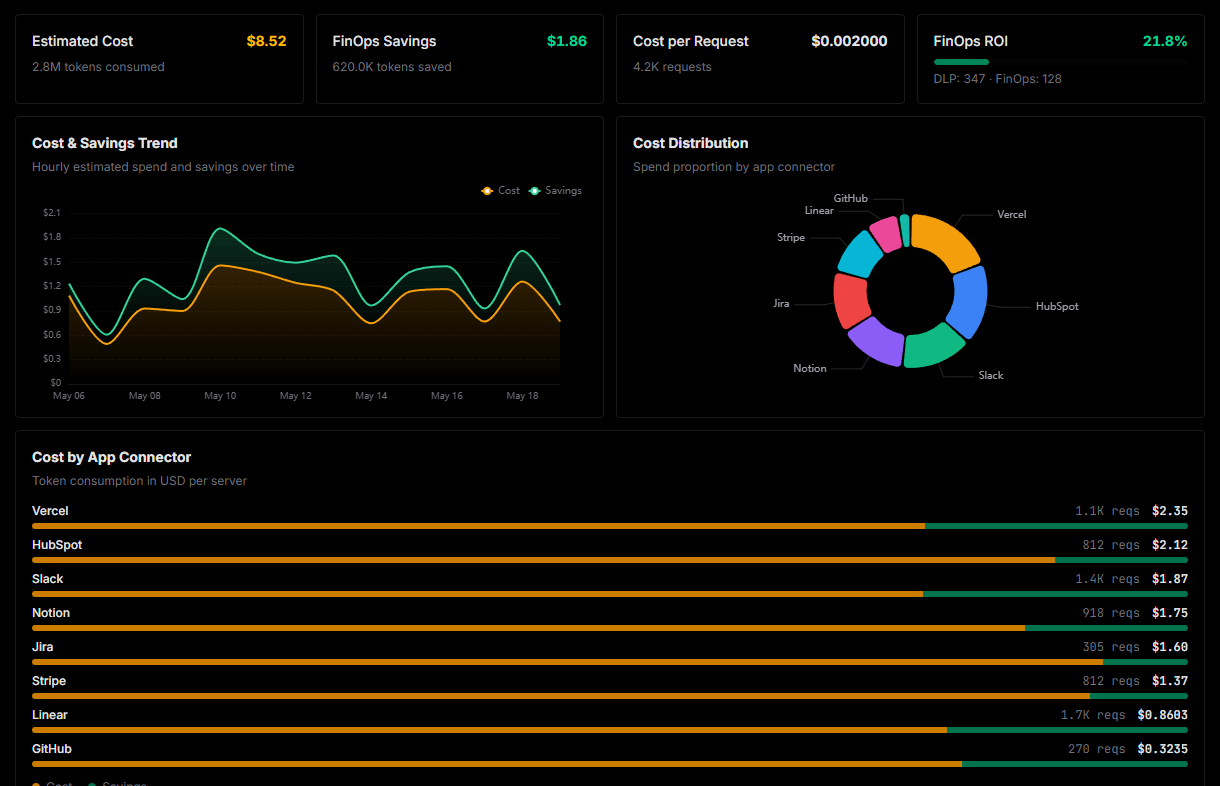
Explore our live AI Agents Analytics dashboard to see it all working
This dashboard is included when you connect OpenLaws using Vinkius. You will never be left in the dark about what your AI agents are doing with your tools.
OpenLaws and 4,000+ other AI tools. No hosting, no code, ready to use.
Professionals who connect OpenLaws to LangChain through Vinkius don't need to write code, manage servers, or worry about security. Everything is pre-configured, secure, and runs automatically in the background.
Raw MCP | Vinkius | |
|---|---|---|
| Ready-to-use MCPs | Find and configure each manually | 4,000+ MCPs ready to use |
| Connection Setup | Manual coding & server setup | 1-click instant connection |
| Server Hosting | You host it yourself (needs 24/7 uptime) | 100% hosted & managed by Vinkius |
| Security & Privacy | Stored in plaintext config files | Bank-grade encrypted vault |
| Activity Visibility | Blind execution (no logs or tracking) | Live dashboard with real-time logs |
| Cost Control | Runaway AI token spend risk | Automatic budget limits |
| Revoking Access | Must delete files or code to stop | 1-click disconnect button |
How Vinkius secures
OpenLaws for LangChain
Every request between LangChain and OpenLaws is protected by our secure gateway. We automatically keep your sensitive data private, prevent unauthorized access, and let you disconnect instantly at any time.
Frequently asked questions
How do I get an OpenLaws API key and what authentication method is used?
Visit openlaws.us/api and click Get API Access to register. Once approved, you'll receive a Bearer token. Include it in the Authorization header as Authorization: Bearer YOUR_TOKEN. The API uses standard Bearer token authentication for all v1 endpoints at https://api.openlaws.us/api/v1/.
Can I search statutes across all 50 states simultaneously?
Yes! Use the search_statutes tool without specifying a jurisdiction parameter to search all 53 jurisdictions (50 states + DC + Puerto Rico + federal) at once. This is perfect for 50-state surveys. Alternatively, scope your search to a specific jurisdiction by providing its ID (e.g., 'ca' for California, 'ny' for New York, 'us' for federal).
How does citation validation work and what formats are supported?
Use the validate_citation tool with any standard legal citation format. The API will identify the original government source, validate the citation accuracy, and flag malformed citations. It supports Bluebook format (e.g., '42 U.S.C. § 1983', '347 U.S. 483 (Brown v. Board)'), state citations for all 50 states, DC, and Puerto Rico. This is ideal for validating citations in legal documents, spreadsheets, and databases.
What legal data sources does OpenLaws cover?
OpenLaws covers ~4.3 million tracked sections across 53 jurisdictions with 100% federal statutes and regulations coverage. Data includes: United States Code (USC), Code of Federal Regulations (CFR), all 50 state statutes and regulations, DC and Puerto Rico laws, ~5-6 million case opinions (from Harvard CAP and CourtListener), US Constitution and all 50 state constitutions, and legislative history for federal laws.
How does LangChain connect to MCP servers?
Use langchain-mcp-adapters to create an MCP client. LangChain discovers all tools and wraps them as native LangChain tools compatible with any agent type.
Which LangChain agent types work with MCP?
All agent types including ReAct, OpenAI Functions, and custom agents work with MCP tools. The tools appear as standard LangChain tools after the adapter wraps them.
Can I trace MCP tool calls in LangSmith?
Yes. All MCP tool invocations appear as traced steps in LangSmith, showing input parameters, response payloads, latency, and token usage.
MultiServerMCPClient not found
Install: pip install langchain-mcp-adapters
Explore More MCP Servers
View all →
Deterministic Text Summarizer & Extractor
3 toolsEquip your AI with pure Term Frequency (TF) text analysis. Deterministically extract keywords, bigrams, and generate extractive summaries without external API calls.

ORCID (Researcher IDs)
14 toolsConnect to the ORCID registry to search for researchers, fetch biographical data, and manage research activities like works and funding.
BILL Spend & Expense
5 toolsManage corporate spend via BILL — list budgets, cards, and transactions directly from any AI agent.

Retell AI
10 toolsEmpower your conversational AI to orchestrate, analyze, and automate phone calls or web-based voice agent interactions via Retell.