
Roboflow MCP Server for CursorGive Cursor instant access to 29 tools to Add Projects To Folder, Auto Label, Cancel Training, and more
 GDPR Free for Subscribers
Cursor is an AI-first code editor built on VS Code that integrates LLM-powered coding assistance directly into the development workflow. Its Agent mode enables autonomous multi-step coding tasks, and MCP support lets agents access external data sources and APIs during code generation.
Ask AI about this MCP Server for Cursor
The Roboflow MCP Server for Cursor is a standout in the Developer Tools category — giving your AI agent 29 tools to work with, ready to go from day one.
Vinkius delivers Streamable HTTP and SSE to any MCP client
 Gemini
{
"mcpServers": {
"roboflow": {
"url": "https://edge.vinkius.com/[YOUR_TOKEN_HERE]/mcp"
}
}
}Vinkius Desktop App
The modern way to manage MCP Servers — no config files, no terminal commands. Install Roboflow and 4,000+ MCP Servers from a single visual interface.
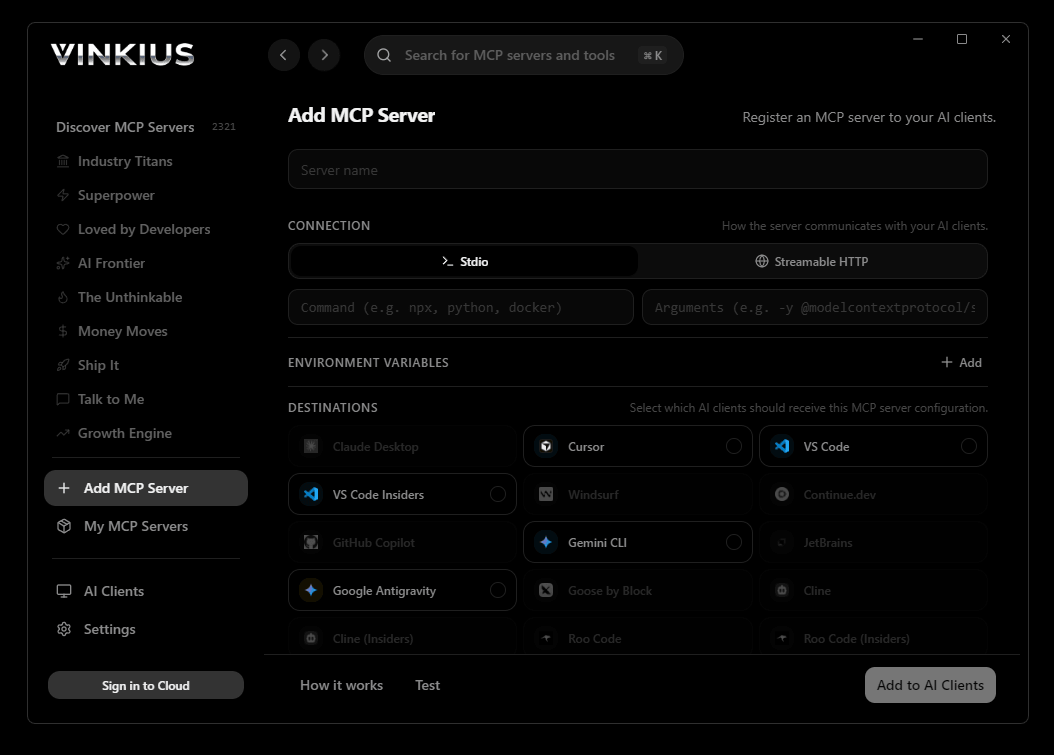

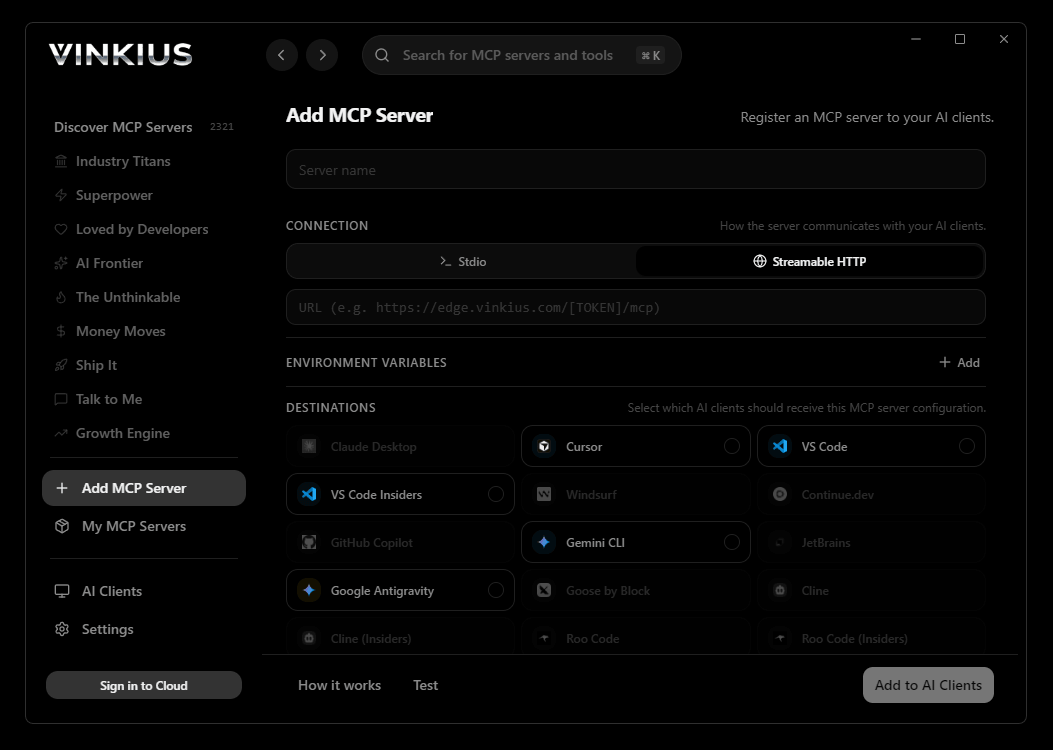
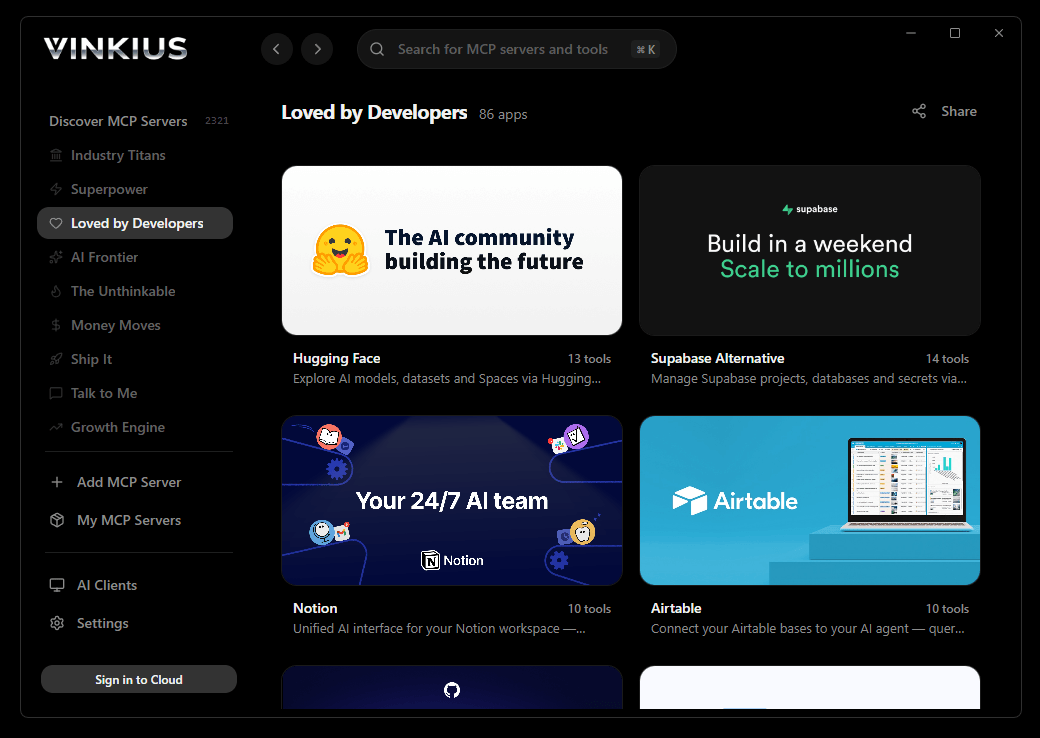

* Every MCP server runs on Vinkius-managed infrastructure inside AWS - a purpose-built runtime with per-request V8 isolates, Ed25519 signed audit chains, and sub-40ms cold starts optimized for native MCP execution. See our infrastructure
About Roboflow MCP Server
Connect Roboflow to your AI agent to streamline your computer vision pipeline. From dataset management to model training and inference, handle your entire CV lifecycle through natural language.
Cursor's Agent mode turns Roboflow into an in-editor superpower. Ask Cursor to generate code using live data from Roboflow and it fetches, processes, and writes. all in a single agentic loop. 29 tools appear alongside file editing and terminal access, creating a unified development environment grounded in real-time information.
What you can do
- Workspace & Project Management — List projects, create new ones, or fork from Roboflow Universe to jumpstart your development.
- Dataset Operations — Upload images (via URL or Base64), manage versions, and download datasets in various formats like COCO or YOLO.
- Model Training — Start training runs, monitor results, and retrieve precise performance metrics (mAP, precision, recall) for any version.
- Image Search — Search and filter images within your workspace to audit your data and improve model accuracy.
- Inference & Results — Run inference on images and retrieve results to verify model behavior in real-time.
The Roboflow MCP Server exposes 29 tools through the Vinkius. Connect it to Cursor in under two minutes — credentials fully managed, no infrastructure to provision, no vendor lock-in. Your configuration, your data, your control.
All 29 Roboflow tools available for Cursor
When Cursor connects to Roboflow through Vinkius, your AI agent gets direct access to every tool listed below — spanning computer-vision, dataset-management, model-training, and more. Every call runs in a secure, isolated environment with full audit visibility. Beyond a simple connection, you get real-time monitoring of agent activity, enterprise governance, and optimized token usage.
Add projects to folder on Roboflow
Add projects to a folder (Enterprise)
Auto label on Roboflow
Start an auto-labeling job using foundation models
Cancel training on Roboflow
Cancel an active training job
Create annotation job on Roboflow
Assign a batch of images to a labeler and reviewer
Create folder on Roboflow
Create a project folder (Enterprise)
Create project on Roboflow
Create a new project in a workspace
Delete images on Roboflow
Delete multiple images from a project
Delete project on Roboflow
Delete a project or version (moves to Trash)
Download dataset on Roboflow
Retrieve a download link for a zipped dataset in a specific format
Fork universe project on Roboflow
Fork a public project from Roboflow Universe
Get async task on Roboflow
Track long-running operations like forking or large exports
Get dataset health on Roboflow
Check dataset health (class distribution, missing annotations, etc)
Get image on Roboflow
Get details for a specific image
Get project on Roboflow
Get project details, metadata, and versions
Get root on Roboflow
Verify authentication and retrieve default workspace
Get training results on Roboflow
Retrieve metrics and status for a version training run
Get version on Roboflow
Retrieve metadata for a specific dataset version
List folders on Roboflow
List project folders in a workspace (Enterprise)
List trash on Roboflow
List items in the workspace trash
List workspace projects on Roboflow
List information about a workspace and its projects
Manage image tags on Roboflow
Add, remove, or set tags on an image
Restore trash on Roboflow
Restore an item from the trash
Run inference on Roboflow
Run inference on an image using hosted models
Search project images on Roboflow
Search and filter images within a specific project
Search workspace images on Roboflow
Search and filter images within a workspace
Start training on Roboflow
Start training a model on a dataset version
Stop training on Roboflow
Early stop an active training job
Upload annotation on Roboflow
Attach an annotation file to an existing image
Upload image on Roboflow
Upload an image to a project
Connect Roboflow to Cursor via MCP
Follow these steps to wire Roboflow into Cursor. The entire setup takes under two minutes — your credentials stay safe behind Vinkius.
Open MCP Settings
Cmd+Shift+P (macOS) or Ctrl+Shift+P (Windows/Linux) → search "MCP Settings"Add the server config
mcp.json file that opensSave the file
Start using Roboflow
Why Use Cursor with the Roboflow MCP Server
Cursor AI Code Editor provides unique advantages when paired with Roboflow through the Model Context Protocol.
Agent mode turns Cursor into an autonomous coding assistant that can read files, run commands, and call MCP tools without switching context
Cursor's Composer feature can generate entire files using real-time data fetched through MCP. no copy-pasting from external dashboards
MCP tools appear alongside built-in tools like file reading and terminal access, creating a unified agentic environment
VS Code extension compatibility means your existing workflow, keybindings, and extensions all work alongside MCP tools
Roboflow + Cursor Use Cases
Practical scenarios where Cursor combined with the Roboflow MCP Server delivers measurable value.
Code generation with live data: ask Cursor to generate a security report module using live DNS and subdomain data fetched through MCP
Automated documentation: have Cursor query your API's tool schemas and generate TypeScript interfaces or OpenAPI specs automatically
Infrastructure-as-code: Cursor can fetch domain configurations and generate corresponding Terraform or CloudFormation templates
Test scaffolding: ask Cursor to pull real API responses via MCP and generate unit test fixtures from actual data
Example Prompts for Roboflow in Cursor
Ready-to-use prompts you can give your Cursor agent to start working with Roboflow immediately.
"List all projects in my Roboflow workspace 'industrial-safety'."
"Upload this image URL to the 'Hard Hat Detection' project in workspace 'industrial-safety'."
"Show me the training metrics for version 5 of the 'Forklift Tracking' project."
Troubleshooting Roboflow MCP Server with Cursor
Common issues when connecting Roboflow to Cursor through Vinkius, and how to resolve them.
Tools not appearing in Cursor
Server shows as disconnected
Roboflow + Cursor FAQ
Common questions about integrating Roboflow MCP Server with Cursor.
What is Agent mode and why does it matter for MCP?
Where does Cursor store MCP configuration?
mcp.json file. You can configure servers at the project level (.cursor/mcp.json in your project root) or globally (~/.cursor/mcp.json). Project-level configs take precedence.Can Cursor use MCP tools in inline edits?
How do I verify MCP tools are loaded?
Explore More MCP Servers
View all →
Presenton
12 toolsAutomate presentation generation via Presenton — create AI slide decks and manage exports directly from any AI agent.

IPinfo
6 toolsGeolocate and audit IP addresses — identify ASNs and privacy details via AI.
Syncthing
28 toolsManage file synchronization via Syncthing — monitor device connections, browse directories, and control sync folders directly from any AI agent.

Stigg
12 toolsAutomate billing and subscription management via Stigg — provision customers, manage plans, and report usage directly from any AI agent.