
Stanford GDELT MCP Server for Vercel AI SDKGive Vercel AI SDK instant access to 16 tools to Get Geo Data, Get Themes, Get Timeline Country, and more
 GDPR Free for Subscribers
The Vercel AI SDK is the TypeScript toolkit for building AI-powered applications. Connect Stanford GDELT through Vinkius and every tool is available as a typed function. ready for React Server Components, API routes, or any Node.js backend.
Ask AI about this MCP Server for Vercel AI SDK
The Stanford GDELT MCP Server for Vercel AI SDK is a standout in the Data Analytics category — giving your AI agent 16 tools to work with, ready to go from day one.
Vinkius delivers Streamable HTTP and SSE to any MCP client
 Gemini
import { createMCPClient } from "@ai-sdk/mcp";
import { generateText } from "ai";
import { openai } from "@ai-sdk/openai";
async function main() {
const mcpClient = await createMCPClient({
transport: {
type: "http",
// Your Vinkius token. get it at cloud.vinkius.com
url: "https://edge.vinkius.com/[YOUR_TOKEN_HERE]/mcp",
},
});
try {
const tools = await mcpClient.tools();
const { text } = await generateText({
model: openai("gpt-4o"),
tools,
prompt: "Using Stanford GDELT, list all available capabilities.",
});
console.log(text);
} finally {
await mcpClient.close();
}
}
main();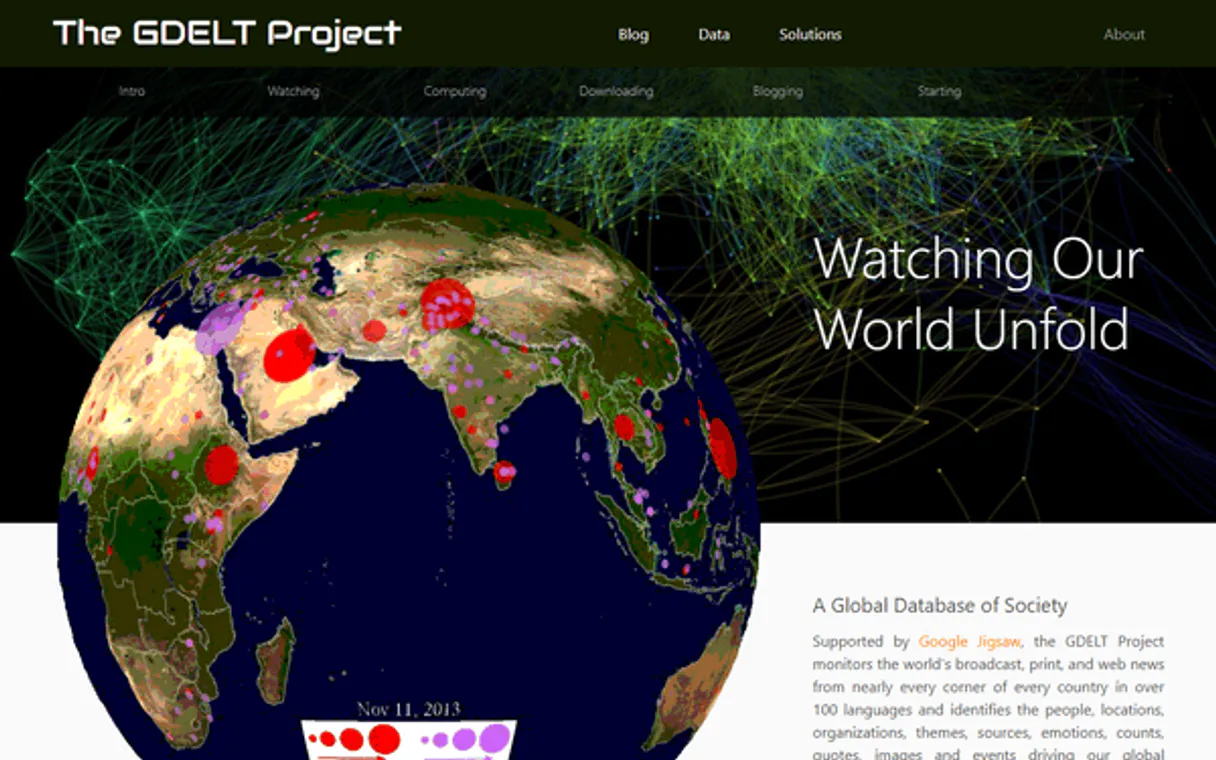
* Every MCP server runs on Vinkius-managed infrastructure inside AWS - a purpose-built runtime with per-request V8 isolates, Ed25519 signed audit chains, and sub-40ms cold starts optimized for native MCP execution. See our infrastructure
About Stanford GDELT MCP Server
Connect to the GDELT Project API — the world's largest open platform for monitoring global news media in real time.
The Vercel AI SDK gives every Stanford GDELT tool full TypeScript type inference, IDE autocomplete, and compile-time error checking. Connect 16 tools through Vinkius and stream results progressively to React, Svelte, or Vue components. works on Edge Functions, Cloudflare Workers, and any Node.js runtime.
What you can do
- Article Search — Search global news articles with filters for language, country, date range, and topic
- Volume Timelines — Track how media attention to any topic changes over time
- Sentiment Analysis — Monitor tone and sentiment shifts in coverage of any subject
- Geographic Mapping — Visualize where news events are happening around the world
- TV News Search — Search closed caption transcripts from CNN, Fox News, MSNBC, BBC, and more
- Theme Analysis — Explore standardized GDELT themes across geopolitics, health, environment, and economics
- Language Distribution — See which linguistic communities are covering a topic
- Country Distribution — Identify which nations produce the most coverage of specific issues
- Proximity Search — Find articles where two terms appear near each other
- Word Clouds — Extract dominant terms and concepts from coverage
The Stanford GDELT MCP Server exposes 16 tools through the Vinkius. Connect it to Vercel AI SDK in under two minutes — credentials fully managed, no infrastructure to provision, no vendor lock-in. Your configuration, your data, your control.
All 16 Stanford GDELT tools available for Vercel AI SDK
When Vercel AI SDK connects to Stanford GDELT through Vinkius, your AI agent gets direct access to every tool listed below — spanning gdelt, global-news, sentiment-analysis, and more. Every call runs in a secure, isolated environment with full audit visibility. Beyond a simple connection, you get real-time monitoring of agent activity, enterprise governance, and optimized token usage.
Get geo data on Stanford GDELT
Each point includes coordinates, location name, and article metadata. Use modes: "PointData" for individual points, "PointHeat" for heatmap data. Get geographic point data for news events
Get themes on Stanford GDELT
GDELT uses hundreds of themes from politics, economics, health, environment, technology, and more to classify news content. Get GDELT theme distribution for a topic
Get timeline country on Stanford GDELT
Reveals geographic patterns in media attention, identifies when a story goes global, and shows which nations are most interested in specific issues. Get source country distribution timeline
Get timeline lang on Stanford GDELT
Reveals which linguistic communities are paying attention to an issue and when interest spreads across language barriers. Get language distribution timeline for a topic
Get timeline tone on Stanford GDELT
Positive values indicate positive coverage, negative values indicate negative coverage. Essential for tracking public opinion shifts, crisis communications, and brand reputation monitoring. Get sentiment and tone timeline for a topic
Get timeline volume on Stanford GDELT
Essential for tracking media attention, identifying news spikes, and understanding the lifecycle of a story. Default timespan is 3 months. Get news volume timeline for any topic
Get tone chart on Stanford GDELT
Shows whether coverage is predominantly positive, negative, or neutral, and the overall emotional intensity of the coverage. Get tone distribution chart for a topic
Get tv channels on Stanford GDELT
Use this to understand the scope of TV news coverage available for analysis. Get available TV news channels inventory
Get tv timeline on Stanford GDELT
Reveals which stories dominate TV airtime and how TV coverage patterns differ from online news. Get TV news mention volume timeline
Get word cloud on Stanford GDELT
Reveals the dominant themes, entities, and concepts associated with a topic in media discourse. Get word cloud data showing key terms for a topic
Search articles on Stanford GDELT
Returns article titles, URLs, dates, source domains, languages, and source countries. Use timespan like "1d" (1 day), "1w" (1 week), "3m" (3 months). Use sourcelang codes like "english", "spanish", "portuguese", "french", "chinese", "arabic". Use sourcecountry codes like "US", "BR", "UK", "FR", "DE". Search global news articles across 100+ languages
Search by country on Stanford GDELT
Country codes follow ISO 2-letter format: US (United States), BR (Brazil), UK (United Kingdom), FR (France), DE (Germany), CN (China), JP (Japan), IN (India), RU (Russia), AU (Australia), CA (Canada), etc. Essential for understanding country-specific media perspectives on global events. Search news articles from a specific country
Search by language on Stanford GDELT
Covers 100+ languages. Language codes include: english, spanish, portuguese, french, german, italian, chinese, japanese, korean, arabic, russian, hindi, turkish, dutch, swedish, polish, and many more. Essential for monitoring how different linguistic communities cover the same event. Search news articles in a specific language
Search by theme on Stanford GDELT
Themes are standardized topic categories like TAX_FNCACT (financial actions), HEALTH_PANDEMIC, ENV_CLIMATECHANGE, TERROR, PROTEST, ELECTION, ECON_BANKRUPTCY, etc. Use this for precise topic-based monitoring. Search articles by GDELT standardized theme
Search nearby on Stanford GDELT
More precise than simple keyword search. Use distance parameter to control proximity (default 10 words). Example: term1="climate", term2="migration", distance=15. Search articles where two terms appear near each other
Search tv on Stanford GDELT
Returns clips with timestamps, station names, transcript snippets, and video preview URLs. Covers CNN, Fox News, MSNBC, BBC, and more. Modes: "ClipGallery" for clips, "StationChart" for station comparison. Search TV news transcripts by keyword
Connect Stanford GDELT to Vercel AI SDK via MCP
Follow these steps to wire Stanford GDELT into Vercel AI SDK. The entire setup takes under two minutes — your credentials stay safe behind Vinkius.
Install dependencies
npm install @ai-sdk/mcp ai @ai-sdk/openaiReplace the token
[YOUR_TOKEN_HERE] with your Vinkius tokenRun the script
agent.ts and run with npx tsx agent.tsExplore tools
Why Use Vercel AI SDK with the Stanford GDELT MCP Server
Vercel AI SDK provides unique advantages when paired with Stanford GDELT through the Model Context Protocol.
TypeScript-first: every MCP tool gets full type inference, IDE autocomplete, and compile-time error checking out of the box
Framework-agnostic core works with Next.js, Nuxt, SvelteKit, or any Node.js runtime. same Stanford GDELT integration everywhere
Built-in streaming UI primitives let you display Stanford GDELT tool results progressively in React, Svelte, or Vue components
Edge-compatible: the AI SDK runs on Vercel Edge Functions, Cloudflare Workers, and other edge runtimes for minimal latency
Stanford GDELT + Vercel AI SDK Use Cases
Practical scenarios where Vercel AI SDK combined with the Stanford GDELT MCP Server delivers measurable value.
AI-powered web apps: build dashboards that query Stanford GDELT in real-time and stream results to the UI with zero loading states
API backends: create serverless endpoints that orchestrate Stanford GDELT tools and return structured JSON responses to any frontend
Chatbots with tool use: embed Stanford GDELT capabilities into conversational interfaces with streaming responses and tool call visibility
Internal tools: build admin panels where team members interact with Stanford GDELT through natural language queries
Example Prompts for Stanford GDELT in Vercel AI SDK
Ready-to-use prompts you can give your Vercel AI SDK agent to start working with Stanford GDELT immediately.
"What are the latest news articles about AI regulation?"
"How has sentiment about climate change evolved over the last 3 months?"
"Search for TV news clips mentioning quantum computing"
Troubleshooting Stanford GDELT MCP Server with Vercel AI SDK
Common issues when connecting Stanford GDELT to Vercel AI SDK through Vinkius, and how to resolve them.
createMCPClient is not a function
npm install @ai-sdk/mcpStanford GDELT + Vercel AI SDK FAQ
Common questions about integrating Stanford GDELT MCP Server with Vercel AI SDK.
How does the Vercel AI SDK connect to MCP servers?
createMCPClient from @ai-sdk/mcp and pass the server URL. The SDK discovers all tools and provides typed TypeScript interfaces for each one.Can I use MCP tools in Edge Functions?
Does it support streaming tool results?
useChat and streamText that handle tool calls and display results progressively in the UI.Explore More MCP Servers
View all →
Eventbrite Alternative
8 toolsManage your Eventbrite events — audit organizations, attendees, and orders via AI.
Mailjet
12 toolsDeliver emails at scale with collaborative template editing, real-time monitoring, and deliverability analytics in one platform.

Lago
12 toolsManage your metering and usage-based billing with Lago — handle customers, subscriptions, plans, and events directly from your AI agent.

Jinshuju / 金数据
10 toolsPowerful online form and data collection platform — manage forms, entries, and webhooks via AI.