
Bring Gdelt
to Vercel AI SDK
Learn how to connect Stanford GDELT to Vercel AI SDK and start using 16 AI agent tools in minutes. Fully managed, enterprise secure, and ready to use without writing a single line of code.
 GDPR Free for Subscribers
Compatible with every major AI agent and IDE
 Gemini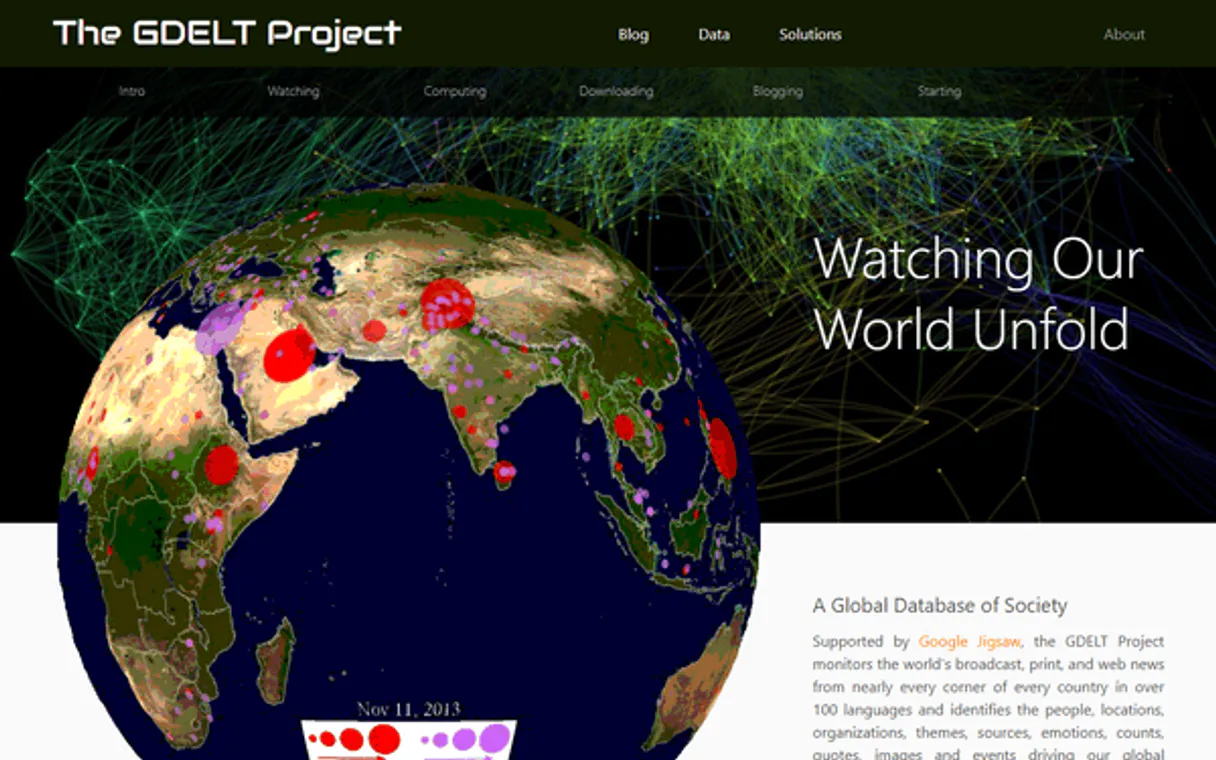
What is the Stanford GDELT MCP Server?
Connect to the GDELT Project API — the world's largest open platform for monitoring global news media in real time.
What you can do
- Article Search — Search global news articles with filters for language, country, date range, and topic
- Volume Timelines — Track how media attention to any topic changes over time
- Sentiment Analysis — Monitor tone and sentiment shifts in coverage of any subject
- Geographic Mapping — Visualize where news events are happening around the world
- TV News Search — Search closed caption transcripts from CNN, Fox News, MSNBC, BBC, and more
- Theme Analysis — Explore standardized GDELT themes across geopolitics, health, environment, and economics
- Language Distribution — See which linguistic communities are covering a topic
- Country Distribution — Identify which nations produce the most coverage of specific issues
- Proximity Search — Find articles where two terms appear near each other
- Word Clouds — Extract dominant terms and concepts from coverage
How it works
- Subscribe to this server
- No API key required — GDELT is completely free
- Start monitoring global news from Claude, Cursor, or any MCP-compatible client
Who is this for?
- Journalists — track breaking stories and media narratives
- Political Scientists — analyze geopolitical events and public discourse
- PR & Communications — monitor brand reputation and crisis communications
- Policy Analysts — understand how issues are covered across different countries and languages
Built-in capabilities (16)
Each point includes coordinates, location name, and article metadata. Use modes: "PointData" for individual points, "PointHeat" for heatmap data. Get geographic point data for news events
GDELT uses hundreds of themes from politics, economics, health, environment, technology, and more to classify news content. Get GDELT theme distribution for a topic
Reveals geographic patterns in media attention, identifies when a story goes global, and shows which nations are most interested in specific issues. Get source country distribution timeline
Reveals which linguistic communities are paying attention to an issue and when interest spreads across language barriers. Get language distribution timeline for a topic
Positive values indicate positive coverage, negative values indicate negative coverage. Essential for tracking public opinion shifts, crisis communications, and brand reputation monitoring. Get sentiment and tone timeline for a topic
Essential for tracking media attention, identifying news spikes, and understanding the lifecycle of a story. Default timespan is 3 months. Get news volume timeline for any topic
Shows whether coverage is predominantly positive, negative, or neutral, and the overall emotional intensity of the coverage. Get tone distribution chart for a topic
Use this to understand the scope of TV news coverage available for analysis. Get available TV news channels inventory
Reveals which stories dominate TV airtime and how TV coverage patterns differ from online news. Get TV news mention volume timeline
Reveals the dominant themes, entities, and concepts associated with a topic in media discourse. Get word cloud data showing key terms for a topic
Returns article titles, URLs, dates, source domains, languages, and source countries. Use timespan like "1d" (1 day), "1w" (1 week), "3m" (3 months). Use sourcelang codes like "english", "spanish", "portuguese", "french", "chinese", "arabic". Use sourcecountry codes like "US", "BR", "UK", "FR", "DE". Search global news articles across 100+ languages
Country codes follow ISO 2-letter format: US (United States), BR (Brazil), UK (United Kingdom), FR (France), DE (Germany), CN (China), JP (Japan), IN (India), RU (Russia), AU (Australia), CA (Canada), etc. Essential for understanding country-specific media perspectives on global events. Search news articles from a specific country
Covers 100+ languages. Language codes include: english, spanish, portuguese, french, german, italian, chinese, japanese, korean, arabic, russian, hindi, turkish, dutch, swedish, polish, and many more. Essential for monitoring how different linguistic communities cover the same event. Search news articles in a specific language
Themes are standardized topic categories like TAX_FNCACT (financial actions), HEALTH_PANDEMIC, ENV_CLIMATECHANGE, TERROR, PROTEST, ELECTION, ECON_BANKRUPTCY, etc. Use this for precise topic-based monitoring. Search articles by GDELT standardized theme
More precise than simple keyword search. Use distance parameter to control proximity (default 10 words). Example: term1="climate", term2="migration", distance=15. Search articles where two terms appear near each other
Returns clips with timestamps, station names, transcript snippets, and video preview URLs. Covers CNN, Fox News, MSNBC, BBC, and more. Modes: "ClipGallery" for clips, "StationChart" for station comparison. Search TV news transcripts by keyword
Why Vercel AI SDK?
The Vercel AI SDK gives every Stanford GDELT tool full TypeScript type inference, IDE autocomplete, and compile-time error checking. Connect 16 tools through Vinkius and stream results progressively to React, Svelte, or Vue components. works on Edge Functions, Cloudflare Workers, and any Node.js runtime.
- —
TypeScript-first: every MCP tool gets full type inference, IDE autocomplete, and compile-time error checking out of the box
- —
Framework-agnostic core works with Next.js, Nuxt, SvelteKit, or any Node.js runtime. same Stanford GDELT integration everywhere
- —
Built-in streaming UI primitives let you display Stanford GDELT tool results progressively in React, Svelte, or Vue components
- —
Edge-compatible: the AI SDK runs on Vercel Edge Functions, Cloudflare Workers, and other edge runtimes for minimal latency
Stanford GDELT in Vercel AI SDK
Stanford GDELT and 4,000+ other MCP servers. One platform. One governance layer.
Teams that connect Stanford GDELT to Vercel AI SDK through Vinkius don't need to source, host, or maintain individual MCP servers. Every tool call runs inside a hardened runtime with credential isolation, DLP, and a signed audit chain.
Raw MCP | Vinkius | |
|---|---|---|
| Server catalog | Find and host yourself | 4,000+ managed |
| Infrastructure | Self-hosted | Sandboxed V8 isolates |
| Credential handling | Plaintext in config | Vault + runtime injection |
| Data loss prevention | None | Configurable DLP policies |
| Kill switch | None | Global instant shutdown |
| Financial circuit breakers | None | Per-server limits + alerts |
| Audit trail | None | Ed25519 signed logs |
| SIEM log streaming | None | Splunk, Datadog, Webhook |
| Honeytokens | None | Canary alerts on leak |
| Custom domains | Not applicable | DNS challenge verified |
| GDPR compliance | Manual effort | Automated purge + export |
Why teams choose Vinkius for Stanford GDELT in Vercel AI SDK
The Stanford GDELT MCP Server runs on Vinkius-managed infrastructure inside AWS — a purpose-built runtime with per-request V8 isolates, Ed25519 signed audit chains, and sub-40ms cold starts. All 16 tools execute in hardened sandboxes optimized for native MCP execution.
Your AI agents in Vercel AI SDK only access the data you authorize, with DLP that blocks sensitive information from ever reaching the model, kill switch for instant shutdown, and up to 60% token savings. Enterprise-grade infrastructure, zero maintenance.
* Every MCP server runs on Vinkius-managed infrastructure inside AWS - a purpose-built runtime with per-request V8 isolates, Ed25519 signed audit chains, and sub-40ms cold starts optimized for native MCP execution. See our infrastructure
How Vinkius secures
Stanford GDELT for Vercel AI SDK
Every tool call from Vercel AI SDK to the Stanford GDELT MCP Server is protected by DLP redaction, cryptographic audit chains, V8 sandbox isolation, kill switch, and financial circuit breakers.
Frequently asked questions
Do I need an API key?
No. The GDELT API is completely free and requires no authentication or registration.
How often is GDELT updated?
GDELT updates every 15 minutes, making it one of the most real-time global news monitoring platforms available. It processes news from virtually every country on Earth in over 100 languages.
Can I search TV news transcripts?
Yes. GDELT provides access to closed caption transcripts from major TV news networks including CNN, Fox News, MSNBC, BBC, and many international broadcasters. You can search by keyword and get clip galleries with timestamps.
How does the Vercel AI SDK connect to MCP servers?
Import createMCPClient from @ai-sdk/mcp and pass the server URL. The SDK discovers all tools and provides typed TypeScript interfaces for each one.
Can I use MCP tools in Edge Functions?
Yes. The AI SDK is fully edge-compatible. MCP connections work on Vercel Edge Functions, Cloudflare Workers, and similar runtimes.
Does it support streaming tool results?
Yes. The SDK provides streaming primitives like useChat and streamText that handle tool calls and display results progressively in the UI.
createMCPClient is not a function
Install: npm install @ai-sdk/mcp
Explore More MCP Servers
View all →
Wrike
12 toolsCollaborative project management to manage tasks, projects, and team workflows with AI.
CodeRabbit
9 toolsManage AI-powered code reviews via CodeRabbit — list users, track PR review metrics, audit admin actions, and control seat assignments from any AI agent.
Crelate Talent CRM
10 toolsEquip your AI agent to manage candidates, jobs, and client companies directly via the Crelate API.

WhatsApp Business
6 toolsSend text, media, and interactive messages on WhatsApp — the world's most popular messaging platform.