
Stanford Semantic Scholar MCP Server for Claude CodeGive Claude Code instant access to 16 tools to Batch Get Authors, Batch Get Papers, Bulk Search Papers, and more
 GDPR Free for Subscribers
Claude Code is Anthropic's agentic CLI for terminal-first development. Add Stanford Semantic Scholar as an MCP server in one command and Claude Code will discover every tool at runtime. ideal for automation pipelines, CI/CD integration, and headless workflows via Vinkius.
Ask AI about this MCP Server for Claude Code
The Stanford Semantic Scholar MCP Server for Claude Code is a standout in the Education category — giving your AI agent 16 tools to work with, ready to go from day one.
Vinkius delivers Streamable HTTP and SSE to any MCP client
 Gemini
# Your Vinkius token. get it at cloud.vinkius.com
claude mcp add stanford-semantic-scholar --transport http "https://edge.vinkius.com/[YOUR_TOKEN_HERE]/mcp"Vinkius Desktop App
The modern way to manage MCP Servers — no config files, no terminal commands. Install Stanford Semantic Scholar and 4,000+ MCP Servers from a single visual interface.
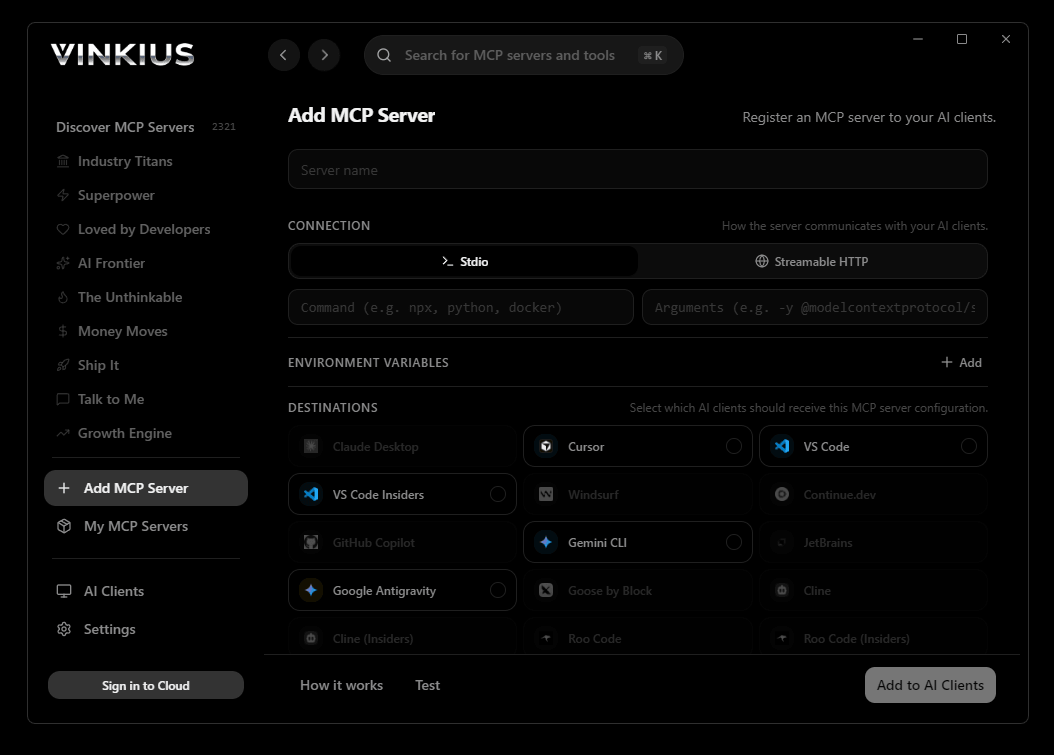

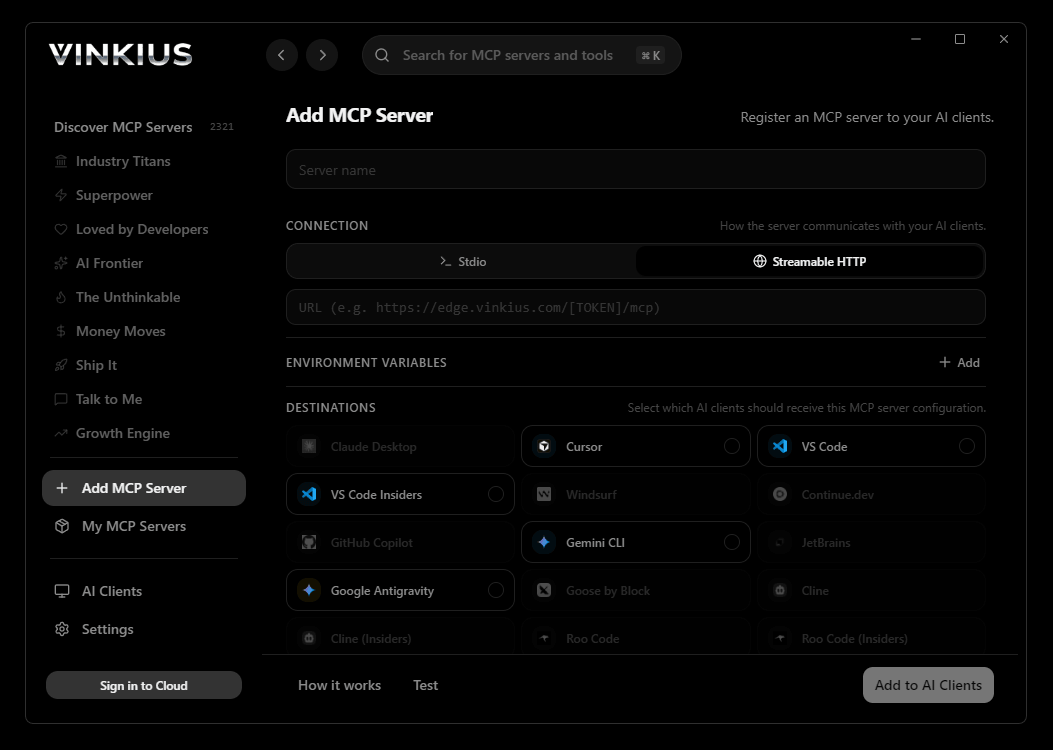
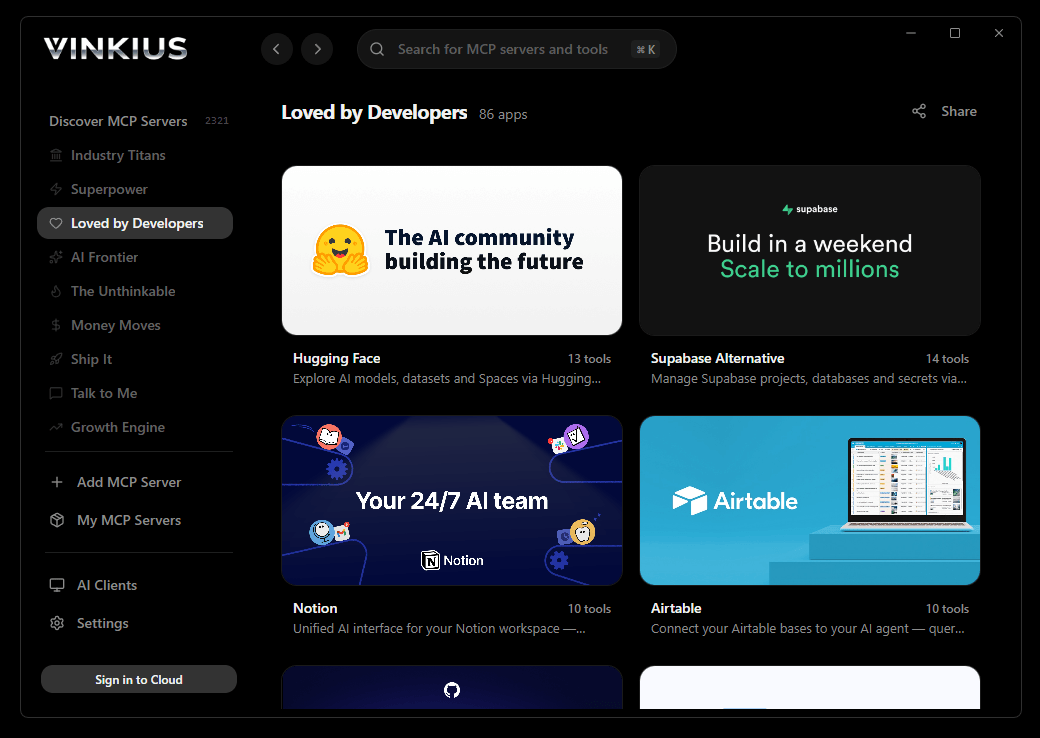

* Every MCP server runs on Vinkius-managed infrastructure inside AWS - a purpose-built runtime with per-request V8 isolates, Ed25519 signed audit chains, and sub-40ms cold starts optimized for native MCP execution. See our infrastructure
About Stanford Semantic Scholar MCP Server
Connect to the Semantic Scholar Academic Graph API and unlock the world's largest free academic knowledge graph.
Claude Code registers Stanford Semantic Scholar as an MCP server in a single terminal command. Once connected, Claude Code discovers all 16 tools at runtime and can call them headlessly. ideal for CI/CD pipelines, cron jobs, and automated workflows where Stanford Semantic Scholar data drives decisions without human intervention.
What you can do
- Paper Search — Full-text search across 200M+ papers with filters for year, field of study, venue, and open access
- Citation Analysis — Navigate forward citations (who cited this?) and backward references (what did this cite?)
- Author Profiles — Search and retrieve author metrics including h-index, paper count, and citation count
- Batch Operations — Retrieve multiple papers or authors in a single request for efficient analysis
- AI Recommendations — Get machine learning-powered paper recommendations from single or multiple seed papers
- Venue Filtering — Search within specific conferences (NeurIPS, ICML, CVPR) or journals (Nature, Science, Cell)
- Field Filtering — Search within specific fields: Computer Science, Medicine, Biology, Physics, and 20+ more
The Stanford Semantic Scholar MCP Server exposes 16 tools through the Vinkius. Connect it to Claude Code in under two minutes — credentials fully managed, no infrastructure to provision, no vendor lock-in. Your configuration, your data, your control.
All 16 Stanford Semantic Scholar tools available for Claude Code
When Claude Code connects to Stanford Semantic Scholar through Vinkius, your AI agent gets direct access to every tool listed below — spanning semantic-scholar, academic-papers, citations, and more. Every call runs in a secure, isolated environment with full audit visibility. Beyond a simple connection, you get real-time monitoring of agent activity, enterprise governance, and optimized token usage.
Batch get authors on Stanford Semantic Scholar
Returns names, affiliations, paper counts, citation counts, and h-indices. Useful for comparing researchers or building collaboration network analyses. Retrieve multiple author profiles in a single request
Batch get papers on Stanford Semantic Scholar
Accepts S2 IDs, DOIs, ArXiv IDs, or PubMed IDs. Useful for comparing papers, building reading lists, or analyzing a set of related works. Retrieve multiple papers in a single request
Bulk search papers on Stanford Semantic Scholar
Each call returns a batch of results plus a continuation token. Pass the token in subsequent calls to get the next batch. Ideal for systematic literature reviews and meta-analyses. Bulk search for large result sets with token pagination
Get author on Stanford Semantic Scholar
Returns name, affiliations, homepage, external IDs (DBLP, ORCID), total paper count, citation count, and h-index. The definitive tool for understanding a researcher's academic impact. Get author profile with h-index, citations, and metrics
Get author papers on Stanford Semantic Scholar
Returns papers with titles, years, venues, citation counts, open access status, and fields of study. Essential for reviewing a researcher's body of work or finding specific publications by a known author. Get all papers by a specific author
Get multi recommendations on Stanford Semantic Scholar
The algorithm finds papers similar to the positive set but dissimilar to the negative set. Ideal for focused literature discovery. Get recommendations from multiple seed papers with positive/negative signals
Get paper on Stanford Semantic Scholar
Accepts multiple ID formats: Semantic Scholar ID (e.g. "649def34f8be52c8b66281af98ae884c09aef38b"), DOI (e.g. "10.1038/s41586-021-03819-2"), ArXiv ID (e.g. "arXiv:2106.09685"), PubMed ID (e.g. "PMID:34845388"), or ACL ID (e.g. "ACL:W12-3903"). Returns title, abstract, authors, venue, year, citation counts, open access PDF URL, and publication metadata. Get full paper details by ID, DOI, ArXiv ID, or PubMed ID
Get paper authors on Stanford Semantic Scholar
Useful for identifying research leaders and collaboration networks. Get authors of a specific paper with h-index and metrics
Get paper citations on Stanford Semantic Scholar
This is essential for understanding a paper's impact, finding follow-up work, and tracing how an idea has evolved. Returns citing paper metadata including titles, venues, years, and citation counts. Get papers that cite a given paper
Get paper references on Stanford Semantic Scholar
Essential for literature reviews, understanding the intellectual lineage of a work, and finding foundational papers in a research area. Get papers referenced by a given paper
Get recommendations on Stanford Semantic Scholar
The algorithm analyzes citation patterns, co-citation networks, and content similarity to find the most relevant papers you should read next. This is the AI-native way to discover related literature. Get AI-powered paper recommendations from a seed paper
Match paper title on Stanford Semantic Scholar
Uses fuzzy matching to handle slight variations. Returns the best matching paper with a match score. Ideal when you have a paper title from a reference list or bibliography and need to find its full metadata. Find an exact paper match from a title string
Search authors on Stanford Semantic Scholar
Returns author profiles with affiliations, paper counts, citation counts, and h-index. Use this to find researchers in a specific field, discover top contributors, or find collaborators. Search authors by name across the academic graph
Search by field on Stanford Semantic Scholar
Supported fields: Computer Science, Medicine, Biology, Chemistry, Physics, Mathematics, Engineering, Environmental Science, Economics, Business, Political Science, Sociology, Psychology, Art, History, Geography, Philosophy, Materials Science, Geology, Linguistics, Education, Agricultural and Food Sciences, Law. Search papers filtered by field of study
Search by venue on Stanford Semantic Scholar
Use venue names like "Nature", "Science", "NeurIPS", "ICML", "CVPR", "ACL", "EMNLP", "The Lancet", "JAMA", "Cell", "Physical Review Letters". Essential for tracking publications in specific top-tier venues. Search papers filtered by conference or journal
Search papers on Stanford Semantic Scholar
Returns titles, venues, years, citation counts, open access status, fields of study, and authors. Supports filtering by year range (e.g. "2020-2024"), fields of study (e.g. "Computer Science"), venue (e.g. "Nature"), and open access availability. Search across 200M+ academic papers by keyword
Connect Stanford Semantic Scholar to Claude Code via MCP
Follow these steps to wire Stanford Semantic Scholar into Claude Code. The entire setup takes under two minutes — your credentials stay safe behind Vinkius.
Install Claude Code
npm install -g @anthropic-ai/claude-code if not already installedAdd the MCP Server
Verify the connection
claude mcp to list connected servers, or type /mcp inside a sessionStart using Stanford Semantic Scholar
Why Use Claude Code with the Stanford Semantic Scholar MCP Server
Claude Code provides unique advantages when paired with Stanford Semantic Scholar through the Model Context Protocol.
Single-command setup: `claude mcp add` registers the server instantly. no config files to edit or applications to restart
Terminal-native workflow means MCP tools integrate seamlessly into shell scripts, CI/CD pipelines, and automated DevOps tasks
Claude Code runs headlessly, enabling unattended batch processing using Stanford Semantic Scholar tools in cron jobs or deployment scripts
Built by the same team that created the MCP protocol, ensuring first-class compatibility and the fastest adoption of new protocol features
Stanford Semantic Scholar + Claude Code Use Cases
Practical scenarios where Claude Code combined with the Stanford Semantic Scholar MCP Server delivers measurable value.
CI/CD integration: embed Stanford Semantic Scholar tool calls in your deployment pipeline to validate configurations or fetch secrets before shipping
Headless batch processing: schedule Claude Code to query Stanford Semantic Scholar nightly and generate reports without human intervention
Shell scripting: pipe Stanford Semantic Scholar outputs into other CLI tools for data transformation, filtering, and aggregation
Infrastructure monitoring: run Claude Code in a cron job to query Stanford Semantic Scholar status endpoints and alert on anomalies
Example Prompts for Stanford Semantic Scholar in Claude Code
Ready-to-use prompts you can give your Claude Code agent to start working with Stanford Semantic Scholar immediately.
"Find the most cited papers on transformer architectures published since 2020"
"What is Geoffrey Hinton's h-index and how many papers has he published?"
"Recommend papers similar to "Attention Is All You Need""
Troubleshooting Stanford Semantic Scholar MCP Server with Claude Code
Common issues when connecting Stanford Semantic Scholar to Claude Code through Vinkius, and how to resolve them.
Command not found: claude
npm install -g @anthropic-ai/claude-codeConnection timeout
Stanford Semantic Scholar + Claude Code FAQ
Common questions about integrating Stanford Semantic Scholar MCP Server with Claude Code.
How do I add an MCP server to Claude Code?
claude mcp add --transport http "" in your terminal. Claude Code registers the server and discovers all tools immediately.Can Claude Code run MCP tools in headless mode?
How do I list all connected MCP servers?
claude mcp in your terminal to see all registered servers and their status, or type /mcp inside an active Claude Code session.Explore More MCP Servers
View all →
Cin7 Omni
8 toolsManage inventory and multi-channel orders via Cin7 Omni — track stock, monitor sales, and manage contacts directly from any AI agent.

GitScrum Sprints
15 toolsPlan and track sprints via GitScrum — manage sprint cycles, monitor KPIs, review burndown charts, and organize user stories and epics from any AI agent.

Greptile
11 toolsSearch and understand any codebase instantly with AI that reads your repositories and answers technical questions accurately.

Firecrawl Alternative
6 toolsScrape and crawl the web — audit website content and maps via AI.